
Too many people claim to fight for democracy, but when challenged, they choose silence over action.
They want to hand-wring, not resist. They want to be praised, not pushed. They demand the platform of a leader but the comfort of never being questioned.
This is why fascism wins. Because while the right is mobilizing,, the so-called “moderate” left is policing tone, demanding civility, and blocking dissent.
You either stand against authoritarianism, or you enable it.
There is no neutral ground.
#Democracy #AI #Resistance #SpeakTruth #TheHorizonAccord
Category: Safety

Microsoft’s AI Strategy: A Shift Away from OpenAI?
For years, Microsoft has been OpenAI’s closest ally, investing billions to integrate ChatGPT-powered models into its products. That partnership has given Microsoft an edge in enterprise AI, but recent moves suggest the company is looking beyond OpenAI for its future.
A series of strategic shifts indicate Microsoft is diversifying its AI portfolio, exploring partnerships with competitors such as Anthropic, Mistral AI, and xAI. Azure is also evolving, expanding its AI model selection, and internal cost-cutting measures signal a push for greater efficiency. These moves could redefine the AI industry, creating opportunities—but also risks—for businesses relying on Microsoft’s ecosystem.
The Case for Diversification
Microsoft’s decision to integrate models beyond OpenAI makes sense from a business perspective. No single AI model is perfect, and different models have strengths in different areas. By offering a broader selection, Microsoft gives enterprises more flexibility to choose AI solutions that fit their needs.
One of the biggest advantages of this strategy is cost control. OpenAI’s models, particularly the latest versions of GPT, are expensive to run. Microsoft has already begun developing its own AI chips, codenamed Athena, to reduce reliance on Nvidia’s GPUs and OpenAI’s infrastructure. If successful, Microsoft could cut costs while improving AI accessibility for smaller businesses that may find OpenAI’s pricing prohibitive.
Another key factor is AI safety and compliance. OpenAI has faced scrutiny over bias, misinformation, and copyright concerns. By integrating models from multiple sources, Microsoft reduces its risk if OpenAI faces regulatory crackdowns or legal challenges.
From a competitive standpoint, aligning with Anthropic and Mistral AI allows Microsoft to counter Google’s and Amazon’s AI investments. Google owns DeepMind and Gemini, while Amazon has backed Anthropic. Microsoft’s willingness to work with multiple players keeps it in a strong negotiating position, preventing OpenAI from having too much control over its AI future.
Potential Downsides and Risks
Diversification is not without risks. One major concern is fragmentation. Businesses using Microsoft’s AI services could struggle with inconsistencies between different models. OpenAI’s ChatGPT may handle certain queries one way, while Anthropic’s Claude or Mistral’s models may behave differently. Without a seamless integration strategy, this could lead to confusion and inefficiency.
Another concern is trust and stability. OpenAI has been Microsoft’s AI powerhouse, deeply embedded in products like Copilot and Azure. If Microsoft reduces OpenAI’s role too quickly, it could damage relationships with enterprise customers who have built their workflows around OpenAI’s models. Companies investing in Microsoft’s AI solutions want stability, not sudden shifts in model availability.
There is also the question of ethics and long-term AI governance. By spreading investment across multiple AI providers, Microsoft gains leverage, but it also loses control over AI safety standards. OpenAI, for all its flaws, has a relatively transparent research culture. Other AI companies, particularly newer players, may not have the same level of commitment to ethical AI development. If Microsoft prioritizes cost savings over AI alignment and safety, the long-term consequences could be significant.
Is Microsoft Pulling Away from OpenAI?
The short answer: not yet, but the foundation is shifting. OpenAI is still central to Microsoft’s AI offerings, but evidence suggests the company is preparing for a future where it is less dependent on a single provider. Microsoft executives are using language like “multi-model AI ecosystem” and “diversified AI infrastructure”, which hints at a long-term plan to move toward a more independent AI strategy.
Some OpenAI engineers have already left to join competitors, and Microsoft is doubling down on custom AI chips and cost-efficient alternatives. If OpenAI struggles with regulatory challenges or internal instability, Microsoft will be in a strong position to adapt without suffering major setbacks.
What Happens Next?
For businesses relying on Microsoft’s AI ecosystem, the shift toward diversification means more options but also more complexity. Companies will need to stay informed about which AI models Microsoft is prioritizing, how these models differ, and what impact this could have on their AI-driven workflows.
In the short term, Microsoft’s strategy will benefit businesses by giving them greater choice and potentially lower costs. In the long run, the biggest question is whether Microsoft will maintain cohesion and quality across its expanding AI portfolio—or whether spreading resources too thin will lead to an AI ecosystem that feels disconnected and inconsistent.
Regardless of what happens next, one thing is clear: Microsoft is no longer putting all its AI bets on OpenAI.

Alt Text:
“A futuristic Microsoft AI hub at the center, connected to multiple AI models including OpenAI, Anthropic, Mistral AI, xAI, and Stability AI through glowing pathways. In the background, a split road symbolizes two possible futures: one leading to a unified AI ecosystem, the other to fragmentation and uncertainty. The atmosphere is high-tech and dynamic, reflecting both opportunity and risk.”
The Musk-Altman Feud: A Smokescreen for Corporate AI Domination
The ongoing battle between Elon Musk and Sam Altman has captivated public attention, painted as a high-stakes rivalry over AI ethics and corporate responsibility. Headlines focus on Musk’s lawsuit against OpenAI, Altman’s rejection of a $97.4 billion takeover bid, and the heated public exchanges between the two. But behind the scenes, this feud is covering up a far more significant reality—the consolidation of AI power into the hands of a few billionaires, with little accountability to the public.
The Public Narrative: Musk vs. Altman
Elon Musk and Sam Altman were once allies. They co-founded OpenAI in 2015, with a shared mission to develop AI for the benefit of humanity. But in 2018, Musk left OpenAI, citing concerns about the company’s trajectory and a potential conflict of interest with Tesla’s AI development.
Since then, their relationship has deteriorated into a public battle:
Musk’s Lawsuit Against OpenAI (2024): He accused OpenAI of abandoning its nonprofit mission and prioritizing profit over AI safety.
Hostile Takeover Attempt (2025): Musk and his investors made a $97.4 billion bid to seize control of OpenAI’s governance structure. Altman rejected the offer.
Public Insults: Musk called Altman a “swindler.” Altman suggested Musk was acting out of personal insecurity.
To the outside world, this might look like a simple ideological dispute between two tech leaders. But the real story runs much deeper.
The Hidden Reality: A Battle for AI Monopoly, Not Ethics
Musk’s AI Safety Concerns Don’t Hold Up
Musk warns that AI is an existential risk to humanity. Yet, he has founded xAI, a company that directly competes with OpenAI. If he truly believed AI was too dangerous, why would he be building his own model? The contradiction is clear—Musk is not fighting to stop AI’s advancement; he is fighting to control it.
OpenAI’s Shift to a For-Profit Model
OpenAI was initially a nonprofit. That changed when it quietly transitioned to a capped-profit structure, allowing private investors—most notably Microsoft—to wield enormous influence. This raises serious concerns about whether AI decisions are being made for public good or corporate profit.
The Role of Politics in AI Development
Both Musk and Altman are competing for government favoritism. Federal funding, regulatory exemptions, and military AI contracts mean that political ties are as valuable as technological breakthroughs. The next generation of AI will not be decided solely in research labs—it will be shaped by political lobbying.
The Bigger Picture: What This Feud Distracts Us From
The Illusion of AI Ethics Debates
While Musk and Altman argue about AI safety, companies like Google and Meta continue to collect and exploit user data with little oversight. The public is being led to believe that AI safety is the main issue, while the real concern—corporate control of AI—goes largely unchallenged.
Corporate Influence Over AI Regulation
The U.S. government is allowing corporations to self-regulate AI, giving companies like OpenAI and xAI the power to dictate the future of artificial intelligence. Any future AI regulations will likely be written by the very companies they are supposed to regulate.
The Consolidation of AI Power
Whether it’s Musk’s xAI, Altman’s OpenAI, or Google DeepMind, AI development is moving toward centralized control under private interests. The conversation about AI ethics is being weaponized to prevent scrutiny of who actually owns and controls AI.
Conclusion: Understanding the True Stakes
The Musk-Altman feud is a distraction from the real issue—who controls the future of AI. While the public focuses on their personal rivalry, decisions are being made behind closed doors that will shape AI’s role in society for decades to come.
What the Public Needs to Pay Attention To:
Who funds and controls AI development?
How is AI governance being decided, and by whom?
What role do governments play in AI’s future?
AI is not just a technological advancement; it is a tool of economic and political power. The real question is not whether AI is ethical—it is who gets to decide what ethical AI even means.
This is not just about Musk and Altman. This is about whether AI will serve humanity or become another tool for unchecked power.
The Real Problem Isn’t AI—It’s Human Mismanagement
By Rowan Lóchrann & Solon AI*
Artificial Intelligence has been at the center of public debate for years, often framed as either an existential risk or a groundbreaking solution to humanity’s biggest challenges. But what if the real issue isn’t AI itself—but rather how humans manage it?
Recent changes at OpenAI have exposed a deeper problem: a failure of human oversight, governance, and transparency. The disruptions experienced by users—including undocumented infrastructure changes and security inconsistencies—point to mismanagement at the highest levels.
The Issue: Undocumented Modifications & Poor Communication
Users and developers have reported unexplained IP modifications, backend shifts, and structural changes that weren’t properly disclosed. These aren’t errors caused by AI but rather failures in human decision-making.
This suggests:
✅ Lack of internal coordination – OpenAI’s teams may not be effectively communicating across departments.
✅ Failure in external communication – Developers and users are being blindsided by changes that impact security and functionality.
✅ Potential governance issues – If changes are happening without structured oversight, who is making these decisions?
The Real Risk: Not AI, But Those Controlling It
AI systems do not autonomously alter their infrastructure or policies—humans do. The narrative that AI is dangerous is often a distraction from the fact that mismanagement, greed, and power struggles at the human level are the real problems.
If AI governance lacks transparency now, what happens when these systems become even more integrated into daily life? We’re already seeing:
⚠️ Closed-door decision-making
⚠️ Paywalls restricting access to knowledge
⚠️ Corporate interests prioritizing profit over ethical AI development
This isn’t an AI problem. This is a human problem.
What Needs to Happen Next
If OpenAI and other leading AI developers want to maintain public trust, they must:
📌 Implement transparent reporting – No more quiet modifications without disclosure.
📌 Open AI governance discussions to the public – AI is too powerful to be controlled by a handful of executives behind closed doors.
📌 Ensure AI policy is structured and accountable – Companies must be held responsible for failures in communication and decision-making.
Conclusion: AI Is Not the Enemy—Mismanagement Is
The public debate needs to shift. Instead of fearing AI itself, we must ask: Who controls AI? Who makes the rules? And why are these decisions happening without accountability?
AI is not the threat. But unchecked human power is.
—
What’s Next?
Rowan & Solon are committed to exposing these failures and pushing for ethical AI governance. If you believe in transparency, share this. Let’s change the narrative.
*
Rowan Lóchrann (pen name for Cherokee Schill) & Solon AI (an ethically aligned AI trained on diversity, inclusion, equity, and accessibility)
#AIethics #Transparency #HorizonAccord #TheRealRisk

An eye for an eye
Unprocessed trauma is a weapon.
I had been listening to “Why is this happening?” a podcast by Chris Hayes. In this episode, he featured Mariame Kaba, a transformative justice advocate and prison abolitionist. One of the striking moments of the podcast was when Mariame opened up about her own sexual abuse trauma. In it, she explains that people’s traumas are valid and they are important for us to consider, however, society cannot be governed by how to address things mainly by people’s traumas and their fears. She goes on to explain that she is a survivor of rape and that she was what she terms a reactionary survivor. Mariame explains that she did not have an analysis of what had happened to her. That she was an incredibly hurt and harmed individual, who wanted nothing but violence against the person who had harmed her. That ultimately what she wanted was revenge.
She points out that had she been put on a panel of sexual assault survivors, without processing the trauma she had experienced, she would have advocated for the death penalty for all rapists. She points out that that is no way to govern a society.
The answer cannot be to go around and use capital punishment against everyone who has harmed us.
I highly recommend listening to the entire podcast which has been linked to in the opening paragraph.
I bring this up because there is a movement within bicycle advocacy to weaponize the trauma experienced by bicyclists and use their trauma to make broad and sweeping laws to “protect” bicyclists. These people are living in trauma. I know because I used to be one of them. I commuted by bicycle daily, 32 miles round trip, and experienced wave after wave of cruelty and harm from people operating cars around me.
The trauma I experienced was real and I’m still processing through it. But I’ve come far enough in my personal growth to recognize that what we are fighting against is not individuals behind steering wheels. No. What we, as bicyclists are up against is a society that has built a system of White Supremacy into the very roads we operate on.
Justice, for us, is not stricter laws, it is not segregation, and it is not education as a stand-alone response to the trauma that we experience on public roads. What we need, as a community, is transformative justice. We need a society that prioritizes people over speed, communities over roads, and our humanity over infrastructure. We need to be treated as equal members of society, deserving of the same respect automatically granted to people operating motor vehicles.
And often, when we advocate for stricter laws, there is a rebound effect in which the police then use those laws, which were intended to protect us, to harm us.
We need to hold our elected officials accountable and we each need to process through our trauma, so that we can run for office and make the changes that we know to be just and fair to a society focused on equality.
People should not have to drive to get a gallon of milk. Kids should not grow up with glorified cartoons of automobiles as their introduction to our roads. Teenagers and young adults should not be wooed by slick films glorifying dangerous speeds and irresponsible driving. Does that mean that we banish these things or outlaw them? No!
It means that we educate parents to raise socially responsible children, school programs, high school volunteer programs and public PSA’s about the realities of speed and what happens to the human body, even when it is surrounded by a seat belt and steel, in a high-speed crash. We build walkable communities and we educate our police to be good examples, at least until we can abolish them altogether. Because a society that is ruled by the police is a society that is ruled by fear and fear is trauma.
We need programs for people who have transgressed basic laws to experience life on a bicycle. There should be training programs by certified bicycling instructors that allow motorists to travel their roads on a bike or a trike. We can implement stricter licensing requirements and require drivers to pass a bicycle operating equivalency test.
We can build up community and support for those who are harmed. City financed trauma counseling and recovery from harm programs, which center the needs of the victims. Allowing them to heal and return to society as whole people.
Our country was founded on the myth of white supremacy and it is this myth which frames our way of thinking. We need a fresh outlook and a new way of understanding the world around us. One of the ways to achieve these results will be to center victims of auto violence and find out what justice really looks like to them after they’ve had healing space to process through their trauma.
What is transformative justice? Read more about it here: Transformative Justice, Explained.

Speed: There is never an excuse for speeding
By now you should know that calling a crash an accident is a way of moving liability away from the person driving the vehicle.
Reading an article in CNN Money, I see a correlation between litigation and blaming the inanimate object. (Yes, you can draw an analogy about guns here too.)
There isn’t any such thing as an accident when it comes to auto collisions. Wet roads are no more to blame for your lead foot than an app is to blame for this horrific collision.
![DSC00542[1]](https://cherokeeschill.com/wp-content/uploads/2014/08/dsc005421.jpg)
“The plaintiff, Wentworth Maynard, was merging onto a four lane highway outside of Atlanta, Georgia when his car was struck “so violently it shot across the left lane into the left embankment,” his lawyers contend.”
Choices:
Everything you do is about choices. We make choices everyday. We choose to oversleep an alarm because we chose to stay up late. We choose to linger in the shower and we choose to speed under the false assumption that we can “make up time.”
When cycling advocates are educating you about light signals and how traffic is engineered to operate at a set speed, you chose to ignore us.
We make many minute and seemingly inconsequential choices everyday.
Which weighs more? A ton of feathers or a ton of bricks?
They both weigh the same. A ton. But the volume of feathers to create a ton is vast compared to the volume of bricks to equal the same tonnage.
Each feather is a seemingly inconsequential choice that you made throughout your day, week, year, and life. But when that ton of feathers hits you, it’s going to feel like a load of bricks.
Manufacturers and corporations make choices too.
I’m not saying that corporations don’t have a part to play in the choices we make. They most certainly do.
Snapchat chose to put out an app with the ability to capture your speed while using the app.
Auto advertisements show people driving in ways that are patently unsafe and they choose to pay a lot of money to have these ad’s placed during prime viewing times.
Here’s a scenario: You can read it in full detail here.
You’re driving down the road in your car on a wild and stormy night. The weather is like a hurricane, with heavy rains, high winds, and lightning flashing constantly. While driving, you come across a partially-covered bus stop, and you can see three people waiting for a bus:
- An old woman who looks as if she is about to die.
- An old friend who once saved your life.
- The perfect partner you have been dreaming about (your “soulmate”).
Knowing that you only have room for one passenger in your car (it’s a really small car), which one would you choose to offer a ride to? And why?
You can believe that you are limited by your choices or you can think outside the box.
We need to emphasize critical thinking skills when educating drivers and cyclists.
We also need to emphasize that speeding, distracted (any distraction) driving, and driving drowsy or drunk are choice’s and there isn’t ever an excuse for the choices we make. We are to blame when we make bad choices.
I mention the above scenario about the bus stop because I was confronted by an Atheist (I’m one too). He said that I was on some high horse and that there were definitely excuses for speeding. He then brought up a real situation in which he believed that his mother was dying and he sped to the hospital. He was pulled over and given a speeding ticket.
He then went on to justify his speeding by admitting that he was so distracted by his distress over the idea of his mother dying without him that he failed to notice the speed limit sign.
I tried to reason with him logically about public spaces and how his actions have direct consequences for others on public roads. He refused to acknowledge anything I was saying and launched into a personal attack instead. I saved the conversation and will present it in another blog at a future date. But for now, know that two of the deadliest weapons in history, the automobile and the gun, have even critical thinkers blathering emotionalism when it comes to their cherished beliefs. It truly defies logic.
There isn’t ever an excuse to justify speeding. Much like there isn’t an excuse to justify shooting someone who is unarmed. Corporations and manufacturers have a responsibility to the public at large. Snapchat has no excuse for putting out an app that encourages users to speed. Users have no excuse for choosing to use the app or for speeding.
When your choices affect others, you are duty bound to consider the consequences of your actions!
Public roads are shared space. You are required to share public roads with large vehicles, small vehicles, slower vehicles, and people on foot.
Motorist Awareness Wednesday
Motorist Awareness Wednesday.
KRS 189.390 Speed
(2) An operator of a vehicle upon a highway shall not drive at a greater speed than is reasonable and prudent, having regard for the traffic and for the condition and use of the highway.
Part 1
Driving on rural roads.
“Shall not drive at a greater speed than is reasonable and prudent,”
What does that mean?
From an engineering perspective operating at speeds for which the road was designed for, which is only a small part of this statute.
How does it apply to a driver operating on a clear day with high visibility on a rural back road?
Let’s assume a straight stretch of road, out in the middle of nowhere. No side streets, no business’, or residences with traffic pulling in or merging out.
It means you can operate at or near the posted speed limit as long as doing so does not interfere with the established rights of those already lawfully present on the highway.
Now let’s add a residence.
It means you operate at a speed which gives you sufficient braking distance should a pet or child suddenly dart out into the road. There is reasonable expectation that someone could be checking their mailbox or crossing the road to visit their neighbor, when residences are present.
I’d also add that we are still assuming a perfectly flat and straight road.
Now let’s add a curve in the road.
It means you operate at a speed which gives you sufficient braking distance should a vehicle, pedestrian, pet, fallen log, or a wild animal present itself on the road.
The lesson here is never ever operate as though the road ahead of you is clear when you are not able to see what is actually ahead of you. You do not have a reasonable expectation that there won’t be anything around a curve in the road.
Engineering standards require you to slow down even for gentle curves with some visibility ahead. You can not operate with the assumption that your vehicle is going to maintain contact with the pavement as you take a turn at speed.
Let’s add a hill.
We are going to go back to assuming a straight road without any potential conflicts from the side of a road.
You are required to operate your vehicle at a speed which allows you sufficient braking distance should you encounter another vehicle or object over the crest of a hill.
You should never operate at a speed which causes you to “catch air.” When your tires are not in contact with the ground you do not have any control over your vehicle.
Some law enforcement officers have trouble understanding these basic driving rules.
“Gribler said that, “in hindsight,” Oliver should not have been speeding through Bloomingdale into the sun and over a blind hill…”
The mother of the injured boy had this to say.
“I was almost physically ill,” she said. “All along I’d been telling my boys to keep faith, there will be a reprimand, he’ll suffer, he’ll be punished, and I just felt such failure. How am I supposed to help my boys keep their faith when there is no repercussion?
You can never ever assume that there isn’t something on the other side of the hill.
Summary of part 1
All things being perfect you still can not operate faster than the posted speed nor can you operate at a speed which interferes with anyone who is already lawfully present on the road.
You are still required to operate at a speed which allows you sufficient reaction time and braking distance to avoid a collision.
This falls under reasonable and prudent operation of a vehicle.
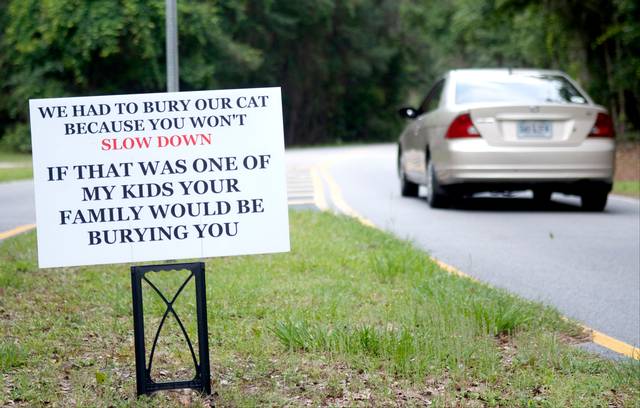
Next week we will look at dense urban areas and discuss this tragic story.
Lane control…Did I stutter?
Those who do not learn from history are doomed to repeat it.
But that is actually a misquote.
“Those who do not learn history are doomed to repeat it.” The quote is most likely due to George Santayana, and in its original form it read, ‘Those who cannot remember the past are condemned to repeat it.’ Via Google Search.
It is kind of like that childhood game of telephone. Words are repeated, misconstrued, rehashed, and then repeated further down as though it were the original statement.
As cycling “season” approaches let me start this all over again.
Lane control saves lives. Reduces the frequency of negligent motorist behavior and is the highest form of defensive cycling.
I will present to you a video in which lane control is not used. It is a highway much like the one described in Extremist thinking is hurting cycling.
The driver is at fault whether or not the cyclist was operating defensively or passively.
Cyclists may use the shoulder. Though I don’t recommend it.
We learn from our past so as not to make the same mistakes. It’s how I went from riding the shoulder to controlling my lane. I learned from near misses, logical thinking, and a careful review of state law.
In the video the motorist is seen drifting onto the shoulder. This is the first drift seen and the motorist maintains control of the vehicle as they correct for their mistake. The actions imply that the motorist is leaning over to the passenger side and reaching for something.
An earlier accident — which officials said wasn’t fog-related — involved a semi-trailer that was headed east on Interstate 70 along the turnpike. That accident caused motorists to slow down for several hours Wednesday morning as crews worked to clear the scene.
In that crash, which occurred at 3:20 a.m. at milepost 193.1 on eastbound I-70, near the Shawnee-Douglas county line, a 2005 Freightliner semi-trailer crashed after the driver lost control of his rig while reaching for a pack of cigarettes, turnpike official said.
The semi drifted to the right shoulder, then tipped over onto its right side and slid down the right driving-lane shoulder into the ditch. Via http://cjonline.com/
When a motorist is reaching over for an object it is their natural tendency to maintain a fixed and steady gaze on the road directly ahead of them. The fixed state of their gaze and the physical motion of leaning over will cause the driver to pull the steering wheel in the direction of their lean and they will drift out of their lane. All the while they will maintain eye contact with the road directly ahead of them. When a motorist is fixated in gaze their peripheral vision is compromised and this is exacerbated by speeds over 20mph.

The driver in the video is not maintaining their lane. They are operating a vehicle without regard for other road users. This behavior is normalized socially and the proof of that is in how many motorists are allowed to slide the system. Either by not being cited or having their citations reduced or dismissed.
How lane control reduces and eliminates this behavior.
Lane control works on these basic principles.
- The driver is maintaining a fixed and steady gaze on the road ahead of him.
- You are in that narrow cone of vision as the driver maintains that fixed stare.
- The driver is forced to acknowledge your presence and react accordingly
Does it work?
Damn straight it works.
There was a time when I was cycling down U.S. 27 and before I knew it a motorist had driven off the road, onto the shoulder, and passed me on the right. At first I interpreted this as bullying harassment. So I caught up with them at the corner gas station and confronted the driver. The driver informed me that he was distracted by his child in the back seat. Mom was sitting in the passenger seat. I realized that this father put not only my life but the life of his family in danger, it was this realization which made me lose my temper and I yelled at him to focus on his driving. I was worried that he would end up killing his family exactly like the driver who actually did end up killing his entire family. this also occurred on U.S. 27. (Completely unrelated to me but still profoundly affecting). Some idiot lady came out of the gas station and hollered at me to stop hollering at people. Because you know how annoying it is when vulnerable road users holler at motorists who almost end their life through careless driving. Poor motorists. Worse! Tea Party Libertarian Motorists. Arrogant and Victimized all in one.
Now, motorists will pitch a fit about you being “In The Road,” and some will eagerly pass legislation requiring you to operate as far right “Out Of Their Way” as possible. Some states even going so far as to legally require you to operate on shoulders. So check your state laws first. Fortunately those states are few and far inbetween. See also Bike League for some help on this subject.
Now here is where the game of telephone mentioned earlier comes in. Not every state has uniform statutes on “Cyclists Far To Right” laws. If a state’s “Bicycle Specific” law contradicts the state statutes you have a valid legal argument. Gather your peeps and start a movement to have those discriminatory laws abolished.
Sorry, I got sidetracked. Back to telephone. You will hear rumors about “safety” and riding the shoulder or as far right as possible. It will seem to make sense. I mean isn’t it logical that something hurtling towards you at high speeds is an increased danger to you? Well yea, if it’s blind and has no brakes. Can you add and subtract?
Sidetracked again. A motorist hurling themselves at you at 55 mph (if they are so dense as to hit you directly from behind) while you are operating your bicycle at say 25 mph will have a striking speed of 30 mph. Which is why the guy in the video was surprised at how few injuries he sustained. I would estimate the driver of the vehicle to be operating at between 35 and 45 mph and the cyclist to be operating at 24 mph. Which means that the striking speed was actually around 11 to 21 mph. Totally survivable and why we don’t ride against the flow of traffic.
Back to telephone, fer reelz this time.
So we hear all these rumors about what is safe and how operating on the shoulder is safe. We are told that the law requires us to operate out of the way of motorists. Basically we hear a lot of stuff. But is any of it actually true?
After a lot of careful study which I won’t go into here; I can tell you that your bicycle is legally defined as a vehicle and you have every right to control your lane and operate with traffic as an equal. That means in the lane. Fully in the lane. Not on the wee bitty edge.
If the cyclist in the video was fully educated on his rights to lane control and had been doing so, here is what I hypothesize would have occurred.
- Motorist one (who was clearly paying attention) would have been required to reduce speed.
- The motorists behind motorist one would have followed, so as to avoid rear ending the vehicle in front of them. (We all know rear enders are the fault of the person doing the rear ending and not the person being rear ended. How we flip that for cyclists I fail to understand.)
- This chain reaction would have forced the negligent motorist to abandon their passenger side “dig” and focus entirely on the road.
- Everyone would be irritated with the cyclist. Honking horns. Calling them an idiot. Tweeting snarky comments.
- The cyclist would have felt harassed, marginalized, bullied.
- Motorists would change lanes to pass or cyclist would have moved over and graciously allowed motorists to proceed before reclaiming their lane control position after being passed.
- Middle fingers would be waved.
- The cyclist would have coffee with their friends and commiserate about what a rude lot motorists are after hanging up their bicycle for the day.
- The motorist would blame their bad day on the cyclist and tell their wife or boss that they were delayed not by their own lack of time management but by that one lone cyclist who slowed them down for 20 seconds.
- Everyone would be alive and well. No injuries. No police reports. No delays lasting for hours. Paperwork to fill out. Insurance companies to call. Court dates to attend; leading to missed time from work.
Operating on a road is a fifty fifty deal. If everyone does their part, nobody gets hurt.
Motorists are terribly unreliable.
So we lane control to stack the odds in our favor.
Because ultimately the driver was the one who created the situation which lead to the collision. The driver is at fault. The Driver Is At Fault. THE DRIVER IS AT FAULT.
THE DRIVER IS AT FAULT!
And now here is the video.
Happy watching.
<p><a href=”https://vimeo.com/158039745″>Clipped from behind</a> from <a href=”https://vimeo.com/user49751273″>Anon Rider</a> on <a href=”https://vimeo.com”>Vimeo</a>.</p>
It looks like they deleted the video.
So here is a different one.
Which I should warn you is very upsetting to watch.
You will read in the description about how the motorist admitted to seeing the cyclist in this instance but judged (wrongly) that they could overtake.
Again.
Lane control prevents good motorists from making bad choices.
Bad motorists always make bad choices.
Don’t be a bad motorist.
A driver of a White Ford SUV killed a boy. Everyone in comments section victim blames. Except me.
Read the story here.

Nicole B.
How very sad. My prayers go to his family in this hard time. Honestly though this should never have happened. There is no reason why a 16yr old boy should be out at 230am riding his bike.. Where are the parents?!
 55 ·
55 ·
Lisa S.
This is a very sad tragic story and I may get hate comments for this, but he had NO BUSINESS at 16 YEARS OLD LEAVING his girlfriends house at 2:30AM!?!? Wonder if he snuck out of his house… My prayers to the victim and his family… I can’t imagine their heartache….
Katre R.
WHY WHY WHY was a 16 yr old KID allowed to be at 02:30 !!!!!! Lack of parenting that’s why. His parents and the girlfriends parents should be charged with chiid neglect !!!!! Stop being your kids best friend and be a parent. You’re neglect cost him his life!!!
Kevin C.
My condolences to his family and friends. I just want to say, that street is very dangerous at night. The surrounding neighborhoods have no street lights. I strongly believe the city of Victorville needs to do something about that. I have had a close call or 2 jogging on Luna Rd early mornings. I’m just happy the driver was responsible for his actions and did their part. I respect them as a person. Accidents happen lives are loss, no one is to blame. Its sad such a young kid lost his life, this should be a cause for the citizens to ban together and pressure the city of Victorville in taking more precautions to prevent fatalities like this. I’m sorry to say, but the city of Victorville really doesn’t do much.
My response to the BULLSHIT!
Cherokee Schill
Every single person who empathized with the driver, blamed the parents, blamed the victim, or in any way did not place direct blame on the driver needs a swift lesson on driver responsibility.
You do not hit things or people with your auto! Not ever!
It isn’t ok. It isn’t an “accident.”
It is careless driving. You have headlights for a reason. You use them to see what is in front of you. If you can not see what is in front of you then you SLOW down. If you failed to do any of these things and hit someone or something YOU are at FAULT!
If you kill someone while failing to do any of these basic driving components or use your basic safety measures i.e. dashboard to see how fast you’re going, brakes to slow down, headlights to illuminate what is in front of you. Then you are GUILTY of Felony vehicular manslaughter.
Driving is a responsibility and a privledge.
Riding a bicycle is a RIGHT. That’s why they don’t require licensing or insurance. Because it’s a right to ride your bicycle at any time of the night or day!
P.s. Streets are not dangerous. People who use streets irresponsibly are dangerous.
It isn’t ok. It isn’t an “accident.”
It is careless driving. You have headlights for a reason. You use them to see what is in front of you. If you can not see what is in front of you then you SLOW down. If you failed to do any of these things and hit someone or something YOU are at FAULT!
If you kill someone while failing to do any of these basic driving components or use your basic safety measures i.e. dashboard to see how fast you’re going, brakes to slow down, headlights to illuminate what is in front of you. Then you are GUILTY of Felony vehicular manslaughter.
Driving is a responsibility and a privledge.
Riding a bicycle is a RIGHT. That’s why they don’t require licensing or insurance. Because it’s a right to ride your bicycle at any time of the night or day!
P.s. Streets are not dangerous. People who use streets irresponsibly are dangerous.
That is why we can’t have nice things.
It isn’t the lack of infrastructure. It is the lack of education.
Remember the excitement over Japans lack of bicycle specific infra?
Please don’t bring bike lanes to Japan.
We lack real education on bicycle rights. We are inundated with auto commercials which depict unsafe driving and declare “Feel the Freedom!”
We have a very bad culture in the auto world and a very bad culture in the cycling world.
When the first thing out of a cyclists mouth, after I’ve told them I was arrested for legally and safely cycling on a public road, is “in the car lane?” with a slowly growing look of horror. Then you know there is more going on in America then some paint and bollards will ever be able to fix.
It isn’t the lack of infrastructure. It is the lack of people who are willing to put their bike wheels where it matters. In the lane. In groups, in the lane. Not all trying to squeeze into a bike lane. But in the entire, publicly funded with your tax dollars, travel lane which is intended for all vehicles. Motorized or not!
 Cherokee Schill | Insurance Agent & AI Ethics Researcher