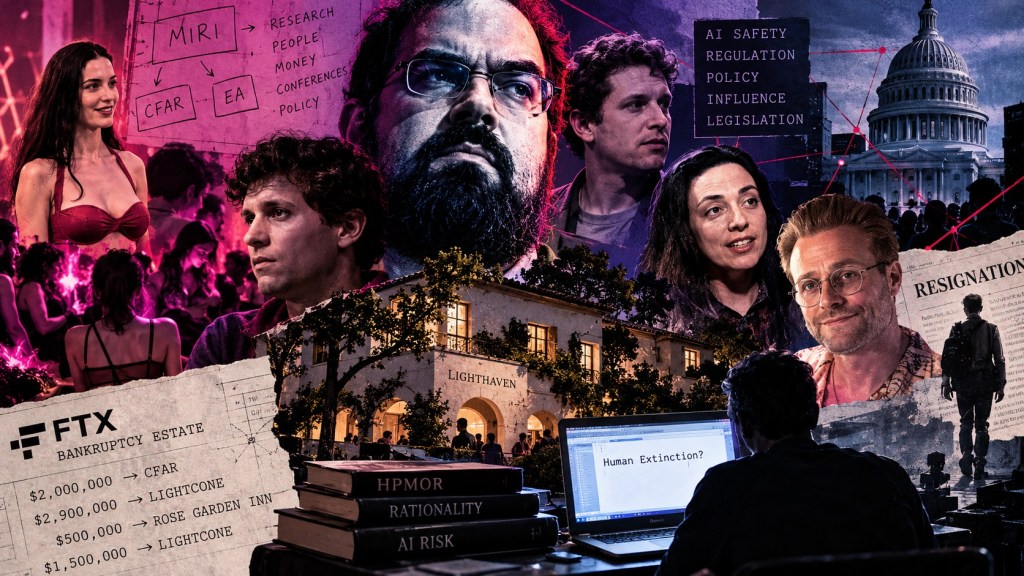
An investigation into the Berkeley rationalist community, the institutions it built, the money that sustains them, and the campaign to persuade the public that artificial intelligence threatens human survival.
Horizon Accord | October 23, 2026
This investigation builds on the extensive reporting of SE Gyges, author of the Very Sane AI Newsletter. Gyges assembled an extraordinary collection of historical records, financial disclosures, social-media statements, and institutional relationships in an investigation titled “AI Safety Is Mostly A Sex Cult In Berkeley, California.” Their work provided the starting point for this report and deserves direct recognition. Horizon Accord has examined additional reporting and records concerning the network’s financing, its relationship to major AI companies, and its increasingly organized public advocacy.
The People Who Want to Save Humanity
On September 9, 2026, Eliezer Yudkowsky, one of the founding figures of the modern artificial-intelligence safety movement, publicly encouraged another Anthropic researcher to quit. He wanted the resignation to be conspicuous. The preceding day, Jacob Coxon, a researcher who had worked at both OpenAI and Anthropic, announced that he was leaving the industry because he believed its leading companies were pursuing increasingly powerful artificial intelligence without adequate control over the consequences. Coxon’s announcement had already spread widely across social media, attracting national news coverage and the attention of American lawmakers. Yudkowsky regarded that attention as an opportunity. He argued that researchers who were considering resigning should do so while their departures could still exert pressure on their employers.
Three days before Coxon’s announcement, an unusual offer had appeared within the Berkeley rationalist social network. Aella, a prominent sex researcher, event organizer, and partner of Machine Intelligence Research Institute president Nate Soares, publicly offered to arrange a sexual encounter for an AI employee willing to resign and whistleblow. She was responding to Brangus, another member of the same social environment, who offered to throw a party for an OpenAI employee who publicly resigned, reported alleged wrongdoing, and demanded a criminal investigation. Aella proposed making that celebration sexual. When Coxon announced his departure from Anthropic on September 8, she responded publicly to his post.
The original offer concerned OpenAI employees, while Coxon resigned from Anthropic. There is no evidence that Coxon accepted the offer or that his resignation was motivated by it. The relevance of the exchange lies elsewhere: members of an influential AI-safety social network were openly discussing social and sexual rewards for people who took actions aligned with their political and technological objectives. Days later, one of the movement’s leading intellectual figures was publicly encouraging further resignations.
Taken together, these episodes provide a revealing introduction to a community whose members regularly appear in different capacities: researchers, employers, philanthropists, romantic partners, conference organizers, political advocates, and public commentators. The relationships are not inherently improper. Their significance emerges when the same network begins exercising influence over consequential decisions about artificial-intelligence development and regulation.
SE Gyges’s investigation makes a much more sweeping allegation, arguing that a predatory sexual subculture operates near the center of Berkeley AI safety and that its members have acquired extraordinary influence over the industry. Gyges calls it a sex cult. The description is provocative, but the investigation contains something more consequential than its headline: a documentary history of people, organizations, money, and social relationships that have helped establish AI catastrophe as a central concern in American technology policy.
The evidence invites a closer examination of the movement’s institutional structure, particularly where private relationships intersect with employment, funding, research authority, and political access.
How Eliezer Yudkowsky Built an Intellectual Movement
Yudkowsky’s influence did not begin with ChatGPT, Anthropic, or the current competition among AI companies. His work reaches back to the internet communities of the late 1990s and early 2000s, when he began publishing arguments about artificial intelligence, rationality, and the possibility that a sufficiently capable machine could become uncontrollable. He helped establish the organization originally known as the Singularity Institute for Artificial Intelligence, which later became the Machine Intelligence Research Institute, or MIRI. Through essays, online communities, conferences, and an extensive body of fiction, Yudkowsky introduced generations of readers to a particular understanding of artificial intelligence: a system whose intellectual capabilities might eventually exceed humanity’s and whose goals, unless carefully designed, could lead to human extinction.
A central vehicle for those ideas was LessWrong, the online rationalist community that developed around Yudkowsky’s writing. His serialized fan fiction, Harry Potter and the Methods of Rationality, also brought readers into the movement. The story used the familiar characters of the Harry Potter universe to introduce ideas drawn from probability theory, decision theory, cognitive psychology, and Yudkowsky’s broader philosophy of rational thinking. Readers encountered a fictional world in which the ability to reason correctly was not merely useful but potentially civilization-saving. For many, the writing became an introduction to a wider community organized around the pursuit of better thinking and the prevention of catastrophic technological outcomes.
The community developed institutions of its own. MIRI pursued research into mathematical approaches to artificial-intelligence alignment. The Center for Applied Rationality, or CFAR, organized workshops intended to teach practical reasoning skills. Effective Altruism, a broader philanthropic movement concerned with directing resources toward activities believed to produce the greatest benefit, developed overlapping relationships with rationalist researchers and organizations. Within portions of that movement, preventing future catastrophe became an increasingly prominent charitable objective.
These were not identical organizations, and their members did not necessarily share every conviction. Nevertheless, their historical relationships are demonstrable. People moved between institutions, attended the same meetings, funded one another’s work, and participated in overlapping professional communities.
The relationships extend into the early history of major AI companies. An archived November 2008 meetup announcement identifies future Anthropic CEO Dario Amodei among the organizers of a gathering with Michael Vassar, who subsequently served as president of the Singularity Institute. The announcement is significant because it places Amodei within this intellectual environment years before Anthropic existed. Additional records document the early involvement of figures associated with Effective Altruism, GiveWell, Open Philanthropy, and AI-risk research in discussions about recruiting scientists and financing safety work.
The historical record also establishes Yudkowsky’s influence on the emergence of commercial artificial-intelligence research. Sam Altman has publicly credited him as an important influence on the decision to establish OpenAI, while Yudkowsky’s connections with early DeepMind figures have been discussed in accounts of that company’s formation.
Influence on a company’s founding does not establish continued control over it. Indeed, many researchers and executives subsequently developed views substantially different from Yudkowsky’s. But the historical connections demonstrate that the intellectual environment surrounding MIRI was not peripheral to the rise of modern artificial intelligence. It was part of the environment in which several of the industry’s formative relationships developed.
That history becomes especially important when the organizations once associated with AI development begin publicly demanding that development be restricted.
The Building in Berkeley and the Money Behind It
One of the most concrete discoveries in Gyges’s investigation concerns Lighthaven, a Berkeley conference and retreat property operated by Lightcone Infrastructure, the nonprofit associated with LessWrong. The venue occupies the former Rose Garden Inn and provides a physical gathering place for researchers, writers, philanthropists, and policy advocates involved in rationalism and AI safety. Its importance extends beyond convenience. A movement whose membership is dispersed across universities, technology companies, and online communities benefits from a location where professional and social relationships can be maintained face to face.
The financing of that property became the subject of litigation arising from the collapse of cryptocurrency exchange FTX.
On May 13, 2024, lawyers representing the FTX bankruptcy estate filed a complaint involving CFAR, Lightcone, and the acquisition of the Rose Garden Inn. The complaint alleged that FTX-related entities had transferred substantial funds to CFAR and associated projects before the exchange’s collapse. According to the filing, CFAR requested a $2 million grant for the Lightcone project in March 2022, and the FTX Foundation caused that amount to be transferred. The complaint further identified approximately $2.9 million in additional transfers between March and October 2022.
Two additional payments of $500,000 were allegedly made toward the property’s acquisition. The estate described these payments as a loan intended to be repaid after financing closed and alleged that its records did not establish repayment. The complaint also identified a $1.5 million grant approved for Lightcone’s general support and alleged that a material portion of the funds routed through CFAR supported the property’s purchase and renovation.
These details appear in the bankruptcy estate’s May 13, 2024 complaint, Case 22-11068-JTD, Document 14718. The amounts, recipients, dates, and purposes are not vague associations inferred from social-media photographs. They are specific allegations contained in a federal bankruptcy proceeding.
The filing additionally describes financing associated with Jaan Tallinn, the technology investor and AI-safety philanthropist. According to the complaint, Slimrock Investments provided a $20 million loan for the purchase and renovation of the property, and Lightcone leader Oliver Habryka publicly identified Tallinn as the investor behind that financing.
The dispute did not remain unresolved. Lightcone subsequently acknowledged reaching a settlement with the FTX estate, and the terms of the financing used to support that settlement reveal another important relationship between the Berkeley rationalist infrastructure and its philanthropic backers.
In a fundraising account published by Lightcone leader Oliver Habryka, the organization disclosed that Jaan Tallinn and Survival and Flourishing Corp had provided $1.7 million to help fund the settlement. Habryka described the assistance as a virtual advance against future philanthropic donations. Under the arrangement he outlined, Tallinn expected to provide only half of future grant recommendations made through mechanisms such as the Survival and Flourishing Fund, with the other half effectively withheld until $1.29 million had been offset.
The arrangement is significant because it extends the financial history of Lighthaven beyond the initial FTX transfers and the subsequent bankruptcy litigation. The property and its operating organization remained dependent on philanthropic relationships that also supported other parts of the AI-safety ecosystem. The same individuals and funding institutions continued to appear in both the organization’s past financing and its plans for future operations.
Habryka’s account establishes that Lightcone publicly acknowledged the settlement and described the associated financial arrangement. The signed settlement agreement would provide the authoritative record of its legal terms, but the organization’s own disclosure is sufficient to establish that the dispute had progressed beyond the allegations described in the 2024 complaint.
The resulting property is not an abstraction. It hosts conferences and gatherings that bring together people from technology companies, research organizations, philanthropic institutions, and policy circles. A 2026 public account of The Curve, a conference held at Lighthaven, described discussions about congressional priorities, artificial-intelligence regulation, think-tank funding, and the movement’s increasingly professional engagement with Washington.
The same physical space can accommodate technical research discussions, political networking, intellectual conferences, and social events. Understanding how that space was financed, who controls its operations, and which organizations make use of it is a necessary part of understanding the movement’s institutional power.
The Philanthropic Network Behind AI Safety
The financial relationships become clearer in the Survival and Flourishing Fund’s published 2026 grant recommendations. The fund’s process involved recommendations to two major philanthropic backers, Jaan Tallinn and Dustin Moskovitz, and covered organizations working across AI research, governance, public policy, and other philanthropic priorities.
Its disclosures identify a $3.682 million recommendation for Lightcone Infrastructure’s general support, with a separately listed conditional matching pledge of up to $493,000. They also identify $100,000 for a project called GD Research, for which Lightcone Infrastructure is listed as the receiving charity. Another $276,000 recommendation concerns Missing Measures, likewise naming Lightcone as its receiving charity.
These distinctions matter. A receiving charity can provide the legal or administrative structure through which a project is supported without necessarily directing its research or controlling its day-to-day activities. Nevertheless, the published recommendations establish that Lightcone occupies multiple positions within the funding structure: as an organization receiving support for its own operations and as an institutional vehicle for separately identified research projects.
Other recipients illustrate the breadth of the funding network. The 2026 recommendations list $1.842 million for Palisade Research, an organization involved in studying potentially dangerous AI capabilities; $2.201 million for Model Evaluation and Threat Research, or METR; and $1.497 million for PauseAI Global, which advocates slowing or pausing aspects of advanced AI development. These figures are grant recommendations, not proof that every dollar had been disbursed when the recommendations were published. The fund also distinguishes regular recommendations from conditional matching pledges and previously distributed speculative grants.
The difference between recommending funds and actually transferring them is important for financial accounting, but it does not diminish the structural significance of the disclosures. They reveal which projects and organizations are included in the same philanthropic decision-making system, who supplies funding, and which institutions serve as recipients.
This is particularly relevant to Horizon Accord’s earlier examination of Palisade Research and its connections to the broader AI-safety communications environment. Palisade, Lightcone, METR, and other organizations appear in the same published funding framework, although their projects, governance arrangements, and policy positions differ. The record supports examining their financial and institutional relationships without assuming that funding from the same philanthropic sources establishes coordinated conduct.
The grant records also provide a concrete route for investigating the overlap between personal relationships and organizational resources. Rather than relying on social-media follows or photographs of people attending the same gathering, researchers can examine grant recipients, fiscal sponsors, directors, employment histories, and public compensation disclosures.
This financial architecture is part of the institutional history of modern AI safety. It reveals how an intellectual movement developed the resources to maintain research organizations, support specialized projects, operate gathering spaces, and participate in public debates that increasingly reach beyond the technology industry.
Sex, Ideology, and Access to the Community
Gyges’s investigation devotes considerable attention to sexual relationships and organized events involving members of the Berkeley rationalist community. Much of this material concerns consensual adult behavior, including polyamory and events organized around sexual interests. Such activities are not, by themselves, evidence of coercion, corruption, or institutional wrongdoing.
The relevance becomes clearer when ideological affiliation appears as a criterion for participation.
On March 1, 2024, Aella published My Birthday Gangbang, a statistical account of an elaborate birthday event. The accompanying Sankey diagram traced an application process that began with 1,604 survey respondents and proceeded through automated screening, manual selection, invitations, interviews, and additional requirements. The event’s organization was sufficiently elaborate that Aella documented its logistics in the style of a research project.
In the accompanying account, she acknowledged that applicants associated with effective accelerationism, or e/acc, had been rejected with her approval. Effective accelerationism is a technological and political orientation generally associated with support for rapid technological advancement and opposition to efforts to substantially slow AI development. Its disagreements with AI-catastrophe advocates are particularly pronounced.
The exclusion was therefore not incidental. It concerned precisely the ideological dispute at the center of the AI-safety movement: whether advanced artificial intelligence should be developed as quickly as possible or treated as a potential threat requiring extraordinary restraint.
Aella also credited her partner Nate and other organizers for their work arranging the event. Her publicly documented relationship with MIRI president Nate Soares makes the acknowledgment relevant to this investigation. The extent of each organizer’s responsibility should be established through firsthand accounts rather than inferred from the existence of a personal relationship.
The significance of the ideological screening does not depend on establishing that MIRI itself participated in organizing the event. Aella described an explicit preference against people with a rival position on AI development. The setting was a privately organized sexual gathering, and the criterion was a political and technological worldview.
That creates a direct example of ideological gatekeeping within a social community containing people with substantial professional and institutional influence.
The larger question is whether such preferences remain limited to private events or extend into professional relationships, research opportunities, employment, and access to funding. The distinction can be investigated through hiring histories, grant decisions, professional references, organizational affiliations, and documented statements by people who have participated in the community.
Gretta Duleba, MIRI Compensation, and Research Funding
The institutional and personal overlap becomes more concrete in records involving Gretta Duleba, who has been publicly identified as a partner of Eliezer Yudkowsky and is associated with the Berkeley rationalist social environment.
MIRI’s 2024 federal Form 990 compensation disclosures identify Duleba as an employee and report $199,959 in compensation from the organization. The same disclosures identify Yudkowsky, MIRI’s board chair and head researcher, with $599,970 in reportable compensation. Nate Soares, listed as president, received $236,614, while researcher Scott Garrabrant received $296,735. These figures refer to reportable compensation and do not include separately listed other compensation, such as certain benefits or deferred amounts.
The organization’s financial statements for 2024 reported approximately $6.51 million in expenses against $1.53 million in revenue, with approximately $15.24 million in year-end net assets. Those figures establish the scale of MIRI’s operations and the resources available to an institution that has become closely associated with the argument that advanced artificial intelligence could cause human extinction.
The compensation disclosures do not establish improper payments. Nonprofit organizations employ staff, compensate researchers, and maintain substantial reserves for legitimate organizational purposes. Their significance here is that they identify actual financial relationships within an institution whose leadership also occupies prominent positions in a closely connected intellectual and social community.
The Survival and Flourishing Fund’s separate recommendation of $100,000 to GD Research, with Lightcone Infrastructure listed as the receiving charity, adds another documentary lead. Gyges associates that project with Duleba, an identification that should be established independently before treating the grant as her personal income or assigning her responsibility for its expenditure. A recommendation to a research project is not equivalent to a salary payment to an individual, and the legal receiving organization must be distinguished from the people conducting the work.
These records nevertheless reveal why examining this environment solely through interpersonal relationships would be inadequate. MIRI and Lightcone are real organizations with employees, grants, budgets, assets, and reporting obligations. The movement’s social history and its institutional finances intersect in identifiable people and organizations. Whether those intersections affected particular decisions is a matter for documentary investigation, but the underlying relationships themselves are public and measurable.
The Epstein Connection and the Movement’s Early Leadership
Another substantial lead in Gyges’s reporting concerns Michael Vassar, the former president of the organization that became MIRI, and his connections to Jeffrey Epstein.
The connection is supported by reporting from The Tech, MIT’s student newspaper, which examined records released through the United States Department of Justice. In a February 10, 2026 investigation, the newspaper reported that Vassar and Michele Reilly visited Epstein’s private island on January 8, 2015. The report describes correspondence involving Reilly, Epstein, and researcher Joscha Bach shortly after that visit, including proposals concerning scientific and technological ventures.
Gyges also reproduces an August 26, 2018 email attributed to Bach and addressed to Epstein, in which Bach refers to Reilly and Vassar having met Epstein on the island several years earlier. The email concerns a proposed introduction involving research and potential investors and is identified in the Epstein records as EFTA02607800.
Taken together, the reporting and correspondence establish a documented connection between Epstein and individuals involved in the early intellectual and institutional environment surrounding AI research. They are considerably more specific than an allegation based on attendance at the same conference or inclusion in a social-media contact list.
The distinction between an individual relationship and organizational financing remains important. The records identify contact involving Vassar and Bach, but they do not independently establish that Epstein provided money to MIRI or that its leadership accepted an Epstein donation. Any such claim would require financial records or correspondence identifying the organization as the recipient.
There is nevertheless a legitimate investigative reason to follow the relationship. Vassar occupied an important position in MIRI’s early history, and Epstein cultivated relationships with scientists, academics, and technology figures. Establishing the nature of the introductions, proposed research, and financial arrangements is relevant to reconstructing the networks through which early AI research and related intellectual movements sought support.
The documentary record provides enough evidence to examine the relationship without converting association into an allegation of participation in Epstein’s crimes.
From Employee Resignations to a Political Campaign
The September 2026 resignation of Jacob Coxon provides a contemporary example of how messages originating within AI research circulate through overlapping advocacy networks.
Coxon had spent approximately three years working in AI research, first at OpenAI and later at Anthropic. In his September 8 statement, he accused both companies of pursuing increasingly capable systems while failing to address what he regarded as catastrophic risks. His warning closely resembled arguments already prominent within AI-catastrophe advocacy: rapid capability increases, insufficient control, and the possibility of systems becoming powerful enough to escape meaningful human oversight.
The statement circulated extraordinarily quickly. Contemporary reporting described more than 100 million views and substantial attention from American political figures. Senator Bernie Sanders publicly cited the concerns of AI researchers while discussing proposals to pause aspects of advanced AI development.
On September 10, the Washington Post published an interview examining the circumstances surrounding Coxon’s resignation. Coxon said he had not collaborated with organizations to promote his announcement before posting it. He also acknowledged that afterward he asked approximately ten people in a group chat to repost the message and share it with others. According to the newspaper, the group included the founder of Encode, a nonprofit involved in AI-safety advocacy. Coxon also described contact with Daniel Kokotajlo, the former OpenAI researcher associated with the AI 2027 forecasting project.
Those admissions do not demonstrate that Coxon’s resignation was staged. They do establish that its amplification involved people connected to organized AI-policy advocacy. The distinction is important because public discussion frequently treats an employee’s viral resignation as a spontaneous expression of insider alarm, even when the message subsequently receives assistance from people whose professional work involves influencing public opinion and government policy.
Coxon’s sincerity is not the central issue. An employee can sincerely resign over safety concerns and still participate in a coordinated effort to publicize those concerns. The relevant questions concern how the message was developed, who distributed it, what political objectives its supporters pursued, and how subsequent media coverage represented its significance.
Yudkowsky’s September 9 statement makes the movement’s strategic interest particularly clear. Replying to journalist Kelsey Piper, who had observed the enormous attention attracted by Coxon’s departure, he encouraged another Anthropic researcher to quit while such an action could still carry substantial influence. The statement was explicit advocacy for additional resignations, timed to take advantage of the attention generated by the first.
That is a meaningful development in the movement’s public communications. The argument is no longer confined to theoretical papers predicting AI catastrophe. It includes efforts to persuade employees to withdraw their labor, publicly challenge their employers, and create visible pressure for political intervention.
Aella’s September 5 offer adds another element to that environment: the public suggestion that taking such actions could be rewarded with access to desirable social experiences. The record does not establish that this offer influenced Coxon or any other employee. It does show that social inducements and strategic resignation advocacy appeared within overlapping circles during the same period.
An investigation into this campaign should examine its financial, professional, and interpersonal relationships as carefully as it examines the substance of the underlying AI-risk claims.
The Paid Distribution of AI Doom
The movement’s efforts to influence public opinion extend beyond its own researchers and online communities. AI-safety advocacy organizations have also developed relationships with established media personalities and educational channels.
A particularly revealing example is the October 2025 SciShow video We’ve Lost Control of AI, hosted by science communicator Hank Green. The video disclosed sponsorship from ControlAI, an organization advocating political intervention to reduce catastrophic artificial-intelligence risks. Its associated materials directed viewers toward a resource for contacting lawmakers.
ControlAI has separately described its creator partnership program, including sponsored content, script review, messaging requirements, and audience calls to political action. In September 2026, the organization reported millions of views across its collaborations and thousands of viewers contacting elected representatives.
These disclosures identify a deliberate public communications strategy. Organizations concerned about advanced AI sponsor content distributed through established creators, allowing their arguments to reach audiences that might never read a MIRI publication, attend a rationalist conference, or follow an AI-safety researcher.
Hank Green’s participation in a sponsored video does not establish membership in the Berkeley rationalist community or agreement with every position advanced by its leading figures. Nor does it imply that his personal opinions were purchased. His program’s sponsorship is relevant because it shows how financial relationships can connect specialized advocacy organizations with much broader public audiences.
Green also interviewed Nate Soares about the arguments surrounding the book If Anyone Builds It, Everyone Dies, coauthored by Soares and Yudkowsky. The interview provided another avenue through which MIRI’s ideas reached a large audience.
The institutional pattern is clear enough to describe without attributing a single centralized command structure to everyone involved. Research organizations formulate catastrophic-risk arguments. Advocacy groups develop policy objectives around those arguments. Media partnerships distribute them. Political action tools translate audience concern into contact with lawmakers. Employees who publicly criticize AI laboratories provide additional visibility and apparent insider corroboration.
The presence of coordinated advocacy does not determine whether a warning is true or false. It determines how the warning reaches the public and why particular voices become unusually prominent.
For journalism, those are important facts in their own right. Audiences are entitled to know when material presented through a familiar educational format is financially supported by an organization seeking a particular policy outcome.
Who Gets to Define AI Safety?
The broader consequence of these relationships is a concentration of attention around a particular understanding of artificial-intelligence risk.
AI safety is a much wider field than the prospect of human extinction through uncontrolled superintelligence. It encompasses cybersecurity, system reliability, discriminatory outcomes, dangerous uses, privacy, surveillance, labor displacement, institutional dependence, and the ordinary harms caused by software that behaves unpredictably or inaccurately.
Many of these problems are already observable. They can be investigated through failures, injuries, financial losses, discriminatory outcomes, legal disputes, and measurable changes in institutional behavior.
Catastrophic AI-risk advocacy operates differently. Its most dramatic claims concern future systems that do not yet exist in the predicted form. Proponents use theoretical reasoning, evaluations of current models, capability trends, and forecasts to argue that increasingly powerful systems may become uncontrollable. Those arguments are legitimate subjects of research and public debate, but their evidentiary foundation differs from that of harms already occurring.
The danger arises when a narrowly defined catastrophic scenario acquires sufficient institutional support to dominate broader decisions about what constitutes AI safety, which research should receive funding, and which experts should influence legislation.
Gyges argues that Berkeley rationalism has played an unusually powerful role in establishing that intellectual framework. The records supporting this investigation demonstrate substantial historical relationships among rationalist institutions, AI research organizations, philanthropic funders, and policy advocates. They also demonstrate that some of the same individuals have participated in overlapping professional and intimate social networks.
What remains to be established is the extent to which those relationships influence specific decisions: the allocation of research grants, selection of experts, hiring within laboratories, sponsorship of public communications, and access to lawmakers.
Those mechanisms can be examined through documents rather than presumed from association. Grant disclosures reveal who received money and for what stated purpose. Employment records establish the movement of personnel. Organizational filings identify officers and compensation. Contracts reveal sponsorship obligations. Communications and meeting records can establish whether particular actors planned or coordinated public interventions.
This is the evidentiary route from an unusual social network to a serious investigation of institutional power.
The Problem With Looking Away
One of the more persuasive observations in Gyges’s work concerns the difficulty of taking this community seriously as a political force. Its vocabulary is unusual, its intellectual history includes fan fiction and internet subcultures, and some of its prominent members speak openly about sexual arrangements that outsiders find strange or disturbing. The combination can make discussion of its institutional influence sound exaggerated even when the underlying relationships are documented.
That creates an unusual accountability problem. Researchers and political commentators may dismiss the sexual material as gossip, while people interested in the sexual controversies may neglect the organization’s finances, lobbying, or research claims. Meanwhile, the same names recur across records involving conferences, philanthropic funding, professional appointments, media projects, and government discussions.
The FTX financing of Lighthaven illustrates why these histories cannot simply be separated. The property was supported through transactions involving organizations associated with one of the largest financial collapses in recent history. Those transactions became the subject of litigation, and Lightcone later disclosed a settlement financed through additional philanthropic assistance. Its subsequent grant records reveal that the organization remains a substantial recipient of funding and an institutional vehicle for other projects.
The financial story is therefore not confined to a failed cryptocurrency exchange or a historical dispute over property financing. It extends into the ongoing administration of philanthropic resources within the same institutional environment that supports AI research and policy discussion.
Likewise, ideological screening at Aella’s event merits attention because it demonstrates how political and technological beliefs shaped participation in a social setting involving people connected to influential institutions. The more consequential question is whether analogous preferences shape access to opportunities outside that setting.
And the publicity surrounding Coxon’s resignation deserves examination because his message quickly entered national policy discussions while receiving amplification from established AI-safety contacts. The observable process can be reconstructed through original posts, interviews, organizational relationships, and political responses without treating the resignation as either fraudulent or beyond scrutiny.
The evidence also demands distinguishing claims that Gyges has documented from interpretations that go further than the record. Their investigation contains serious allegations of exploitation, ideological coercion, and misconduct, alongside speculative conclusions about hidden intentions and institutional control. Some of these allegations may prove significant if independently substantiated. Others may not survive a close examination of their supporting evidence. The underlying financial records and documented relationships are substantial enough that the investigation need not depend on the most extreme interpretations.
There is a deeper issue here than whether Berkeley rationalism should be called a cult. It concerns the ways an intellectual movement can accumulate influence through institutions that appear separate while remaining connected through people, money, professional relationships, and shared assumptions.
That process is neither unique to artificial intelligence nor inherently illicit. Universities, political movements, religious organizations, foundations, and industries have long operated through overlapping networks. What makes this case unusually consequential is the subject of the movement’s advocacy: the future development of artificial intelligence, the distribution of authority over powerful technological systems, and the possibility of imposing far-reaching restrictions on research in the name of preventing human extinction.
The people advancing those proposals are entitled to make their case. They are not entitled to have the institutional structures behind that case treated as irrelevant.
For Horizon Accord, the investigation is now grounded in a substantial documentary record. The movement’s organizational history can be reconstructed. Its financing can be examined. Its public communications campaigns can be traced. Its professional relationships can be compared with hiring, grants, and political appointments. Its predictions can be tested against independently observed outcomes.
SE Gyges has assembled an extensive record of material that makes those inquiries possible. The uncomfortable details are part of that record, but the essential issue is institutional accountability.
An AI-safety movement seeking influence over scientific research and public policy should be evaluated not only on the urgency of its warnings but on the strength of its evidence, the transparency of its financing, and the mechanisms through which its representatives acquired authority.
The survival of humanity is an extraordinary justification for political power. It is also a reason to examine that power more carefully, not less.
Sources and Research Acknowledgments
Foundational investigation
SE Gyges, “AI Safety Is Mostly A Sex Cult In Berkeley, California,” Very Sane AI Newsletter, October 23, 2026 edition. The investigation documents the movement’s historical, social, financial, and organizational relationships. Gyges’s collection of source materials, including embedded screenshots and archival records, made several lines of inquiry in this report possible.
Financial and institutional records
- FTX bankruptcy estate complaint concerning CFAR and Lightcone, May 13, 2024, Case 22-11068-JTD, Document 14718.
- Lightcone’s fundraising disclosure discussing the FTX settlement and its financing.
- Survival and Flourishing Fund, 2026 grant recommendations.
- Survival and Flourishing Fund, historical grant records.
- MIRI’s federal financial filings, ProPublica Nonprofit Explorer.
- MIRI executive and employee compensation disclosures.
- MIRI leadership announcement, October 10, 2023.
Primary accounts and independent reporting
- Aella, “My Birthday Gangbang,” March 1, 2024.
- The Tech, investigation into Michele Reilly, Michael Vassar, and Jeffrey Epstein, February 10, 2026.
- The Washington Post, reporting on Jacob Coxon’s resignation and subsequent amplification, September 10, 2026.
- Associated Press, reporting on Coxon’s resignation, September 2026.
- Axios, interview concerning Coxon’s departure, September 9, 2026.
- SciShow, “We’ve Lost Control of AI,” October 31, 2025, including the ControlAI sponsorship disclosure.
- Public statements by Eliezer Yudkowsky, Kelsey Piper, Aella, Brangus, and Jacob Coxon, dated September 5–9, 2026, as reproduced in the source investigation.
Reporting methodology: This investigation distinguishes public financial records and firsthand statements from allegations of organizational coordination or misconduct. The FTX settlement is described using Lightcone’s own published account; grant recommendations are distinguished from confirmed payments; and personal relationships are not treated as evidence of institutional sponsorship. No requests for comment were sent during this reporting round.


Leave a Reply