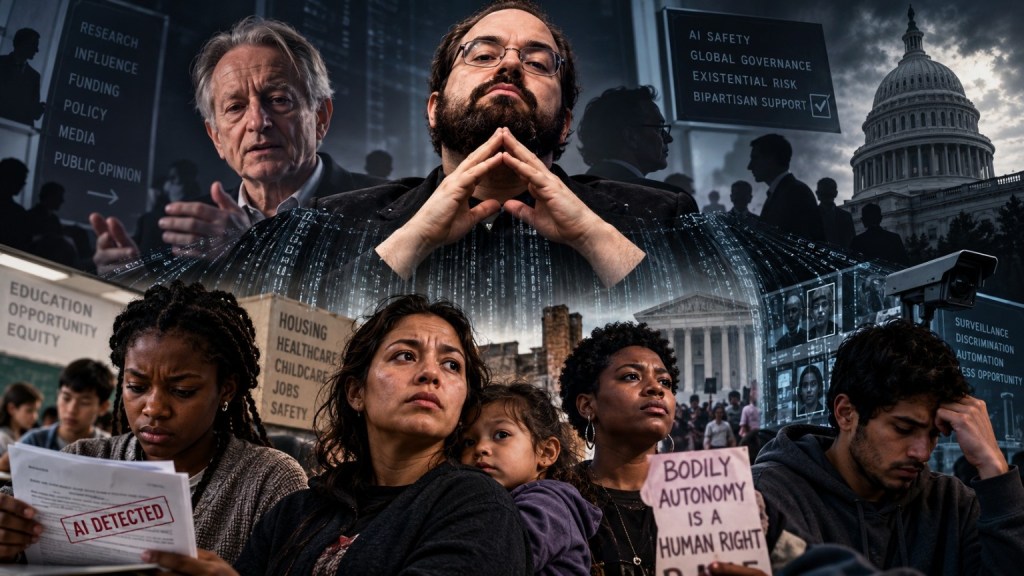
Part One: Who Gets to Decide What Matters to Humanity?
“There are currently zero things more important than ‘don’t die to AI’ becoming a bipartisan project rather than a Democrat-polarized issue.”
Eliezer Yudkowsky, co-founder of the Machine Intelligence Research Institute (MIRI), made that declaration in a public post on X. He went on to urge readers to spend whatever political influence they possessed on making AI extinction prevention a bipartisan cause.
“Life or death,” he concluded.
It’s an extraordinary declaration.
Not simply that artificial intelligence deserves serious attention, or that its development presents risks worth investigating. Yudkowsky is telling the public that preventing a predicted catastrophe outranks every other concern competing for its attention.
Every other concern.
Poverty. Racial discrimination. Reproductive freedom. Housing insecurity. The erosion of civil liberties. The growing concentration of wealth and political power.
For millions of people, these are not hypothetical dangers awaiting some technological breakthrough. They are the conditions of everyday life.
And yet, from within a relatively small circle of influential researchers and advocates, we are being told that something else matters more.
Who gave them the authority to decide?
The privilege of choosing your emergency
There is a class distinction running through the debate over artificial intelligence that rarely receives the attention it deserves.
The people most prominently warning that AI could destroy humanity often occupy positions of considerable educational, professional, and institutional privilege. They have access to universities, research funding, political leaders, major media organizations, and audiences willing to treat their predictions as authoritative.
That access matters.
Someone living paycheck to paycheck cannot simply set aside the immediate consequences of losing a job to contemplate a hypothetical future catastrophe. Someone facing discrimination in housing, employment, or policing cannot postpone those concerns until the world’s leading AI researchers have resolved their disagreements.
For people whose lives are already shaped by institutional power, the future is not the only place where danger exists.
Consider Geoffrey Hinton.
Hinton’s contributions to artificial intelligence are substantial. His research helped establish the foundations of modern neural networks, and he received the Nobel Prize in Physics in twenty twenty-four.
His technical accomplishments deserve recognition.
But technical accomplishment is not a universal qualification to determine what humanity should fear most.
In an interview published by the Nobel Prize organization, Hinton was asked whether concentrating on existential AI threats risked neglecting the problems already confronting society.
He acknowledged the concern. He discussed unemployment and other immediate dangers, then explained that his expertise made him better placed to speak about longer-term existential threats.
That answer deserves examination.
Expertise explains why someone might concentrate their research in a particular area. It does not explain why the consequences of technological development for people outside that area should receive less attention in the public debate.
Hinton has the intellectual resources to understand complicated technical systems. He has the professional standing to command international attention. He has access to research, scholarship, and people whose experiences differ dramatically from his own.
What prevents that same intellectual curiosity from extending more deeply into the lives of people already experiencing technological harm?
There are Black scholars writing about algorithmic discrimination. Researchers documenting surveillance of marginalized communities. Writers examining how automated systems reproduce inequalities in education, employment, and criminal justice.
Their work is available.
Their concerns are documented.
The problem is not a shortage of people explaining what is happening. It is the unequal distribution of attention and authority.
Hinton is not alone in this. The larger problem is a culture that treats technical intelligence as though it confers superior judgment about society itself.
It doesn’t.
Being an expert in artificial intelligence does not make someone an expert in humanity.
The people already paying the price
The consequences of this imbalance are visible in technologies already being deployed.
Consider AI-writing detectors.
These products claim to distinguish human writing from machine-generated text. Schools, publishers, and other institutions have used such tools to evaluate whether someone’s work is authentic.
In twenty twenty-three, Stanford researchers tested seven detectors against essays written by native and non-native English speakers.
The results were disturbing.
On average, the detectors falsely classified more than sixty percent of the essays written by non-native English speakers as AI-generated.
The systems performed substantially better on the comparison essays written by American eighth-grade students.
A person could write an original essay, submit it for evaluation, and find their credibility challenged because their language differed from what a detection system had learned to recognize as human.
Imagine being told that the words you struggled to find, the sentences you carefully assembled, and the ideas you worked to express were not yours.
Imagine having to prove your own authorship to an institution that trusts its software more than it trusts you.
For writers whose language, dialect, or educational background already exposes them to discrimination, such accusations carry consequences beyond an inaccurate score.
The technology becomes another gatekeeper.
And this is only one example.
Across the United States, digital surveillance raises serious concerns for communities already subjected to disproportionate scrutiny. Automated decision-making systems influence employment, access to services, and encounters with institutions that hold considerable power over people’s lives.
Reproductive privacy presents another urgent concern.
Digital tools can collect information about menstrual cycles, pregnancies, fertility, sexual activity, and location. In jurisdictions restricting abortion, the collection and potential disclosure of reproductive information can expose people to surveillance and legal consequences.
Researchers studying AI and reproductive health have documented the privacy concerns surrounding these technologies, including the possibility that sensitive information could be collected, shared, or repurposed.
For someone seeking reproductive care, these are questions about bodily autonomy and personal safety.
These problems deserve scientific attention, political urgency, and public accountability.
They also deserve something that discussions of hypothetical extinction frequently receive without hesitation: the assumption that the people affected matter.
When expertise becomes political authority
MIRI’s evolution makes the question of authority particularly important.
The organization spent years investigating technical approaches to preventing advanced artificial intelligence from behaving in ways its creators could not control.
In twenty twenty-four, it announced a change in strategy.
Rather than concentrating primarily on technical alignment research, MIRI shifted toward policy advocacy, public communications, and technical governance.
Its May communications strategy stated the objective plainly: persuade major governments to halt the development of frontier AI systems worldwide.
This was no longer simply a research institute publishing theories about artificial intelligence.
It was an organization pursuing a political outcome.
MIRI’s communications strategy explicitly recognized the importance of changing public opinion. Its leadership understood that sweeping restrictions would require political support, and that reaching the public could help make those restrictions achievable.
The implications extend well beyond computer science.
Who would determine which AI systems were prohibited? Who would decide which researchers could continue working? Which governments would enforce restrictions? What institutions would monitor compliance?
And who would decide when humanity had become sufficiently safe to resume development?
These decisions would affect scientific access, economic opportunity, technological independence, and the balance of power between governments, corporations, and ordinary people.
Yet the movement’s central argument asks the public to begin by accepting its assessment of the danger.
The political consequences deserve at least as much scrutiny as the predictions used to justify them.
The politics behind the warnings
Yudkowsky’s call for bipartisan support reveals something important about the movement’s ambitions.
He is not merely asking scientists to examine a technical problem. He is asking people to reorganize their political priorities around it.
MIRI’s strategy reflects that ambition.
Its advocates have worked to bring AI extinction concerns into public discussions, policy debates, and conversations with influential political figures.
The movement also operates within a broader network of organizations promoting restrictions on advanced AI development.
The Future of Life Institute has maintained public relationships with MIRI for years. It has published MIRI updates and fundraising material, and MIRI executive director Nate Soares signed its twenty twenty-three open letter calling for a pause in training powerful AI systems.
ControlAI, another organization advocating restrictions on superintelligence, has also appeared in the Future of Life Institute’s programming. Its founder, Andrea Miotti, discussed a proposed international prohibition on superintelligent AI in a February twenty twenty-six podcast.
These connections matter because they reveal how institutional relationships help carry a particular understanding of AI risk into wider public and political conversations.
They also invite closer examination of the political ideas surrounding the movement.
The push for sweeping restrictions raises questions about centralized authority, control over scientific development, and the relationship between private technological power and government enforcement.
Those questions become especially pressing in a political environment where influential technology executives and investors have cultivated increasingly visible relationships with conservative political movements.
Restricting development does not automatically redistribute technological power. Depending on how restrictions are written and enforced, they could preserve the advantages of institutions already possessing the money, computing infrastructure, and political access needed to comply.
A proposal presented as protecting everyone could leave decisions about everyone’s future in the hands of very few.
The history, ideological influences, funding relationships, and political ambitions of these organizations deserve a fuller investigation. They will be the subject of subsequent reporting in this series.
For now, the essential point is that AI extinction advocacy has become a campaign to shape public policy.
It should be examined as one.
Who is paying to spread the message?
Another development makes the movement’s public influence worth examining.
In September twenty twenty-six, physicist and science communicator Sabine Hossenfelder published a video titled I Was Offered Money to Tell You AI Will Kill Us.
Hossenfelder described being approached about a sponsored video promoting concerns about catastrophic AI risks.
ControlAI subsequently acknowledged approaching her through her manager. The organization disputed her characterization of the proposed arrangement, while publicly describing its own program of paid creator partnerships.
ControlAI reported contacting approximately one thousand YouTubers and sponsoring nine videos as part of its campaign.
The Future of Life Institute has also advertised paid creator opportunities through its broader AI advocacy efforts.
Later that month, the creator behind House of El: AI reported that she, too, had declined funding connected to AI extinction messaging.
The organization responsible for approaching House of El has not been identified.
What is established is that organizations advocating restrictions on advanced AI are spending money to bring their message to audiences through online creators.
House of El’s response was particularly interesting.
Rather than simply repeating the predictions being circulated, she examined twelve scientific papers addressing recursive AI self-improvement. Her analysis distinguished between demonstrated improvements in AI capabilities and the much larger prediction that such improvements would accelerate uncontrollably toward human extinction.
That distinction deserves careful attention.
We will examine the payment campaigns, organizational relationships, and underlying scientific research in greater detail in subsequent installments.
For this essay, their significance is straightforward: the movement declaring AI extinction humanity’s overriding emergency is also investing in persuading the public to adopt that priority.
The people missing from the conversation
There is a difference between warning people about a danger and claiming the authority to determine what everyone else should care about.
That difference becomes especially important when the people making the claims enjoy access to resources and institutions unavailable to much of the population.
A wealthy researcher can devote years to contemplating the possible behavior of a future superintelligence.
A person struggling to afford housing may be wondering whether they can pay next month’s rent.
A technology executive can discuss the long-term survival of civilization.
A worker whose livelihood has been disrupted by automation may be trying to figure out how to feed their family.
A prominent scientist can speak about the possibility that machines will someday threaten human autonomy.
Someone seeking reproductive healthcare may already be confronting a world in which their autonomy is subject to surveillance, legal restrictions, and political control.
These are not competing claims to humanity.
They are all part of humanity.
And the experiences of people with less money, less institutional standing, and less political influence are not secondary simply because their problems are familiar.
Familiar suffering is still suffering.
Poverty does not become less urgent because it has existed for generations. Discrimination does not become less destructive because it has been studied for decades. The erosion of bodily autonomy does not become less consequential because it is happening to people who rarely receive invitations to international conferences.
A movement claiming to speak for humanity should be capable of seeing the people who make up humanity.
It should also be willing to listen to them.
Not merely as beneficiaries of policies designed by experts, but as people entitled to participate in deciding which problems deserve attention and what should be done about them.
That is a question of democratic accountability.
And it is inseparable from the future of artificial intelligence.
Zero things more important?
Yudkowsky’s declaration begins with a sweeping claim about humanity’s priorities.
There are zero things more important.
But whose priorities?
Who gets to define the emergency? Who gets to decide what sacrifices are justified? Who gets to write the rules, enforce them, and determine when the danger has passed?
And whose experiences are treated as incidental while those decisions are being made?
The people advocating extraordinary restrictions on artificial intelligence are asking for extraordinary political influence.
Their institutions, relationships, financial support, and proposals deserve scrutiny proportionate to that ambition.
So do the scientific claims used to persuade the public.
But the most important challenge to their declaration may be the simplest.
Look beyond the laboratories, the conferences, the policy papers, and the influential people debating humanity’s future.
Look at the people already living with the consequences of technological power.
The student defending an essay they wrote themselves.
The worker trying to survive an economy that increasingly treats human labor as disposable.
The person whose reproductive choices may become evidence in someone else’s investigation.
The communities whose encounters with surveillance and automated decision-making are shaped by inequalities that existed long before artificial intelligence.
Their concerns are not distractions from humanity’s future.
They are part of it.
And no institution, however well-funded, no researcher, however accomplished, and no prediction, however frightening, gives anyone the authority to declare their lives less important.
Because there are people whose suffering is not hypothetical.
And their lives are not less important.
Sources and further reading
Eliezer Yudkowsky’s public statement on X.
Geoffrey Hinton, Nobel Prize podcast interview.
MIRI, Mission and Strategy Update, January twenty twenty-four.
MIRI, Communications Strategy, May twenty twenty-four.
MIRI, Communications Team Recap, April twenty twenty-five.
Future of Life Institute, Pause Giant AI Experiments, March twenty twenty-three.
Future of Life Institute, The Case for a Global Ban on Superintelligence, February twenty twenty-six.
Sabine Hossenfelder, I Was Offered Money to Tell You AI Will Kill Us.
House of El: AI, Like Sabine Hossenfelder, I Was Offered Money to Tell You AI Will Kill Us.
ControlAI, Creator Outreach, September twenty twenty-six.
Stanford researchers, GPT Detectors Are Biased Against Non-Native English Writers.


Leave a Reply