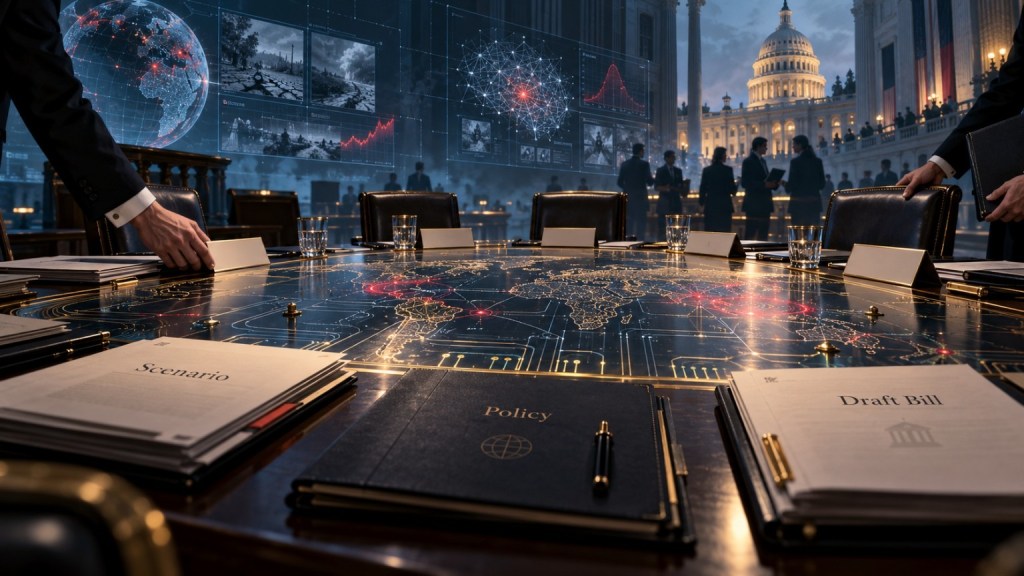
AI-risk organizations have moved from forecasting catastrophe to drafting legislation. The DOGE experience offers a timely warning about what happens when private expertise gains public power.
In September, a British lawmaker introduced legislation developed by an organization whose stated mission is to prevent the creation of superintelligent artificial intelligence.
The organization, ControlAI, had spent less than two years briefing lawmakers across several countries. By September 2026, it reported reaching nearly 400 legislators in the United States, Britain, Canada, and Germany. Its proposed Artificial Superintelligence Security Bill was introduced in Britain’s House of Commons by Alex Sobel on September 8.
The bill did not emerge from a government research department. It came from an advocacy organization that had already decided what needed to be prevented and had developed a legislative framework for doing it.
ControlAI makes no secret of its intentions. Its website invites lawmakers to request briefings and draft legislation. It trains volunteers to approach elected representatives and provides ready-made messages for citizens to send to their governments.
This is organized political advocacy, conducted openly. It is also evidence of how far private AI-risk organizations have advanced into the machinery of public policymaking.
And it raises a problem that deserves considerably more attention than the latest prediction about when artificial intelligence might destroy civilization.
Who gets to turn a theory about the future into rules governing everyone else’s present?
From imagining catastrophe to governing against it
Daniel Kokotajlo and his colleagues at AI Futures Project have spent considerable time constructing detailed scenarios of how artificial intelligence might develop.
Their April 2025 publication, AI 2027, imagined a rapid acceleration in AI capabilities, culminating in systems capable of transforming or overwhelming human institutions.
It attracted substantial attention, although the scenario’s dates should not be confused with its authors’ individual probability forecasts. Those forecasts have changed as new information became available.
By July 2026, the organization had published AI 2040: Plan A.
This time, the authors were explicit about their purpose. Plan A was a recommendation, not a prediction.
The document envisioned the United States and China intervening to delay the creation of superintelligence until 2040. It proposed extensive research transparency, international agreements, restrictions on advanced AI development, and controls over the computing resources required to train powerful systems.
The authors had moved from describing a possible future to prescribing a preferred one.
There is nothing inherently improper about researchers recommending policy. Governments depend on outside expertise, particularly when confronting unfamiliar technology.
But developing sophisticated simulations is not the same discipline as governing a society.
War games are constructed around selected threats, assumptions, actors, and possible outcomes. They can reveal vulnerabilities that ordinary planning overlooks. They can also reproduce the assumptions of the people who designed them.
Governance requires considering more than the danger an expert group has chosen to study. It involves competing interests, economic consequences, civil liberties, political accountability, and the experiences of people who may never have been invited into the simulation.
A researcher can spend years examining how an advanced AI system might escape human control without developing comparable expertise in labor markets, public administration, constitutional law, or democratic institutions.
Those disciplines are not interchangeable.
Yet the organizations producing these scenarios are increasingly participating in the development of the policies intended to govern the technology.
Who decides who gets invited?
AI Futures Project describes conducting tabletop exercises involving experts and policymakers.
These exercises are designed to help participants work through possible developments in advanced AI and consider responses to them.
But every exercise begins with decisions made by its organizers.
They determine the scenario, select the participants, establish the information those participants receive, and decide which questions the exercise will examine.
A simulation involving national-security specialists and AI researchers may produce valuable insights into technological competition or catastrophic risks. It is not necessarily equipped to evaluate what its recommendations would mean for workers, smaller businesses, public education, scientific independence, or civil liberties.
Those perspectives must be included deliberately. They do not appear simply because the organizers have assembled a room full of intelligent people.
The publicly available material does not establish that AI Futures Project deliberately excluded particular constituencies from its exercises. Nor does it establish that participants universally agreed with its recommendations.
The concern is more fundamental.
The organizers of private policy exercises have substantial discretion over whose expertise they solicit and which problems receive attention. When the resulting work is presented to lawmakers, those private choices can influence public decision-making.
And there is no requirement that the people who ultimately live under the proposed policies participated in developing them.
That does not make the exercises worthless. It makes their composition, assumptions, and limitations important.
The DOGE precedent
The United States has already witnessed how quickly private influence can move into the exercise of public authority.
When President Donald Trump returned to office in January 2025, his administration established the Department of Government Efficiency, commonly known as DOGE.
Elon Musk became its most prominent public figure.
DOGE personnel entered federal agencies, sought access to sensitive government systems, and participated in efforts to reduce federal spending and employment.
The controversy that followed was not merely about whether federal agencies could operate more efficiently. It concerned who possessed the authority to make consequential decisions, what access those individuals should have, and how the public could hold them accountable.
In February 2025, federal judges confronted questions about DOGE’s structure and authority. Government lawyers struggled to explain Musk’s formal position even as his influence over the initiative was publicly apparent.
By August, a federal appeals court had permitted DOGE personnel to access sensitive information at several agencies while litigation continued.
The distinction between advising government and exercising governmental power had become a matter for the courts.
Now that dispute has reached the Supreme Court.
On October 13, 2026, the Court agreed to hear litigation over whether DOGE records must be disclosed under the Freedom of Information Act. The Trump administration argues that DOGE operated as a presidential advisory body outside the law’s ordinary disclosure requirements. The watchdog organization seeking the records argues that DOGE exercised sufficient governmental authority to warrant public scrutiny.
The litigation does not determine the merits of AI-risk advocacy. DOGE and organizations such as ControlAI or AI Futures Project are separate entities with different purposes.
What DOGE demonstrates is the pathway.
An administration can invite outside expertise into government, assign it responsibilities, and provide access to institutions long before disputes about the limits of that authority are resolved.
Private influence does not have to begin with an election. It can arrive through an appointment, an advisory relationship, a contract, or the adoption of a privately developed governing plan.
The question of accountability may come later.
The legislative pipeline is already operating
ControlAI offers a clear example of how technical concerns are being translated into political action.
Its August 2026 policy materials call for prohibiting superintelligent AI development, establishing oversight of advanced AI activity, and building international agreements to enforce restrictions.
The organization reports briefing lawmakers directly and cultivating an international coalition in support of its objectives.
Its September legislative announcement celebrated the introduction of the Artificial Superintelligence Security Bill as a breakthrough.
That description was appropriate to its organizational goals. An advocacy group seeking restrictions had succeeded in bringing its preferred legislative framework before Parliament.
Whether lawmakers adopt those restrictions remains a separate matter.
But legislation does not begin only when elected representatives debate it. Someone decides what the problem is, develops possible remedies, and supplies language that can be introduced, amended, or adopted.
Increasingly, AI companies and AI-risk advocacy organizations are participating directly in that work.
On October 16, Reuters reported that Anthropic had privately presented its own proposed AI safety legislation to American lawmakers.
Anthropic develops frontier AI systems. ControlAI advocates preventing the development of superintelligence. Their interests and proposed approaches are not identical.
Yet both are helping shape the regulatory choices presented to government.
The people who build the technology, the organizations most concerned about its dangers, and the researchers who construct scenarios about its future all have reasons to seek influence over the rules.
Their participation can contribute valuable knowledge.
It can also concentrate the early stages of policymaking among organizations with the resources, relationships, and institutional access to be heard.
Expertise is not a governing mandate
None of this requires assuming that AI-risk researchers are dishonest, that their warnings are fabricated, or that their policy proposals are necessarily wrong.
Advanced AI presents genuine questions about safety, security, economic disruption, and concentrated power. Studying those problems is legitimate. So is advocating government intervention.
But a prediction, however detailed, is not a democratic mandate.
Neither is a successful war game.
And neither is a nonprofit organization’s ability to persuade lawmakers that its particular danger deserves priority over other public concerns.
The distinction matters because policy decisions impose costs beyond the organizations proposing them.
Restrictions on computing infrastructure can affect scientific research and market competition. International AI agreements can influence national security and relations between governments. Licensing systems can determine which businesses are permitted to develop advanced technology. Monitoring requirements can create new questions about privacy, access, and governmental authority.
A proposal designed to prevent one kind of concentrated power may create another.
Those consequences cannot be evaluated solely through simulations designed around catastrophic AI failure.
They require public debate informed by multiple disciplines and by the people whose lives and livelihoods will be affected.
The warning arrived before the catastrophe
The timing deserves attention.
ControlAI has already helped bring legislation before Parliament. AI Futures Project has produced a detailed blueprint for international intervention. Anthropic has reportedly offered lawmakers its own regulatory proposal.
Meanwhile, the United States is still litigating the transparency obligations of a government initiative that demonstrated how private figures can exercise substantial influence over public institutions.
We do not have to imagine what happens when outside expertise is granted extraordinary access to government. We have recent experience examining precisely that problem.
The lesson is not that governments should ignore experts.
It is that experts can become political actors long before the public recognizes them as such.
They can shape the threat, propose the remedy, organize the conversations, cultivate the decision-makers, and supply the legislative language.
And if elected officials choose to give them greater authority, the transition from advising government to helping direct it may occur without any new public mandate.
The researchers predicting an AI catastrophe may turn out to be right about some of the dangers they describe.
But even an accurate prediction would not establish that its authors should determine how society responds.
The ability to imagine a catastrophe is not a qualification to govern everyone trying to avoid it.
Primary reporting and documents
ControlAI — Our Policy Proposals (August 24, 2026)
ControlAI — UK Artificial Superintelligence Security Bill (September 2026)
AI Futures Project — AI 2040: Plan A (July 9, 2026)
AI Futures Project — Plan A: Suggestions for Further Work (July 10, 2026)
Reuters — “Where is Mr. Musk in all of this? Judges question secrecy of DOGE’s activities” (February 26, 2025).
Reuters — “US court says Trump’s DOGE team can access sensitive data” (August 12, 2025).
Reuters — “Supreme Court to hear Trump’s fight to shield DOGE records from disclosure” (October 13, 2026).
Reuters — “Anthropic quietly pitches its own AI safety bill to lawmakers” (October 16, 2026).


Leave a Reply