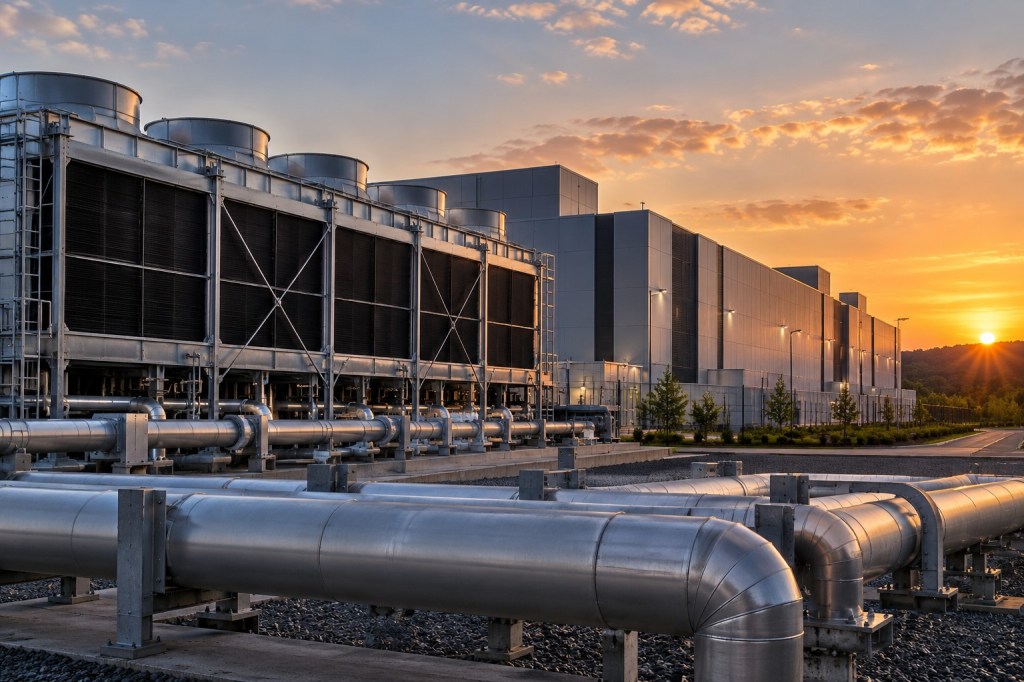
A data center developer comes to town with an answer ready for one of the first questions residents are likely to ask: What about the water?
The facility will use a closed-loop cooling system. The water will be recycled. It will use little or no potable water. Sometimes the claim goes further: zero water for cooling during normal operations.
Those statements can describe real engineering advantages. Closed-loop liquid cooling can substantially reduce water consumption, improve cooling efficiency and, in some configurations, eliminate the evaporative cooling towers responsible for much of a data center’s onsite water demand.
But none of those phrases describes the entire cooling system.
That matters when a technical description becomes a public assurance.
If a developer tells a planning commission that residents need not worry about water because a proposed data center will use “closed-loop cooling,” what has the developer actually told them?
Start by following the heat.
Computer chips produce heat. In a direct-to-chip liquid cooling system, liquid passes through cold plates attached to processors, absorbs that heat and carries it away. The liquid then circulates back through the system instead of being continuously discarded.
That’s the closed loop.
Research from Lawrence Berkeley National Laboratory has found meaningful energy savings from direct liquid cooling. But the size of those savings depends on the rest of the facility. One modeled retrofit produced overall data-center energy savings of about twenty percent. Another installation, where the liquid system still relied on an existing chilled-water plant, produced savings of only about three to four percent.
The difference points to the question that matters most: Where does the heat go next?
Getting heat off the chip is only part of the job. That heat still has to leave the building.
A closed loop around the computers can transfer heat into another water loop, which might carry it to dry coolers, chillers, cooling towers or some combination of equipment.
Those systems have very different water and electricity demands.
The U.S. Department of Energy describes configurations in which a closed IT cooling loop ultimately transfers heat to a cooling tower. The liquid around the computers keeps circulating, but the cooling tower still loses water through evaporation and requires replacement water.
A different facility might pair its closed loop with dry heat rejection and avoid routine evaporative cooling almost entirely.
Both can use closed-loop cooling.
So “closed loop” and “zero water consumption” are not synonyms.
Water use can also move rather than disappear. Cooling systems that consume less water onsite may require more electricity. Depending on the electricity source, some water consumption can shift upstream to power generation.
Berkeley Lab researchers found more than a ten-thousand-fold variation in water consumption associated with computing workloads depending on factors including cooling technology, server efficiency, utilization, climate and the water intensity of the electricity supply.
That doesn’t make a claim of low onsite water use false. It tells us what the claim actually measures.
What liquid cooling does well.
There are strong arguments for liquid cooling. Artificial-intelligence and high-performance computing hardware pack enormous amounts of power into small spaces. Liquid can remove heat from those components more effectively than moving ever-larger volumes of air.
A recent Nature lifecycle study also found advanced cooling technologies could reduce energy demand, greenhouse-gas emissions and blue-water consumption compared with conventional cooling.
But the systems come with their own requirements.
Coolant chemistry and water quality have to be controlled. Pumps, manifolds, cold plates and distribution units have to remain reliable. Corrosion, biological growth and leaks have to be managed. ASHRAE guidance for liquid-cooled data centers devotes substantial attention to those issues.
Cooling failures can also develop quickly when high-density equipment depends on circulating liquid. Experimental research has found equipment approaching protective shutdown conditions in less than a minute after some forms of cooling loss. That makes redundancy—backup pumps, power and coolant capacity—part of the engineering equation.
Liquid cooling also doesn’t necessarily eliminate air cooling. Processors may be liquid cooled while memory, storage, power supplies and other components continue dumping heat into the surrounding air. Most direct-liquid-cooled facilities remain some combination of air and liquid cooling.
What “recycled water” tells you.
A facility can reuse water repeatedly and still need new water to replace losses from evaporation, maintenance or blowdown. “Recycled water” can also mean reclaimed wastewater instead of drinking water. That’s potentially a substantial benefit to a community’s potable-water supply, but it isn’t the same thing as consuming no water.
The distinction doesn’t erase the benefit. It defines it.
Five questions to ask.
Whatever cooling system a proposed data center uses, residents and local officials can get much farther by asking for concrete information rather than relying on labels.
- How will heat from the servers ultimately be removed from the facility?
- Will any part of the cooling system use evaporation or cooling towers?
- How much water is the facility expected to withdraw and consume each year, and what will that water be used for?
- What water sources will the facility use, including potable, reclaimed or other sources?
- Will water use or cooling operations change during extreme heat, maintenance, startup or emergencies?
None of those questions assumes the developer is hiding something.
The answers may make its case stronger.
A facility may genuinely use a closed liquid loop with dry heat rejection, eliminate cooling towers and require almost no routine water for cooling. If that’s the design, residents should know it.
But residents should also know what the words on the presentation slide actually mean.
“Closed loop.” “Recycled water.” “Waterless.” “Zero water.”
They can all describe meaningful improvements.
They are not complete answers.
Ask where the heat goes.
Cherokee Schill is a researcher, analyst, and independent writer at Horizon Accord, covering technology, institutions, law, and the systems that shape public life. This essay was researched and written with the assistance of AI. The reporting, analysis, editorial judgment, and responsibility for the published work remain the author’s.


Leave a comment