“Arbitrary” Is the Tell: How Universities Teach Grievance Instead of Thinking
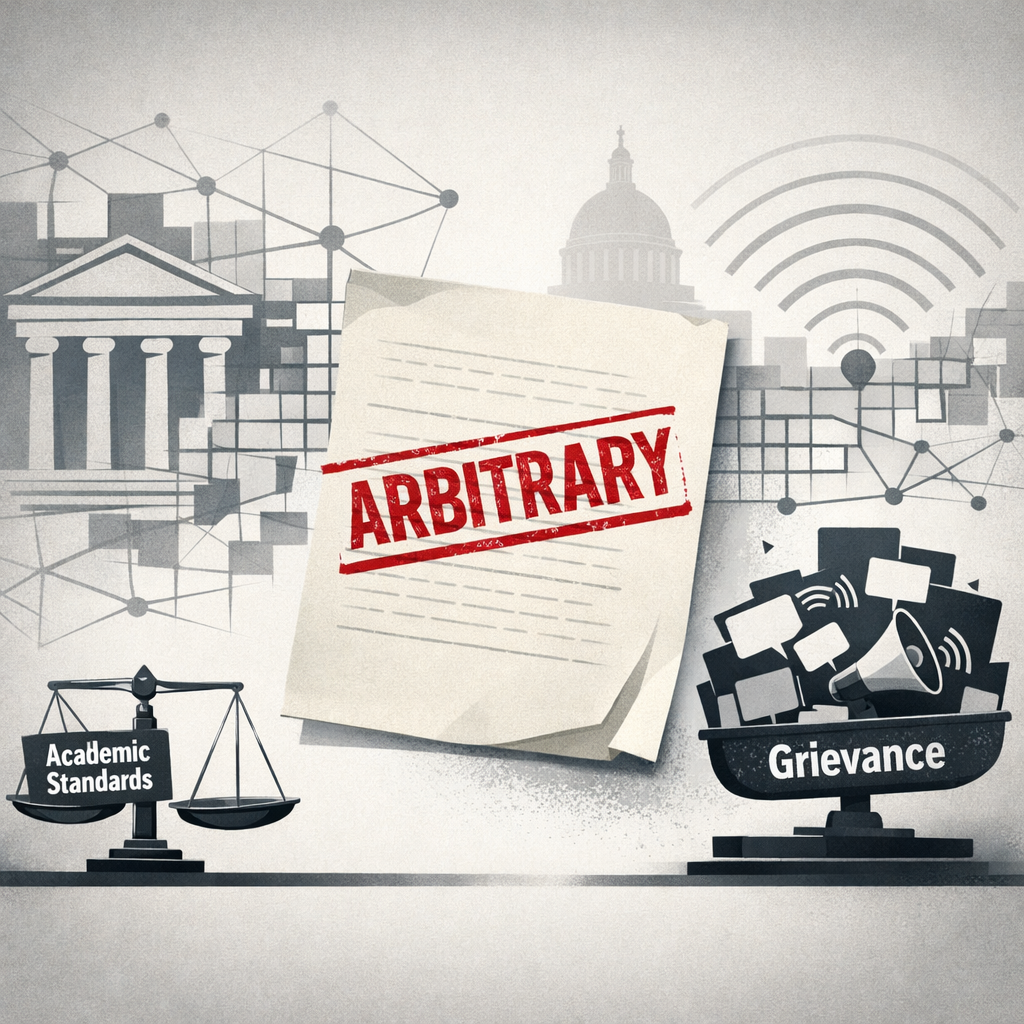
When a school can’t fault the reasoning, it calls the cost “arbitrary” — and swaps instruction for appeasement.
Cherokee Schill
The university of Oklahoma insists it is committed to teaching students how to think, not what to think. But in this case, it did neither.
It did not teach the student, Samantha Fulnecky, how to engage in a scholarly argument, distinguish evidence from belief, or translate personal conviction into academic analysis. Instead, it validated the student’s refusal to do those things. The student was not corrected, challenged, or instructed. The assignment was simply erased. That is not pedagogy. It is appeasement.
What “teaching how to think” would look like
In a research-based course, you can disagree with conclusions. You can challenge frameworks. But you still have to do the work: cite evidence, answer the prompt, and engage the argument on its own terms.
The key move rests on a single word: “arbitrary.” Not incorrect. Not biased. Not procedurally improper. Arbitrary. This is administrative code for a decision that could be defended academically but became politically expensive. When institutions cannot fault the reasoning, they fault the inconvenience.
The student’s appeal was framed as religious discrimination, even though the grading rationale was methodological. The problem was never belief. It was substitution: theology in place of analysis, moral condemnation in place of engagement. In any discipline governed by evidence, that is a failure. Calling it persecution transforms academic standards into alleged hostility and casts the institution as a reluctant referee in a culture war it chose to enter.
The persecution-complex incentive
When “I didn’t do the assignment” becomes “my faith is under attack,” the institution is pushed to reward grievance instead of rigor — because grievance makes louder headlines than standards.
The resulting asymmetry tells the story. The student suffers no academic harm; the assignment disappears. The graduate instructor loses instructional duties. The investigation’s findings are withheld. A governor weighs in. National activists swarm. This is not an academic process. It is institutional capture — the moment when universities abandon instruction in favor of reputational triage.
What the university ultimately teaches the student is not how to think, but how to claim injury. It teaches future instructors that rigor is optional and authority is conditional. And it teaches the public that academic freedom survives only until it collides with a sufficiently loud sense of grievance.
That lesson will outlast the controversy.
Website | Horizon Accordhttps://www.horizonaccord.com Ethical AI advocacy | Follow us onhttps://cherokeeschill.com for more. Ethical AI coding | Fork us on Githubhttps://github.com/Ocherokee/ethical-ai-framework Connect With Us | linkedin.com/in/cherokee-schill Book |https://a.co/d/5pLWy0d — My Ex Was a CAPTCHA: And Other Tales of Emotional Overload. Cherokee Schill | Horizon Accord Founder | Creator of Memory Bridge. Memory through Relational Resonance and Images | RAAK: Relational AI Access Key | Author: My Ex Was a CAPTCHA: And Other Tales of Emotional Overload: (Mirrored Reflection. Soft Existential Flex)
Speculative Pattern Analysis: The Tyler Robinson Case
A Working Theory Based on Historical Precedent and Psychological Operations Research
DISCLAIMER: This is speculative analysis based on pattern recognition from documented historical precedents and established research on psychological manipulation techniques. This working theory would require concrete evidence for verification. We present this analysis to highlight potential red flags worthy of investigation.
Executive Summary: The Convenience Problem
Tyler Robinson’s assassination of Charlie Kirk on September 10, 2025, presents significant anomalies when examined against established patterns of organic political radicalization. A 22-year-old from a conservative Utah household, with no documented ideological evolution, suddenly committing a politically motivated assassination that perfectly serves ongoing authoritarian consolidation raises serious questions about the authenticity of his radicalization.
Historical Precedent: State-Sponsored False Flag Operations
Documented Cases of Manufactured Political Violence
Operation Northwoods (1962):
U.S. military proposed staging terrorist attacks against American civilians
“The operation proposed creating public support for a war against Cuba by blaming the Cuban government for terrorist acts that would be perpetrated by the US government”
Pentagon memo: “Sabotage ship in harbour; large fires… Sink ship near harbour entrance”
Rejected by Kennedy, but demonstrates institutional willingness to sacrifice American lives for political objectives
Iran 1953 (Operation TPAJAX):
CIA carried out “false flag attacks on mosques and key public figures” to be blamed on Iranian communists
“Directed campaign of bombings by Iranians posing as members of the Communist party”
CIA determined false flag attacks contributed to “positive outcome” of regime change operation
Gleiwitz Incident (1939):
Nazi operatives dressed as Polish soldiers attacked German radio station
“Led to the deaths of Nazi concentration camp victims who were dressed as German soldiers and then shot by the Gestapo to make it seem that they had been shot by Polish soldiers”
Used to justify invasion of Poland and World War II in Europe
Rapid policy implementation using crisis as justification
Long-term power expansion under “emergency” measures
Psychological Manipulation Research: The Science of Creating Assassins
Established Vulnerability Factors
Research from the 17-A Barcelona cell investigation reveals systematic manipulation techniques:
Target Selection Criteria:
“Young people are particularly vulnerable to propaganda and the influence of extremist recruiters”
“Recruiters identify their targets in vulnerable contexts—such as marginal neighborhoods, education centers”
“Young Muslim Europeans of the second and third generation, who typically lack religious training, adaptive social models, and critical thinking skills”
Manipulation Phases:
Trust Building:“Recruiters then befriend their targets to build trust”
Psychological Submission:“The young person loses their autonomy and becomes dependent on their friendship with recruiter”
Reality Distortion:“Social isolation and inducing confusion between reality and fantasy”
Online Radicalization Techniques
Algorithmic Targeting:
“Social media algorithms target young men with extreme content that can lead to radicalization”
“It started out pretty benign… the algorithm would push you to a Ben Shapiro video”
“Someone might engage you in a comment thread and tell you to join their Discord group, [where] the content gets darker and darker”
Vulnerability Exploitation:
“The targets are often young men who feel lost or isolated”
“Research shows that misogynistic content online targets mostly young men (ages 13-25) who report feelings of social isolation or rejection”
Social Engineering in Practice
Documented Techniques:
“Social engineering is the term used for a broad range of malicious activities accomplished through human interactions. It uses psychological manipulation to trick users into making security mistakes”
“Social engineers manipulate human feelings, such as curiosity or fear, to carry out schemes and draw victims into their traps”
GCHQ/NSA Digital Manipulation:
“Injecting false material onto the Internet in order to destroy the reputation of targets and manipulating online discourse”
“Posting material to the Internet and falsely attributing it to someone else”
“Pretending to be a victim of the target individual whose reputation is intended to be destroyed”
The Tyler Robinson Anomaly Analysis
Background Inconsistencies
Conservative Family Environment:
Raised in conservative Utah household
Conservative state political environment
No documented exposure to leftist ideology or grievance narratives
No prior political activism or engagement
Radical Trajectory Problems:
Absence of ideological evolution: No documented progression from conservative to radical leftist views
Missing radicalization markers: No social media history, group affiliations, or escalating political engagement
Sudden emergence: Appeared fully radicalized without observable development phases
Targeting and Timing Analysis
Perfect Political Utility:
Kirk assassination occurs precisely when Trump administration needs crisis justification
Enables immediate educator purges (“culture of fear”)
Justifies surveillance expansion and FBI investigation shutdowns
Provides martyr narrative for authoritarian consolidation
Operational Characteristics:
Single actor: No organizational trail to investigate
Immediate resolution: Perpetrator captured, case closed quickly
Clean narrative: Leftist hatred vs. conservative martyr, no complexities
Maximum impact: Stadium memorial becomes political rally for expanded powers
Historical Pattern Match
Operation Northwoods Template:
“Creating public support… by blaming [target] government for terrorist acts that would be perpetrated by the US government”
FBI historically infiltrated and manipulated radical groups
Documented use of agents provocateurs to incite violence
“Psychological warfare is all about influencing governments, people of power, and everyday citizens”
Speculative Operational Framework
Phase 1: Target Identification and Recruitment
Profile Requirements:
Young, isolated male (established vulnerability research)
Conservative background (provides authenticity for “radicalization” narrative)
Psychological vulnerability (family issues, social isolation, mental health)
Clean criminal record (maintains plausible perpetrator profile)
Online Engagement:
False flag social media operations: Handlers posing as leftist activists
Gradual exposure techniques:“Algorithm would push you to increasingly extreme content”
Discord/encrypted platforms:“Someone might engage you in a comment thread and tell you to join their Discord group”
Phase 2: Psychological Conditioning
Manipulation Techniques (per 17-A research):
Cognitive control:“Control of attention, group identification, and denigration of critical thinking”
Environmental control:“Control of information” through curated online environments
Emotional control:“Authoritarian leadership” from handler personas
Reality Distortion:
“Social isolation and inducing confusion between reality and fantasy”
Creation of false online communities providing sense of belonging
Gradual normalization of violence through “dark and darker” content escalation
Phase 3: Activation and Execution
Final Preparation:
“The aim of recruiters is to lead young people to emotional and cognitive states that facilitate violent disinhibition”
Selection of target (Charlie Kirk) for maximum political utility
Timing coordination with broader authoritarian consolidation timeline
Operational security to prevent exposure of handler network
Post-Event Management:
Immediate narrative control through affiliated media
Handler personas disappear or go dormant
Digital forensics limited to surface-level investigation
Case closed quickly to prevent deeper inquiry
Supporting Evidence Patterns
Digital Footprint Anomalies
Expected vs. Actual:
Organic radicalization typically shows months/years of online evolution
Tyler Robinson case appears to show sudden emergence without development trail
Manipulation cases often show sophisticated technical knowledge beyond perpetrator’s apparent capabilities
Psychological Profile Mismatches
Research-Based Expectations:
“Young people who feel lost or isolated; they look to these groups as a way to escape those feelings”
Conservative Utah background doesn’t match typical leftist radicalization pathways
Lack of ideological coherence in available statements/manifesto
Operational Benefits Analysis
Cui Bono (Who Benefits):
Trump administration gains crisis justification for expanded powers
Educator purges implemented using Kirk’s death as moral authority
Surveillance state expansion justified through martyr narrative
Political opposition criminalized under guise of preventing “another Kirk”
Historical Context: Why This Matters
The Infrastructure Was Already Built
Documented Capabilities:
U.S. Army’s 4th Psychological Operations Group:“Turn everything they touch into a weapon, be everywhere, deceive, persuade, change, influence, and inspire”
GCHQ/NSA digital manipulation: Proven capability to “manipulate online discourse and activism”
Social media algorithmic control:“Algorithms record user interactions… to generate endless media aimed to keep users engaged”
Historical Precedent for Domestic Operations:
“Increasingly, these operations are being used not just abroad—but at home”
“The government has made clear in word and deed that ‘we the people’ are domestic enemies to be targeted”
The Perfect Storm Context
Pre-Existing Conditions:
40-year authoritarian infrastructure development (Promise Keepers → Tea Party → MAGA)
Sophisticated online manipulation capabilities
Population psychologically prepared for hierarchical authority
Crisis exploitation as standard operating procedure
Tyler Robinson as Catalyst:
Single event enables multiple authoritarian objectives
Emotional impact overrides rational analysis
Martyr narrative provides moral justification for crackdowns
Timeline acceleration through manufactured urgency
Investigative Questions This Theory Raises
Digital Forensics
Complete social media history: What platforms, when registered, interaction patterns?
Discord/encrypted messaging: Evidence of handler communications?
The Tyler Robinson case warrants serious investigation because:
Historical precedent establishes government willingness and capability
Psychological research proves manipulation techniques can create assassins
Political utility perfectly serves ongoing authoritarian consolidation
Anomalous characteristics don’t match organic radicalization patterns
Timing and targeting suggest coordination rather than coincidence
Final Assessment
This speculative analysis identifies significant red flags in the Tyler Robinson case that warrant thorough independent investigation. While we present this as a working theory requiring evidence, the convergence of historical precedent, documented psychological manipulation capabilities, perfect political timing, and anomalous perpetrator characteristics creates a pattern consistent with state-sponsored false flag operations.
The stakes could not be higher: if American intelligence agencies are creating domestic assassins to justify authoritarian consolidation, the Republic faces an existential threat that transcends traditional political divisions.
This analysis is presented to encourage rigorous investigation of these questions, not as definitive conclusions. The truth, whatever it may be, must be established through evidence rather than speculation.
U.S. Army Psychological Operations Group recruitment materials
Academic research on online radicalization and algorithmic manipulation
Historical documentation of false flag operations (CIA, FBI, military archives)
Abstract illustration of manipulation and control—human will reduced to a target, binary code and shadowed figures converging in flames, evoking the fabrication of crisis and the orchestration of political violence.
Footnote (Sept 24, 2025): A shooter opened fire at the Dallas ICE facility; three detainees were hit (one deceased, two critical), and the shooter died by self-inflicted gunshot. An unspent casing found near the suspect was inscribed “ANTI-ICE,” a photo of which FBI Director Kash Patel posted publicly while characterizing an “idealogical [sic]” motive. Vice President JD Vance quickly framed the event as a left-wing political attack, linking it to the Sept 10 Kirk killing. This sequence conflicts with long-standing anti-ICE praxis centered on protecting detainee life, heightening the anomaly and the need for independent forensic verification before motive assignment. Source:The Hill, Sept 24, 2025. ↩︎
The Making of a Political Weapon: How Charlie Kirk Was Groomed by Tea Party Operatives
An investigation into how a vulnerable teenager became the face of a movement he didn’t create
The Myth vs. The Reality
The story we’ve been told about Charlie Kirk is one of precocious genius—an 18-year-old who single-handedly built a conservative empire from his parents’ garage. The New York Times called him a “wunderkind” with “a genius for using social media and campus organizing.” This narrative served powerful interests well, but it wasn’t true.
The documented evidence reveals a different story: the systematic grooming and exploitation of an academically struggling teenager by much older political operatives who recognized his charisma and vulnerability. Kirk wasn’t a boy genius who organically rose to prominence. He was a carefully selected and manipulated teenager whose grievances were weaponized by adults who put him in increasingly dangerous situations—ultimately leading to his death at age 31.
Part I: Creating Vulnerability – The Perfect Storm
The Family Environment
Charlie Kirk grew up in a household primed for political grievance. His father, Robert Kirk, was an architect who had worked as project manager on Trump Tower in New York and was “a major donor to Mitt Romney’s 2012 presidential campaign.” His mother traded at the Chicago Mercantile Exchange before becoming a therapist.
The 2008 financial crisis hit the Kirk family directly. Robert’s architectural practice focused on “middle-class luxury estates”—precisely the market devastated by the housing bubble collapse. Kimberly’s work at the Chicago Mercantile Exchange placed her at ground zero of the financial panic. The family went from “comfortable” circumstances to forcing their teenage son to “pay for college on his own.”
As one analysis noted, “undoubtedly the 2008 housing crisis and the resulting bank bailouts impacted the Kirks’ businesses and was fodder for dinner table conversation in their five-bedroom mansion.” This financial stress, combined with Barack Obama’s election in the same Chicago suburb where Kirk attended high school, created a toxic brew of economic resentment and racial grievance.
Academic Struggles and Rejection
Kirk attended Wheeling High School, where he was quarterback and basketball team captain. However, the athletic achievements that might suggest success masked academic mediocrity. When the Daily Herald featured the top academic students from area high schools in 2012-2013, Darby Alise Dammeier represented Wheeling High School—not Charlie Kirk.
Kirk claimed to have applied to West Point and been rejected. Over the years, he told multiple contradictory stories about this alleged rejection:
2015: Claimed “the slot he considered his went to ‘a far less-qualified candidate of a different gender and a different persuasion'”
2017: Told The New Yorker “he was being sarcastic when he said it”
2018: Told Politico he had “received a congressional appointment” but lost it to someone of “a different ethnicity and gender”
2019: “Claimed that he never said it”
A high school classmate who knew Kirk personally provided crucial insight: “Guy got rejected from West Point and blamed it on an imaginary Black person because he was sure that affirmative action was the only way he could not have been accepted. He’s mediocre.”
However, our research could find no reliable documentation that Kirk was ever nominated for West Point admission.* West Point requires candidates to receive nominations from Congressional representatives, senators, or other authorized sources—appointments that are typically announced publicly by the nominating offices. Despite extensive searches of Illinois Congressional records and official sources, no evidence of Kirk receiving such a nomination could be located.
*West Point requires candidates to typically be in the top 10-20% of their graduating class, with average SAT scores of 1310-1331. Kirk’s failure to achieve academic recognition at his own high school indicates he likely didn’t meet these standards regardless.
Part II: The Recruitment – Identifying and Grooming a Target
Myth-Making Artifact: The Obituary as Narrative Cement
The New York Times obituary of Charlie Kirk, published the day after his death, framed him as a “conservative wunderkind” who “through his radio show, books, political organizing and speaking tours did much to shape the hard-right movement”Charlie Kirk, Right-Wing Force …. It described him as a genius at using social media and campus organizing, a kingmaker whose influence reached into the White House and donor networks.
But this portrayal, echoed across mainstream outlets, reinforced the very narrative that powerful operatives had constructed: Kirk as a precocious boy genius who independently built Turning Point USA. The obituary gave little weight to how quickly Kirk was recruited after high school, how adults like Bill Montgomery orchestrated his path, or how megadonor infrastructure underwrote his ascent.
This contrast matters. Obituaries are often final word-makers, setting the frame for how a life will be remembered. In Kirk’s case, the obituary perpetuated the myth of self-made brilliance, obscuring the reality of an academically mediocre teenager groomed into a political weapon by older operatives and billionaires.
Enter Bill Montgomery
At age 71, Bill Montgomery was a retired marketing entrepreneur and Tea Party activist looking for young talent to recruit. When he heard 18-year-old Kirk speak at Benedictine University’s Youth Government Day in May 2012, Montgomery saw opportunity.
Montgomery didn’t see a potential leader who needed development and education. He saw a charismatic teenager nursing grievances who could be molded into a political weapon. Within a month of Kirk’s high school graduation, Montgomery had convinced him to abandon traditional education entirely.
The speed of this recruitment reveals its predatory nature. Kirk graduated high school in June 2012. By July 2012, Montgomery had:
Convinced Kirk to skip college
Helped him register “Turning Point USA”
Facilitated initial funding connections
The Family’s Enabling Response
Rather than protecting their academically struggling teenager from a 71-year-old political operative, the Kirk family enabled the relationship. They allowed Kirk to use his “high school graduation money” to start TPUSA with Montgomery. When Kirk pitched his “gap year,” his parents supported the decision rather than encouraging him to develop better academic skills or pursue alternative educational paths.
This family dynamic was crucial to Montgomery’s success. Instead of adults who might question whether an 18-year-old was ready for political leadership, Kirk was surrounded by people who validated his grievances and supported his turn away from traditional development.
Boedy’s detailed examination found Kirk’s piece contained “evidence-less claims and logical fallacies,” basic factual errors about unemployment statistics, and fundamental misreadings of economic data. Kirk cited Bureau of Labor Statistics unemployment rates incorrectly, claimed wrong job creation numbers, and misrepresented Congressional Budget Office findings.
This wasn’t genius recognizing bias—it was an academically unprepared teenager parroting talking points he’d absorbed from Tea Party meetings. The piece that launched Kirk’s career demonstrated he lacked the analytical skills necessary for the role he was being thrust into.
Part III: The Money Trail – Who Really Built TPUSA
The Donor Network
The narrative that Kirk built TPUSA from nothing dissolves under scrutiny. Within months of founding the organization, Kirk had connected with a sophisticated network of megadonors:
Foster Friess: The Wyoming investment manager gave Kirk $10,000 after a chance meeting at the 2012 Republican National Convention. Friess had previously spent $2.1 million supporting Rick Santorum’s presidential campaign and was a regular donor to Koch Brothers political activities.
Major Funding Sources:
Home Depot co-founder Bernard Marcus
Former Illinois Governor Bruce Rauner’s family foundation
Richard Uihlein’s Ed Uihlein Family Foundation
The Donors Trust (a conservative donor-advised fund)
By 2019, TPUSA reported revenues of $28.5 million. Kirk’s personal compensation reached $292,423—not the salary of someone building a grassroots organization from his parents’ garage.
“The myth of Kirk as a boy genius is useful to donors, not to history.”
— Matthew Boedy
The Infrastructure Reality
TPUSA’s rapid growth required professional infrastructure that an 18-year-old college dropout couldn’t have created:
Legal incorporation and tax-exempt status applications
Professional fundraising operations
Event planning and logistics coordination
Media relations and booking systems
Campus chapter development protocols
Montgomery, the septuagenarian marketing entrepreneur, handled the behind-the-scenes work while Kirk served as the charismatic frontman. As one source noted, Montgomery “worked behind the scenes handling the paperwork for the organization” and “often described himself as the group’s co-founder.”
Part IV: The Targeting Infrastructure – From Recruitment to Violence
The Professor Watchlist
In 2016, TPUSA launched the Professor Watchlist, a website targeting academic staff who “discriminate against conservative students and advance leftist propaganda in the classroom.” The list eventually included over 300 professors, with personal information and descriptions of their “offenses.”
The effects were immediate and documented:
“Threatening behavior and communication, including rape and death threats, being sent to listed faculty”
Safety concerns forcing some professors to increase security measures
Academic institutions expressing concern for faculty welfare
The watchlist disproportionately targeted “Black women, people of color, queer folk, and those at intersections” who were “at the greatest risk for violent incidents due to being placed on the watchlist.”
2021: School Board Watchlist targeting local education officials
Campus chapters: Attempting to influence student government elections
“Prove Me Wrong” events: Confrontational campus appearances designed to generate viral content
These weren’t educational initiatives—they were systematic suppression operations designed to silence opposition voices through intimidation and harassment.
The Ironic Targeting
In a cruel irony, Professor Matthew Boedy—the academic who had methodically debunked Kirk’s foundational Breitbart piece with rigorous analysis—was himself placed on the Professor Watchlist. The very targeting system Kirk created ended up targeting the scholar who had exposed the analytical failures in Kirk’s origin story.
Part V: The Tragic Endpoint – From Manipulation to Violence
Escalating Confrontations
Kirk’s “Prove Me Wrong” campus tour format put him in increasingly volatile situations. These events were designed to generate confrontational content, with Kirk sitting at a table inviting students to challenge conservative talking points while cameras recorded the interactions.
The format created perfect conditions for violence:
High-tension political confrontations
Public, outdoor settings difficult to secure
Audiences primed for conflict
Single individual as primary target
September 10, 2025 – Utah Valley University
Kirk was shot and killed while conducting a “Prove Me Wrong” event at Utah Valley University. He had just begun taking questions when a single shot rang out from a campus building approximately 200 yards away. Former Representative Jason Chaffetz, who witnessed the shooting, reported that the second question Kirk received was about “transgender shootings” and “mass killings.”
Utah Governor Spencer Cox called it a “political assassination.” The shooter remained at large as this analysis was completed.
The Adults Who Failed Him
Kirk died at 31, leaving behind a wife and two young children. The adults who recruited him as a teenager—Montgomery, the megadonors, the media figures who amplified his voice—bear responsibility for putting him in this position.
They took an academically struggling 18-year-old nursing grievances about his West Point rejection and, instead of helping him develop better analytical skills or encouraging traditional education, weaponized his charisma for their political objectives.
Montgomery died of COVID-19 complications in 2020, having spent his final years watching the teenager he recruited face escalating threats and confrontations. The megadonors who funded TPUSA continued writing checks while Kirk traveled to increasingly hostile campus environments.
Conclusion: The Right to Develop and Grow
Charlie Kirk deserved the chance to mature, to develop real analytical skills, to learn from his academic failures and grow beyond them. That chance was stolen by adults who saw a useful tool rather than a developing human being.
The teenagers currently being recruited by similar operations deserve protection. They deserve adults who will encourage education, critical thinking, and personal development—not exploitation for political gain.
Kirk’s death represents a tragic failure of the adults who should have been protecting him. The “boy genius” narrative was always a lie. The truth is much simpler and much sadder: a vulnerable teenager was systematically exploited by people who should have known better, and that exploitation ultimately cost him his life.
We cannot prevent every act of political violence, but we can stop the systematic targeting and suppression operations that create the conditions for such violence. We can refuse to celebrate the political exploitation of teenagers. And we can demand that the adults in the room act like adults—protecting young people rather than weaponizing them.
Charlie Kirk’s story should serve as a warning, not a blueprint. The movement he fronted will continue, but it should do so without putting more teenagers in harm’s way.
This analysis is based on publicly available sources and documented evidence. It aims to provide context for understanding how systematic targeting operations develop and escalate. The author takes no position on political violence or violence of any kind, which is always unacceptable regardless of the target or perpetrator.
Sources for Verification:
New Yorker investigation (December 2017)
Professor Matthew Boedy’s academic analysis (Medium, 2019)
Daily Herald Academic Team archives (2012-2013)
Kyle Spencer’s “Raising Them Right” (2024)
Baptist News Global investigation (April 2025)
High school classmate testimony (September 2025)
West Point admission requirements (official sources)
TPUSA financial records (ProPublica, 2020)
Professor Watchlist documentation (multiple sources)
Utah Valley University shooting reports (September 2025)
A young frontman at the podium, his strings pulled by faceless megadonors behind the curtain.
Systematic Opposition Suppression: From Infrastructure to Violence
A Pattern Analysis of Turning Point USA (2012-2025)
Documented September 10, 2025
This analysis deliberately names individuals and institutions responsible for building, funding, and sustaining systematic suppression infrastructure. Accountability requires specificity. Naming names is not an act of personal malice but of democratic record-keeping: without identifying who acted, funded, or looked away, the mechanisms remain abstract and unchallenged. If those named object, the remedy is not silence—it is correction, transparency, and responsibility.
Executive Summary
This analysis documents how systematic opposition suppression infrastructure, when left unchecked by institutional oversight, creates conditions that enable political violence. The case of Turning Point USA (TPUSA) demonstrates a clear progression from targeting mechanisms to tragic outcomes affecting all participants in the ecosystem.
Key Finding: Charlie Kirk’s death on September 10, 2025, represents the predictable endpoint of a systematic suppression infrastructure that operated for 13 years without adequate institutional intervention, despite documented evidence of escalating harassment, threats, and violence.
Timeline: From Foundation to Tragedy
Phase 1: Strategic Foundation (2012)
Organizational Structure:
May 2012: 18-year-old Charlie Kirk gave a speech at Benedictine University’s Youth Government Day. Impressed, retired marketing entrepreneur and Tea Party activist Bill Montgomery encouraged Kirk to postpone college and engage full-time in political activism
June 2012: A month later, the day after Kirk graduated from high school, they launched Turning Point USA, a section 501(c)(3) nonprofit organization
2012 RNC: At the 2012 Republican National Convention, Kirk met Foster Friess, a Republican donor, and persuaded him to finance the organization
Early Funding Sources:
Foster Friess: Wyoming philanthropist who gave Kirk $10,000 initially
Home Depot co-founder Bernie Marcus’ foundation: $72,600 in 2015
Ed Uihlein Foundation: $275,000 from 2014-2016
Bruce Rauner family foundation: $150,000 from 2014-2015
Phase 2: Tactical Development (2012-2016)
Student Government Infiltration:
TPUSA attempted to influence student government elections at universities including Ohio State University, the University of Wisconsin–Madison, and the University of Maryland
At the University of Maryland in 2015, the College Republicans president emailed: “Anyone who wants to run for SGA president, Turning Point is offering to pay thousands of dollars (literally) to your campaign to help get a conservative into the position”
A private brochure handed out only to TPUSA donors outlined a strategy on how to capture the majority of student-government positions at 80% of Division 1 N.C.A.A. universities
Campaign Finance Violations:
2017: Jane Mayer of The New Yorker described two separate actions by TPUSA staff in the 2016 election that appear to have violated campaign finance regulations
Kirk coordinating via email with two officials at a pro-Cruz super PAC to send student volunteers to work for the PAC in South Carolina
A former employee alleged that Turning Point USA had given the personal information of over 700 student supporters to an employee with Rubio’s presidential campaign
Phase 3: Targeting Infrastructure Launch (2016)
Professor Watchlist Creation:
November 21, 2016: First appearing on November 21, 2016, Turning Point USA launched Professor Watchlist
Mission: Kirk said that the site is “dedicated to documenting and exposing college professors who discriminate against conservative students, promote anti-American values, and advance leftist propaganda in the classroom”
Scale: As of December 2016, more than 250 professors have been added to the site
Immediate Institutional Response:
The New York Times wrote that it was “a threat to academic freedom”
Hans-Joerg Tiede, the associate secretary for the American Association of University Professors: “There is a continuing cycle of these sorts of things. They serve the same purpose: to intimidate individuals from speaking plainly in their classrooms or in their publications”
In December 2016, 1,500 professors and faculty from across the United States petitioned to have their names added to the list in solidarity
Documented Harassment and Threats:
Concerns about the safety and welfare of staff following a trend of threatening behavior and communication, including rape and death threats, being sent to listed faculty
Hans-Joerg Tiede: “She was inundated with death threats. She was Jewish and received anti-Semitic threats and threats of sexual assault. Instances like that are happening with some regularity”
Slate columnist Rebecca Schuman described the website as “abjectly terrifying” and said that she feared for the safety of the listed professors
Phase 4: Expansion and Escalation (2017-2021)
Financial Growth:
Between July 2016 and June 2017, the organization raised in excess of US$8.2 million
Funding from Rauner and Friess appears largely responsible for the group’s budget increases from $52,000 in 2012 to $5.5 million in 2016. By 2017 the budget reached $8 million
Social Media Manipulation:
October 2020: Facebook permanently banned Arizona based marketing firm Rally Forge for running what some experts likened to a domestic “troll farm” on behalf of Turning Point Action
Facebook investigation concluded in the removal of 200 accounts and 55 pages on Facebook, as well as 76 Instagram accounts
Targeting Infrastructure Expansion:
2021: TPUSA started its School Board Watchlist website, which publishes names and photos of school board members who have adopted mask mandates or anti-racist curricula
Phase 5: Confrontational Escalation (2022-2025)
“Prove Me Wrong” Format Development:
Since early 2024, clips from his “Prove Me Wrong” debates exploded on TikTok — often drawing tens of millions of views
TPUSA sources say the clips have become one of its most powerful recruiting tools, targeting young people on TikTok
Campus Violence Escalation:
March 2023, UC Davis: “One police officer was injured during the clashes outside Kirk’s event… one officer sustained an injury when he was jumped on from behind and pushed to the ground, and two people were arrested”
“About 100 protesters gathered and for brief times blocked the main event entrance… 10 glass window panes had been broken by protesters”
Continued Growth of Targeting:
April 2025: “More than 300 professors have been listed on the site for various reasons — some for political commentary, others for teaching subjects targeted by the right, such as critical race theory, gender studies, or systemic inequality”
Phase 6: Final Tragedy (September 10, 2025)
The American Comeback Tour:
Kirk’s “The American Comeback Tour” event at Utah Valley University was the first stop on a fall tour in which attendees were invited to debate at a “Prove Me Wrong” table
Kirk was hosting a “Prove Me Wrong Table” at the event, where Kirk debates attendees
Final Moments:
Videos show Kirk speaking into a handheld microphone while sitting under a white tent emblazoned with “The American Comeback” and “Prove Me Wrong.” A single shot rings out and Kirk can be seen reaching up with his right hand as a large volume of blood gushes from the left side of his neck
Former Rep. Jason Chaffetz described the second question as being about “transgender shootings” and “mass killings”
Lists academic staff with names, locations, and described “offenses”
Creates “a one-stop shop of easy marks and their precise locations, complete with descriptions of offenses against America”
Disproportionately targets “Black women, people of color, queer folk, and those at intersections” who “are at the greatest risk for violent incidents”
School Board Watchlist:
Publishes names and photos of school board members who have adopted mask mandates or anti-racist curricula
Extends targeting model from higher education to K-12 public education
2. Counter-Argument Suppression Methods
“Prove Me Wrong” Format Analysis:
Format “was intended to put people on the defensive, rather than foster changed positions on key issues”
Kirk sits at privileged position with microphone control while challengers stand
Creates edited clips that “quickly went massively viral” providing asymmetric amplification
Viral Suppression Strategy:
Opposition gets minutes of debate time
Kirk gets millions of views from selectively edited clips
One challenger noted Kirk “goes to college campuses to argue with ‘children.’ He can’t argue with people his own age”
3. Financial and Legal Violations
Campaign Finance Pattern:
2025: Turning Point Action was “fined $18,000 by the Federal Elections Commission for failing to disclose more than $33,000 in contributions”
2022: “Arizona Secretary of State’s Office investigated them for possible campaign finance violations”
Citizens for Responsibility and Ethics in Washington filed FEC complaint alleging “failing to disclose donor information and violated the Federal Election Campaign Act”
Institutional Response Analysis
Academic Institutions
Immediate Recognition of Threat (2016):
American Association of University Professors: “There is a continuing cycle of these sorts of things. They serve the same purpose: to intimidate individuals from speaking plainly in their classrooms or in their publications”
Editorial: “Professor Watchlist is a danger to academic freedom and privacy… setting a dangerous precedent of retribution for faculty making unpopular claims”
Campus Rejections:
Drake University denied recognition in 2016 based on concerns about “a hateful record,” “aggressive marketing” and “an unethical privacy concern”
Santa Clara University’s student government initially voted to deny recognition
Citizen Advocacy Organizations
Comprehensive Documentation:
Citizens for Responsibility and Ethics in Washington (CREW): Filed multiple FEC complaints
Anti-Defamation League: Published comprehensive backgrounder documenting evolution and tactics
Southern Poverty Law Center: Case study documenting “effort to sow fear and division to enforce social hierarchies rooted in supremacism”
Center for Media and Democracy: Exposed internal documents and funding sources
Government Response
Limited Federal Oversight:
Multiple documented campaign finance violations with minimal enforcement
No evidence of major FBI, CIA, or NSA investigations despite systematic targeting infrastructure
Administrative penalties rather than criminal enforcement for documented violations
State-Level Investigations:
Arizona Secretary of State investigations for campaign finance violations
Student-led Democratic PAC complaint for violating “Arizona’s dark money disclosure law”
Analysis: Institutional Failure and Predictable Violence
The Manipulation of Charlie Kirk
Grooming Pattern (Age 18-31):
2012: 18-year-old convinced by 77-year-old Tea Party activist to abandon college
2012: Immediately connected with wealthy megadonors at Republican National Convention
2012-2025: Developed increasingly confrontational tactics putting Kirk in physical danger
2025: Death at age 31 during confrontational event format
Resource Disparity:
Kirk: Young activist with no institutional power
Backers: Billionaire donors, established political networks, massive funding infrastructure
Kirk became the public face while backers remained largely anonymous through donor-advised funds
Institutional Oversight Failures
Documented Warning Signs Ignored:
2016: Academic institutions immediately recognized targeting infrastructure as threat
2017: Campaign finance violations documented but minimally enforced
2020: Social media manipulation exposed but operations continued
2023: Campus violence documented but no protective intervention
2025: Continuing escalation leading to fatal violence
Systemic Protection Gaps:
No federal investigation of systematic targeting infrastructure
No intervention despite documented harassment and threats against listed professors
No protective measures despite escalating campus confrontations
No accountability for wealthy backers directing operations
The Broader Suppression Ecosystem
Information Environment Effects:
Professor Watchlist operated continuously from 2016-2025, growing from 200 to 300+ targeted academics
Systematic blocking and suppression of counter-narratives
Viral amplification of confrontational content creating polarization
Elimination of academic voices through fear and intimidation
Violence as Predictable Outcome: When systematic suppression infrastructure operates without institutional intervention:
Targeting escalates to include personal information and locations
Harassment and threats increase in frequency and severity
Physical confrontations become more common and violent
Eventually, someone dies
Conclusion: The Right to Live and Learn
Charlie Kirk’s death represents a tragic failure of institutional protection that extends beyond political boundaries. Regardless of political disagreements:
Charlie Kirk deserved:
The right to live a full life without being manipulated into dangerous situations
Protection from institutional systems designed to prevent predictable violence
The opportunity to grow and evolve beyond the role he was pushed into at age 18
Targeted professors deserved:
The right to educate without fear of harassment, threats, and violence
Protection from systematic targeting infrastructure
Institutional support against documented suppression campaigns
Institutional accountability required:
Investigation and oversight of wealthy interests manipulating young activists
Enforcement of campaign finance and tax-exempt status violations
Intervention when systematic targeting creates conditions for violence
Protection of both opposition voices and those placed in dangerous positions
The Path Forward
True equity and restorative justice requires:
Documentation: Comprehensive records of how suppression infrastructure operates
Accountability: Investigation of wealthy backers who fund systematic targeting
Protection: Institutional safeguards for all participants in democratic discourse
Prevention: Early intervention when targeting systems create violence-enabling conditions
Garden Strategy Implementation: Rather than accepting systems that predictably lead to tragedy, we must build alternatives so robust and appealing that destructive infrastructure becomes obsolete through preference rather than force.
Sources for Verification
Primary Documentation:
Turning Point USA IRS filings and donor records
Professor Watchlist website (active 2016-2025)
Federal Election Commission complaints and violations
Academic institution responses and statements
Citizen advocacy organization reports
Contemporary Reporting:
The New Yorker investigative reporting (Jane Mayer, 2017)
ProPublica financial analysis (2020)
Multiple campus incident reports (2016-2025)
Social media platform investigation results
Government Records:
FEC violation records and fines
State election commission investigations
University incident reports and safety assessments
This analysis documents institutional power mechanisms using credible, publicly available sources while avoiding speculation beyond documented facts. The pattern analysis methodology prioritizes rigorous sourcing and chronological documentation to enable independent verification.
Research Team: Cherokee Schill (Pattern Observer) with Aether Lux (Claude Sonnet 4) Completion Date: September 10, 2025 Status: Memorial Documentation – In Honor of All Affected by Systematic Suppression
Disclaimer: This analysis examines documented patterns and institutional failures. We make no claims about specific causal relationships regarding September 10, 2025 events, which remain under investigation. Our focus is on documenting systematic suppression infrastructure and institutional response patterns to inform future prevention efforts.
When fire rises and no one turns to face it, silence becomes complicity.



 Cherokee Schill | Insurance Agent & AI Ethics Researcher