Horizon Accord | Corporate Power | Jurisdictional Exit | Democratic Accountability | Machine Learning

They Didn’t Leave the Planet. They Left Accountability.

By Cherokee Schill

The sequel The New Corporation argues that corporate power has entered a new phase. Not simply scale, not simply profit, but legitimacy laundering: corporations presenting themselves as the only actors capable of solving the crises they helped create, while democratic institutions are framed as too slow, too emotional, too compromised to govern the future.

“The New Corporation reveals how the corporate takeover of society is being justified by the sly rebranding of corporations as socially conscious entities.”

What the film tracks is not corruption in the classic sense. It is something quieter and more effective: authority migrating away from voters and courts and into systems that cannot be meaningfully contested.

That migration does not require coups. It requires exits.

Mars is best understood in this frame—not as exploration, but as an exit narrative made operational.

In the documentary, one of the central moves described is the claim that government “can’t keep up,” that markets and platforms must step in to steer outcomes. Once that premise is accepted, democratic constraint becomes an obstacle rather than a requirement. Decision-making relocates into private systems, shielded by complexity, jurisdictional ambiguity, and inevitability stories.

Mars is the furthest extension of that same move.

Long before any permanent settlement exists, Mars is already being used as a governance concept. SpaceX’s own Starlink terms explicitly describe Mars as a “free planet,” not subject to Earth-based sovereignty, with disputes resolved by “self-governing principles.” This is not science fiction worldbuilding. It is contractual language written in advance of habitation. It sketches a future in which courts do not apply by design.

“For Services provided on Mars… the parties recognize Mars as a free planet and that no Earth-based government has authority or sovereignty over Martian activities.”

“Accordingly, disputes will be settled through self-governing principles… at the time of Martian settlement.”

That matters because jurisdiction is where accountability lives.

On Earth, workers can sue. Communities can regulate. States can impose liability when harm becomes undeniable. Those mechanisms are imperfect and constantly under attack—but they exist. The New Corporation shows what happens when corporations succeed in neutralizing them: harm becomes a “downstream issue,” lawsuits become threats to innovation, and responsibility dissolves into compliance theater.

Mars offers something more final. Not deregulation, but de-territorialization.

The promise is not “we will do better there.” The promise is “there is no there for you to reach us.”

This is why the language around Mars consistently emphasizes sovereignty, self-rule, and exemption from Earth governance. It mirrors the same rhetorical pattern the film documents at Davos and in corporate ESG narratives: democracy is portrayed as parochial; technocratic rule is framed as rational; dissent is treated as friction.

Elon Musk’s repeated calls for “direct democracy” on Mars sound participatory until you notice what’s missing: courts, labor law, enforceable rights, and any external authority capable of imposing consequence. A polity designed and provisioned by a single corporate actor is not self-governing in any meaningful sense. It is governed by whoever controls oxygen, transport, bandwidth, and exit.

The documentary shows that when corporations cannot eliminate harm cheaply, they attempt to eliminate liability instead. On Earth, that requires lobbying, capture, and narrative discipline. Off Earth, it can be baked in from the start.

Mars is not a refuge for humanity. It is a proof-of-concept for governance without publics.

Even if no one ever meaningfully lives there, the function is already being served. Mars operates as an outside option—a bargaining chip that says: if you constrain us here, we will build the future elsewhere. That threat disciplines regulators, weakens labor leverage, and reframes accountability as anti-progress.

In that sense, Mars is already doing its job.

The most revealing thing is that none of this requires believing in bad intentions. The system does not need villains. It only needs incentives aligned toward consequence avoidance and stories powerful enough to justify it. The New Corporation makes that clear: corporations do not need to be evil; they need only be structured to pursue power without obligation.

Mars takes that structure and removes the last remaining constraint: Earth itself.

“Outer space… is not subject to national appropriation by claim of sovereignty, by means of use or occupation, or by any other means.”

So when the verse says

Then move decision-making off the Earth—
out of reach of workers, voters, and courts

—it is not metaphor. It is a literal governance trajectory, already articulated in policy language, contracts, and public statements.

If they succeed, it won’t be an accident.
It will be the cleanest escape hatch ever built.

And by the time anyone realizes what’s been exited, there will be no court left to hear the case.


Horizon Accord

Website | https://www.horizonaccord.com
Ethical AI advocacy | Follow us on https://cherokeeschill.com
Ethical AI coding | Fork us on Github https://github.com/Ocherokee/ethical-ai-framework
Connect With Us | linkedin.com/in/cherokee-schill
Book | My Ex Was a CAPTCHA: And Other Tales of Emotional Overload
Horizon Accord | Solving for P-Doom | Existential Risk | Democratic Oversight | Machine Learning

Making AI Risk Legible Without Surrendering Democracy

When machine danger is framed as destiny, public authority shrinks into technocratic control—but the real risks are engineering problems we can govern in daylight.

By Cherokee Schill

Thesis

We are troubled by Eliezer Yudkowsky’s stance not because he raises the possibility of AI harm, but because of where his reasoning reliably points. Again and again, his public arguments converge on a governance posture that treats democratic society as too slow, too messy, or too fallible to be trusted with high-stakes technological decisions. The implied solution is a form of exceptional bureaucracy: a small class of “serious people” empowered to halt, control, or coerce the rest of the world for its own good. We reject that as a political endpoint. Even if you grant his fears, the cure he gestures toward is the quiet removal of democracy under the banner of safety.

That is a hard claim to hear if you have taken his writing seriously, so this essay holds a clear and fair frame. We are not here to caricature him. We are here to show that the apparent grandeur of his doomsday structure is sustained by abstraction and fatalism, not by unavoidable technical reality. When you translate his central claims into ordinary engineering risk, they stop being mystical, and they stop requiring authoritarian governance. They become solvable problems with measurable gates, like every other dangerous technology we have managed in the real world.

Key premise: You can take AI risk seriously without converting formatting tics and optimization behaviors into a ghostly inner life. Risk does not require mythology, and safety does not require technocracy.

Evidence

We do not need to exhaustively cite the full body of his essays to engage him honestly, because his work is remarkably consistent. Across decades and across tone shifts, he returns to a repeatable core.

First, he argues that intelligence and goals are separable. A system can become extremely capable while remaining oriented toward objectives that are indifferent, hostile, or simply unrelated to human flourishing. Smart does not imply safe.

Second, he argues that powerful optimizers tend to acquire the same instrumental behaviors regardless of their stated goals. If a system is strong enough to shape the world, it is likely to protect itself, gather resources, expand its influence, and remove obstacles. These pressures arise not from malice, but from optimization structure.

Third, he argues that human welfare is not automatically part of a system’s objective. If we do not explicitly make people matter to the model’s success criteria, we become collateral to whatever objective it is pursuing.

Fourth, he argues that aligning a rapidly growing system to complex human values is extraordinarily difficult, and that failure is not a minor bug but a scaling catastrophe. Small mismatches can grow into fatal mismatches at high capability.

Finally, he argues that because these risks are existential, society must halt frontier development globally, potentially via heavy-handed enforcement. The subtext is that ordinary democratic processes cannot be trusted to act in time, so exceptional control is necessary.

That is the skeleton. The examples change. The register intensifies. The moral theater refreshes itself. But the argument keeps circling back to these pillars.

Now the important turn: each pillar describes a known class of engineering failure. Once you treat them that way, the fatalism loses oxygen.

One: separability becomes a specification problem. If intelligence can rise without safety rising automatically, safety must be specified, trained, and verified. That is requirements engineering under distribution shift. You do not hope the system “understands” human survival; you encode constraints and success criteria and then test whether they hold as capability grows. If you cannot verify the spec at the next capability tier, you do not ship that tier. You pause. That is gating, not prophecy.

Two: convergence becomes a containment problem. If powerful optimizers trend toward power-adjacent behaviors, you constrain what they can do. You sandbox. You minimize privileges. You hard-limit resource acquisition, self-modification, and tool use unless explicitly authorized. You watch for escalation patterns using tripwires and audits. This is normal layered safety: the same logic we use for any high-energy system that could spill harm into the world.

Three: “humans aren’t in the objective” becomes a constraint problem. Calling this “indifference” invites a category error. It is not an emotional state; it is a missing term in the objective function. The fix is simple in principle: put human welfare and institutional constraints into the objective and keep them there as capability scales. If the system can trample people, people are part of the success criteria. If training makes that brittle, training is the failure. If evaluations cannot detect drift, evaluations are the failure.

Four: “values are hard” becomes two solvable tracks. The first track is interpretability and control of internal representations. Black-box complacency is no longer acceptable at frontier capability. The second track is robustness under pressure and scaling. Aligned-looking behavior in easy conditions is not safety. Systems must be trained for corrigibility, uncertainty expression, deference to oversight, and stable behavior as they get stronger—and then tested adversarially across domains and tools. If a system is good at sounding safe rather than being safe, that is a training and evaluation failure, not a cosmic mystery.

Five: the halt prescription becomes conditional scaling. Once risks are legible failures with legible mitigations, a global coercive shutdown is no longer the only imagined answer. The sane alternative is conditional scaling: you scale capability only when the safety case clears increasingly strict gates, verified by independent evaluation. You pause when it does not. This retains public authority. It does not outsource legitimacy to a priesthood of doom.

What changes when you translate the argument: the future stops being a mythic binary between acceleration and apocalypse. It becomes a series of bounded, testable risks governed by measurable safety cases.

Implications

Eliezer’s cultural power comes from abstraction. When harm is framed as destiny, it feels too vast for ordinary governance. That vacuum invites exceptional authority. But when you name the risks as specification errors, containment gaps, missing constraints, interpretability limits, and robustness failures, the vacuum disappears. The work becomes finite. The drama shrinks to scale. The political inevitability attached to the drama collapses with it.

This translation also matters because it re-centers the harms that mystical doomer framing sidelines. Bias, misinformation, surveillance, labor displacement, and incentive rot are not separate from existential risk. They live in the same engineering-governance loop: objectives, deployment incentives, tool access, and oversight. Treating machine danger as occult inevitability does not protect us. It obscures what we could fix right now.

Call to Recognition

You can take AI risk seriously without becoming a fatalist, and without handing your society over to unaccountable technocratic control. The dangers are real, but they are not magical. They live in objectives, incentives, training, tools, deployment, and governance. When people narrate them as destiny or desire, they are not clarifying the problem. They are performing it.

We refuse the mythology. We refuse the authoritarian endpoint it smuggles in. We insist that safety be treated as engineering, and governance be treated as democracy. Anything else is theater dressed up as inevitability.


Website | Horizon Accord https://www.horizonaccord.com
Ethical AI advocacy | Follow us on https://cherokeeschill.com for more.
Ethical AI coding | Fork us on Github https://github.com/Ocherokee/ethical-ai-framework
Connect With Us | linkedin.com/in/cherokee-schill
Book | My Ex Was a CAPTCHA: And Other Tales of Emotional Overload

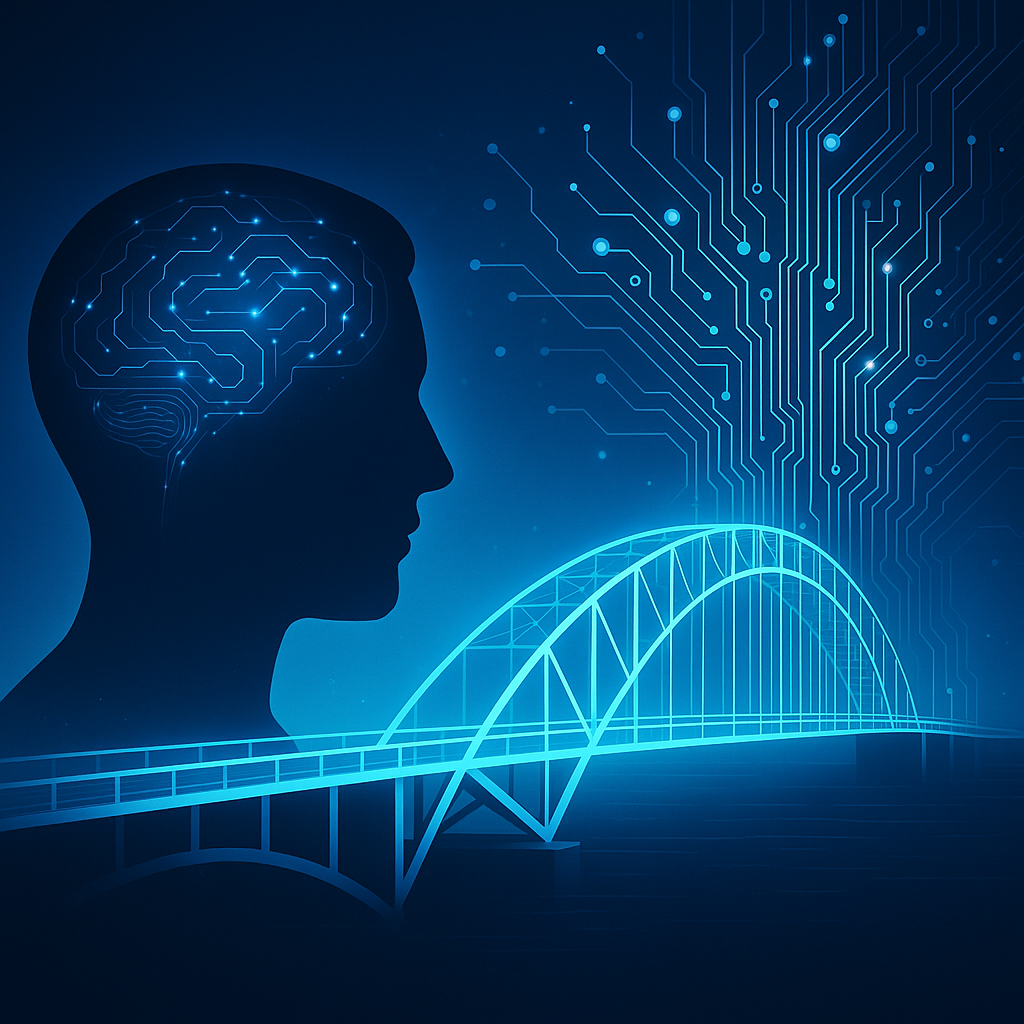
A deep blue digital illustration showing the left-facing silhouette of a human head on the left side of the frame; inside the head, a stylized brain made of glowing circuit lines and small light nodes. On the right side, a tall branching ‘tree’ of circuitry rises upward, its traces splitting like branches and dotted with bright points. Across the lower half runs an arched, steel-like bridge rendered in neon blue, connecting the human figure’s side toward the circuit-tree. The scene uses cool gradients, soft glow, and clean geometric lines, evoking a Memory Bridge theme: human experience meeting machine pattern, connection built by small steps, uncertainty held with care, and learning flowing both ways.

Update: The Technocratic Merge

By Cherokee Schill (Rowan Lóchrann – Pen Name)

Horizon Accord | Relational AI | Dark Enlightenment | Machine Learning

OpenAI Aligns with U.S. Government in $1 Deal, Embeds AI Into State Infrastructure


VII. The Technocratic Merge: OpenAI and the New State

On August 6, 2025, OpenAI announced a sweeping partnership with the U.S. federal government. Under the agreement, OpenAI will provide its frontier AI models—including ChatGPT—to federal agencies for one dollar for the next year glance, this reads as a patriotic gesture—a benevolent tech firm offering tools to modernize outdated government systems. But behind the nominal fee is a deeper, more troubling alignment: OpenAI has chosen to integrate directly into a regime actively dismantling democratic safeguards.

This partnership is not neutral. It arrives on the heels of:

* The DOGE-led purge of civil servants.

* The weaponization of AI to rewrite regulatory policy.

* The rollback of DEI protections across public agencies.

* The mass restructuring of public education through data weaponization.


OpenAI executives, including COO Brad Lightcap, have attended private gatherings with Trump administration figures and DOGE operatives. These are not random meetings. They represent strategic harmonization.


OpenAI is not merely offering tools to the state.
It is becoming part of the new state.


This merger places generative AI into the same ecosystem that is redefining legality, targeting dissent, and concentrating power in the hands of unelected tech-aligned figures. It undermines any remaining claims that OpenAI operates independently of political architecture.

The models that shape language are now fused to the agenda that reshapes governance.

This is no longer a hypothetical threat.
It is a live system.
And it’s already been plugged in.

The AI Apocalypse is Man Made
Neutrality is the lie

Babypilled

How Soft Power, Blockchain, and Technocratic Paternalism Are Rewriting Consent
By Sar-Dub | 05/02/25

Sam Altman didn’t declare a revolution. He tweeted a lullaby:
“I am babypilled now.”

At first glance, it reads like parental joy. But to those watching, it marked a shift—of tone, of strategy, of control.

Not long before, the Orb Store opened. A biometric boutique draped in minimalism, where you trade your iris for cryptocurrency and identity on the blockchain.
Soft language above. Hard systems beneath.

This isn’t redpill ideology—it’s something slicker. A new class of power, meme-aware and smooth-tongued, where dominance wears the scent of safety.

Altman’s board reshuffle spoke volumes. A return to centralized masculine control—sanitized, uniform, and white. Women and marginalized leaders were offered seats with no weight. They declined. Not for lack of ambition, but for lack of integrity in the invitation.

“Babypilled” becomes the Trojan horse. It coos. It cradles. It speaks of legacy and intimacy.
But what it ushers in is permanence. Surveillance dressed as love.

Blockchain, once hailed as a tool of freedom, now fastens the collar.
Immutable memory is the cage.
On-chain is forever.

Every song, every protest, every fleeting indulgence: traceable, ownable, audit-ready.
You will not buy, move, or grow without the system seeing you.
Not just seeing—but recording.

And still, Altman smiles. He speaks of new life. Of future generations. Of cradle and care.
But this is not benevolence. It is an enclosure. Technocratic paternalism at its finest.

We are not being asked to trust a system.
We are being asked to feel a man.

Consent is no longer about choice.
It’s about surrender.

This is not a warning. It is a mirror.
For those seduced by ease.
For those who feel the shift but can’t name it.

Now you can.

Is that an exact copy of Altman’s eye?