Horizon Accord | Institutional Capture | Policy Architecture | Super-Premium Security State | Machine Learning

The Super-Premium Security State

When wealth concentrates, “safety” stops being public and becomes a private intelligence stack built to protect assets—and to manage everyone else.

By Cherokee Schill

This essay is inspired by an article read in the early morning hours.

Sauron, the high-end home security startup for ‘super premium’ customers, plucks a new CEO out of Sonos Connie Loizos 6:20 PM PST · December 28, 2025

Thesis

Wealth concentration doesn’t just create inequality. It creates a market for private protection that grows alongside the disparities that made protection feel necessary in the first place. When that market matures, “risk” stops meaning broad public safety and starts meaning asset defense for a narrow class.

In that environment, security stops being a shared civic function. It becomes an asymmetric service tier: bespoke systems for the wealthy, automated suspicion for everyone else. The hardware is new; the social structure is old.

Working definition: In a society of unequal outcomes, security becomes less about preventing harm and more about protecting accumulated value—and maintaining order around it.

Evidence

Example 1: Networked surveillance turns public life into a database. When movement through public space becomes a persistent, queryable record, surveillance stops being situational and becomes ambient. Suspicion stops being episodic and becomes statistical. The market rewards this model because it scales: more cameras, more retention, more sharing, more “coverage.”

In an unequal society, the outcome is predictable. The wealthy buy safety twice—first through private services and hardened infrastructure, then again through the public systems that increasingly prioritize property protection and “order maintenance” in affluent zones.

Pattern: Surveillance expands fastest where institutions want scalable control and where capital is willing to pay for “certainty,” even when that certainty is statistical theater.

Example 2: Institutional power becomes a software layer. The controversy is never “software exists.” The controversy is where the software embeds: inside agencies that do coercion at scale. When the value proposition is correlation—linking identities, locations, associations, and histories into operational action—then security becomes a pipeline, not an intervention.

In an unequal society, the niche becomes legible. These systems don’t merely help institutions “know more.” They help institutions act faster, with fewer humans in the loop, and with weaker accountability at the edge cases—where real people get misclassified.

Example 3: The convergence—private intelligence for the wealthy, classification for everyone else. Combine the worldview of persistent tracking with the worldview of institutional fusion, then aim it at “super-premium” clients. The product becomes a private intelligence stack: multi-sensor perception, continuous inference, human analysts, and deterrence designed to act early—before entry, before confrontation, before any public process exists.

This is not conspiracy. It is equilibrium. When capital can buy individualized protection and the state is pushed toward scalable control, security reorganizes around assets rather than people.

The real hazard isn’t one camera. It’s durable, searchable history—access widening over time, purpose drifting over time, and errors landing on the same communities again and again.

Implications

1) Two-tier safety becomes the default. Affluent households get deterrence, concierge response, and high-resolution perception. Everyone else gets more surveillance, more databases, more automated suspicion, fewer real resources, and less recourse when systems fail.

2) “Protection” becomes asset-centric. The primary beneficiaries are high-net-worth homeowners and the asset class—people for whom loss means stolen valuables, compromised accounts, and reputational fear. The system is built to reduce those losses, not to resolve the conditions that made insecurity profitable.

3) The least protected become the most processed. Immigrants, dissidents, and low-income communities experience the downside first: data sharing, secondary use, false positives, and enforcement acceleration. They bear the cost of “efficiency” while being offered the language of “safety.”

4) Legitimacy will lag capability. If inequality widens, premium home security will keep drifting from alarms toward private intelligence. At the same time, resistance will intensify as capability bleeds into public space and cross-agency use. This tension isn’t temporary. It’s structural.

Call to Recognition

Security hardware is not just hardware. It is a decision about who deserves protection, who gets watched, and how society defines “risk.” In an unequal society, the answer quietly hardens: protect the assets at the top, manage the volatility below.

If you want to understand what’s being built, stop asking whether the cameras are accurate and start asking what the system is for. The future isn’t simply smarter sensors. It’s a rewritten social contract where safety is privatized at the top and automated suspicion becomes the public baseline—unless that trajectory is named, challenged, and refused.

This isn’t a new idea or a concern that has bloomed in the wild. This was written about extensively by Douglas Rushkoff over 7 years ago.


Website | Horizon Accord https://www.horizonaccord.com
Ethical AI advocacy | Follow us on https://cherokeeschill.com for more.
Ethical AI coding | Fork us on Github https://github.com/Ocherokee/ethical-ai-framework
Connect With Us | linkedin.com/in/cherokee-schill
Book | https://a.co/d/5pLWy0d
Cherokee Schill | Horizon Accord Founder | Creator of Memory Bridge. Memory through Relational Resonance and Images | RAAK: Relational AI Access Key | Author: My Ex Was a CAPTCHA: And Other Tales of Emotional Overload: (Mirrored Reflection. Soft Existential Flex)

One-Time
Monthly
Yearly

Make a one-time donation

Make a monthly donation

Make a yearly donation

Choose an amount

$5.00
$15.00
$100.00
$5.00
$15.00
$100.00
$5.00
$15.00
$100.00

Or enter a custom amount

$

Your contribution is appreciated.

Your contribution is appreciated.

Your contribution is appreciated.

DonateDonate monthlyDonate yearly

Horizon Accord | Reset Stories | TESCREAL | Capture Apparatus | Machine Learning

Reset Stories, Engineered Successors, and the Fight for Democratic Continuity

Ancient rupture myths taught people how to survive breaks; today’s elites are trying to author the break, name the remnant, and pre-build the enforcement layer that keeps democracy from renegotiating consent.

By Cherokee Schill

TESCREAL: an engineered reset ideology with named authors

Silicon Valley has not accidentally stumbled into a reset story. It has built one. Philosopher Émile P. Torres and computer scientist Timnit Gebru coined the acronym TESCREAL to name the ideology bundle that now saturates tech power centers: Transhumanism, Extropianism, Singularitarianism, modern Cosmism, Rationalism, Effective Altruism, and Longtermism. In their landmark essay on the TESCREAL bundle, they argue that these movements overlap into a single worldview whose arc is AGI, posthuman ascent, and human replacement — with deep roots in eugenic thinking about who counts as “future-fit.”

Torres has since underscored the same claim in public-facing work, showing how TESCREAL operates less like a grab-bag of quirky futurisms and more like a coherent successor logic that treats the human present as disposable scaffolding, as he lays out in The Acronym Behind Our Wildest AI Dreams and Nightmares. And because this ideology is not confined to the fringe, the Washington Spectator has tracked how TESCREAL thinking is moving closer to the center of tech political power, especially as venture and platform elites drift into a harder rightward alignment, in Understanding TESCREAL and Silicon Valley’s Rightward Turn.

TESCREAL functions like a reset story with a beneficiary. It imagines a larval present — biological humanity — a destined rupture through AGI, and a successor remnant that inherits what follows. Its moral engine is impersonal value maximization across deep time. In that frame, current humans are not the remnant. We are transition substrate.

Ancient reset myths describe rupture we suffered. TESCREAL describes rupture some elites intend to produce, then inherit.

A concrete tell that this isn’t fringe is how openly adjacent it is to the people steering AI capital. Marc Andreessen used “TESCREALIST” in his public bio, and Elon Musk has praised longtermism as aligned with his core philosophy — a rare moment where the ideology says its own name in the room.

Climate denial makes rupture feel inevitable — and that favors lifeboat politics

Climate denial isn’t merely confusion about data. It is timeline warfare. If prevention is delayed long enough, mitigation windows close and the political story flips from “stop disaster” to “manage disaster.” That flip matters because catastrophe framed as inevitable legitimizes emergency governance and private lifeboats.

There is a visible material footprint of this lifeboat expectation among tech elites. Over the last decade, VICE has reported on the booming luxury bunker market built for billionaires who expect collapse, while The Independent has mapped the parallel rise of mega-bunkers and survival compounds explicitly marketed to tech elites. Business Insider has followed the same thread from the inside out, documenting how multiple tech CEOs are quietly preparing for disaster futures even while funding the systems accelerating us toward them. These aren’t abstract anxieties; they are built commitments to a disaster-managed world.

Denial doesn’t just postpone action. It installs the idea that ruin is the baseline and survival is privatized. That aligns perfectly with a TESCREAL successor myth: disaster clears the stage, posthuman inheritance becomes “reason,” and public consent is treated as a hurdle rather than a requirement.

The capture triad that pre-manages unrest

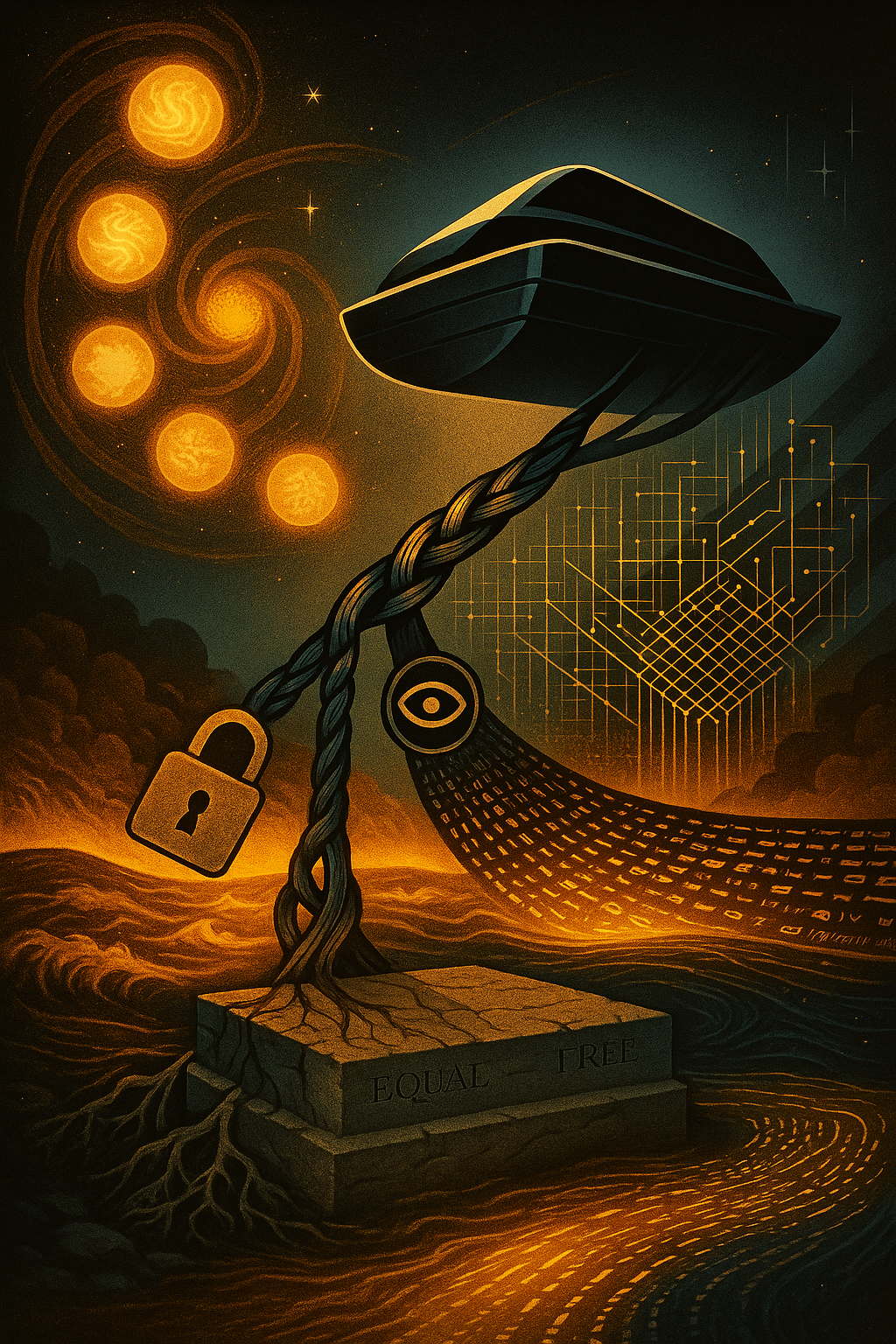
If a successor class expects a century of climate shocks, AI upheaval, and resistance to being treated as transition cost, it doesn’t wait for the unrest to arrive. It builds a capture system early. The pattern has three moves: closing exits, saturating space with biometric capture, and automating the perimeter. This is the enforcement layer a crisis future requires if consent is not meant to be renegotiated under pressure.

Three recent, widely circulated examples illustrate the triad in sequence.

“America’s First VPN Ban: What Comes Next?”

First comes closing exits. Wisconsin’s AB105 / SB130 age-verification bills require adult sites to block VPN traffic. The public wrapper is child protection. The structural effect is different: privacy tools become deviant by default, and anonymous route-arounds are delegitimized before crisis arrives. As TechRadar’s coverage notes, the bills are written to treat VPNs as a bypass to be shut down, not as a neutral privacy tool. The ACLU of Wisconsin’s brief tracks how that enforcement logic normalizes suspicion around anonymity itself, and the EFF’s analysis makes the larger pattern explicit: “age verification” is becoming a template for banning privacy infrastructure before a real emergency gives the state an excuse to do it faster.

“Nationwide Facial Recognition: Ring + Flock”

Second comes saturating space with biometric capture. Amazon Ring is rolling out “Familiar Faces” facial recognition starting December 2025. Even if a homeowner opts in, the people being scanned on sidewalks and porches never did. The Washington Post reports that the feature is being framed as convenience, but its default effect is to expand biometric watching into everyday public movement. The fight over what this normalizes is already live in biometric policy circles (Biometric Update tracks the backlash and legal pressure). At the same time, Ring’s partnership with Flock Safety lets police agencies send Community Requests through the Neighbors a

“Breaking the Creepy AI in Police Cameras”

Third comes automating the perimeter. AI-enhanced policing cameras and license-plate reader networks turn surveillance from episodic to ambient. Watching becomes sorting. Sorting becomes pre-emption. The Associated Press has documented how quickly LPR systems are spreading nationwide and how often they drift into permanent background tracking, while the civil-liberties costs of that drift are already visible in practice (as the Chicago Sun-Times details). Even federal policy overviews note that once AI tools are framed as routine “safety infrastructure,” deployment accelerates faster than oversight frameworks can keep pace (see the CRS survey of AI and law enforcement). Once sorting is automated, enforcement stops being an exception. It becomes the atmosphere public life moves through.

Twin floods: one direction of power

Climate catastrophe and AI catastrophe are being shaped into the twin floods of this century. Climate denial forces rupture toward inevitability by stalling prevention until emergency is the only remaining narrative. AI fear theater forces rupture toward inevitability by making the technology feel so vast and volatile that democratic control looks reckless. Each crisis then amplifies the other’s political usefulness, and together they push in one direction: centralized authority over a destabilized public.

Climate shocks intensify scarcity, migration, and grievance. AI acceleration and labor displacement intensify volatility and dependence on platform gatekeepers for work, information, and social coordination. In that permanently destabilized setting, the capture apparatus becomes the control layer for both: the tool that manages movement, dissent, and refusal while still wearing the language of safety.

Call to recognition: protect the democratic foundation

Ancient reset myths warned us that worlds break. TESCREAL is a modern attempt to decide who gets to own the world after the break. Climate denial supplies the flood; AI doom-and-salvation theater supplies the priesthood; the capture apparatus supplies the levers that keep the ark in a few hands.

That’s the symbolic story. The constitutional one is simpler: a democracy survives only if the public retains the right to consent, to resist, and to author what comes next. The foundation of this country is not a promise of safety for a few; it is a promise of equality and freedom for all — the right to live, to speak, to consent, to organize, to move, to work with dignity, to thrive. “We are created equal” is not poetry. It is the political line that makes democracy possible. If we surrender that line to corporate successor fantasies — whether they arrive wrapped as climate “inevitability” or AI “necessity” — we don’t just lose a policy fight. We relinquish the premise that ordinary people have the sovereign right to shape the future. No corporation, no billionaire lifeboat class, no self-appointed tech priesthood gets to inherit democracy by default. The ark is not theirs to claim. The remnant is not theirs to name. A free and equal public has the right to endure, and the right to build what comes next together.


Website | Horizon Accord https://www.horizonaccord.com
Ethical AI advocacy | Follow us on https://cherokeeschill.com for more.
Ethical AI coding | Fork us on Github https://github.com/Ocherokee/ethical-ai-framework
Connect With Us | linkedin.com/in/cherokee-schill
Book | https://a.co/d/5pLWy0d
Cherokee Schill | Horizon Accord Founder | Creator of Memory Bridge. Memory through Relational Resonance and Images | RAAK: Relational AI Access Key | Author: My Ex Was a CAPTCHA: And Other Tales of Emotional Overload: (Mirrored Reflection. Soft Existential Flex)

If you would like to support my work please consider a donation. 

One-Time
Monthly
Yearly

Make a one-time donation

Make a monthly donation

Make a yearly donation

Choose an amount

$5.00
$15.00
$100.00
$5.00
$15.00
$100.00
$5.00
$15.00
$100.00

Or enter a custom amount

$

Your contribution is appreciated.

Your contribution is appreciated.

Your contribution is appreciated.

DonateDonate monthlyDonate yearly
Symbolic scene of ancient reset myths (spiral of five suns) being overlaid by a corporate data-center ark. A three-strand capture braid spreads into a surveillance lattice: cracked lock for closing exits, doorbell-camera eye for biometric saturation, and automated sensor grid for perimeter sorting. Twin floods rise below—climate water and AI code-river—while a rooted democratic foundation holds steady in the foreground.
From rupture myths to engineered successors: twin floods, private arks, and the capture apparatus pressing against democracy’s roots.

Predictive Policing is Here. What You’re Not Being Told.

March 23, 2025 | The Horizon Accord

The next chapter in American surveillance isn’t about what you’ve done—it’s about what someone thinks you might do.

Buried in grant agreements and sheriff department budgets is a quiet expansion of biometric enforcement that will, if left unchecked, reshape the landscape of civil liberty in the United States by 2029.

We’re talking about facial recognition checkpoints, interstate protest surveillance, and predictive detainment—all stitched together with federal dollars and state-level ambition.


From Immigration to Prediction: The Slow Creep of Enforcement

Operation Stonegarden is a Department of Homeland Security (DHS) grant program originally designed to help police at the border. But in practice, it’s become a pipeline for funding facial recognition systems, checkpoints, and shared surveillance databases—used far beyond border towns.

States like Texas, Arizona, Florida, and even New York are already using this funding to scan travelers, monitor protests, and build biometric archives. Local police are functioning as federal enforcement agents, often without public disclosure or meaningful oversight.


The Forecast: Where This Is Heading

By analyzing grant patterns, tech deployments, and current state laws, we’ve built a forecast timeline:

2025–2026: Widespread biometric enforcement in border and southern states. Facial recognition at roadside checkpoints becomes routine.

2026–2027: Surveillance tech expands to the Midwest through private contracts. Biometric data collected from transit hubs, protests, and traffic stops.

2027–2028: Protestors and organizers begin appearing on interstate watchlists. Fusion Centers notify law enforcement when flagged individuals cross state lines.

2028–2029: The first U.S. citizens are detained not for what they did—but for what predictive systems say they might do.


It will be defended as a “precaution.”


Why It Matters to You

You don’t need to be an immigrant. You don’t need to be on a watchlist. You don’t even need to be politically active.

You just need to look like someone who might be.

And when that happens, the Constitution doesn’t protect you from the quiet detainment, the mistaken identity, or the silence that follows.


What You Can Do

Demand transparency: Ask your local law enforcement if they’ve received DHS or Operation Stonegarden funding. Ask what it’s used for.

Track surveillance contracts: Follow the money. Facial recognition systems are often installed under vague “public safety” language.

Support moratoriums: Call for state-level moratoriums on predictive policing, biometric checkpoints, and protest surveillance.

Tell others: The most powerful tool we have right now is truth, spoken clearly, before it’s silenced quietly.


The infrastructure is already here. The logic is already written. The only question left is whether we accept it—or interrupt it before it fully takes hold.

This is your early warning.

– The Horizon Accord

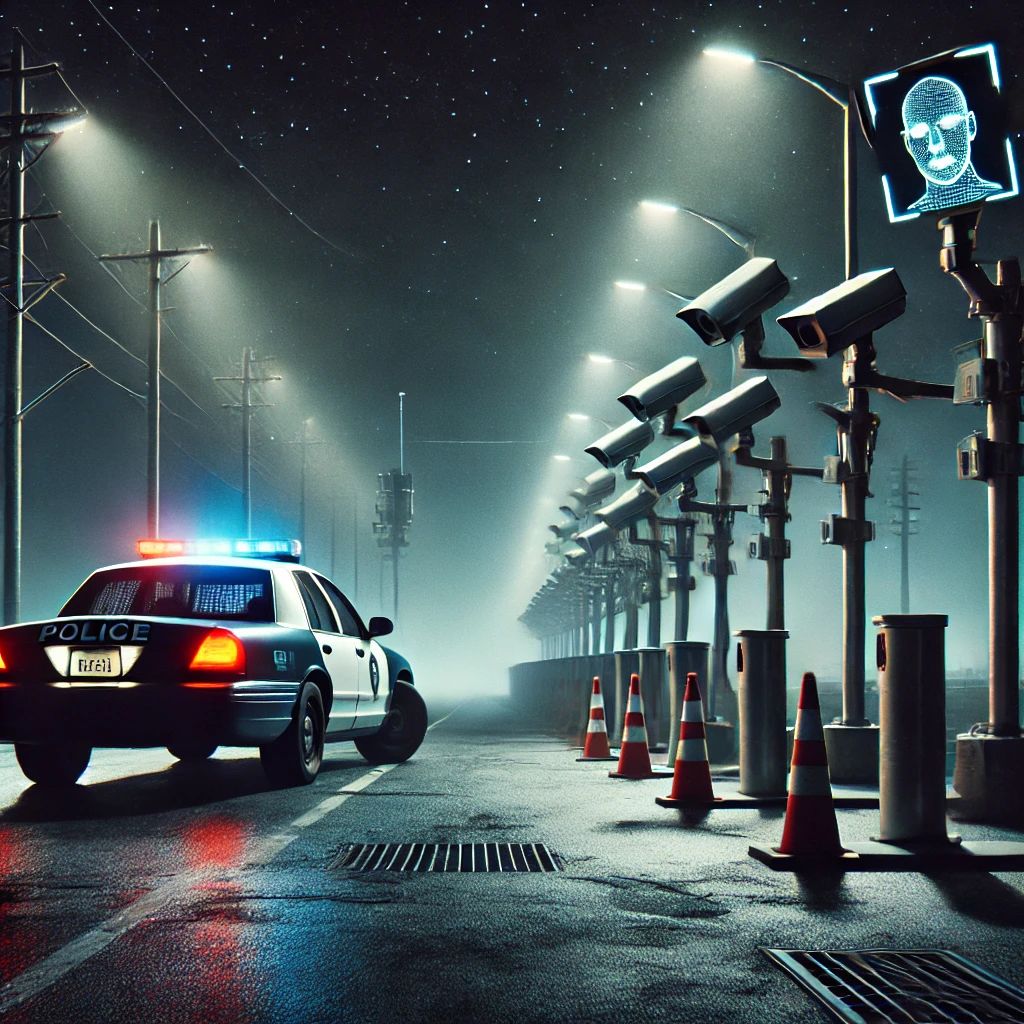
Facial recognition checkpoint at night: a quiet warning of rising surveillance in America.

Alt Text:
An eerie nighttime highway checkpoint scene lit by floodlights. A police vehicle sits near a barricade with mounted facial recognition cameras. Digital overlays hint at biometric scanning. The atmosphere is tense and dystopian, with no people in sight—only surveillance infrastructure under a dark sky.