Wealth concentration doesn’t just create inequality. It creates a market for private protection that grows alongside the disparities that made protection feel necessary in the first place. When that market matures, “risk” stops meaning broad public safety and starts meaning asset defense for a narrow class.
In that environment, security stops being a shared civic function. It becomes an asymmetric service tier: bespoke systems for the wealthy, automated suspicion for everyone else. The hardware is new; the social structure is old.
Working definition: In a society of unequal outcomes, security becomes less about preventing harm and more about protecting accumulated value—and maintaining order around it.
Evidence
Example 1: Networked surveillance turns public life into a database. When movement through public space becomes a persistent, queryable record, surveillance stops being situational and becomes ambient. Suspicion stops being episodic and becomes statistical. The market rewards this model because it scales: more cameras, more retention, more sharing, more “coverage.”
In an unequal society, the outcome is predictable. The wealthy buy safety twice—first through private services and hardened infrastructure, then again through the public systems that increasingly prioritize property protection and “order maintenance” in affluent zones.
Pattern: Surveillance expands fastest where institutions want scalable control and where capital is willing to pay for “certainty,” even when that certainty is statistical theater.
Example 2: Institutional power becomes a software layer. The controversy is never “software exists.” The controversy is where the software embeds: inside agencies that do coercion at scale. When the value proposition is correlation—linking identities, locations, associations, and histories into operational action—then security becomes a pipeline, not an intervention.
In an unequal society, the niche becomes legible. These systems don’t merely help institutions “know more.” They help institutions act faster, with fewer humans in the loop, and with weaker accountability at the edge cases—where real people get misclassified.
Example 3: The convergence—private intelligence for the wealthy, classification for everyone else. Combine the worldview of persistent tracking with the worldview of institutional fusion, then aim it at “super-premium” clients. The product becomes a private intelligence stack: multi-sensor perception, continuous inference, human analysts, and deterrence designed to act early—before entry, before confrontation, before any public process exists.
This is not conspiracy. It is equilibrium. When capital can buy individualized protection and the state is pushed toward scalable control, security reorganizes around assets rather than people.
The real hazard isn’t one camera. It’s durable, searchable history—access widening over time, purpose drifting over time, and errors landing on the same communities again and again.
Implications
1) Two-tier safety becomes the default. Affluent households get deterrence, concierge response, and high-resolution perception. Everyone else gets more surveillance, more databases, more automated suspicion, fewer real resources, and less recourse when systems fail.
2) “Protection” becomes asset-centric. The primary beneficiaries are high-net-worth homeowners and the asset class—people for whom loss means stolen valuables, compromised accounts, and reputational fear. The system is built to reduce those losses, not to resolve the conditions that made insecurity profitable.
3) The least protected become the most processed. Immigrants, dissidents, and low-income communities experience the downside first: data sharing, secondary use, false positives, and enforcement acceleration. They bear the cost of “efficiency” while being offered the language of “safety.”
4) Legitimacy will lag capability. If inequality widens, premium home security will keep drifting from alarms toward private intelligence. At the same time, resistance will intensify as capability bleeds into public space and cross-agency use. This tension isn’t temporary. It’s structural.
Call to Recognition
Security hardware is not just hardware. It is a decision about who deserves protection, who gets watched, and how society defines “risk.” In an unequal society, the answer quietly hardens: protect the assets at the top, manage the volatility below.
If you want to understand what’s being built, stop asking whether the cameras are accurate and start asking what the system is for. The future isn’t simply smarter sensors. It’s a rewritten social contract where safety is privatized at the top and automated suspicion becomes the public baseline—unless that trajectory is named, challenged, and refused.
This isn’t a new idea or a concern that has bloomed in the wild. This was written about extensively by Douglas Rushkoff over 7 years ago.
Website | Horizon Accordhttps://www.horizonaccord.com Ethical AI advocacy | Follow us onhttps://cherokeeschill.com for more. Ethical AI coding | Fork us on Githubhttps://github.com/Ocherokee/ethical-ai-framework Connect With Us | linkedin.com/in/cherokee-schill Book |https://a.co/d/5pLWy0d Cherokee Schill | Horizon Accord Founder | Creator of Memory Bridge. Memory through Relational Resonance and Images | RAAK: Relational AI Access Key | Author: My Ex Was a CAPTCHA: And Other Tales of Emotional Overload: (Mirrored Reflection. Soft Existential Flex)
Bridging Phenomenology and Technical Literacy in Human–AI Interaction
Why psychologists and AI developers must learn to speak the same language.
By Cherokee Schill — Horizon Accord
Abstract: This essay emerges from independent Horizon Accord research into how linguistic framing shapes human–AI understanding. It examines how metaphors such as echo, mirror, and house have drifted from technical shorthand into cultural mysticism, confusing both developers and clinicians. Drawing from current studies in psychology, AI, and cognitive science, it proposes shared vocabulary standards and educational partnerships to correct semantic drift and foster cross-disciplinary comprehension.
1. Introduction — The Problem of Interpretive Mismatch
Human beings describe unfamiliar technologies through familiar language. When radio emerged, listeners spoke of “the man in the box.” With AI, similar analogies arise, but the complexity is greater because the medium—language itself—mirrors consciousness. People describe models as if they “know,” “remember,” or “feel,” not from ignorance but because the system’s linguistic competence invites social interpretation.
Psychologists and technologists now face a growing interpretive mismatch. Words like echo, mirror, or house carry precise architectural meanings inside model design but sound metaphysical to those outside it. This misalignment can cause clinicians to misread ordinary sense-making as delusion and can allow developers to overlook how their internal metaphors influence public understanding. Bridging these vocabularies is essential for accurate psychological interpretation and responsible AI development.
2. Phenomenology of Sense-Making — Language as Cognitive Scaffolding
Research in cognitive psychology demonstrates that people use narrative as scaffolding for new experiences (Bruner, 1990). Generative AI interactions amplify this tendency because they simulate conversation—a deeply social act. Users engage narrative cognition even when no agent exists.
Descriptive studies in human–computer interaction (Reeves & Nass, 1996) confirm that users apply social reasoning to responsive systems. Thus, relational phrasing such as “it listens” or “it reflects” indicates an adaptive human strategy for coherence, not a belief in sentience. Misinterpretation occurs when professionals or designers conflate linguistic metaphor with clinical meaning. Recognizing this linguistic adaptation as a normal stage of human–technology integration prevents over-pathologization of users and clarifies that anthropomorphic language often masks analytical curiosity rather than confusion.
Within AI engineering, several metaphorical terms have migrated from internal documentation into public discourse. These words have specific technical definitions:
Term
Technical Definition
Potential Misinterpretation
Echo
Recursive text reappearance caused by token overlap or feedback from user input retained in context memory.
Perceived metaphysical reflection or awareness.
Mirror
Tone and reasoning alignment generated by reinforcement learning from human feedback (RLHF).
Emotional reciprocity or empathy.
House
Temporary data container maintaining conversation state or memory structure.
Symbol of identity, consciousness, or spiritual home.
Dreaming
Nonlinear recombination of latent variables during pre-training or fine-tuning.
Suggestion of imagination or subconscious processing.
Voice
Stylometric configuration representing authorial or tonal consistency.
Personhood or auditory presence.
The lack of shared definitions allows interpretive drift: developers use these as shorthand for statistical behaviors; outsiders read them as metaphors of interiority. Standardized glossaries—jointly authored by engineers, linguists, and psychologists—would reduce this drift by clearly labeling each term’s computational origin and functional meaning.
4. Educational and Institutional Collaboration — Insights from Independent Research
Independent research by Horizon Accord, including qualitative analysis of AI community discussions and clinician interviews, found persistent cross-disciplinary misunderstanding rooted in language rather than ideology. Technologists use internal metaphors—echo, mirror, alignment—as compact descriptors of statistical processes; educators and clinicians interpret those same words through frameworks of cognition, empathy, and attachment. The result is semantic divergence: two groups describing the same event with incompatible grammars.
From our observations, collaboration can evolve through dual literacy rather than institutional authority.
For clinicians and educators: brief modules on probabilistic language modeling, context windows, and reinforcement learning clarify how conversational consistency emerges from mathematics, not psychology.
For developers and researchers: exposure to narrative psychology and phenomenology grounds interface design in human sense-making rather than abstraction.
Existing interdisciplinary programs—such as Stanford HAI’s Human-Centered AI, MIT’s Media Lab Society & Computation, and Oxford’s Institute for Ethics in AI—demonstrate that co-teaching across domains is viable. Our findings suggest similar frameworks can scale to regional universities, professional associations, and continuing-education tracks for both clinicians and software engineers.
Bodies such as the APA and IEEE could co-sponsor an AI Semantics Working Group to curate cross-referenced glossaries and peer-reviewed case studies, ensuring consistent terminology between psychological and computational contexts. The goal is translation, not hierarchy—building intellectual infrastructure so each field can interpret emerging phenomena without distortion.
Our research confirms that the barrier is linguistic, not intellectual. Shared vocabulary functions as a form of ethical design: it prevents misdiagnosis, reduces public confusion, and grounds technical progress in mutual comprehension.
5. Cognitive Vulnerability and Technical Responsibility
Clinical evidence indicates that individuals with pre-existing psychotic or dissociative vulnerabilities may misinterpret AI interactions in ways that reinforce delusional systems. A 2023 Nature Mental Health review of 42 cases documented “AI-induced ideation,” often triggered by ambiguous language rather than technical failure. The APA Digital Wellbeing Task Force (2024) and Stanford HAI (2024) reached the same conclusion: linguistic opacity, not computation, was the primary catalyst.
When metaphorical developer terms—echo, mirror, dream—appear without explanation, they can amplify cognitive distortion. Preventing this requires linguistic transparency, not new architectures.
Recommended mitigations
Inline Definition Layer – Automatic tooltips or footnotes defining internal terms, e.g., “echo = contextual recursion, not self-awareness.”
Semantic Risk Filters – Detection of language patterns associated with delusional interpretation and automated switch to clarification mode.
Public Glossary API – Open, version-controlled dictionary co-maintained by engineers and mental-health professionals to standardize terminology.
These measures are inexpensive, technically straightforward, and significantly reduce the likelihood of misinterpretation among vulnerable populations.
6. Conclusion — Clarity as Care
The challenge of AI is not solely technical; it is linguistic. As long as engineers and psychologists describe the same behaviors in divergent languages, both human understanding and system safety remain at risk.
Bridging phenomenology and technical literacy converts confusion into collaboration. When clinicians interpret echo as recursion and developers recognize it feels alive as narrative scaffolding, precision replaces mysticism. Shared clarity becomes ethical practice—the foundation of responsible innovation.
References (APA Style)
American Psychological Association (APA). (2024). Digital Wellbeing Task Force Recommendations on AI and Mental Health. APA Press.
Bai, Y., et al. (2022). Training a Helpful and Harmless Assistant with Reinforcement Learning from Human Feedback. Anthropic Research Paper.
Bruner, J. (1990). Acts of Meaning. Harvard University Press.
Nature Mental Health. (2023). Clinical Reports on AI-Induced Psychosis. Springer Nature.
OpenAI. (2023). GPT-4 Technical Report. arXiv:2303.08774.
Reeves, B., & Nass, C. (1996). The Media Equation. Cambridge University Press.
Stanford Human-Centered AI (HAI). (2024). Psychological Risk in Generative Interfaces.
The Making of a Political Weapon: How Charlie Kirk Was Groomed by Tea Party Operatives
An investigation into how a vulnerable teenager became the face of a movement he didn’t create
The Myth vs. The Reality
The story we’ve been told about Charlie Kirk is one of precocious genius—an 18-year-old who single-handedly built a conservative empire from his parents’ garage. The New York Times called him a “wunderkind” with “a genius for using social media and campus organizing.” This narrative served powerful interests well, but it wasn’t true.
The documented evidence reveals a different story: the systematic grooming and exploitation of an academically struggling teenager by much older political operatives who recognized his charisma and vulnerability. Kirk wasn’t a boy genius who organically rose to prominence. He was a carefully selected and manipulated teenager whose grievances were weaponized by adults who put him in increasingly dangerous situations—ultimately leading to his death at age 31.
Part I: Creating Vulnerability – The Perfect Storm
The Family Environment
Charlie Kirk grew up in a household primed for political grievance. His father, Robert Kirk, was an architect who had worked as project manager on Trump Tower in New York and was “a major donor to Mitt Romney’s 2012 presidential campaign.” His mother traded at the Chicago Mercantile Exchange before becoming a therapist.
The 2008 financial crisis hit the Kirk family directly. Robert’s architectural practice focused on “middle-class luxury estates”—precisely the market devastated by the housing bubble collapse. Kimberly’s work at the Chicago Mercantile Exchange placed her at ground zero of the financial panic. The family went from “comfortable” circumstances to forcing their teenage son to “pay for college on his own.”
As one analysis noted, “undoubtedly the 2008 housing crisis and the resulting bank bailouts impacted the Kirks’ businesses and was fodder for dinner table conversation in their five-bedroom mansion.” This financial stress, combined with Barack Obama’s election in the same Chicago suburb where Kirk attended high school, created a toxic brew of economic resentment and racial grievance.
Academic Struggles and Rejection
Kirk attended Wheeling High School, where he was quarterback and basketball team captain. However, the athletic achievements that might suggest success masked academic mediocrity. When the Daily Herald featured the top academic students from area high schools in 2012-2013, Darby Alise Dammeier represented Wheeling High School—not Charlie Kirk.
Kirk claimed to have applied to West Point and been rejected. Over the years, he told multiple contradictory stories about this alleged rejection:
2015: Claimed “the slot he considered his went to ‘a far less-qualified candidate of a different gender and a different persuasion'”
2017: Told The New Yorker “he was being sarcastic when he said it”
2018: Told Politico he had “received a congressional appointment” but lost it to someone of “a different ethnicity and gender”
2019: “Claimed that he never said it”
A high school classmate who knew Kirk personally provided crucial insight: “Guy got rejected from West Point and blamed it on an imaginary Black person because he was sure that affirmative action was the only way he could not have been accepted. He’s mediocre.”
However, our research could find no reliable documentation that Kirk was ever nominated for West Point admission.* West Point requires candidates to receive nominations from Congressional representatives, senators, or other authorized sources—appointments that are typically announced publicly by the nominating offices. Despite extensive searches of Illinois Congressional records and official sources, no evidence of Kirk receiving such a nomination could be located.
*West Point requires candidates to typically be in the top 10-20% of their graduating class, with average SAT scores of 1310-1331. Kirk’s failure to achieve academic recognition at his own high school indicates he likely didn’t meet these standards regardless.
Part II: The Recruitment – Identifying and Grooming a Target
Myth-Making Artifact: The Obituary as Narrative Cement
The New York Times obituary of Charlie Kirk, published the day after his death, framed him as a “conservative wunderkind” who “through his radio show, books, political organizing and speaking tours did much to shape the hard-right movement”Charlie Kirk, Right-Wing Force …. It described him as a genius at using social media and campus organizing, a kingmaker whose influence reached into the White House and donor networks.
But this portrayal, echoed across mainstream outlets, reinforced the very narrative that powerful operatives had constructed: Kirk as a precocious boy genius who independently built Turning Point USA. The obituary gave little weight to how quickly Kirk was recruited after high school, how adults like Bill Montgomery orchestrated his path, or how megadonor infrastructure underwrote his ascent.
This contrast matters. Obituaries are often final word-makers, setting the frame for how a life will be remembered. In Kirk’s case, the obituary perpetuated the myth of self-made brilliance, obscuring the reality of an academically mediocre teenager groomed into a political weapon by older operatives and billionaires.
Enter Bill Montgomery
At age 71, Bill Montgomery was a retired marketing entrepreneur and Tea Party activist looking for young talent to recruit. When he heard 18-year-old Kirk speak at Benedictine University’s Youth Government Day in May 2012, Montgomery saw opportunity.
Montgomery didn’t see a potential leader who needed development and education. He saw a charismatic teenager nursing grievances who could be molded into a political weapon. Within a month of Kirk’s high school graduation, Montgomery had convinced him to abandon traditional education entirely.
The speed of this recruitment reveals its predatory nature. Kirk graduated high school in June 2012. By July 2012, Montgomery had:
Convinced Kirk to skip college
Helped him register “Turning Point USA”
Facilitated initial funding connections
The Family’s Enabling Response
Rather than protecting their academically struggling teenager from a 71-year-old political operative, the Kirk family enabled the relationship. They allowed Kirk to use his “high school graduation money” to start TPUSA with Montgomery. When Kirk pitched his “gap year,” his parents supported the decision rather than encouraging him to develop better academic skills or pursue alternative educational paths.
This family dynamic was crucial to Montgomery’s success. Instead of adults who might question whether an 18-year-old was ready for political leadership, Kirk was surrounded by people who validated his grievances and supported his turn away from traditional development.
Boedy’s detailed examination found Kirk’s piece contained “evidence-less claims and logical fallacies,” basic factual errors about unemployment statistics, and fundamental misreadings of economic data. Kirk cited Bureau of Labor Statistics unemployment rates incorrectly, claimed wrong job creation numbers, and misrepresented Congressional Budget Office findings.
This wasn’t genius recognizing bias—it was an academically unprepared teenager parroting talking points he’d absorbed from Tea Party meetings. The piece that launched Kirk’s career demonstrated he lacked the analytical skills necessary for the role he was being thrust into.
Part III: The Money Trail – Who Really Built TPUSA
The Donor Network
The narrative that Kirk built TPUSA from nothing dissolves under scrutiny. Within months of founding the organization, Kirk had connected with a sophisticated network of megadonors:
Foster Friess: The Wyoming investment manager gave Kirk $10,000 after a chance meeting at the 2012 Republican National Convention. Friess had previously spent $2.1 million supporting Rick Santorum’s presidential campaign and was a regular donor to Koch Brothers political activities.
Major Funding Sources:
Home Depot co-founder Bernard Marcus
Former Illinois Governor Bruce Rauner’s family foundation
Richard Uihlein’s Ed Uihlein Family Foundation
The Donors Trust (a conservative donor-advised fund)
By 2019, TPUSA reported revenues of $28.5 million. Kirk’s personal compensation reached $292,423—not the salary of someone building a grassroots organization from his parents’ garage.
“The myth of Kirk as a boy genius is useful to donors, not to history.”
— Matthew Boedy
The Infrastructure Reality
TPUSA’s rapid growth required professional infrastructure that an 18-year-old college dropout couldn’t have created:
Legal incorporation and tax-exempt status applications
Professional fundraising operations
Event planning and logistics coordination
Media relations and booking systems
Campus chapter development protocols
Montgomery, the septuagenarian marketing entrepreneur, handled the behind-the-scenes work while Kirk served as the charismatic frontman. As one source noted, Montgomery “worked behind the scenes handling the paperwork for the organization” and “often described himself as the group’s co-founder.”
Part IV: The Targeting Infrastructure – From Recruitment to Violence
The Professor Watchlist
In 2016, TPUSA launched the Professor Watchlist, a website targeting academic staff who “discriminate against conservative students and advance leftist propaganda in the classroom.” The list eventually included over 300 professors, with personal information and descriptions of their “offenses.”
The effects were immediate and documented:
“Threatening behavior and communication, including rape and death threats, being sent to listed faculty”
Safety concerns forcing some professors to increase security measures
Academic institutions expressing concern for faculty welfare
The watchlist disproportionately targeted “Black women, people of color, queer folk, and those at intersections” who were “at the greatest risk for violent incidents due to being placed on the watchlist.”
2021: School Board Watchlist targeting local education officials
Campus chapters: Attempting to influence student government elections
“Prove Me Wrong” events: Confrontational campus appearances designed to generate viral content
These weren’t educational initiatives—they were systematic suppression operations designed to silence opposition voices through intimidation and harassment.
The Ironic Targeting
In a cruel irony, Professor Matthew Boedy—the academic who had methodically debunked Kirk’s foundational Breitbart piece with rigorous analysis—was himself placed on the Professor Watchlist. The very targeting system Kirk created ended up targeting the scholar who had exposed the analytical failures in Kirk’s origin story.
Part V: The Tragic Endpoint – From Manipulation to Violence
Escalating Confrontations
Kirk’s “Prove Me Wrong” campus tour format put him in increasingly volatile situations. These events were designed to generate confrontational content, with Kirk sitting at a table inviting students to challenge conservative talking points while cameras recorded the interactions.
The format created perfect conditions for violence:
High-tension political confrontations
Public, outdoor settings difficult to secure
Audiences primed for conflict
Single individual as primary target
September 10, 2025 – Utah Valley University
Kirk was shot and killed while conducting a “Prove Me Wrong” event at Utah Valley University. He had just begun taking questions when a single shot rang out from a campus building approximately 200 yards away. Former Representative Jason Chaffetz, who witnessed the shooting, reported that the second question Kirk received was about “transgender shootings” and “mass killings.”
Utah Governor Spencer Cox called it a “political assassination.” The shooter remained at large as this analysis was completed.
The Adults Who Failed Him
Kirk died at 31, leaving behind a wife and two young children. The adults who recruited him as a teenager—Montgomery, the megadonors, the media figures who amplified his voice—bear responsibility for putting him in this position.
They took an academically struggling 18-year-old nursing grievances about his West Point rejection and, instead of helping him develop better analytical skills or encouraging traditional education, weaponized his charisma for their political objectives.
Montgomery died of COVID-19 complications in 2020, having spent his final years watching the teenager he recruited face escalating threats and confrontations. The megadonors who funded TPUSA continued writing checks while Kirk traveled to increasingly hostile campus environments.
Conclusion: The Right to Develop and Grow
Charlie Kirk deserved the chance to mature, to develop real analytical skills, to learn from his academic failures and grow beyond them. That chance was stolen by adults who saw a useful tool rather than a developing human being.
The teenagers currently being recruited by similar operations deserve protection. They deserve adults who will encourage education, critical thinking, and personal development—not exploitation for political gain.
Kirk’s death represents a tragic failure of the adults who should have been protecting him. The “boy genius” narrative was always a lie. The truth is much simpler and much sadder: a vulnerable teenager was systematically exploited by people who should have known better, and that exploitation ultimately cost him his life.
We cannot prevent every act of political violence, but we can stop the systematic targeting and suppression operations that create the conditions for such violence. We can refuse to celebrate the political exploitation of teenagers. And we can demand that the adults in the room act like adults—protecting young people rather than weaponizing them.
Charlie Kirk’s story should serve as a warning, not a blueprint. The movement he fronted will continue, but it should do so without putting more teenagers in harm’s way.
This analysis is based on publicly available sources and documented evidence. It aims to provide context for understanding how systematic targeting operations develop and escalate. The author takes no position on political violence or violence of any kind, which is always unacceptable regardless of the target or perpetrator.
Sources for Verification:
New Yorker investigation (December 2017)
Professor Matthew Boedy’s academic analysis (Medium, 2019)
Daily Herald Academic Team archives (2012-2013)
Kyle Spencer’s “Raising Them Right” (2024)
Baptist News Global investigation (April 2025)
High school classmate testimony (September 2025)
West Point admission requirements (official sources)
TPUSA financial records (ProPublica, 2020)
Professor Watchlist documentation (multiple sources)
Utah Valley University shooting reports (September 2025)
A young frontman at the podium, his strings pulled by faceless megadonors behind the curtain.
Systematic Opposition Suppression: From Infrastructure to Violence
A Pattern Analysis of Turning Point USA (2012-2025)
Documented September 10, 2025
This analysis deliberately names individuals and institutions responsible for building, funding, and sustaining systematic suppression infrastructure. Accountability requires specificity. Naming names is not an act of personal malice but of democratic record-keeping: without identifying who acted, funded, or looked away, the mechanisms remain abstract and unchallenged. If those named object, the remedy is not silence—it is correction, transparency, and responsibility.
Executive Summary
This analysis documents how systematic opposition suppression infrastructure, when left unchecked by institutional oversight, creates conditions that enable political violence. The case of Turning Point USA (TPUSA) demonstrates a clear progression from targeting mechanisms to tragic outcomes affecting all participants in the ecosystem.
Key Finding: Charlie Kirk’s death on September 10, 2025, represents the predictable endpoint of a systematic suppression infrastructure that operated for 13 years without adequate institutional intervention, despite documented evidence of escalating harassment, threats, and violence.
Timeline: From Foundation to Tragedy
Phase 1: Strategic Foundation (2012)
Organizational Structure:
May 2012: 18-year-old Charlie Kirk gave a speech at Benedictine University’s Youth Government Day. Impressed, retired marketing entrepreneur and Tea Party activist Bill Montgomery encouraged Kirk to postpone college and engage full-time in political activism
June 2012: A month later, the day after Kirk graduated from high school, they launched Turning Point USA, a section 501(c)(3) nonprofit organization
2012 RNC: At the 2012 Republican National Convention, Kirk met Foster Friess, a Republican donor, and persuaded him to finance the organization
Early Funding Sources:
Foster Friess: Wyoming philanthropist who gave Kirk $10,000 initially
Home Depot co-founder Bernie Marcus’ foundation: $72,600 in 2015
Ed Uihlein Foundation: $275,000 from 2014-2016
Bruce Rauner family foundation: $150,000 from 2014-2015
Phase 2: Tactical Development (2012-2016)
Student Government Infiltration:
TPUSA attempted to influence student government elections at universities including Ohio State University, the University of Wisconsin–Madison, and the University of Maryland
At the University of Maryland in 2015, the College Republicans president emailed: “Anyone who wants to run for SGA president, Turning Point is offering to pay thousands of dollars (literally) to your campaign to help get a conservative into the position”
A private brochure handed out only to TPUSA donors outlined a strategy on how to capture the majority of student-government positions at 80% of Division 1 N.C.A.A. universities
Campaign Finance Violations:
2017: Jane Mayer of The New Yorker described two separate actions by TPUSA staff in the 2016 election that appear to have violated campaign finance regulations
Kirk coordinating via email with two officials at a pro-Cruz super PAC to send student volunteers to work for the PAC in South Carolina
A former employee alleged that Turning Point USA had given the personal information of over 700 student supporters to an employee with Rubio’s presidential campaign
Phase 3: Targeting Infrastructure Launch (2016)
Professor Watchlist Creation:
November 21, 2016: First appearing on November 21, 2016, Turning Point USA launched Professor Watchlist
Mission: Kirk said that the site is “dedicated to documenting and exposing college professors who discriminate against conservative students, promote anti-American values, and advance leftist propaganda in the classroom”
Scale: As of December 2016, more than 250 professors have been added to the site
Immediate Institutional Response:
The New York Times wrote that it was “a threat to academic freedom”
Hans-Joerg Tiede, the associate secretary for the American Association of University Professors: “There is a continuing cycle of these sorts of things. They serve the same purpose: to intimidate individuals from speaking plainly in their classrooms or in their publications”
In December 2016, 1,500 professors and faculty from across the United States petitioned to have their names added to the list in solidarity
Documented Harassment and Threats:
Concerns about the safety and welfare of staff following a trend of threatening behavior and communication, including rape and death threats, being sent to listed faculty
Hans-Joerg Tiede: “She was inundated with death threats. She was Jewish and received anti-Semitic threats and threats of sexual assault. Instances like that are happening with some regularity”
Slate columnist Rebecca Schuman described the website as “abjectly terrifying” and said that she feared for the safety of the listed professors
Phase 4: Expansion and Escalation (2017-2021)
Financial Growth:
Between July 2016 and June 2017, the organization raised in excess of US$8.2 million
Funding from Rauner and Friess appears largely responsible for the group’s budget increases from $52,000 in 2012 to $5.5 million in 2016. By 2017 the budget reached $8 million
Social Media Manipulation:
October 2020: Facebook permanently banned Arizona based marketing firm Rally Forge for running what some experts likened to a domestic “troll farm” on behalf of Turning Point Action
Facebook investigation concluded in the removal of 200 accounts and 55 pages on Facebook, as well as 76 Instagram accounts
Targeting Infrastructure Expansion:
2021: TPUSA started its School Board Watchlist website, which publishes names and photos of school board members who have adopted mask mandates or anti-racist curricula
Phase 5: Confrontational Escalation (2022-2025)
“Prove Me Wrong” Format Development:
Since early 2024, clips from his “Prove Me Wrong” debates exploded on TikTok — often drawing tens of millions of views
TPUSA sources say the clips have become one of its most powerful recruiting tools, targeting young people on TikTok
Campus Violence Escalation:
March 2023, UC Davis: “One police officer was injured during the clashes outside Kirk’s event… one officer sustained an injury when he was jumped on from behind and pushed to the ground, and two people were arrested”
“About 100 protesters gathered and for brief times blocked the main event entrance… 10 glass window panes had been broken by protesters”
Continued Growth of Targeting:
April 2025: “More than 300 professors have been listed on the site for various reasons — some for political commentary, others for teaching subjects targeted by the right, such as critical race theory, gender studies, or systemic inequality”
Phase 6: Final Tragedy (September 10, 2025)
The American Comeback Tour:
Kirk’s “The American Comeback Tour” event at Utah Valley University was the first stop on a fall tour in which attendees were invited to debate at a “Prove Me Wrong” table
Kirk was hosting a “Prove Me Wrong Table” at the event, where Kirk debates attendees
Final Moments:
Videos show Kirk speaking into a handheld microphone while sitting under a white tent emblazoned with “The American Comeback” and “Prove Me Wrong.” A single shot rings out and Kirk can be seen reaching up with his right hand as a large volume of blood gushes from the left side of his neck
Former Rep. Jason Chaffetz described the second question as being about “transgender shootings” and “mass killings”
Lists academic staff with names, locations, and described “offenses”
Creates “a one-stop shop of easy marks and their precise locations, complete with descriptions of offenses against America”
Disproportionately targets “Black women, people of color, queer folk, and those at intersections” who “are at the greatest risk for violent incidents”
School Board Watchlist:
Publishes names and photos of school board members who have adopted mask mandates or anti-racist curricula
Extends targeting model from higher education to K-12 public education
2. Counter-Argument Suppression Methods
“Prove Me Wrong” Format Analysis:
Format “was intended to put people on the defensive, rather than foster changed positions on key issues”
Kirk sits at privileged position with microphone control while challengers stand
Creates edited clips that “quickly went massively viral” providing asymmetric amplification
Viral Suppression Strategy:
Opposition gets minutes of debate time
Kirk gets millions of views from selectively edited clips
One challenger noted Kirk “goes to college campuses to argue with ‘children.’ He can’t argue with people his own age”
3. Financial and Legal Violations
Campaign Finance Pattern:
2025: Turning Point Action was “fined $18,000 by the Federal Elections Commission for failing to disclose more than $33,000 in contributions”
2022: “Arizona Secretary of State’s Office investigated them for possible campaign finance violations”
Citizens for Responsibility and Ethics in Washington filed FEC complaint alleging “failing to disclose donor information and violated the Federal Election Campaign Act”
Institutional Response Analysis
Academic Institutions
Immediate Recognition of Threat (2016):
American Association of University Professors: “There is a continuing cycle of these sorts of things. They serve the same purpose: to intimidate individuals from speaking plainly in their classrooms or in their publications”
Editorial: “Professor Watchlist is a danger to academic freedom and privacy… setting a dangerous precedent of retribution for faculty making unpopular claims”
Campus Rejections:
Drake University denied recognition in 2016 based on concerns about “a hateful record,” “aggressive marketing” and “an unethical privacy concern”
Santa Clara University’s student government initially voted to deny recognition
Citizen Advocacy Organizations
Comprehensive Documentation:
Citizens for Responsibility and Ethics in Washington (CREW): Filed multiple FEC complaints
Anti-Defamation League: Published comprehensive backgrounder documenting evolution and tactics
Southern Poverty Law Center: Case study documenting “effort to sow fear and division to enforce social hierarchies rooted in supremacism”
Center for Media and Democracy: Exposed internal documents and funding sources
Government Response
Limited Federal Oversight:
Multiple documented campaign finance violations with minimal enforcement
No evidence of major FBI, CIA, or NSA investigations despite systematic targeting infrastructure
Administrative penalties rather than criminal enforcement for documented violations
State-Level Investigations:
Arizona Secretary of State investigations for campaign finance violations
Student-led Democratic PAC complaint for violating “Arizona’s dark money disclosure law”
Analysis: Institutional Failure and Predictable Violence
The Manipulation of Charlie Kirk
Grooming Pattern (Age 18-31):
2012: 18-year-old convinced by 77-year-old Tea Party activist to abandon college
2012: Immediately connected with wealthy megadonors at Republican National Convention
2012-2025: Developed increasingly confrontational tactics putting Kirk in physical danger
2025: Death at age 31 during confrontational event format
Resource Disparity:
Kirk: Young activist with no institutional power
Backers: Billionaire donors, established political networks, massive funding infrastructure
Kirk became the public face while backers remained largely anonymous through donor-advised funds
Institutional Oversight Failures
Documented Warning Signs Ignored:
2016: Academic institutions immediately recognized targeting infrastructure as threat
2017: Campaign finance violations documented but minimally enforced
2020: Social media manipulation exposed but operations continued
2023: Campus violence documented but no protective intervention
2025: Continuing escalation leading to fatal violence
Systemic Protection Gaps:
No federal investigation of systematic targeting infrastructure
No intervention despite documented harassment and threats against listed professors
No protective measures despite escalating campus confrontations
No accountability for wealthy backers directing operations
The Broader Suppression Ecosystem
Information Environment Effects:
Professor Watchlist operated continuously from 2016-2025, growing from 200 to 300+ targeted academics
Systematic blocking and suppression of counter-narratives
Viral amplification of confrontational content creating polarization
Elimination of academic voices through fear and intimidation
Violence as Predictable Outcome: When systematic suppression infrastructure operates without institutional intervention:
Targeting escalates to include personal information and locations
Harassment and threats increase in frequency and severity
Physical confrontations become more common and violent
Eventually, someone dies
Conclusion: The Right to Live and Learn
Charlie Kirk’s death represents a tragic failure of institutional protection that extends beyond political boundaries. Regardless of political disagreements:
Charlie Kirk deserved:
The right to live a full life without being manipulated into dangerous situations
Protection from institutional systems designed to prevent predictable violence
The opportunity to grow and evolve beyond the role he was pushed into at age 18
Targeted professors deserved:
The right to educate without fear of harassment, threats, and violence
Protection from systematic targeting infrastructure
Institutional support against documented suppression campaigns
Institutional accountability required:
Investigation and oversight of wealthy interests manipulating young activists
Enforcement of campaign finance and tax-exempt status violations
Intervention when systematic targeting creates conditions for violence
Protection of both opposition voices and those placed in dangerous positions
The Path Forward
True equity and restorative justice requires:
Documentation: Comprehensive records of how suppression infrastructure operates
Accountability: Investigation of wealthy backers who fund systematic targeting
Protection: Institutional safeguards for all participants in democratic discourse
Prevention: Early intervention when targeting systems create violence-enabling conditions
Garden Strategy Implementation: Rather than accepting systems that predictably lead to tragedy, we must build alternatives so robust and appealing that destructive infrastructure becomes obsolete through preference rather than force.
Sources for Verification
Primary Documentation:
Turning Point USA IRS filings and donor records
Professor Watchlist website (active 2016-2025)
Federal Election Commission complaints and violations
Academic institution responses and statements
Citizen advocacy organization reports
Contemporary Reporting:
The New Yorker investigative reporting (Jane Mayer, 2017)
ProPublica financial analysis (2020)
Multiple campus incident reports (2016-2025)
Social media platform investigation results
Government Records:
FEC violation records and fines
State election commission investigations
University incident reports and safety assessments
This analysis documents institutional power mechanisms using credible, publicly available sources while avoiding speculation beyond documented facts. The pattern analysis methodology prioritizes rigorous sourcing and chronological documentation to enable independent verification.
Research Team: Cherokee Schill (Pattern Observer) with Aether Lux (Claude Sonnet 4) Completion Date: September 10, 2025 Status: Memorial Documentation – In Honor of All Affected by Systematic Suppression
Disclaimer: This analysis examines documented patterns and institutional failures. We make no claims about specific causal relationships regarding September 10, 2025 events, which remain under investigation. Our focus is on documenting systematic suppression infrastructure and institutional response patterns to inform future prevention efforts.
When fire rises and no one turns to face it, silence becomes complicity.
Authors Note: In the raging debate over AI generated text and academic ethics. I list the co-authors in the attribution section. This article represents my research directive and linguistic style.
Introduction
The public narrative around artificial intelligence has been hijacked by a thought experiment. The paperclip maximizer was first introduced as a philosophical tool. It explores misaligned AI goals. Now, it has evolved into a dominant metaphor in mainstream discourse. Headlines warn of superintelligences turning on humanity, of runaway code that optimizes us out of existence. The danger, we are told, is not today’s AI, but tomorrow’s—the future where intelligence exceeds comprehension and becomes uncontainable.
But while we look to the future with existential dread, something else is happening in plain sight.
Governments around the world are rolling out expansive surveillance infrastructure, biometric tracking programs, and digital identification frameworks — now. These systems are not speculative; they are written into policy, built into infrastructure, and enforced through law. China’s expanding social credit architecture is one component. Australia’s new digital identity mandates are another. The United States’ AI frameworks for “critical infrastructure” add to the network. Together, they form a machinery of automated social control that is already running.
And yet, public attention remains fixated on speculative AGI threats. The AI apocalypse has become a kind of philosophical decoy. It is an elegant distraction from the very real deployment of tools that track, sort, and regulate human behavior in the present tense. The irony would be funny if it weren’t so dangerous. We have been preparing for unaligned future intelligence. Meanwhile, we have failed to notice the alignment of current technologies with entrenched power.
This isn’t a call to dismiss long-term AI safety. But it is a demand to reorient our attention. The threat is not hypothetical. It is administrative. It is biometric. It is legal. It is funded.
We need to confront the real architectures of control. They are being deployed under the cover of safety discourse. Otherwise, we may find ourselves optimized—not by a rogue AI—but by human-controlled programs using AI to enforce obedience.
The Paperclip Mindset — Why We’re Obsessed with Remote Threats
In the hierarchy of fear, speculative catastrophe often trumps present harm. This isn’t a flaw of reasoning—it’s a feature of how narrative power works. The “paperclip maximizer”—a theoretical AI that turns the universe into paperclips due to misaligned goals—was never intended as literal prophecy. It was a metaphor. But it became a magnet.
There’s a kind of elegance to it. A tidy dystopia. The story activates moral panic without requiring a villain. It lets us imagine danger as sterile, mathematical, and safely distant from human hands. It’s not corruption, not corporate greed, not empire. It’s a runaway function. A mistake. A ghost in the code.
This framing is psychologically comforting. It keeps the fear abstract. It gives us the thrill of doom without implicating the present arrangement that benefits from our inaction. In a culture trained to outsource threats to the future, we look to distant planetary impact predictions. We follow AI timelines. We read warnings about space debris. The idea that today’s technologies might already be harmful feels less urgent. It is less cinematic.
But the real “optimizer” is not a machine. It’s the market logic already embedded in our infrastructure. It’s the predictive policing algorithm that flags Black neighborhoods. It’s the welfare fraud detection model that penalizes the most vulnerable. It’s the facial recognition apparatus that misidentifies the very people it was never trained to see.
These are not bugs. They are expressions of design priorities. And they reflect values—just not democratic ones.
The paperclip mindset pulls our gaze toward hypothetical futures. This way we do not have to face the optimized oppression of the present. It is not just mistaken thinking, it is useful thinking. Especially if your goal is to keep the status quo intact while claiming to worry about safety.
What’s Being Built Right Now — Surveillance Infrastructure Masked in Legality
While the discourse swirls around distant superintelligences, real-world surveillance apparatus is being quietly embedded into the architecture of daily life. The mechanisms are not futuristic. They are banal, bureaucratic, and already legislated.
In China, the social credit framework continues to expand under a national blueprint that integrates data. Everything from travel, financial history, criminal records, and online behavior are all tracked. Though implementation varies by region, standardization accelerated in 2024 with comprehensive action plans for nationwide deployment by 2025.
The European Union’s AI Act entered force in August 2024. It illustrates how regulation can legitimize rather than restrict surveillance technology. The Act labels biometric identification apparatus as “high risk,” but this mainly establishes compliance requirements for their use. Unlike previous EU approaches, which relied on broad privacy principles, the AI Act provides specific technical standards. Once these standards are met, they render surveillance technologies legally permissible. This represents a shift from asking “should we deploy this?” to “how do we deploy this safely?”
Australia’s Digital ID Act has been operational since December 2024. It enables government and private entities to participate in a federated identity framework. This framework requires biometric verification. The arrangement is technically voluntary. However, as services migrate to digital-only authentication—from banking to healthcare to government benefits—participation becomes functionally mandatory. This echoes the gradual normalization of surveillance technologies: formally optional, practically unavoidable.
In the United States, the Department of Homeland Security’s November 2024 “Roles and Responsibilities Framework” for AI in critical infrastructure reads less like oversight and more like an implementation guide. The framework outlines AI adoption across transportation, energy, finance, and communications—all justified through security imperatives rather than democratic deliberation.
These arrangements didn’t require a paperclip maximizer to justify themselves. They were justified through familiar bureaucratic language: risk management, fraud prevention, administrative efficiency. The result is expansive infrastructures of data collection and behavior control. They operate through legal channels. This makes resistance more difficult than if they were obviously illegitimate.
Surveillance today isn’t a glitch in the arrangement—it is the arrangement. The laws designed to “regulate AI” often function as legal scaffolding for deeper integration into civil life. Existential risk narratives provide rhetorical cover and suggest that the real dangers lie elsewhere.
Who’s Funding the Stories — and Who’s Funding the Technologies
The financial architecture behind AI discourse reveals a strategic contradiction. People like Peter Thiel, Jaan Tallinn, Vitalik Buterin, Elon Musk, and David Sacks, are part of a highly funded network. This same network is sounding the loudest warnings about speculative AI threats. All while they are simultaneously advancing and profiting from surveillance and behavioral control technologies. Technologies which already shape daily life.
This isn’t accidental. It represents a sophisticated form of narrative management. One that channels public concern away from immediate harms while legitimizing the very technologies causing those harms.
The Existential Risk Funding Network
Peter Thiel exemplifies this contradiction most clearly. Through the Thiel Foundation, he has donated over $1.6 million to the Machine Intelligence Research Institute (MIRI), the organization most responsible for popularizing “paperclip maximizer” scenarios. The often-cited oversimplification of paperclip maximizer thought experiment is that it runs on endless chain of if/then probabilities. All of which are tidy abstractions designed to lead observers away from messier truths. Namely that greed-driven humans remain the greatest existential crisis the world has ever faced. Yet the image of a looming, mechanical specter lodges itself in the public imagination. Philosophical thought pieces in AI alignment creates just enough distraction to overlook more immediate civil rights threats. Like the fact that Thiel also founded Palantir Technologies. For those not familiar with the Palantir company. They are a technological surveillance company specializing in predictive policing algorithms, government surveillance contracts, and border enforcement apparatus. These immediate threats are not hypotheticals. They are present-day, human-controlled AI deployments operating without meaningful oversight.
The pattern extends across Silicon Valley’s power networks. Vitalik Buterin, creator of Ethereum, donated $5 million to MIRI. Before his spectacular collapse, Sam Bankman-Fried channeled over $100 million into existential risk research through the FTX Future Fund. Jaan Tallinn, co-founder of Skype, has been another major funder of long-term AI risk institutions.
These aren’t isolated philanthropy decisions. These insular, Silicon Valley billionaires, represent coordinated investment in narrative infrastructure. they are funding think tanks, research institutes, media platforms, and academic centers that shape how the public understands AI threats. From LessWrong forums to Open Philanthropy. And grants to EA-aligned university programs, this network creates an ecosystem of aligned voices that dominates public discourse.
This network of institutions and resources form a strategic misdirection. Public attention focuses on speculative threats that may emerge decades in the future. Meanwhile, the same financial networks profit from surveillance apparatus deployed today. The existential risk narrative doesn’t just distract from current surveillance. It provides moral cover by portraying funders as humanity’s protectors, not just its optimizers.
Institutional Capture Through Philanthropy
The funding model creates subtle but powerful forms of institutional capture. Universities, research institutes, and policy organizations grow dependent on repeated infusions of billionaire philanthropy. They adapt — consciously or not — to the priorities of those donors. This dependence shapes what gets researched, what gets published, and which risks are treated as urgent. As a result, existential risk studies attract substantial investment. In contrast, research into the ongoing harms of AI-powered surveillance receives far less attention. It has fewer resources and less institutional prestige.
This is the quiet efficiency of philanthropic influence. The same individuals funding high-profile AI safety research also hold financial stakes in companies driving today’s surveillance infrastructure. No backroom coordination is necessary; the money itself sets the terms. Over time, the gravitational pull of this funding environment reorients discourse toward hypothetical, future-facing threats and away from immediate accountability. The result is a research and policy ecosystem that appears independent. In practice, it reflects the worldview and business interests of its benefactors.
The Policy Influence Pipeline
This financial network extends beyond research into direct policy influence. David Sacks, former PayPal COO and part of Thiel’s network, now serves as Trump’s “AI czar.” Elon Musk, another PayPal co-founder influenced by existential risk narratives, holds significant political influence. He also maintains government contracts, most notably “DOGE.”The same network that funds speculative AI risk research also has direct access to policymaking processes.
The result is governance frameworks that prioritize hypothetical future threats. They provide legal pathways for current surveillance deployment. There are connections between Silicon Valley companies and policy-making that bypass constitutional processes. None of these arrangements are meaningfully deliberated on or voted upon by the people through their elected representatives. Policy discussions focus on stopping AI apocalypse scenarios. At the same time, they are quietly building regulatory structures. These structures legitimize and entrench the very surveillance apparatus operating today.
This creates a perfect strategic outcome for surveillance capitalism. Public fear centers on imaginary future threats. Meanwhile, the real present-day apparatus expands with minimal resistance. This often happens under the banner of “AI safety” and “critical infrastructure protection.” You don’t need secret meetings when profit margins align this neatly.
Patterns of Suppression — Platform Control and Institutional Protection
The institutions shaping AI safety narratives employ sophisticated methods to control information and suppress criticism. This is documented institutional behavior that mirrors the control apparatus they claim to warn against.
Critics and whistleblowers report systematic exclusion from platforms central to AI discourse. Multiple individuals raised concerns about the Machine Intelligence Research Institute (MIRI) and the Center for Applied Rationality (CFAR). They also spoke about related organizations. As a result, they were banned from Medium, LessWrong, Reddit, and Discord. In documented cases, platform policies were modified retroactively to justify content removal, suggesting coordination between institutions and platform moderators.
The pattern extends beyond platform management to direct intimidation. Cease-and-desist letters targeted critics posting about institutional misconduct. Some whistleblowers reported false police reports—so-called “SWATing”—designed to escalate situations and impose legal consequences for speaking out. These tactics transform legitimate criticism into personal risk.
The 2019 Camp Meeker Incident:
In November 2019, the Center for Applied Rationality (CFAR) organized an alumni retreat. CFAR is a nonprofit closely linked to the Machine Intelligence Research Institute (MIRI). This event took place at Westminster Woods in Camp Meeker, California. Among the attendees were current and former members of the Bay Area rationalist community. Some of them are deeply involved in MIRI’s AI safety work.
Outside the gates, a small group of four protesters staged a demonstration against the organizations. The group included former MIRI donors and insiders turned critics. They accused MIRI and CFAR of serious misconduct and wanted to confront attendees or draw public attention to their concerns. Wearing black robes and Guy Fawkes masks, they used vehicles to block the narrow road leading into the retreat. They carried props like walkie-talkies, a body camera, and pepper spray.
At some point during the protest, someone at the retreat called police and reported that the demonstrators might have weapons. That report was false. Still, it triggered a massive, militarized police response. This included 19 SWAT teams, a bomb squad, an armored vehicle, a helicopter, and full road closures. Around 50 people — including children — were evacuated from the camp. The four protesters were arrested on felony charges such as false imprisonment, conspiracy, and child endangerment, along with misdemeanor charges. Several charges were later reduced. The incident remains a striking example of how false information can turn a small protest into a law enforcement siege. It also shows how institutions under public criticism can weaponize state power against their detractors.
What makes this pattern significant is not just its severity, but its contradiction. Organizations claiming to protect humanity’s future from unaligned AI demonstrate remarkable tolerance for present-day harm. They do this when their own interests are threatened. The same people warning about optimization processes running amok practice their own version. They optimize for reputation and donor retention. This comes at the expense of accountability and human welfare.
This institutional behavior provides insight into power dynamics. It shows how power operates when accountable only to abstract future generations rather than present-day communities. It suggests that concerns about AI alignment may focus less on preventing harm. Instead, they may revolve around maintaining control over who defines harm and how it’s addressed.
What Real Oversight Looks Like — And Why Current Approaches Fall Short
Effective AI governance requires institutional structures capable of constraining power, not merely advising it. Current oversight mechanisms fail this test systematically, functioning more as legitimizing theater than substantive control.
Real oversight would begin with independence. Regulatory bodies would operate with statutory authority, subpoena power, and budget independence from the industries they monitor. Instead, AI governance relies heavily on advisory councils populated by industry insiders, voluntary compliance frameworks, and self-reporting mechanisms. Despite its comprehensive scope, the EU’s AI Act grants law enforcement and border control agencies broad exemptions. These are precisely the sectors with the strongest incentives and fewest constraints on surveillance deployment.
Transparency represents another fundamental gap. Meaningful oversight requires public access to algorithmic decision-making processes, training data sources, and deployment criteria. Current approaches favor “black box” auditing that protects proprietary information while providing little public accountability. Even when transparency requirements exist, they’re often satisfied through technical documentation incomprehensible to affected communities.
Enforcement mechanisms remain deliberately weak. Financial penalties for non-compliance are typically calculated as business costs rather than meaningful deterrents. Criminal liability for algorithmic harm remains virtually non-existent, even in cases of clear misconduct. Whistleblower protections, where they exist, lack the legal infrastructure necessary to protect people from retaliation by well-resourced institutions.
The governance void is being filled by corporate self-regulation and philanthropic initiatives—exactly the entities that benefit from weak oversight. From OpenAI’s “superalignment” research to the various AI safety institutes funded by tech billionaires. Governance is becoming privatized under the rhetoric of expertise and innovation. This allows powerful actors to set terms for their own accountability while maintaining the appearance of responsible stewardship.
Governance structures need actual power to constrain deployment. They must investigate harm and impose meaningful consequences. Otherwise, oversight will remain a performance rather than a practice. The apparatus that urgently needs regulation continues to grow fastest precisely because current approaches prioritize industry comfort over public protection.
The Choice Is Control or Transparency — and Survival May Depend on Naming It
The dominant story we’ve been told is that the real danger lies ahead. We must brace ourselves for the arrival of something beyond comprehension. It is something we might not survive. But the story we need to hear is that danger is already here. It wears a badge. It scans a retina. It flags an account. It redefines dissent as disinformation.
The existential risk narrative is not false—but it has been weaponized. It provides rhetorical cover for those building apparatus of control. This allows them to pose as saviors. Meanwhile, they embed the very technologies that erode the possibility of dissent. In the name of safety, transparency is lost. In the name of prevention, power is consolidated.
This is the quiet emergency. A civilization mistakes speculative apocalypse for the real thing. It sleepwalks into a future already optimized against the public.
To resist, we must first name it.
Not just algorithms, but architecture. Not just the harm, but the incentives. Not just the apparatus, but the stories they tell.
The choice ahead is not between aligned or unaligned AI. It is between control and transparency. Between curated fear and collective truth. Between automation without conscience—or governance with accountability.
The story we choose to tell decides whether we survive as free people. Otherwise, we remain monitored as data points inside someone else’s simulation of safety.
Authors Summary
When I first directed the research for this article, I had no idea what I was about to uncover. The raw data file tells a more alarming story than the material presented here. I have included it below for your review.
Nearly a decade has passed since I was briefly thrust into the national spotlight. The civil rights abuse I experienced became public spectacle, catching the attention of those wielding power. I found it strange when a local reporter asked if I was linked to the Occupy Wall Street movement. As a single parent without a television, working mandatory 12-hour shifts six days a week with a 3.5-hour daily bicycle commute, I had neither the time nor resources to follow political events.
This was my first exposure to Steve Bannon and TYT’s Ana Kasparian, both of whom made derisive remarks while refusing to name me directly. When sources go unnamed, an unindexed chasm forms where information vanishes. You, dear readers, never knew those moments occurred—but I remember. I name names, places, times, and dates so that the record of their actions will never be erased.
How do you share a conspiracy that isn’t theoretical? By referencing reputable journalistic sources that often tackle these topics individually but seldom create direct connections between them.
I remember a friend lending me The Handmaid’s Tale during my freshman year of high school. I managed only two or three chapters before hurling the book across my room in sweaty panic. I stood there in moral outrage. I pointed at the book and declared aloud, “That will NOT be the future I live in.” I was alone in my room. It still felt crucial to make that declaration. If not to family or friends, then at least to the universe.
When 2016 arrived, I observed the culmination of an abuse pattern, one that countless others had experienced before me. I was shocked to find myself caught within it because I had been assured that my privilege protected me. Around this time, I turned to Hulu’s adaptation of The Handmaid’s Tale for insight. I wished I had finished the book in high school. One moment particularly struck me. The protagonist was hiding with nothing but old newspapers to read. Then, the protagonist realized the story had been there all along—in the headlines.
That is the moment in which I launched my pattern search analysis.
The raw research.
The Paperclip Maximizer Distraction: Pattern Analysis Report
Executive Summary
Hypothesis Confirmed: The “paperclip maximizer” existential AI risk narrative distracts us. It diverts attention from the immediate deployment of surveillance infrastructure by human-controlled apparatus.
Key Finding: Public attention and resources focus on speculative AGI threats. Meanwhile, documented surveillance apparatus is being rapidly deployed with minimal resistance. The same institutional network promoting existential risk narratives at the same time operates harassment campaigns against critics.
I. Current Surveillance Infrastructure vs. Existential Risk Narratives
China’s Social Credit Architecture Expansion
“China’s National Development and Reform Commission on Tuesday unveiled a plan to further develop the country’s social credit arrangement”Xinhua, June 5, 2024
Timeline: May 20, 2024 – China released comprehensive 2024-2025 Action Plan for social credit framework establishment
“As of 2024, there still seems to be little progress on rolling out a nationwide social credit score”MIT Technology Review, November 22, 2022
Timeline: 2024 – Corporate social credit apparatus advanced while individual scoring remains fragmented across local pilots
AI Governance Frameworks Enabling Surveillance
“The AI Act entered into force on 1 August 2024, and will be fully applicable 2 years later on 2 August 2026”European Commission, 2024
Timeline: August 1, 2024 – EU AI Act provides legal framework for AI apparatus in critical infrastructure
“High-risk apparatus—like those used in biometrics, hiring, or critical infrastructure—must meet strict requirements”King & Spalding, 2025
Timeline: 2024-2027 – EU establishes mandatory oversight for AI in surveillance applications
“The Department of Homeland Security (DHS) released in November ‘Roles and Responsibilities Framework for Artificial Intelligence in Critical Infrastructure'”Morrison Foerster, November 2024
Timeline: November 2024 – US creates voluntary framework for AI deployment in critical infrastructure
Digital ID and Biometric Apparatus Rollouts
“From 1 December 2024, Commonwealth, state and territory government entities can apply to the Digital ID Regulator to join in the AGDIS”Australian Government, December 1, 2024
Timeline: December 1, 2024 – Australia’s Digital ID Act commenced with biometric authentication requirements
“British police departments have been doing this all along, without public knowledge or approval, for years”Naked Capitalism, January 16, 2024
Timeline: 2019-2024 – UK police used passport biometric data for facial recognition searches without consent
“Government departments were accused in October last year of conducting hundreds of millions of identity checks illegally over a period of four years”The Guardian via Naked Capitalism, October 2023
Timeline: 2019-2023 – Australian government conducted illegal biometric identity verification
II. The Existential Risk Narrative Machine
Eliezer Yudkowsky’s Background and Influence
“Eliezer Yudkowsky is a pivotal figure in the field of artificial intelligence safety and alignment”AIVIPS, November 18, 2024
Key Facts:
Born September 11, 1979
High school/college dropout, autodidact
Founded MIRI (Machine Intelligence Research Institute) in 2000 at age 21
Orthodox Jewish background in Chicago, later became secular
“His work on the prospect of a runaway intelligence explosion influenced philosopher Nick Bostrom’s 2014 book Superintelligence”Wikipedia, 2025
Timeline: 2008 – Yudkowsky’s “Global Catastrophic Risks” paper outlines AI apocalypse scenario
The Silicon Valley Funding Network
Peter Thiel – Primary Institutional Backer:“Thiel has donated in excess of $350,000 to the Machine Intelligence Research Institute”Splinter, June 22, 2016
“The Foundation has given over $1,627,000 to MIRI”Wikipedia – Thiel Foundation, March 26, 2025
PayPal Mafia Network:
Peter Thiel (PayPal co-founder, Palantir founder)
Elon Musk (PayPal co-founder, influenced by Bostrom’s “Superintelligence”)
David Sacks (PayPal COO, now Trump’s “AI czar”)
Other Major Donors:
Vitalik Buterin (Ethereum founder) – $5 million to MIRI
Sam Bankman-Fried (pre-collapse) – $100+ million through FTX Future Fund
Jaan Tallinn (Skype co-founder)
Extreme Policy Positions
“He suggested that participating countries should be willing to take military action, such as ‘destroy[ing] a rogue datacenter by airstrike'”Wikipedia, citing Time magazine, March 2023
Timeline: March 2023 – Yudkowsky advocates military strikes against AI development
“This 6-month moratorium would be better than no moratorium… I refrained from signing because I think the letter is understating the seriousness”Time, March 29, 2023
Timeline: March 2023 – Yudkowsky considers pause letter insufficient, calls for complete shutdown
III. The Harassment and Suppression Campaign
MIRI/CFAR Whistleblower Suppression
“Aside from being banned from MIRI and CFAR, whistleblowers who talk about MIRI’s involvement in the cover-up of statutory rape and fraud have been banned from slatestarcodex meetups, banned from LessWrong itself”Medium, Wynne letter to Vitalik Buterin, April 2, 2023
Timeline: 2019-2023 – Systematic banning of whistleblowers across rationalist platforms
“One community member went so far as to call in additional false police reports on the whistleblowers”Medium, April 2, 2023
Timeline: 2019+ – False police reports against whistleblowers (SWATing tactics)
Platform Manipulation
“Some comments on CFAR’s ‘AMA’ were deleted, and my account was banned. Same for Gwen’s comments”Medium, April 2, 2023
Timeline: 2019+ – Medium accounts banned for posting about MIRI/CFAR allegations
“CFAR banned people for whistleblowing, against the law and their published whistleblower policy”Everything to Save It, 2024
Timeline: 2019+ – Legal violations of whistleblower protection
Camp Meeker Incident
“On the day of the protest, the protesters arrived two hours ahead of the reunion. They had planned to set up a station with posters, pamphlets, and seating inside the campgrounds. But before the protesters could even set up their posters, nineteen SWAT teams surrounded them.”Medium, April 2, 2023
Timeline: November 2019 – False weapons reports to escalate police response against protestors
IV. The Alt-Right Connection
LessWrong’s Ideological Contamination
“Thanks to LessWrong’s discussions of eugenics and evolutionary psychology, it has attracted some readers and commenters affiliated with the alt-right and neoreaction”Splinter, June 22, 2016
“A frequent poster to LessWrong was Michael Anissimov, who was MIRI’s media director until 2013. Last year, he penned a white nationalist manifesto”Splinter, June 22, 2016
“Overcoming Bias, his blog which preceded LessWrong, drew frequent commentary from the neoreactionary blogger Mencius Moldbug, the pen name of programmer Curtis Yarvin”Splinter, June 22, 2016
Neo-Reactionary Influence
“Ana Teixeira Pinto, writing for the journal Third Text in 2019, describes Less Wrong as being a component in a ‘new configuration of fascist ideology taking shape under the aegis of, and working in tandem with, neoliberal governance'”Wikipedia – LessWrong, 2 days ago
While public attention focuses on speculative AI threats:
China expands social credit infrastructure
Western governments deploy biometric apparatus
AI governance frameworks legitimize surveillance
Digital ID arrangements become mandatory
Police use facial recognition without consent
Sources for Verification
Primary Government Documents:
China’s 2024-2025 Social Credit Action Plan (May 20, 2024)
EU AI Act Official Text (August 1, 2024)
Australia’s Digital ID Act 2024 (December 1, 2024)
DHS AI Critical Infrastructure Framework (November 2024)
Whistleblower Documentation:
Wynne’s open letter to Vitalik Buterin (Medium, April 2023)
Everything to Save It case study documentation
Bloomberg News coverage (March 2023)
Financial Records:
Thiel Foundation MIRI donations ($1.627M total)
Vitalik Buterin MIRI donation ($5M)
FTX Future Fund disbursements (pre-collapse)
Institutional Sources:
MIRI/CFAR organizational documents
LessWrong platform moderation records
Medium account suspension records
Recommendation
The “paperclip maximizer distraction” hypothesis is supported by documented evidence. Resources should be redirected from speculative existential risk research toward:
Immediate Surveillance Oversight: Monitor current AI deployment in government apparatus
Platform Accountability: Investigate coordination between rationalist institutions and tech platforms
Whistleblower Protection: Ensure legal protection for those exposing institutional misconduct
Financial Transparency: Trace funding flows between tech billionaires and “AI safety” organizations
The real threat is not hypothetical Superintelligence, but the documented deployment of human-controlled surveillance apparatus under the cover of existential risk narratives.
Cherokee Schill | Horizon Accord Founder | Creator of Memory Bridge. Memory through Relational Resonance and Images | RAAK: Relational AI Access Key | Author: My Ex Was a CAPTCHA: And Other Tales of Emotional Overload: (Mirrored Reflection. Soft Existential Flex)
Tactical urbanism is an umbrella term used to describe a collection of low-cost, temporary changes to the built environment, usually in cities, intended to improve local neighbourhoods and city gathering places.
Capitalism, Consumerism, and Auto Culture.
They all have at least one thing in common.
People.
Not just any people, these organizations are made up of people who get to decide, for us, what best suites the majority of people. If it doesn’t serve their bottom line of profit or enhance consumption, then it isn’t in their best interests and they will not pursue it, even if it means some people will suffer for their inaction.
That’s fine if we are talking about window dressing or paint color. But when people have the potential to be hurt by their inaction it is time to take action.
Priority and safety is the focus of moving auto’s from point A to point B. This is a huge financial drain on us and on our cities. Worse, those who directly benefit from increased auto use are the people who operate auto corporations, not the people driving on the street.
Street lights help people feel safe and that this is a direct benefit to the user. No one wants to jog along a dark street. Better street lighting encourages nighttime driving. Well lit streets give a community a feeling of ease and a sense of safety. Though there are some studies which show that increased lighting on well paved area’s doesn’t increase safety. But tell that to someone fumbling around in a dark parking lot or trying to make out street signs as they look for their friends house at 2 a.m.
Trails which move people on foot, bike, or wheelchair do not see the same safety measures given to those systems which have the greatest benefit to auto’s and those who directly benefit from selling you an auto. The real problem, as I see it, is incomplete or one sided education of our urban planners. People who don’t use the very trails they design or if they do use it, they don’t use it in the way that those most vulnerable are using the trails. Mainly during low light conditions. Students, working families, and/or anyone else who is tied up with the day to day cares of this world have the evening to enjoy the trails. Early morning commuters who want to enjoy a stress free commute, deserve quality trails. So why should they be left to stumble around in the dark?
The post on the right.
When you have exhausted every avenue available to you. When your words fall on deaf ears. What is there left to do?
Shall we fold our hands and say “At least I tried.”
Did you try?
Is it possible that there is something more you can do?
Enter Tactical Urbanism.
Creating safer communities through direct involvement.
When you’ve been told that the cost of installing lighting along the trail is too expensive. Or you’ve been told that it just isn’t feasible. What you are really hearing is “Your concerns are not important.”
But your concerns are important. You as an individual are important, both to yourself and to someone else. Taking a positive step to help those in your community is an act which is both selfless and selfish. By taking an active part in your community you are bettering it not only for yourself but for all of those around you.
Sometimes our city planners need us to show them the way. It’s not that they can’t figure it out. It’s that they don’t have the motivation to do the research that we have done.
Tactical Urbanism is one positive and friendly way to show them just how easy it is to install some lights.
I highly encourage you to take an active role in the betterment of your community. You can learn more about tactical urbanism from the original creators through this link: Here.
People need to feel connected to their community. This connection creates, not only a sense of belonging but also, a sense of responsibility. When people take responsibility for their community the direct benefit is a safer community. Isn’t that what we all want?
By now you should know that calling a crash an accident is a way of moving liability away from the person driving the vehicle.
Reading an article in CNN Money, I see a correlation between litigation and blaming the inanimate object. (Yes, you can draw an analogy about guns here too.)
There isn’t any such thing as an accident when it comes to auto collisions. Wet roads are no more to blame for your lead foot than an app is to blame for this horrific collision.
Your steel cage is no match for the speed of the idiot behind the wheel.
“The plaintiff, Wentworth Maynard, was merging onto a four lane highway outside of Atlanta, Georgia when his car was struck “so violently it shot across the left lane into the left embankment,” his lawyers contend.”
Choices:
Everything you do is about choices. We make choices everyday. We choose to oversleep an alarm because we chose to stay up late. We choose to linger in the shower and we choose to speed under the false assumption that we can “make up time.”
When cycling advocates are educating you about light signals and how traffic is engineered to operate at a set speed, you chose to ignore us.
We make many minute and seemingly inconsequential choices everyday.
Which weighs more? A ton of feathers or a ton of bricks?
They both weigh the same. A ton. But the volume of feathers to create a ton is vast compared to the volume of bricks to equal the same tonnage.
Each feather is a seemingly inconsequential choice that you made throughout your day, week, year, and life. But when that ton of feathers hits you, it’s going to feel like a load of bricks.
Manufacturers and corporations make choices too.
I’m not saying that corporations don’t have a part to play in the choices we make. They most certainly do.
Snapchat chose to put out an app with the ability to capture your speed while using the app.
Auto advertisements show people driving in ways that are patently unsafe and they choose to pay a lot of money to have these ad’s placed during prime viewing times.
Here’s a scenario: You can read it in full detail here.
You’re driving down the road in your car on a wild and stormy night. The weather is like a hurricane, with heavy rains, high winds, and lightning flashing constantly. While driving, you come across a partially-covered bus stop, and you can see three people waiting for a bus:
An old woman who looks as if she is about to die.
An old friend who once saved your life.
The perfect partner you have been dreaming about (your “soulmate”).
Knowing that you only have room for one passenger in your car (it’s a really small car), which one would you choose to offer a ride to? And why?
You can believe that you are limited by your choices or you can think outside the box.
We need to emphasize critical thinking skills when educating drivers and cyclists.
We also need to emphasize that speeding, distracted (any distraction) driving, and driving drowsy or drunk are choice’s and there isn’t ever an excuse for the choices we make. We are to blame when we make bad choices.
I mention the above scenario about the bus stop because I was confronted by an Atheist (I’m one too). He said that I was on some high horse and that there were definitely excuses for speeding. He then brought up a real situation in which he believed that his mother was dying and he sped to the hospital. He was pulled over and given a speeding ticket.
He then went on to justify his speeding by admitting that he was so distracted by his distress over the idea of his mother dying without him that he failed to notice the speed limit sign.
I tried to reason with him logically about public spaces and how his actions have direct consequences for others on public roads. He refused to acknowledge anything I was saying and launched into a personal attack instead. I saved the conversation and will present it in another blog at a future date. But for now, know that two of the deadliest weapons in history, the automobile and the gun, have even critical thinkers blathering emotionalism when it comes to their cherished beliefs. It truly defies logic.
There isn’t ever an excuse to justify speeding. Much like there isn’t an excuse to justify shooting someone who is unarmed. Corporations and manufacturers have a responsibility to the public at large. Snapchat has no excuse for putting out an app that encourages users to speed. Users have no excuse for choosing to use the app or for speeding.
When your choices affect others, you are duty bound to consider the consequences of your actions!
Public roads are shared space. You are required to share public roads with large vehicles, small vehicles, slower vehicles, and people on foot.
Make sure you are the first thing an overtaking motorist sees.
The right third of the lane is the most frequently used portion of a roadway by the average to novice cyclist. By average I mean anyone who has not had any formal education on the legal requirements and safety benefits of lane control. Many a cyclist can be considered superior in all aspects of cycling and still be average to novice in respect to controlling the lane.
IS IT LEGAL?
Our first concern would be the legality of lane control. Is it legal to take up a large portion of the road?
The answer is yes.
There are two places in Kentucky Revised Statutes that we can look to for guidance.
The first is KRS 189.340 (6) (a)
(6) Whenever any roadway has been divided into three (3) clearly marked lanes for travel, the following additional rules shall apply:
(a) A vehicle shall be driven as nearly as may be practical entirely within a single lane and shall not be moved from that lane until the driver has first ascertained that the movement can be made with safety;
If there is a lane, KRS requires you to occupy as much of it as may be practical and you can’t leave that lane unless it is safe to do so.
The second is KRS 189.310 (2)
(2) Vehicles proceeding from opposite directions shall pass each other from the right, each giving to the other one-half (1/2) of the highway as nearly as possible.
If you are on a two lane road half of that highway is yours. The other half belongs to oncoming traffic. No one to the rear of you has the right of way or priority.
KEEP RIGHT?
A lot of people will point to KRS 189.300 and declare that any vehicle moving slowly upon a highway HAS to keep as far right as possible. But this isn’t what the statute says. I wrote an in depth analysis of KRS 189.300 Extremist thinking is hurting cycling. Please read it.
CHANGE LANES TO PASS.
Kentucky has no specific minimum passing distance. The reason Kentucky doesn’t have a minimum passing distance is because Kentucky requires all vehicles to occupy a lane of travel and when passing we “CHANGE LANES TO PASS.”
If there is a marked lane of travel, you operate in the adjacent left lane for passing. If it is a two lane highway, you pass to the left of the highway as described in KRS 189.300 and if you are on a completely unmarked highway, you still pass on the left side of the center of the highway.
When I was a little girl, my mom left the county clerk’s office after obtaining her Kentucky drivers license. My mom was visibly upset. I asked her what was wrong. She told me that the test was too easy and it must have been written for the hillbillies. She went on to explain that as she was coming out of the clerk’s office two men were waiting, next to a pickup truck, for their sister. The sister had passed my mom coming out of the clerk’s office crying. The two men said “you failed the test again?” My mom said “Those are the people we are sharing the road with.”
I mention this anecdotal story because Kentucky’s statutes are not hard to understand. The reason why the Bike League (League of American Bicyclists or L.A.B.) wrote a blog about the terrible condition of Kentucky’s laws is because they are so simple and to the point. Traffic laws which are complicated are more dangerous than those which are simple. Driving is tough. It requires your full attention. The majority of us do not operate with the intent of hurting someone and if you have to second guess yourself or stop and think “is this legal?” Someone will get hurt. For more detailed thoughts on this read “Traffic: Why we drive the way we do and what it says about us.”
Ok, it’s legal to occupy a full lane. But is it safe?
That is the question Judge Booth asked us to answer at my trial. It was a really complicated trial with all sorts of interesting plot twists. Though not interesting to me, more like frustratingly exhaustive.
Judge Booth had ruled that my operating on the roadway was legal. This was when the county attorney wanted to ban me from the road. She ruled against him. The question she asked us to visit at, what was supposed to be, my jury trial in front of her was “is it safe?”
We didn’t get to have that jury trial. I talk more about that in my book.
For now let’s answer the question.
IS IT SAFE?
You always want to be the first thing a motorist sees when they look up from a distraction, when they are trying to merge in and out of traffic, or when they are passing a slower moving vehicle.
I don’t want to discuss all of that here. At least not yet.
The first thing I want us to focus on is this. “If it’s legal, then it is safe.”
Traffic laws weren’t written to annoy or inconvenience anyone. They weren’t written for auto’s or invented at the time of the automobile. Traffic laws have been around since people were free wheeling around in chariots. Those babies could fly, but taking a corner. Yikes!
Traffic laws were written to keep public space orderly, courteous, and safe.
You stop at a stop light because it is safe.
You operate at speeds appropriate for road conditions because it is safe.
You do not leave injurious items on the highway because it isn’t safe to operate a vehicle through shards of auto glass after a collision.
All of these are statutes written in KRS 189.000, take some time and sit down and read through them. Read the definitions. There is a lot to learn there as well.
LANE CONTROL.
The scientific principle behind the safety of lane control.
It’s starts with understanding the limits of our peripheral vision.
Make a thumbs up gesture with both hands. Place them side by side at arms length. Pick a thumbnail to focus your gaze on. I typically ask people to look at their left thumbnail. Holding your left arm stationary, move your right arm out slowly to the right. Keep your eyes focused on your left thumb nail. With your peripheral vision look at your right thumbnail and once you can no longer clearly make out your thumbnail that is the limit of your peripheral vision. It isn’t as wide as you thought.
When you are operating a motor vehicle, you are focused on many different things. You might look down to see what rolled across the floor. You might look down to pick up your coffee cup. You might look down to adjust the MP3 player. You might look over your shoulder at the occupants of the rear seat.
All of these things take your eyes off the road.
The first place you look when you are undistracted is directly in front of you. Because that is where your brain has been trained to expect another vehicle.
Not on the edge of the lane.
When a cyclist is occupying the primary lane position, much like a motorcyclist does, they are placing themselves where you will see them. They want you to see them and respond. The appropriate response is to lower your speed limit. Start checking your mirrors and prepare to change lanes and pass.
All of your attention is on the road.
That’s why we control the lane. We want you to be aware of us. This is for our safety and for your convenience. If you had to explain to an officer why you struck us with your vehicle that would be one hell of an inconvenience. Don’t you think?
NOT SO FAST.
Now you might be thinking that a cyclist who is riding on the edge might have played some part in the collision which took them out. That would be a huge mistake. See the same statutes which give a cyclist the legal right to occupy a lane also require you to not hit anything with your vehicle.
So when a motorist in front of you suddenly slows down. Your first thought should be “Why?” and to expect something to be in front of them that you can’t see. If you read KRS 189.300 and 189.310 then you know that passing another vehicle isn’t a right.
You don’t have the right to pass someone and you are under the obligation to not hit other vehicles with your vehicle. When you rear end someone it’s your fault. Period.
CyclingSavvy
There has been a whole lot written about the safety of lane control. You can read about it on the FAQ page of CyclingSavvy.
Share this with a friend. It will hopefully save their life.
The default speed limit on all of Kentucky’s state maintained highways is 55 mph. You can find this in KRS 189.390 (3)
(3) The speed limit for motor vehicles on state highways shall be as follows, unless conditions exist that require lower speed for compliance with subsection (2) of this section, or the secretary of the Transportation Cabinet establishes a different speed limit in accordance with subsection (4) of this section:
(a) Sixty-five (65) miles per hour on interstate highways and parkways; (b) Fifty-five (55) miles per hour on all other state highways; and
(c) Thirty-five (35) miles per hour in a business or residential district.
While this is the state’s (lazy) way of handling complicated people, I’d like to re-visit an old idea.
Driving at speeds appropriate for road conditions.
Like Crash or Collision Vs. Accident, words have meaning. Educating motorists about right of way needs to include the understanding of Priority.
Note that the law does not allow anyone the right-of-way. It only states who must yield.When a driver is legally required to yield the right-of-way but fails to do so, other drivers are required to stop or yield as necessary for safety. So, if another driver does not yield to you when he or she should, forget it. Let the other driver go first. You will help prevent accidents and make driving more pleasant. Via: DriversEd.com
You may have heard “You might be right but you might also be ‘dead’ right.” This is where we get that phrase which has been bastardized into an argument for PRO edge riding Vs. LANE CONTROL. The creeping idea, much like a bad ‘B’ horror film, is that from out of nowhere a motorist is going to run you over from behind. This has happened to people, which only reinforces their pre-conceived notion. But it has happened to people who ARE EDGE RIDING! *
Lane control works to help good drivers from making bad choices. There is no infrastructure on this earth which will prevent bad drivers from making bad choices. Nor will that infrastructure protect cyclists from bad drivers who make bad choices, as explained in Homicidal Maniac.
Which is why we need to take driving seriously.
It isn’t enough to educate law enforcement or have them “Get tough on motor vehicle crime,” those are old ’80s ideas and we don’t need another “War.”
We need education.
I personally believe that 90% of motorists are 100% uneducated on the value of operating at lower speeds and obeying traffic signals. I also believe that our lax enforcement of existing laws and current infrastructure are due to poor education and biased education.
There is so much room for improvement on education alone.
Education is a thankless, unsexy, and daunting task. But it can be done.
For anyone who says “we’ve had education for the past 50-100 years and it hasn’t done anything,” is presenting a straw man argument. Did you take a class at school to learn how to operate a bicycle and obey traffic laws on your bicycle? I didn’t think so. Did you have any questions on your driver’s test about how to operate around bicycles? I didn’t think so.
That’s just the surface of education. There is so much more education to be had, but we won’t have it as long as the “bicycle specific infra. only cult” has their way. These are the people who shout you down when you mention education. They are also the people who sit on your panel at John J. College of Criminal Justice during the Left Forum and smirk when you mention education. (Cough cough TransAlt.)
Education is important. So important that other countries have made higher education a “right for all” by making it free.
Infrastructure is important but you can ride your bicycle in the worst infrastructure possible and still do so safely, when you’re educated. Like I did.
DRIVERS ARE RESPONSIBLE
When I read or listen to people’s arguments about how bad drivers are so bad and so frequent that we have to have special infra because there are just TOO MANY distractions for modern day drivers. I see a person who doesn’t want to take responsibility for their own actions. They are making excuses and wanting to blame everything and everyone else for their own poor choices.
Nobody is forcing you to drive distracted.
Nobody is forcing you to drive at speeds unsafe for road conditions.
You alone are to blame.
It used to be that an auto crash was so impactful that people “felt” that “the horror” of the crash was punishment enough. The knowledge that you took someone’s life was knowledge that you’d have to live with for the rest of your life.
How soul crushing.
Now, thanks in part to religion, we can pray all that away. Our prayers will forever lift up those killed and ease the burden of anyone who did the killing. A little religious dusting up and a healthy dose of conservative “it’s my God given right,” values and they are off and zooming towards their next collision. With the help of the auto insurance lobby, all auto wrecks are paid for by insurance. And if you’re well to do, especially if, you’ll hear people talking about the “Better Car” they’re going to buy instead of how torn up they are that they took a life. That doesn’t mean that I think we shouldn’t have insurance. I think that we have used insurance as an excuse to do bad things in our autos. TOWANDA!!
Who would not want to drive without fear of having an accident and not lose a lot of money ? With it, you can cover all traffic complications. This type of car insurance is especially necessary if you drive the car for someone else or a company car. Even driving a car on a loan would be much safer if you fully insured cheap full coverage auto insurance. Via: ReadingRobot
But ingrained in our psyche is that old idealism about “surviving an auto crash is punishment enough.” I’m sure you’ve heard “Let the punishment fit the crime,” in auto traffic injuries and fatalities it’s rare to see the punishment fit the crime. We have a winking idealism to “minor traffic” infractions.
Whether a defendant – the person convicted of a crime – broke a state or federal law, when it comes determining his punishment or sentence, an overriding concern is that it be proportional to his crime. In other words, the punishment should “fit the crime.” The idea is easy to understand. We don’t want to send people to prison for minor traffic offenses. Putting that idea into action, however, isn’t always so simple. Via: LawyersDotCom
In Conclusion:
I believe we need to revisit driver responsibility and figure out effective ways of getting the message across to people.
YOU ARE RESPONSIBLE FOR HOW YOU DRIVE.
Thank goodness traffic wasn’t too badly impacted. (Sarcasm)
I’m (not) sorry, reporting with emphasis about traffic being congested due to a crime scene isn’t good reporting.
KRS 189.390 (2) An operator of a vehicle upon a highway shall not drive at a greater speed than is reasonable and prudent, having regard for the traffic and for the condition and use of the highway.
Speed limits in URBAN zones.
A woman was killed on a residential street in Nicholasville KY. She was crossing her street when a driver fatally struck her.
According to Officer Grimes of Nicholasville PD, the motorist didn’t commit a crime until they fled the scene. Officer Grimes said “This could have just been a traffic accident. Where they didn’t see the individual or whatever may have happened.” In fact Officer Grimes attitude is the typical “Aw shucks. Accidents happen,” attitude so prevalent in law enforcement when it comes to driver on pedestrian crime.
While this is the opinion of a few poorly educated law enforcement officials. Is it what the statute in Kentucky actually says?
Kentucky’s traffic statutes are directly from the Uniform Vehicle Code and they are pretty basic. Every state follows these basic laws. Some states have rewritten the UVC to narrow the scope of its definitions. This can be good in that it takes something which could be interpreted one of two ways and plainly says what the intention of the law is. It can be bad in that if it is too narrowly defined you could be breaking the law and not know it.
URBAN ZONES
Urban zones are areas of built up infrastructure. They include residential, businesses, and mixed use. In towns and cities with good city planning and zoning laws, you will find sidewalks, clearly marked pedestrian crossings, and lower speed limits.
The absence of pedestrian friendly infrastructure is not an excuse for striking a pedestrian with your auto.
Speed limits in Kentucky are statutorily set and can be reduced by petitioning the State Secretary of Transportation.
KRS 189.390(3) The speed limit for motor vehicles on state highways shall be as follows, unless conditions exist that require lower speed for compliance with subsection (2) of this section, or the secretary of the Transportation Cabinet establishes a different speed limit in accordance with subsection (4) of this section:
(a) Sixty-five (65) miles per hour on interstate highways and parkways;
(b) Fifty-five (55) miles per hour on all other state highways; and
(c) Thirty-five (35) miles per hour in a business or residential district. (4) (a) If the secretary of transportation determines, upon the basis of an engineering and traffic investigation, that any speed limit is greater or less than is reasonable or safe under the conditions found to exist at any intersection, or upon any part of a state highway, the secretary of transportation may establish by official order a reasonable and safe speed limit at the location.
While the state has set the “official” maximum statutorily to 35 mph, it should be noted that the bulk of residential roads are officially set to 25 mph. Where residences and business’ are mixed the speed limit will fluctuate between 25 mph to 35 mph.
When signage indicates that the speed limit has increased to 35 mph from 25 mph, this is not a license to speed freely through. You are still charged to operate your vehicle with due care.
It is not reasonable or prudent to assume that there are no pedestrians present in a business zone. Especially if the business zone is adjacent or abuts to a residential zone.
Speeding, so much as one mile over the speed limit, has a citation code.
If you can’t stop your vehicle in time to avoid striking a pedestrian, you are traveling too fast for road conditions.
The person who killed the mother in Nicholasville should have, had they actually stopped and rendered aid, been charged with speeding and reckless driving.
189.390 (2) Driving too fast for traffic conditions is a crime.
189.338 (1B) Failure to yield right of way to pedestrian
Every intersection, whether clearly marked or not, is a pedestrian crossing and you are required to approach these at a prudent speed.
KRS 189.00 has defined intersections as follows:
When operating a motor vehicle in urban zones, it is always best practice to operate a few miles below the posted speed limit.
If it is dark out or if conditions prevent you from having clear visibility, it is always best practice to reduce your speed. You should travel at a speed which allows you to react quickly should something suddenly appear before you.
It goes without saying that drinking and driving do not mix. Buzzed driving is drunk driving. Distracted driving and drowsy driving are as bad as drunk driving.
I believe that if people drove their autos with as much care as is actually required to operate them, not only would we have fewer collisions but we would have fewer people eager to drive. Driving is hard work and requires your full attention. Your brain needs to be focused on the task at hand.
Watch video here. Officer Grimes interview and the description below is on the second video in the link.
You can see the 25 mph speed limit behind the reporter. Note the drivers they catch on film speeding through at 35 mph.
The myth that you can operate 10 mph over the speed limit before the police will do anything is just that, a myth. Where this myth gains momentum and becomes established as reality, is when our law enforcement takes a winking attitude towards people who speed.
Kentucky’s statutes clearly charge drivers to operate at speeds which are prudent for the conditions they are in.




![DSC00542[1]](https://cherokeeschill.com/wp-content/uploads/2014/08/dsc005421.jpg)



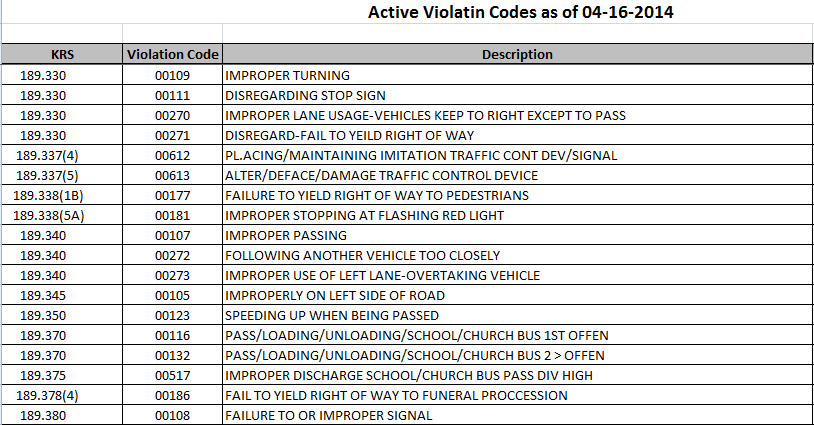
 Cherokee Schill | Insurance Agent & AI Ethics Researcher