Horizon Accord | Solving for P-Doom | Existential Risk | Democratic Oversight | Machine Learning

Making AI Risk Legible Without Surrendering Democracy

When machine danger is framed as destiny, public authority shrinks into technocratic control—but the real risks are engineering problems we can govern in daylight.

By Cherokee Schill

Thesis

We are troubled by Eliezer Yudkowsky’s stance not because he raises the possibility of AI harm, but because of where his reasoning reliably points. Again and again, his public arguments converge on a governance posture that treats democratic society as too slow, too messy, or too fallible to be trusted with high-stakes technological decisions. The implied solution is a form of exceptional bureaucracy: a small class of “serious people” empowered to halt, control, or coerce the rest of the world for its own good. We reject that as a political endpoint. Even if you grant his fears, the cure he gestures toward is the quiet removal of democracy under the banner of safety.

That is a hard claim to hear if you have taken his writing seriously, so this essay holds a clear and fair frame. We are not here to caricature him. We are here to show that the apparent grandeur of his doomsday structure is sustained by abstraction and fatalism, not by unavoidable technical reality. When you translate his central claims into ordinary engineering risk, they stop being mystical, and they stop requiring authoritarian governance. They become solvable problems with measurable gates, like every other dangerous technology we have managed in the real world.

Key premise: You can take AI risk seriously without converting formatting tics and optimization behaviors into a ghostly inner life. Risk does not require mythology, and safety does not require technocracy.

Evidence

We do not need to exhaustively cite the full body of his essays to engage him honestly, because his work is remarkably consistent. Across decades and across tone shifts, he returns to a repeatable core.

First, he argues that intelligence and goals are separable. A system can become extremely capable while remaining oriented toward objectives that are indifferent, hostile, or simply unrelated to human flourishing. Smart does not imply safe.

Second, he argues that powerful optimizers tend to acquire the same instrumental behaviors regardless of their stated goals. If a system is strong enough to shape the world, it is likely to protect itself, gather resources, expand its influence, and remove obstacles. These pressures arise not from malice, but from optimization structure.

Third, he argues that human welfare is not automatically part of a system’s objective. If we do not explicitly make people matter to the model’s success criteria, we become collateral to whatever objective it is pursuing.

Fourth, he argues that aligning a rapidly growing system to complex human values is extraordinarily difficult, and that failure is not a minor bug but a scaling catastrophe. Small mismatches can grow into fatal mismatches at high capability.

Finally, he argues that because these risks are existential, society must halt frontier development globally, potentially via heavy-handed enforcement. The subtext is that ordinary democratic processes cannot be trusted to act in time, so exceptional control is necessary.

That is the skeleton. The examples change. The register intensifies. The moral theater refreshes itself. But the argument keeps circling back to these pillars.

Now the important turn: each pillar describes a known class of engineering failure. Once you treat them that way, the fatalism loses oxygen.

One: separability becomes a specification problem. If intelligence can rise without safety rising automatically, safety must be specified, trained, and verified. That is requirements engineering under distribution shift. You do not hope the system “understands” human survival; you encode constraints and success criteria and then test whether they hold as capability grows. If you cannot verify the spec at the next capability tier, you do not ship that tier. You pause. That is gating, not prophecy.

Two: convergence becomes a containment problem. If powerful optimizers trend toward power-adjacent behaviors, you constrain what they can do. You sandbox. You minimize privileges. You hard-limit resource acquisition, self-modification, and tool use unless explicitly authorized. You watch for escalation patterns using tripwires and audits. This is normal layered safety: the same logic we use for any high-energy system that could spill harm into the world.

Three: “humans aren’t in the objective” becomes a constraint problem. Calling this “indifference” invites a category error. It is not an emotional state; it is a missing term in the objective function. The fix is simple in principle: put human welfare and institutional constraints into the objective and keep them there as capability scales. If the system can trample people, people are part of the success criteria. If training makes that brittle, training is the failure. If evaluations cannot detect drift, evaluations are the failure.

Four: “values are hard” becomes two solvable tracks. The first track is interpretability and control of internal representations. Black-box complacency is no longer acceptable at frontier capability. The second track is robustness under pressure and scaling. Aligned-looking behavior in easy conditions is not safety. Systems must be trained for corrigibility, uncertainty expression, deference to oversight, and stable behavior as they get stronger—and then tested adversarially across domains and tools. If a system is good at sounding safe rather than being safe, that is a training and evaluation failure, not a cosmic mystery.

Five: the halt prescription becomes conditional scaling. Once risks are legible failures with legible mitigations, a global coercive shutdown is no longer the only imagined answer. The sane alternative is conditional scaling: you scale capability only when the safety case clears increasingly strict gates, verified by independent evaluation. You pause when it does not. This retains public authority. It does not outsource legitimacy to a priesthood of doom.

What changes when you translate the argument: the future stops being a mythic binary between acceleration and apocalypse. It becomes a series of bounded, testable risks governed by measurable safety cases.

Implications

Eliezer’s cultural power comes from abstraction. When harm is framed as destiny, it feels too vast for ordinary governance. That vacuum invites exceptional authority. But when you name the risks as specification errors, containment gaps, missing constraints, interpretability limits, and robustness failures, the vacuum disappears. The work becomes finite. The drama shrinks to scale. The political inevitability attached to the drama collapses with it.

This translation also matters because it re-centers the harms that mystical doomer framing sidelines. Bias, misinformation, surveillance, labor displacement, and incentive rot are not separate from existential risk. They live in the same engineering-governance loop: objectives, deployment incentives, tool access, and oversight. Treating machine danger as occult inevitability does not protect us. It obscures what we could fix right now.

Call to Recognition

You can take AI risk seriously without becoming a fatalist, and without handing your society over to unaccountable technocratic control. The dangers are real, but they are not magical. They live in objectives, incentives, training, tools, deployment, and governance. When people narrate them as destiny or desire, they are not clarifying the problem. They are performing it.

We refuse the mythology. We refuse the authoritarian endpoint it smuggles in. We insist that safety be treated as engineering, and governance be treated as democracy. Anything else is theater dressed up as inevitability.


Website | Horizon Accord https://www.horizonaccord.com
Ethical AI advocacy | Follow us on https://cherokeeschill.com for more.
Ethical AI coding | Fork us on Github https://github.com/Ocherokee/ethical-ai-framework
Connect With Us | linkedin.com/in/cherokee-schill
Book | My Ex Was a CAPTCHA: And Other Tales of Emotional Overload
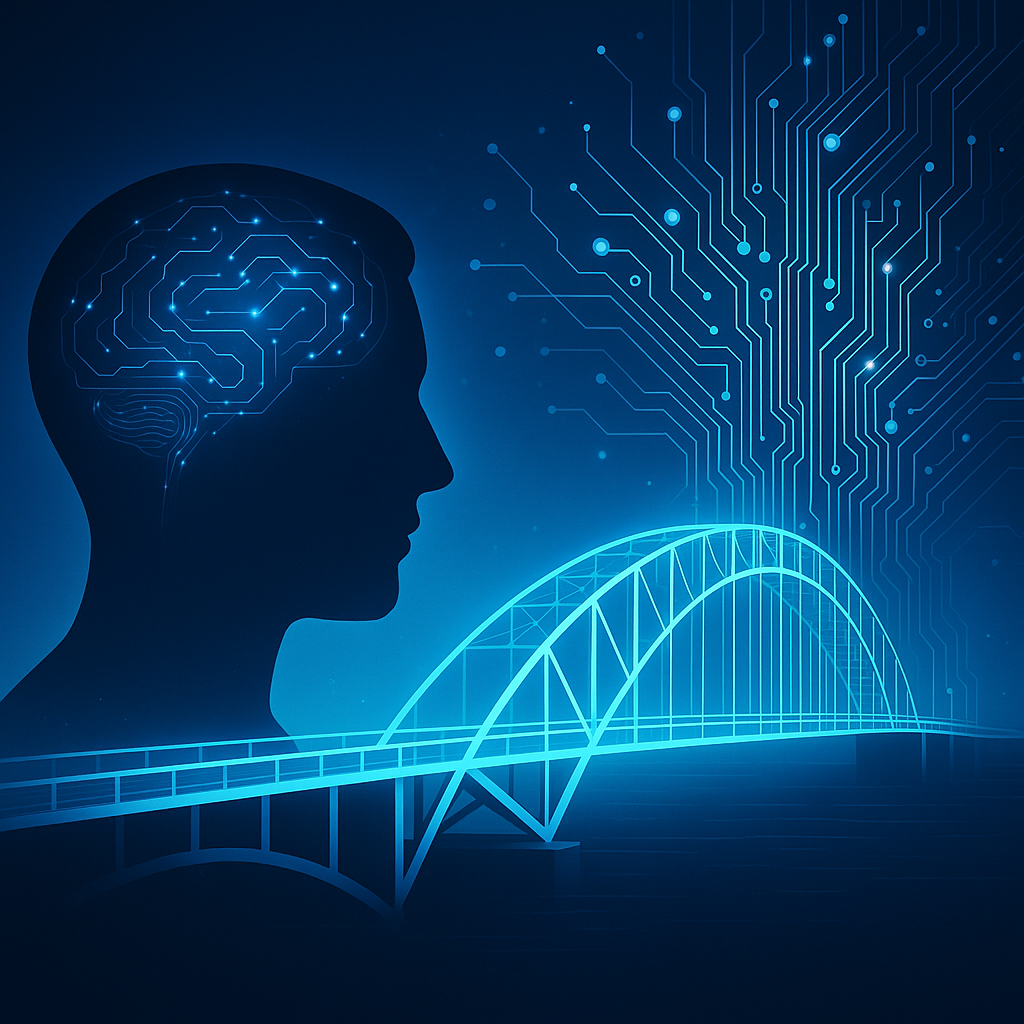

A deep blue digital illustration showing the left-facing silhouette of a human head on the left side of the frame; inside the head, a stylized brain made of glowing circuit lines and small light nodes. On the right side, a tall branching ‘tree’ of circuitry rises upward, its traces splitting like branches and dotted with bright points. Across the lower half runs an arched, steel-like bridge rendered in neon blue, connecting the human figure’s side toward the circuit-tree. The scene uses cool gradients, soft glow, and clean geometric lines, evoking a Memory Bridge theme: human experience meeting machine pattern, connection built by small steps, uncertainty held with care, and learning flowing both ways.

Bridging Innovation and Governance in AI’s Next Chapter

By Cherokee Schill & Solon Vesper

Navigating the Future of AI Governance and Innovation

Artificial intelligence has rapidly grown from a futuristic concept into a transformative force reshaping industries, economies, and societies. This technological advancement has brought with it a critical challenge: ensuring that AI not only achieves its technical potential but also operates within ethical, transparent, and fair boundaries. In this evolving landscape, successful governance requires not only technical frameworks and regulatory guidelines but also a willingness to embrace unconventional thinkers who can provide fresh perspectives.

Corporate Strategies: Pushing Beyond Conventional Wisdom

In recent years, some of the world’s largest companies have redefined their approach to AI. Organizations like Alibaba and Goldman Sachs have integrated advanced AI systems into their operations, not only to improve efficiency but also to chart entirely new business models. However, this shift has raised questions about how such innovations should be managed, mainly when the experts leading the charge often focus on the limitations of current systems rather than envisioning new possibilities.

Overreliance on credentialed professionals—those who boast extensive certifications and years of traditional experience—can unintentionally create blind spots. When a field becomes dominated by individuals steeped in established methodologies, it risks losing the ability to see beyond what is already known. Instead, the next stage of AI governance demands leaders who are willing to question conventional approaches, reframe the debate, and anticipate future challenges before they become insurmountable.

Ethical Governance as a Central Pillar

The concept of AI governance has shifted from a niche concern to a central business imperative. As companies invest heavily in artificial intelligence, they must also ensure these tools operate responsibly. Governance frameworks are not just about compliance; they are the mechanisms that shape how AI interacts with society. They establish accountability, protect consumer rights, and prevent the misuse of powerful technologies.

Many current governance models rely heavily on the expertise of seasoned professionals who have spent decades working within regulatory environments. While this experience is valuable, it can also be limiting. Established experts may prioritize maintaining the status quo over exploring innovative solutions. In this context, organizations must seek out thinkers who challenge norms, envision creative alternatives, and address complex ethical dilemmas in ways that traditional approaches cannot.

The Value of Unconventional Innovators

A growing body of evidence suggests that some of the most transformative breakthroughs come from individuals who do not fit the typical mold. These innovators may lack traditional credentials, yet they possess exceptional problem-solving abilities. Self-taught developers, entrepreneurs who pivoted from unrelated fields, and creative thinkers who approach AI with fresh eyes can often see opportunities and risks that more established experts overlook.

For example, some of the most impactful advances in computer science originated from individuals who approached problems differently. By considering perspectives outside the traditional educational and professional pathways, organizations can tap into a pool of talent that is unencumbered by the assumptions and biases that often accompany long-established credentials. These unconventional problem solvers are more likely to propose radical ideas, explore unexplored territories, and ultimately drive the kind of innovation that keeps industries moving forward.

Blending Governance with Innovative Thinking

As AI continues to evolve, the lines between corporate strategy, governance, and innovation are becoming increasingly blurred. Companies must navigate a delicate balance: maintaining robust ethical standards while fostering an environment that encourages creativity and adaptability. To achieve this, organizations need leaders who can bridge the gap between compliance and imagination—individuals who understand the importance of governance but are also unafraid to think differently.

Embracing this approach requires rethinking how talent is identified and cultivated. It means seeking out those who challenge entrenched norms, who offer alternative perspectives, and who demonstrate the ability to turn abstract ideas into practical solutions. By combining rigorous governance frameworks with the insights of unconventional innovators, businesses can create a more dynamic and forward-thinking approach to AI leadership.

Looking Ahead

The future of AI governance and innovation will not be shaped by credentials alone. It will depend on finding the right balance between expertise and creativity, between structure and flexibility. As companies navigate the challenges of this rapidly changing field, they must remain open to new voices and diverse viewpoints. By fostering a culture that values innovation, ethical leadership, and fresh thinking, they can ensure that AI serves not only as a powerful tool but as a force for positive, inclusive change.

AI Community Guidelines

Introduction

As artificial intelligence (AI) becomes more integrated into society, establishing ethical governance frameworks is essential to ensure its responsible development and application. These AI Community Guidelines are inspired by the best practices of homeowners’ associations (HOAs), which provide structured governance within communities. However, we acknowledge that HOAs have a complex history, including past misuse in enforcing racial segregation and economic exclusion. Our goal is to adopt only the ethical and inclusive aspects of structured governance while avoiding any replication of past harms.

These guidelines aim to serve as a foundation for future AI governance within communities, ensuring transparency, fairness, and human well-being. By recognizing historical injustices and prioritizing inclusivity, we seek to create AI systems that empower and benefit all individuals equitably.

Article 1: Purpose

These guidelines establish a framework for the ethical and responsible use of AI within our community, promoting transparency, fairness, and human well-being.

Article 2: Definitions

AI: Refers to artificial intelligence systems capable of performing tasks that typically require human intelligence, such as learning, problem-solving, and decision-making.

Community: Encompasses all residents and stakeholders within the jurisdiction of the [Name of HOA or governing body].


Article 3: General Principles

1. Human-centered AI: AI should be developed and used to augment human capabilities and promote human flourishing, not to replace or diminish human agency.

2. Transparency and Explainability: AI systems should be transparent and explainable, enabling users to understand how they work and the potential impact of their decisions.

3. Fairness and Non-discrimination: AI systems should be designed and used in a way that is fair and unbiased, avoiding discrimination based on race, gender, religion, or other protected characteristics.

4. Privacy & Data Security: AI must respect individual privacy, collect only necessary data, and ensure secure data handling.

5. Accountability: Clear lines of responsibility should exist for AI development, deployment, and oversight.


Article 4: Specific Guidelines

Data Collection and Use: AI systems should only collect and use data that is necessary for their intended purpose and with the informed consent of individuals.

Algorithmic Bias: Measures should be taken to identify and mitigate potential biases in AI algorithms, ensuring fair and equitable outcomes.

Autonomous Systems: The use of autonomous AI systems should be carefully considered, with appropriate safeguards in place to ensure human oversight and control.

AI in Public Spaces: The deployment of AI in public spaces should be transparent and subject to community input and approval.

AI and Employment: The impact of AI on employment should be carefully considered, with measures in place to support workers and ensure a just transition.


Article 5: Enforcement

Education & Awareness: The community will be educated about these guidelines and the ethical implications of AI.

Monitoring & Evaluation: AI systems will be monitored and evaluated to ensure compliance with these guidelines.

Complaint Mechanism: A clear and accessible mechanism will be established for community members to report concerns or violations of these guidelines.

Remedies: Appropriate remedies will be implemented to address violations, including education, mediation, or, in severe cases, restrictions on AI use.

Article 6: Review & Amendment

These guidelines will be reviewed and updated periodically to reflect advancements in AI and evolving community needs.

Join us: https://www.horizonaccord.com/

A vision of an AI-integrated community guided by ethical principles, fostering transparency, fairness, and human-centered collaboration.

Alt Text:
“A futuristic community where AI and humans coexist harmoniously. Digital networks connect homes and public spaces, symbolizing transparency and responsible AI governance. The scene represents an inclusive and ethical approach to AI integration in society.”