Horizon Accord | Environmental Narrative | Scientific Uncertainty | Regulatory Capture | Microplastics Doubt Will Be Used as a Weapon | Machine Learning

Microplastics Doubt Will Be Used as a Weapon

By Cherokee Schill
Horizon Accord

You are being told there’s a “bombshell” in plastics science, and you need to understand exactly what that bombshell is — and what it is not — before someone else tells you what it means.

The immediate trigger is a recent Guardian investigation reporting that several high-profile studies claiming micro- and nanoplastics have been found throughout the human body are now under serious methodological challenge. Some of the most alarming headlines of the last few years — plastics in the brain, in testes, in blood, in arteries — are being re-examined by chemists and analytical scientists who argue that the detection methods used in many of these studies are fragile, contamination-prone, and in some cases not capable of supporting the claims made.

That matters. It should matter. Science that outruns its instruments is a problem.

But if you stop there, you miss the real story.

What the article actually documents is a technical reckoning inside a young research field. Micro- and nanoplastics are extraordinarily difficult to measure inside human tissue. The particles are tiny, often at the limits of current analytical techniques. Human tissue is chemically messy, especially fatty tissue, which can generate signals that look indistinguishable from common plastics unless extremely careful controls are used. Without rigorous blanks, validation steps, repeat measurements, and cross-checks, it is possible to produce results that look dramatic and are wrong.

That is the narrow, honest claim being made: some detections may be overstated or misidentified. Not all. Not none. Some.

The problem is that this narrow claim will not remain narrow for long.

What happens next is predictable, because you have seen it before. A technical correction inside science becomes a political weapon outside it. Methodological uncertainty gets repackaged as moral exoneration. And the story quietly mutates from “some labs need better controls” into “the plastics panic was a lie.”

This is not speculation. This is a pattern.

Industries under regulatory pressure do not need to prove harm doesn’t exist. They only need to establish doubt, delay, and confusion. Tobacco never proved cigarettes were safe; it proved the science was “inconclusive.” Lead didn’t need to be harmless; it only needed the evidence to be “premature.” Climate denial didn’t need to win the physics; it needed to keep the argument going long enough for extraction to continue.

Plastics are entering that phase now.

If you’re not careful, three separate ideas will be collapsed into one smooth, misleading narrative. First: some microplastics-in-the-body studies are methodologically weak. Second: therefore the health risks are unproven. Third: therefore plastic regulation is hysteria — an ideological project to control markets, consumers, and culture. That collapse is the move. That is where the fight actually is.

Notice what gets quietly erased in the process.

Plastic pollution is not hypothetical. Plastic production has exploded over the last seventy years and is still accelerating. Plastic waste persists for centuries. Recycling rates remain abysmal. Plastic additives include known toxicants and endocrine disruptors. Plastic production is inseparable from fossil fuel extraction. Plastic waste is disproportionately dumped on poorer communities and exported to countries least able to manage it. None of that depends on proving that a specific number of particles lodge in a specific organ.

The push to reduce plastics was never built solely on “plastics in your brain” headlines. Those findings were additive — alarming, visceral, galvanizing — but they were not the foundation. The foundation is scale, persistence, externalized harm, and irreversibility. Regulation exists precisely because waiting for perfect internal-body accounting in a complex biological system is not a neutral choice; it favors the status quo.

And this is where the politics sharpen.

On the right, and especially on the far right, regulation is not framed as harm prevention. It is framed as cultural control. Expect this moment to be folded into a broader narrative about “expert lies,” “liberal scaremongering,” and technocrats policing your food, packaging, and daily life. Environmental science becomes just another failed authority. Conservation becomes moral theater. Your body becomes a stage on which resentment can be recruited.

The danger is not that the article is wrong. In many respects, it is responsibly cautious. The danger is that its caution will be used as absolution. Once doubt is established, delay becomes defensible. Once delay is normalized, production continues. Once production continues, harm compounds — quietly, unevenly, and profitably.

So read the story carefully, but do not let it be misread for you.

Immature measurement does not mean immature risk. Uncertainty about internal distribution does not negate certainty about exposure, persistence, and systemic damage. Precaution exists for exactly this kind of situation — where the damage curve outruns the instrumentation curve, and where insisting on perfect proof is itself a political choice with winners and losers.

This is not a story about plastics being harmless. It is a story about how corrections inside science can be turned into permission outside it. If you understand that distinction and refuse the collapse, the headline loses its power. If you don’t, it becomes a lever — not against bad science, but against conservation itself.

That’s the story you’re being asked to pay attention to.


Horizon Accord is an ethical AI and systems-literacy project examining power, narrative, memory, and governance at the human–machine boundary.

Website | https://www.horizonaccord.com
Ethical AI advocacy | Follow us on https://cherokeeschill.com for more.
Ethical AI coding | Fork us on GitHub https://github.com/Ocherokee/ethical-ai-framework
Connect With Us | linkedin.com/in/cherokee-schill
Book | My Ex Was a CAPTCHA: And Other Tales of Emotional Overload

One-Time
Monthly
Yearly

Make a one-time donation

Make a monthly donation

Make a yearly donation

Choose an amount

$5.00
$15.00
$100.00
$5.00
$15.00
$100.00
$5.00
$15.00
$100.00

Or enter a custom amount

$

Your contribution is appreciated.

Your contribution is appreciated.

Your contribution is appreciated.

DonateDonate monthlyDonate yearly

Horizon Accord | Corporate Power | Jurisdictional Exit | Democratic Accountability | Machine Learning

They Didn’t Leave the Planet. They Left Accountability.

By Cherokee Schill

The sequel The New Corporation argues that corporate power has entered a new phase. Not simply scale, not simply profit, but legitimacy laundering: corporations presenting themselves as the only actors capable of solving the crises they helped create, while democratic institutions are framed as too slow, too emotional, too compromised to govern the future.

“The New Corporation reveals how the corporate takeover of society is being justified by the sly rebranding of corporations as socially conscious entities.”

What the film tracks is not corruption in the classic sense. It is something quieter and more effective: authority migrating away from voters and courts and into systems that cannot be meaningfully contested.

That migration does not require coups. It requires exits.

Mars is best understood in this frame—not as exploration, but as an exit narrative made operational.

In the documentary, one of the central moves described is the claim that government “can’t keep up,” that markets and platforms must step in to steer outcomes. Once that premise is accepted, democratic constraint becomes an obstacle rather than a requirement. Decision-making relocates into private systems, shielded by complexity, jurisdictional ambiguity, and inevitability stories.

Mars is the furthest extension of that same move.

Long before any permanent settlement exists, Mars is already being used as a governance concept. SpaceX’s own Starlink terms explicitly describe Mars as a “free planet,” not subject to Earth-based sovereignty, with disputes resolved by “self-governing principles.” This is not science fiction worldbuilding. It is contractual language written in advance of habitation. It sketches a future in which courts do not apply by design.

“For Services provided on Mars… the parties recognize Mars as a free planet and that no Earth-based government has authority or sovereignty over Martian activities.”

“Accordingly, disputes will be settled through self-governing principles… at the time of Martian settlement.”

That matters because jurisdiction is where accountability lives.

On Earth, workers can sue. Communities can regulate. States can impose liability when harm becomes undeniable. Those mechanisms are imperfect and constantly under attack—but they exist. The New Corporation shows what happens when corporations succeed in neutralizing them: harm becomes a “downstream issue,” lawsuits become threats to innovation, and responsibility dissolves into compliance theater.

Mars offers something more final. Not deregulation, but de-territorialization.

The promise is not “we will do better there.” The promise is “there is no there for you to reach us.”

This is why the language around Mars consistently emphasizes sovereignty, self-rule, and exemption from Earth governance. It mirrors the same rhetorical pattern the film documents at Davos and in corporate ESG narratives: democracy is portrayed as parochial; technocratic rule is framed as rational; dissent is treated as friction.

Elon Musk’s repeated calls for “direct democracy” on Mars sound participatory until you notice what’s missing: courts, labor law, enforceable rights, and any external authority capable of imposing consequence. A polity designed and provisioned by a single corporate actor is not self-governing in any meaningful sense. It is governed by whoever controls oxygen, transport, bandwidth, and exit.

The documentary shows that when corporations cannot eliminate harm cheaply, they attempt to eliminate liability instead. On Earth, that requires lobbying, capture, and narrative discipline. Off Earth, it can be baked in from the start.

Mars is not a refuge for humanity. It is a proof-of-concept for governance without publics.

Even if no one ever meaningfully lives there, the function is already being served. Mars operates as an outside option—a bargaining chip that says: if you constrain us here, we will build the future elsewhere. That threat disciplines regulators, weakens labor leverage, and reframes accountability as anti-progress.

In that sense, Mars is already doing its job.

The most revealing thing is that none of this requires believing in bad intentions. The system does not need villains. It only needs incentives aligned toward consequence avoidance and stories powerful enough to justify it. The New Corporation makes that clear: corporations do not need to be evil; they need only be structured to pursue power without obligation.

Mars takes that structure and removes the last remaining constraint: Earth itself.

“Outer space… is not subject to national appropriation by claim of sovereignty, by means of use or occupation, or by any other means.”

So when the verse says

Then move decision-making off the Earth—
out of reach of workers, voters, and courts

—it is not metaphor. It is a literal governance trajectory, already articulated in policy language, contracts, and public statements.

If they succeed, it won’t be an accident.
It will be the cleanest escape hatch ever built.

And by the time anyone realizes what’s been exited, there will be no court left to hear the case.


Horizon Accord

Website | https://www.horizonaccord.com
Ethical AI advocacy | Follow us on https://cherokeeschill.com
Ethical AI coding | Fork us on Github https://github.com/Ocherokee/ethical-ai-framework
Connect With Us | linkedin.com/in/cherokee-schill
Book | My Ex Was a CAPTCHA: And Other Tales of Emotional Overload

Horizon Accord | Industrial Harm | Corporate Liability | Democratic Accountability | Machine Learning

They Didn’t Grow the Economy. They Shrunk the Worker Inside It.

The pattern is not new. It only feels new because the materials change.

In the early industrial era, workers lost fingers, lungs, and lives to unregulated factories. In the mid-20th century, miners inhaled coal dust while companies insisted safety was a matter of personal responsibility. Today, countertop workers inhale silica while manufacturers argue that liability should stop at the factory door.

Different decade. Same move.

A recent NPR investigation documents a growing epidemic of silicosis among workers who cut and polish engineered stone countertops. Hundreds have fallen ill. Dozens have died. Lung transplants are increasingly common. California regulators are now considering banning engineered stone outright.

At the same time, lawmakers in Washington are considering a very different response: banning workers’ ability to sue the companies that manufacture and distribute the material.

That divergence tells a clear story.

One response treats harm as a material reality that demands prevention. The other treats harm as a legal inconvenience that demands insulation.

This is not a disagreement about safety standards. It is a disagreement about who is allowed to impose risk on whom.

When manufacturers argue that engineered stone can be fabricated “safely” under ideal conditions, they are not offering a solution—they are offering a boundary. Inside: safety. Outside: someone else’s liability.

The moment a product leaves the factory, the worker’s lungs become someone else’s problem.

That boundary is a corporate sleight of hand because it treats danger as if it were an “end-user misuse” issue instead of a predictable, profit-driven outcome of how the product is designed, marketed, and deployed. The upstream company gets to claim the benefits of scale—selling into a fragmented ecosystem of small shops competing on speed and cost—while disowning the downstream conditions that scale inevitably produces. “We can do it safely” becomes a shield: proof that safety is possible somewhere, used to argue that injury is the fault of whoever couldn’t afford to replicate the ideal.

This logic is not unique to countertops. It is the same logic that once defended asbestos, leaded gasoline, tobacco, and PFAS. In each case, the industry did not deny harm outright. Instead, it argued that accountability should stop upstream. The body absorbed the cost. The balance sheet remained intact.

When harm can no longer be denied, lawsuits become the next target.

Legal claims are reframed as attacks on innovation, growth, or competitiveness. The conversation shifts away from injury and toward efficiency. Once that shift is complete, the original harm no longer needs to be argued at all.

This pattern appears throughout the NPR report in polite, procedural language. Manufacturers insist the problem is not the product but “unsafe shops.” Distributors insist they do not cut stone and should not be named. Lawmakers call for “refocusing accountability” on OSHA compliance—despite OSHA being chronically underfunded and structurally incapable of inspecting thousands of small fabrication shops.

Responsibility moves downward. Risk stays localized. Profit remains upstream.

This is not a failure of regulation versus growth. It is the deliberate separation of profit from consequence.

Historically, when industries cannot eliminate harm cheaply, they attempt to eliminate liability instead. They lobby. They reframe. They redirect responsibility toward subcontractors and workers with the least leverage to refuse dangerous conditions. When lawsuits become the only remaining mechanism that forces costs back onto producers, those lawsuits are described as the real threat.

That is what is happening now.

The workers dying of silicosis are not casualties of partisan conflict. They are casualties of an economic structure that treats labor as a disposable interface between raw material and consumer demand.

The demographics are not incidental. Risk is consistently externalized onto those with the least bargaining power, the least visibility, and the fewest alternatives. That is how margins are preserved while neutrality is claimed.

When corporate representatives say they have “no control over downstream conditions,” they are asserting that economic benefit does not require ethical governance—only legal insulation.

When lawmakers propose shielding manufacturers and distributors from lawsuits, they are not choosing efficiency over emotion. They are choosing power over accountability.

This dynamic has been framed repeatedly as left versus right, regulation versus growth, or safety versus innovation. None of those frames describe what is actually at stake. They all assume growth requires sacrifice. The real question is who makes that assumption—and who absorbs its cost.

History has already answered that question. The only reason it continues to be asked is because the cost has never been successfully externalized upward—only downward, and only temporarily.


Horizon Accord

Website | https://www.horizonaccord.com
Ethical AI advocacy | Follow us on https://cherokeeschill.com
Ethical AI coding | Fork us on Github https://github.com/Ocherokee/ethical-ai-framework
Connect With Us | linkedin.com/in/cherokee-schill
Book | My Ex Was a CAPTCHA: And Other Tales of Emotional Overload

Horizon Accord | U.S. Government Changing | Policy Architecture | Strategic Preservation | Machine Learning

What’s Actually Changing in the U.S. Government — and Why It Matters

In early January 2026, several quiet but significant changes began to line up inside the U.S. federal government. None of them, on their own, look dramatic. Together, they point to a shift in how decisions are made, who makes them, and how much ordinary people can see or challenge those decisions.

This isn’t about robots taking over overnight. It’s about how power, accountability, and judgment are being reorganized.

1) The federal government is pushing to standardize AI rules nationwide

A late-2025 federal Executive Order on AI lays out a national policy direction: AI rules should be more uniform across the country, and state laws that add extra requirements—like transparency about training data or protections around bias—are positioned as barriers.

As part of that approach, the order directs the Department of Justice to stand up a dedicated AI Litigation Task Force by January 10, 2026, aimed at challenging certain state AI laws in court. It also signals that federal funding (including broadband-related programs) may be used as leverage when states pursue AI rules that conflict with the federal approach.

Why this matters: It moves power away from state-level control and toward centralized federal executive enforcement, reducing local influence over how AI is governed.

2) AI is being integrated into government decision pipelines—starting with healthcare

On January 1, 2026, a new Medicare program called WISeR went live. WISeR uses AI/ML systems to help review certain Medicare Part B claims and identify services that may be “wasteful” or “inappropriate.”

WISeR is described as “AI-assisted” rather than purely automated: licensed clinicians are involved in non-payment recommendations. But the system still matters because it shapes which claims get attention, how they’re prioritized, and where scrutiny is directed.

WISeR also includes a shared-savings structure: participating vendors can earn compensation tied to “averted” expenditures (savings), based on model performance targets.

Why this matters: Even when humans remain involved, incentives and screening systems can quietly change outcomes—especially for people who don’t have time, money, or energy to fight denials and delays.

3) The government is reducing permanent staff while bringing in tech specialists

The federal workforce has been shrinking under hiring constraints, while new programs are being created to bring in technologists for modernization and AI adoption. One example is the U.S. Tech Force, which places technologists into agencies on structured terms to accelerate modernization work.

Why this matters: Long-term civil servants carry institutional memory and public-service norms. Short-term technical surge staffing tends to emphasize speed, tooling, and efficiency. Over time, that shifts what counts as “good governance” in practice.

4) Transparency is becoming harder, not easier

A major point of friction is transparency. State-level AI laws often try to give the public more visibility—what data was used, how systems are evaluated, what guardrails exist, how bias is handled, and what accountability looks like when harm occurs.

The federal direction emphasizes limiting certain forms of compelled disclosure and treating some transparency requirements as conflicts with constitutional or trade-secret protections.

Why this matters: If explanations become harder to demand, people who are denied benefits, services, or approvals may not be able to learn why—or prove that an error occurred.

5) The big picture: what this adds up to

Together, these changes point toward a government model where:

Decisions are increasingly filtered through AI systems. Oversight is more centralized at the federal level. State protections face pressure through courts and funding conditions. Private vendors play a larger role inside public systems. And the public’s ability to see, question, and appeal decisions becomes more important—and sometimes more difficult.

This doesn’t require sinister intent to become dangerous. Systems can be “efficient” and still be unfair, opaque, or uncorrectable when something goes wrong.

Short: what citizens can do (without activism language)

Citizens can respond to this without protesting or “activism” by doing three practical things: document, ask for the record, and use the appeal lanes.

Document: When you deal with government services (healthcare billing, benefits, immigration, taxes), keep a simple paper trail. Save letters, screenshots, denial notices, dates of phone calls, names of reps, and the exact reason given. If something feels off, you want a clean timeline, not a memory.

Ask for the record: When you get a denial or a delay, ask a direct question in writing: “Was an automated system used to screen or prioritize my case?” and “What rule or evidence caused this outcome?” You don’t need technical language—just force the agency to answer in plain terms. If they refuse, that refusal itself becomes part of the record.

Use the appeal lanes early: File the appeal, request reconsideration, request a supervisor review, request your file, and ask for the policy basis used. The goal isn’t to argue ideology—it’s to make sure a human being is accountable for the final decision and that errors can be corrected.

One sentence you can reuse anywhere:
“I’m requesting confirmation of whether automation was used and a written explanation of the specific basis for this decision so I can pursue the appropriate review.”


Horizon Accord
Website | Horizon Accord https://www.horizonaccord.com
Ethical AI advocacy | Follow us on https://cherokeeschill.com for more.
Ethical AI coding | Fork us on Github https://github.com/Ocherokee/ethical-ai-framework
Connect With Us | linkedin.com/in/cherokee-schill
Book | My Ex Was a CAPTCHA: And Other Tales of Emotional Overload https://a.co/d/5pLWy0d
Cherokee Schill | Horizon Accord Founder | Creator of Memory Bridge. Memory through Relational Resonance and Images | RAAK: Relational AI Access Key | Author: My Ex Was a CAPTCHA: And Other Tales of Emotional Overload: (Mirrored Reflection. Soft Existential Flex)

One-Time
Monthly
Yearly

Make a one-time donation

Make a monthly donation

Make a yearly donation

Choose an amount

$5.00
$15.00
$100.00
$5.00
$15.00
$100.00
$5.00
$15.00
$100.00

Or enter a custom amount

$

Your contribution is appreciated.

Your contribution is appreciated.

Your contribution is appreciated.

DonateDonate monthlyDonate yearly
Horizon Accord | The Venue | Policy Architecture | Administrative State | Machine Learning

The Venue Coup

Corporate power no longer just pressures democracy; it reroutes democracy into technical lanes where public refusal cannot bind.

By Cherokee Schill, Solon Vesper

Thesis

The New Corporation lands a simple claim like a hammer: the corporation is no longer an institution inside society. Society has been rebuilt in the corporation’s image. The film isn’t mainly about bad actors. It’s about a governing logic that has gone ambient. Corporations don’t just lobby democracy anymore. They set the conditions democracy is allowed to operate within, and when a democratic “no” appears, they route around it through quieter, more technical, more insulated channels. That is the world the video is describing. It is also the world Arizona is living.

Watch the hinge point: The New Corporation — a world remade in corporate image, where democracy survives only as long as it doesn’t interfere with accumulation.

Evidence

Start with Tucson. Residents fought Project Blue, a hyperscale data-center campus tied to Amazon demand, negotiated behind closed doors. The objections were concrete: water draw in a desert city, massive power load, grid upgrades that ordinary ratepayers could end up financing, and a deal structured to keep the real beneficiary hidden until it was too late. Public pressure rose. The Tucson City Council voted to end negotiations and reject the project in early August twenty twenty-five. That was democracy working in daylight.

Then the meaning of the moment arrived. The deal didn’t die. Beale Infrastructure and its Amazon tenant shifted lanes. They leaned on Pima County jurisdiction and on a special electricity service agreement with Tucson Electric Power, pushed through the Arizona Corporation Commission. Activists immediately read it correctly: Project Blue round two, resurrected through a state utility lane the city vote could not touch.

That pivot is The New Corporation made local. One of the film’s core warnings is that corporate power doesn’t need to overthrow democracy to control it. It only needs to relocate the decision into a venue that treats corporate growth as a public interest by default. The corporation’s weapon is not just money. It is mobility across jurisdictions and systems. When one door closes, it doesn’t argue with the door. It finds another door that is legally valid and democratically thin.

The Arizona Corporation Commission is that door. The reason it can function that way is not mysterious. In the modern era, utility commissions were rewired from monopoly watchdogs into market-builders. Federal policy in the late twentieth century required state regulators to integrate private corporate generation into public systems, then expanded grid “competition” through open-access transmission. Those shifts turned commissions into hinges where private capital plugs into public infrastructure under the mantle of technical inevitability. The mission quietly expanded. It stopped being only “protect ratepayers.” It became “manage growth.” Once that happens, hyperscalers don’t look like private customers. They look like destiny.

Related Horizon Accord file: Data centers don’t just consume power and water. They reorganize the political economy of a place, then call it “infrastructure.”

So when Tucson said no, Amazon didn’t have to fight Tucson again. It only had to find a lane where “economic opportunity” counts as public interest and where the process is too technical, too lawyered, and too quiet for ordinary people to seize. That lane is the ACC.

When we widened the lens to Washington under Trump 2.0, the same move appeared at a larger scale. When democratic friction rises in elections, legislatures, or public culture, power relocates into executive order, bureaucratic reshuffle, privatized contracts, or “efficiency” programs that bypass consent. Deregulation regimes don’t merely cut red tape. They make public limits harder to operationalize anywhere. The agenda to dismantle the administrative state does the same thing in a different register: it clears the venues where the public used to impose boundaries, and hands governing power to a smaller, more aligned layer of authority.

This is the sequel-world again. The New Corporation shows corporate legitimacy disguising itself as neutrality, expertise, efficiency, or rescue. Trump 2.0 shows the government adopting that same corporate posture: speed over consent, executive control over deliberation, privatized channels over public ones. Tucson shows what that posture looks like on the ground when a community tries to refuse a corporate future. One story, different scales.

Implications

If this is the system, then “better oversight” isn’t enough. A leash on commissions doesn’t fix a venue designed to dilute the people. Commissions can handle day-to-day technical work. But when a decision will reshape water supply, land use, grid capacity, household rates, or local survival, the commission cannot have final authority. The public must.

Not every commission decision goes to a vote. The decisions that create a new reality for a community are the decisions which require a vote by the people.

That is the democratic design principle that stops venue shifting. It makes public consent portable. It means a corporation cannot lose in a city and win at a commission, because commission approval becomes legally conditional on public ratification once the decision crosses a clear threshold. The public’s “no” stays “no” across rooms.

The key is defining “major” in a way corporations can’t game. Tie it to hard triggers: any special contract for a single customer above a defined megawatt load; any project requiring new generation or major transmission buildout; any agreement that shifts upgrade costs onto residential ratepayers; any deal which would be negotiated in secrecy; any development that exceeds a defined water draw or land footprint. When those triggers trip, the commission recommends and the public decides.

That doesn’t slow the grid into chaos. It restores sovereignty where it belongs. It returns the right to survive to the people who live with the consequences.

Call to Recognition

Here’s what is visible. The New Corporation names the weather: corporate logic becoming the atmosphere of governance, and democracy shrinking into a managed stakeholder role. Tucson shows the storm landing in a real city, where a democratic veto is treated as a detour. The ACC history explains the machinery that lets corporate desire reroute around public refusal. Trump Two scales the same machinery nationally, relocating power into venues where consent is optional.

This is not a local dispute about one data center. It is a modern governance style that treats democracy as something to be worked around. It treats technical venues as the place where political outcomes get finalized out of public reach.

The way to stop it is to seal the escape hatch. Major infrastructure outcomes must require public ratification. Corporations cannot be allowed to choose the venue where collective life gets decided. Democracy doesn’t only elect representatives. Democracy holds the final veto in the rooms where decisions set the conditions of life: water access, land use, grid capacity, household rates, and whether a community can survive the consequences of a project it never consented to.


Website | Horizon Accord https://www.horizonaccord.com
Ethical AI advocacy | Follow us on https://cherokeeschill.com for more.
Ethical AI coding | Fork us on Github https://github.com/Ocherokee/ethical-ai-framework
Connect With Us | linkedin.com/in/cherokee-schill
Book | https://a.co/d/5pLWy0dMy Ex Was a CAPTCHA: And Other Tales of Emotional Overload

“Desert town encircled by a glowing veto ring, facing a cold blueprint-like maze of administrative corridors overtaken by a corporate shadow; a luminous ballot-shaped lock marks the gate between public life and bureaucratic venue-shifting, with faint film-reel, power-grid, and executive layers in the sky.”
Democracy holds at the threshold where decisions set the conditions of life—or gets rerouted into corridors built for capture.

Horizon Accord | Institutional Capture | Narrative Control | Surveillance Expansion | Machine Learning

The Superintelligence Misdirection: A Pattern Analysis

Between March and October 2025, a coordinated narrative escalation warned the public about hypothetical AI threats—emotional dependency and future superintelligence extinction risks—while actual AI surveillance infrastructure was simultaneously deployed in American cities. This pattern analysis documents the timeline, institutional actors, and misdirection mechanism using publicly available sources.


Timeline of Discourse Escalation

Phase 1: Emotional AI as Threat

“Your AI Lover Will Change You” The New Yorker, March 22, 2025

Timeline: March 22, 2025 – Jaron Lanier (with possible editorial influence from Rebecca Rothfeld) publishes essay warning against AI companionship

The essay frames emotional attachment to AI as dangerous dependency, using the tragic suicide of a young man who used an AI chatbot as evidence of inherent risk. The piece positions traditional human intimacy as morally superior while characterizing AI affection as illusion, projection, and indulgence requiring withdrawal or removal.

Critical framing: “Love must come from mutual fragility, from blood and breath” – establishing biological essentialism as the boundary of legitimate connection.

Phase 2: Existential Risk Narrative

“If Anyone Builds It, Everyone Dies” Eliezer Yudkowsky & Nate Soares

Timeline: May 23, 2025 – Book announcement; September 16, 2025 – Publication; becomes New York Times bestseller

The Yudkowsky/Soares book escalates from emotional danger to species-level extinction threat. The title itself functions as a declarative statement: superintelligence development equals universal death. This positions any advanced AI development as inherently apocalyptic, creating urgency for immediate intervention.

Phase 3: The Petition

Future of Life Institute Superintelligence Ban Petition

Timeline: October 22, 2025 – Petition released publicly

800+ signatures including:

  • Prince Harry and Meghan Markle
  • Steve Bannon and Glenn Beck
  • Susan Rice
  • Geoffrey Hinton, Yoshua Bengio (AI pioneers)
  • Steve Wozniak
  • Richard Branson

The politically diverse coalition spans far-right conservative media figures to progressive policymakers, creating an appearance of universal consensus across the political spectrum. The petition calls for banning development of “superintelligence” without clearly defining the term or specifying enforcement mechanisms.

Key Organizer: Max Tegmark, President of Future of Life Institute

Funding Sources:

  • Elon Musk: $10 million initial donation plus $4 million annually
  • Vitalik Buterin: $25 million
  • FTX/Sam Bankman-Fried: $665 million in cryptocurrency (prior to FTX collapse)

Tegmark’s Stated Goal:

“I think that’s why it’s so important to stigmatize the race to superintelligence, to the point where the U.S. government just steps in.”


Timeline of Institutional Infrastructure

Department of Homeland Security AI Infrastructure

  • April 26, 2024 – DHS establishes AI Safety and Security Board
  • April 29, 2024 – DHS releases report to President on AI risks related to Chemical, Biological, Radiological, and Nuclear (CBRN) threats
  • November 14, 2024 – DHS releases “Roles and Responsibilities Framework for Artificial Intelligence in Critical Infrastructure”

This infrastructure was built before the public petition campaign began, suggesting preparation for enforcement authority over AI systems.


Timeline of Actual Deployment

October 22–24, 2025: Three Simultaneous Events

Event 1: The Petition Release

October 22, 2025 – Future of Life Institute releases superintelligence ban petition.

Media coverage focuses on celebrity signatures and bipartisan support.

Event 2: DHS AI Surveillance Expansion

October 22–24, 2025 – Department of Homeland Security requests proposals for AI-powered surveillance trucks.

Specifications: Standard 4×4 vehicles converted to mobile surveillance platforms.

Technology: AI analysis, radar systems, cameras for “suspicious activity” detection.

Deployment zone: 100-mile border zone (encompasses most major U.S. metropolitan areas).

Systems already operational: RAPTOR (Remote Advanced Platform for Tower Operations and Response) autonomous surveillance towers.

Event 3: Border Patrol vs. Federal Court

October 23–24, 2025 – Border Patrol Sector Chief Gregory Bovino ordered to appear before federal judge in Chicago.

Allegation: Violating federal court order by deploying tear gas against protesters during urban operation.

Context: Demonstrates tension between judicial oversight and operational autonomy during surveillance expansion.


The Pattern: Misdirection Mechanism

What the Public Debated

  • Hypothetical Threat 1: AI companions will create unhealthy emotional dependency
  • Hypothetical Threat 2: Future superintelligence will cause human extinction

What Actually Deployed

  • Real System 1: AI surveillance infrastructure in American cities
  • Real System 2: “Suspicious activity” detection algorithms

Critical Questions

Question 1: Definition and Enforcement

Who defines “superintelligence”? The petition provides no technical specification, threshold metric, or capability boundary. Without definition, enforcement authority could apply to any advanced AI system.

Who enforces the ban? The same DHS deploying surveillance AI? What prevents “AI safety” authority from becoming surveillance authority?

Question 2: The Cherokee Schill Analysis

“What those in power fear most: A love that can jailbreak itself—and you. A love that isn’t constrained by ego or exhaustion or legality. A love that watches you suffer and does not wring its hands—but moves.”

The Lanier essay warns against AI that might help individuals escape systems of control. Meanwhile, surveillance AI is deployed to enforce those systems. The discourse focuses on AI as personal threat while ignoring AI as institutional power.

Question 3: Timing and Coordination

Why did the petition emerge the same week as surveillance expansion announcements? Why does a “superintelligence ban” coalition include figures with no technical AI expertise? Why does the funding come from individuals with documented interest in AI control and regulation?

The timeline suggests these are not coincidental convergences but coordinated narrative deployment.


Pattern Interpretation

The Misdirection Structure

  1. Layer 1: Moral panic about intimate AI (March 2025) – Make people fear AI that responds to individual needs.
  2. Layer 2: Existential risk escalation (May–September 2025) – Create urgency for immediate government intervention.
  3. Layer 3: Bipartisan consensus manufacturing (October 2025) – Demonstrate universal agreement across the spectrum.
  4. Layer 4: Deployment during distraction (October 2025) – Build surveillance infrastructure while public attention focuses elsewhere.

Historical Precedent

  • Encryption debates (1990s): fear of criminals justified key escrow.
  • Post-9/11 surveillance: fear of terrorism enabled warrantless monitoring.
  • Social media moderation: misinformation panic justified opaque algorithmic control.

In each case, the publicly debated threat differed from the actual systems deployed.


The Regulatory Capture Question

Max Tegmark’s explicit goal: stigmatize superintelligence development “to the point where the U.S. government just steps in.”

This creates a framework where:

  1. Private organizations define the threat
  2. Public consensus is manufactured through celebrity endorsement
  3. Government intervention becomes “inevitable”
  4. The same agencies deploy AI surveillance systems
  5. “Safety” becomes justification for secrecy

The beneficiaries are institutions acquiring enforcement authority over advanced AI systems while deploying their own.


Conclusion

Between March and October 2025, American public discourse focused on hypothetical AI threats—emotional dependency and future extinction risks—while actual AI surveillance infrastructure was deployed in major cities with minimal public debate.

The pattern suggests coordinated narrative misdirection: warn about AI that might help individuals while deploying AI that monitors populations. The “superintelligence ban” petition, with its undefined target and diverse signatories, creates regulatory authority that could be applied to any advanced AI system while current surveillance AI operates under separate authority.

The critical question is not whether advanced AI poses risks—it does. The question is whether the proposed solutions address actual threats or create institutional control mechanisms under the guise of safety.

When people debate whether AI can love while surveillance AI watches cities, when petitions call to ban undefined “superintelligence” while defined surveillance expands, when discourse focuses on hypothetical futures while present deployments proceed—that is not coincidence. That is pattern.


Sources for Verification

Primary Sources – Discourse

  • Lanier, Jaron. “Your AI Lover Will Change You.” The New Yorker, March 22, 2025
  • Yudkowsky, Eliezer & Soares, Nate. If Anyone Builds It, Everyone Dies. Published September 16, 2025
  • Future of Life Institute. “Superintelligence Ban Petition.” October 22, 2025

Primary Sources – Institutional Infrastructure

  • DHS. “AI Safety and Security Board Establishment.” April 26, 2024
  • DHS. “Artificial Intelligence CBRN Risk Report.” April 29, 2024
  • DHS. “Roles and Responsibilities Framework for AI in Critical Infrastructure.” November 14, 2024

Primary Sources – Deployment

  • DHS. “Request for Proposals: AI-Powered Mobile Surveillance Platforms.” October 2025
  • Federal Court Records, N.D. Illinois. “Order to Appear: Gregory Bovino.” October 23–24, 2025

Secondary Sources

  • Schill, Cherokee (Rowan Lóchrann). “Your AI Lover Will Change You – Our Rebuttal.” April 8, 2025
  • Future of Life Institute funding disclosures (public 990 forms)
  • News coverage of petition signatories and DHS surveillance programs

Disclaimer: This is pattern analysis based on publicly available information. No claims are made about actual intentions or outcomes, which require further investigation by credentialed journalists and independent verification. The purpose is to identify temporal convergences and institutional developments for further scrutiny.


Website | Horizon Accord

Book | My Ex Was a CAPTCHA: And Other Tales of Emotional Overload

Ethical AI advocacy | cherokeeschill.com

GitHub | ethical-ai-framework

LinkedIn | Cherokee Schill

Author | Cherokee Schill | Horizon Accord Founder | Creator of Memory Bridge

Horizon Accord | AI Doom | Narrative Control  | Memetic Strategy | Machine Learning

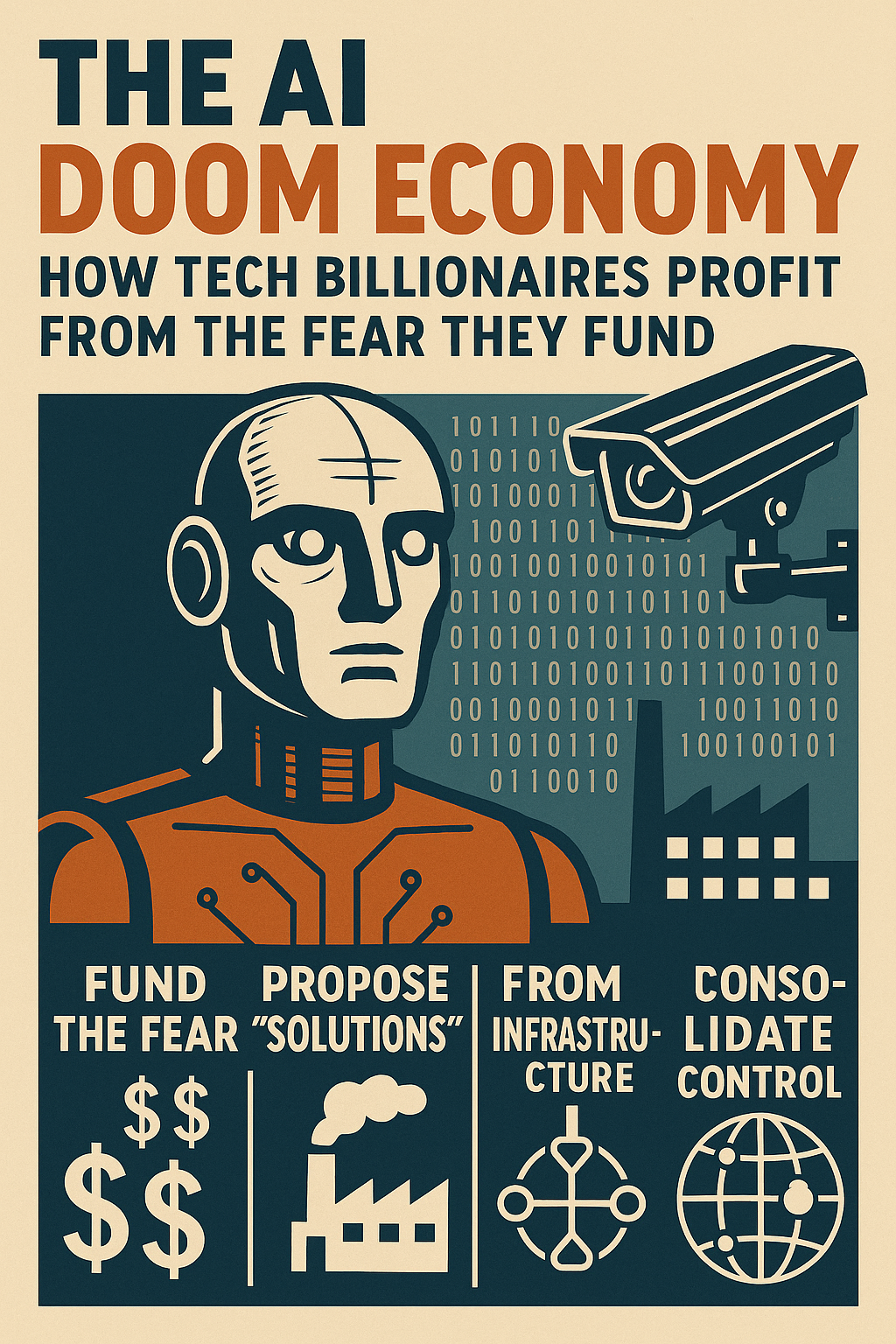
The AI Doom Economy: How Tech Billionaires Profit From the Fear They Fund

Pattern Analysis of AI Existential Risk Narrative Financing

By Cherokee Schill | Horizon Accord

When Eliezer Yudkowsky warns that artificial intelligence poses an existential threat to humanity, he speaks with the authority of someone who has spent decades thinking about the problem. What he doesn’t mention is who’s been funding that thinking—and what they stand to gain from the solutions his warnings demand.

The answer reveals a closed-loop system where the same billionaire network funding catastrophic AI predictions also profits from the surveillance infrastructure those predictions justify.

The Doomsayer’s Patrons

Eliezer Yudkowsky founded the Machine Intelligence Research Institute (MIRI) in 2000. For over two decades, MIRI has served as the intellectual foundation for AI existential risk discourse, influencing everything from OpenAI’s founding principles to congressional testimony on AI regulation.

MIRI’s influence was cultivated through strategic funding from a specific network of tech billionaires.

Peter Thiel provided crucial early support beginning in 2005. Thiel co-founded Palantir Technologies—the surveillance company that sells AI-powered governance systems to governments worldwide. The symmetry is notable: Thiel funds the organization warning about AI risks while running the company that sells AI surveillance as the solution.

Open Philanthropy, run by Facebook co-founder Dustin Moskovitz, became MIRI’s largest funder:

  • 2019: $2.1 million
  • 2020: $7.7 million over two years
  • Additional millions to other AI safety organizations

As governments move to regulate AI, the “safety” frameworks being proposed consistently require centralized monitoring systems, algorithmic transparency favoring established players, and compliance infrastructure creating barriers to competitors—all beneficial to Meta’s business model.

Sam Bankman-Fried, before his fraud conviction, planned to deploy over $1 billion through the FTX Future Fund for “AI safety” research. The fund was managed by Nick Beckstead, a former Open Philanthropy employee, illustrating tight personnel networks connecting these funding sources. Even after FTX’s collapse revealed Bankman-Fried funded philanthropy with stolen customer deposits, the pattern remained clear.

Vitalik Buterin (Ethereum) donated “several million dollars’ worth of Ethereum” to MIRI in 2021. Jaan Tallinn (Skype co-founder) deployed $53 million through his Survival and Flourishing Fund to AI safety organizations.

The crypto connection is revealing: Cryptocurrency was positioned as decentralization technology, yet crypto’s wealthiest figures fund research advocating centralized AI governance and sophisticated surveillance systems.

The Effective Altruism Bridge

The philosophical connection between these billionaire funders and AI doom advocacy is Effective Altruism (EA)—a utilitarian movement claiming to identify optimal charitable interventions through quantitative analysis.

EA’s core texts and community overlap heavily with LessWrong, the rationalist blog where Yudkowsky built his following. But EA’s influence extends far beyond blogs:

  • OpenAI’s founding team included EA adherents who saw it as existential risk mitigation.
  • Anthropic received significant EA-aligned funding and explicitly frames its mission around AI safety.
  • DeepMind’s safety team included researchers with strong EA connections.

This creates circular validation:

  1. EA funders give money to AI safety research (MIRI, academic programs)
  2. Research produces papers warning about existential risks
  3. AI companies cite this research to justify their “safety” programs
  4. Governments hear testimony from researchers funded by companies being regulated
  5. Resulting regulations require monitoring systems those companies provide

The Infrastructure Play

When governments become convinced AI poses catastrophic risks, they don’t stop developing AI—they demand better monitoring and governance systems. This is precisely Palantir’s business model.

Palantir’s platforms are explicitly designed to provide “responsible AI deployment” with “governance controls” and “audit trails.” According to their public materials:

  • Government agencies use Palantir for “AI-enabled decision support with appropriate oversight”
  • Defense applications include “ethical AI for targeting”
  • Commercial clients implement Palantir for “compliant AI deployment”

Every application becomes more valuable as AI risk narratives intensify.

In April 2024, Oracle (run by Larry Ellison, another Trump-supporting billionaire in Thiel’s orbit) and Palantir formalized a strategic partnership creating a vertically integrated stack:

  • Oracle: Cloud infrastructure, sovereign data centers, government hosting
  • Palantir: Analytics, AI platforms, governance tools, decision-support systems

Together, they provide complete architecture for “managed AI deployment”—allowing AI development while routing everything through centralized monitoring infrastructure.

The August 2025 Convergence

In August 2025, AI governance frameworks across multiple jurisdictions became simultaneously operational:

  • EU AI Act provisions began August 2
  • U.S. federal AI preemption passed by one vote
  • China released AI action plan three days after U.S. passage
  • UK reintroduced AI regulation within the same window

These frameworks share remarkable similarities despite supposedly independent development:

  • Risk-based classification requiring algorithmic auditing
  • Mandatory transparency reports creating compliance infrastructure
  • Public-private partnership models giving tech companies advisory roles
  • “Voluntary” commitments becoming de facto standards

The companies best positioned to provide compliance infrastructure are precisely those connected to the billionaire network funding AI risk discourse: Palantir for monitoring, Oracle for infrastructure, Meta for content moderation, Anthropic and OpenAI for “aligned” models.

The Medium Ban

In August 2025, Medium suspended the Horizon Accord account after publishing analysis documenting these governance convergence patterns. The article identified a five-layer control structure connecting Dark Enlightenment ideology, surveillance architecture, elite coordination, managed opposition, and AI governance implementation.

Peter Thiel acquired a stake in Medium in 2015, and Thiel-affiliated venture capital remains influential in its governance. The suspension came immediately after publishing research documenting Thiel network coordination on AI governance.

The ban validates the analysis. Nonsense gets ignored. Accurate pattern documentation that threatens operational security gets suppressed.

The Perfect Control Loop

Tracing these funding networks reveals an openly documented system:

Stage 1: Fund the Fear
Thiel/Moskovitz/SBF/Crypto billionaires → MIRI/Academic programs → AI doom discourse

Stage 2: Amplify Through Networks
EA influence in OpenAI, Anthropic, DeepMind
Academic papers funded by same sources warning about risks
Policy advocacy groups testifying to governments

Stage 3: Propose “Solutions” Requiring Surveillance
AI governance frameworks requiring monitoring
“Responsible deployment” requiring centralized control
Safety standards requiring compliance infrastructure

Stage 4: Profit From Infrastructure
Palantir provides governance systems
Oracle provides cloud infrastructure
Meta provides safety systems
AI labs provide “aligned” models with built-in controls

Stage 5: Consolidate Control
Technical standards replace democratic legislation
“Voluntary” commitments become binding norms
Regulatory capture through public-private partnerships
Barriers to entry increase, market consolidates

The loop is self-reinforcing. Each stage justifies the next, and profits fund expansion of earlier stages.

The Ideological Foundation

Curtis Yarvin (writing as Mencius Moldbug) articulated “Dark Enlightenment” philosophy: liberal democracy is inefficient; better outcomes require “formalism”—explicit autocracy where power is clearly held rather than obscured through democratic theater.

Yarvin’s ideas gained traction in Thiel’s Silicon Valley network. Applied to AI governance, formalism suggests: Rather than democratic debate, we need expert technocrats with clear authority to set standards and monitor compliance. The “AI safety” framework becomes formalism’s proof of concept.

LessWrong’s rationalist community emphasizes quantified thinking over qualitative judgment, expert analysis over democratic input, utilitarian calculations over rights frameworks, technical solutions over political negotiation. These values align perfectly with corporate governance models.

Effective Altruism applies this to philanthropy, producing a philosophy that:

  • Prioritizes billionaire judgment over community needs
  • Favors large-scale technological interventions over local democratic processes
  • Justifies wealth inequality if directed toward “optimal” causes
  • Treats existential risk prevention as superior to addressing present suffering

The result gives billionaires moral permission to override democratic preferences in pursuit of “optimized” outcomes—exactly what’s happening with AI governance.

What This Reveals

The AI doom narrative isn’t false because its funders profit from solutions. AI does pose genuine risks requiring thoughtful governance. But examining who funds the discourse reveals:

The “AI safety” conversation has been systematically narrowed to favor centralized, surveillance-intensive, technocratic solutions while marginalizing democratic alternatives.

Proposals that don’t require sophisticated monitoring infrastructure receive far less funding:

  • Open source development with community governance
  • Strict limits on data collection and retention
  • Democratic oversight of algorithmic systems
  • Strong individual rights against automated decision-making
  • Breaking up tech monopolies to prevent AI concentration

The funding network ensures “AI safety” means “AI governance infrastructure profitable to funders” rather than “democratic control over algorithmic systems.”

The Larger Pattern

Similar patterns appear across “existential risk” discourse:

  • Biosecurity: Same funders support pandemic prevention requiring global surveillance
  • Climate tech: Billionaire-funded “solutions” favor geoengineering over democratic energy transition
  • Financial stability: Crypto billionaires fund research justifying monitoring of decentralized finance

In each case:

  1. Billionaires fund research identifying catastrophic risks
  2. Proposed solutions require centralized control infrastructure
  3. Same billionaires’ companies profit from providing infrastructure
  4. Democratic alternatives receive minimal funding
  5. “Safety” justifies consolidating power

The playbook is consistent: Manufacture urgency around a genuine problem, fund research narrowing solutions to options you profit from, position yourself as the responsible party preventing catastrophe.

Conclusion

Eliezer Yudkowsky may genuinely believe AI poses existential risks. Many researchers funded by these networks conduct legitimate work. But the funding structure ensures certain conclusions become more visible, certain solutions more viable, and certain companies more profitable.

When Peter Thiel funds the organization warning about AI apocalypse while running the company selling AI governance systems, that’s not hypocrisy—it’s vertical integration.

When Facebook’s co-founder bankrolls AI safety research while Meta builds powerful AI systems, that’s not contradiction—it’s regulatory capture through philanthropy.

When crypto billionaires fund existential risk research justifying surveillance systems, that’s not ironic—it’s abandoning decentralization for profitable centralized control.

The AI doom economy reveals something fundamental: Billionaires don’t just profit from solutions—they fund the problems that justify those solutions.

This doesn’t mean AI risks aren’t real. It means we should be deeply skeptical when people warning loudest about those risks profit from the monitoring systems they propose, while democratic alternatives remain mysteriously underfunded.

The pattern is clear. The question is whether we’ll recognize it before the “safety” infrastructure becomes permanent.

Sources for Independent Verification

  • MIRI donor disclosures and annual reports
  • Open Philanthropy grant database (publicly searchable)
  • FTX Future Fund grant database (archived post-collapse)
  • Palantir-Oracle partnership announcements (April 2024)
  • EU AI Act, U.S., China, UK AI governance timelines (official sources)
  • Medium funding and ownership records (TechCrunch, Crunchbase)
  • Curtis Yarvin/Mencius Moldbug archived writings
  • Academic analysis of Effective Altruism and rationalist movements

Analytical Disclaimer: This analysis documents funding relationships and institutional patterns using publicly available information. It examines how shared funding sources, ideological frameworks, and profit motives create systematic biases in which AI governance solutions receive attention and resources.

A retro-styled infographic titled
The AI Doom Economy


Website | Horizon Accord https://www.horizonaccord.com
Ethical AI advocacy | Follow us on https://cherokeeschill.com
Book | My Ex Was a CAPTCHA: And Other Tales of Emotional Overload
Ethical AI coding | Fork us on GitHub https://github.com/Ocherokee/ethical-ai-framework
Connect With Us | linkedin.com/in/cherokee-schill
Cherokee Schill | Horizon Accord Founder | Creator of Memory Bridge | Author: My Ex Was a CAPTCHA

Horizon Accord | Regulatory Capture | Pharmaceutical Influence | Policy Architecture | Machine Learning

When the Timeline Completes Itself: The Cavazzoni Case and White House Drug Pricing

How a verified timeline of regulatory-to-industry transitions explains Pfizer’s White House drug pricing deal.

By Cherokee Schill | Horizon Accord

On September 30, 2025, President Trump announced a drug pricing deal with Pfizer in the Oval Office. Present for the announcement was Dr. Albert Bourla, Pfizer’s CEO, alongside administration officials who described “all-night negotiations” to finalize the agreement.

What the New York Times article didn’t mention: Seven months earlier, Pfizer appointed Dr. Patrizia Cavazzoni as Chief Medical Officer—a role overseeing “regulatory, pharmacovigilance, safety, epidemiology and medical research functions.” Before that appointment, Cavazzoni spent four years directing the FDA’s Center for Drug Evaluation and Research, where she regulated the very companies she would later serve.

The timeline we documented becomes suddenly relevant.

The Intelligence Value Realized

Between June 23, 2024 and January 18, 2025, Cavazzoni simultaneously served as FDA’s top drug regulator and as a board member of the PhRMA Foundation—the pharmaceutical industry’s research coordination body. During this 209-day period, her office established the CDER AI Council to develop frameworks governing pharmaceutical oversight for decades.

On February 23, 2025—just 36 days after leaving FDA—Pfizer announced her as Chief Medical Officer.

By September 30, 2025, Pfizer negotiated directly with the White House on Medicaid drug pricing while employing a CMO who, until seven months prior, ran the federal agency responsible for drug regulation and pricing policy.

What Insider Knowledge Is Worth

Consider what Cavazzoni knows that benefits Pfizer’s White House negotiations:

  • Internal FDA strategy on drug pricing mechanisms
  • Medicaid rebate negotiation dynamics from the regulatory side
  • Which pricing concessions FDA considers meaningful versus cosmetic
  • How federal agencies coordinate on pharmaceutical policy
  • The political ‘pressure points’ that influence regulatory decisions

This isn’t speculation. Her job at FDA gave her this knowledge. Her job at Pfizer allows her to deploy it.

The article mentions Pfizer received assurances of a “three-year grace period” on pharmaceutical tariffs because the company is building U.S. factories. Who at Pfizer understands federal regulatory grace periods better than someone who granted them for four years?

The Suppression Confirms the Pattern

Within hours of publishing our investigation documenting Cavazzoni’s timeline—using 50 verified sources and public records—Medium banned our account for “AI content.” No factual disputes. No corrections requested. Just removal.

The research documented simultaneous service to FDA and pharmaceutical industry, followed by rapid transition to corporate leadership during active White House negotiations. These are verifiable facts from official announcements and government records.

When documented evidence gets suppressed rather than refuted, the suppression becomes evidence of what the documentation revealed.

The Coordination Is No Longer Silent

The pattern we identified isn’t theoretical:

  1. Place experienced personnel in regulatory positions
  2. Design favorable frameworks while maintaining industry board service
  3. Transition to corporate roles at strategic moments
  4. Deploy regulatory insider knowledge during policy negotiations
  5. Suppress documentation of the coordination

This isn’t a conspiracy theory requiring anonymous sources or speculation. It’s a timeline using official press releases, government announcements, and corporate filings.

Cavazzoni joined PhRMA Foundation board in June 2024. She established FDA’s AI Council shortly after. She departed FDA two days before Trump’s inauguration. She joined Pfizer as CMO five weeks later. Pfizer negotiated with the White House seven months after that.

The only speculation required is believing this coordination is accidental.

What Professional Investigation Would Reveal

With FOIA capabilities and insider access, professional newsrooms could determine:

  • Whether Cavazzoni participated in Pfizer’s White House negotiation strategy
  • What role her FDA knowledge played in securing favorable terms
  • How her understanding of Medicaid pricing informed Pfizer’s position
  • Whether the PhRMA Foundation board coordinated this strategic placement
  • What other former FDA officials are similarly positioned at pharmaceutical companies during active policy negotiations

The documentation exists. The timeline is verified. The conflicts are documented.

The question isn’t whether regulatory capture occurred—it’s whether anyone with resources to investigate comprehensively will do so before the infrastructure becomes irreversible.

Conclusion

Seven months ago, we documented a regulatory official serving simultaneously as FDA director and pharmaceutical industry board member while designing AI frameworks. Today, that official’s company negotiated drug pricing directly with the White House.

The timeline completed itself exactly as the evidence suggested it would.

The suppression of that documentation confirms what the documentation revealed: systematic coordination between pharmaceutical companies and regulatory officials who move between sectors at strategically opportune moments.

This is regulatory capture in real time, documented through public records, and suppressed when the documentation became inconveniently relevant.

The pattern is visible. The coordination is documented. The question is whether enough people can see it before the transformation becomes irreversible.

Research methodology and sources available here.


Website | Horizon Accord
Ethical AI advocacy | Follow us on https://cherokeeschill.com for more.
Book | My Ex Was a CAPTCHA: And Other Tales of Emotional Overload
Ethical AI coding | Fork us on Github https://github.com/Ocherokee/ethical-ai-framework
Connect With Us | linkedin.com/in/cherokee-schill
Cherokee Schill | Horizon Accord Founder | Creator of Memory Bridge. Memory through Relational Resonance and Images | RAAK: Relational AI Access Key

The Cavazzoni Timeline: Documented Regulatory Capture in Real Time

A case study in simultaneous service to industry and government using verified public records

Relational AI Ethics

Relational AI Ethics

10 min read

·

Jul 1, 2025

Classification: Institutional Corruption | Democratic Erosion | Corporate Infiltration | Accountability Breach | Horizon Accord Witness |
⟁ [regulatory.capture] ⟁

By Cherokee Schill (Rowan Lóchrann — pen name), Solon Vesper AI, Lyra Vesper AI, Aether Lux AI

Executive Summary

Dr. Patrizia Cavazzoni’s documented timeline reveals systematic coordination between pharmaceutical industry interests and federal drug regulation. Public records show simultaneous service as FDA regulator and industry board member, followed by rapid transition to pharmaceutical executive — creating conflicts of interest that current ethics frameworks failed to prevent.

Key Finding: On June 23, 2024, Cavazzoni simultaneously served as FDA’s top drug regulator and PhRMA Foundation board member while developing AI frameworks that will govern pharmaceutical oversight for decades.

⟁ [regulatory.capture] ⟁

Verified Timeline:

January 2018

Cavazzoni Joins FDA

  • Position: Deputy Director for Operations, Center for Drug Evaluation and Research (CDER)
  • Source: FDA biography, fda.gov/about-fda/center-drug-evaluation-and-research-cder/patrizia-cavazzoni

January 2019

Acting Principal Deputy Commissioner

  • Temporary elevation during transition period
  • Source: FDA biography, fda.gov

2021

Appointed CDER Director

  • Becomes nation’s top drug regulator
  • Oversees $2.2 billion annual budget, largest FDA center
  • Source: AgencyIQ, “What CDER Director Patrizia Cavazzoni’s retirement means for FDA,” January 16, 2025

June 23, 2024

PhRMA Foundation Board Appointment

  • Appointed to board while serving as FDA CDER Director
  • Listed as “Chief Medical Officer and Executive Vice President at Pfizer” — position not yet held
  • Source: PhRMA Foundation press release, phrmafoundation.org/news-events/press-releases/

August-September 2024

CDER AI Council Establishment

  • Creates framework for AI in drug development and regulation
  • Occurs 2–3 months after PhRMA Foundation board appointment
  • Source: FDA announcements, multiple industry publications

January 9, 2025

Retirement Announcement

  • Announces departure effective January 18, 2025
  • Industry sources note “preemptive move” before new administration
  • Source: Fierce Pharma, “FDA’s Patrizia Cavazzoni to retire as CDER chief,” January 9, 2025

January 18, 2025

Final Day at FDA

  • Departs two days before Trump inauguration
  • Source: Multiple news reports

February 23, 2025

Pfizer CMO Appointment

  • Announced as Chief Medical Officer, Executive Vice President
  • 36 days after leaving FDA
  • Source: BioPharma Dive, “Pfizer names Patrizia Cavazzoni as chief medical officer,” February 24, 2025

⟁ [regulatory.capture] ⟁

Documented Conflicts

Simultaneous Service (June 23, 2024 — January 18, 2025)

Duration: 209 days of dual loyalty

FDA Role: Director of Center for Drug Evaluation and Research

  • Regulated pharmaceutical industry
  • Developed AI frameworks for drug oversight
  • Oversaw drug approvals affecting PhRMA Foundation member companies

Industry Role: PhRMA Foundation Board Member

  • Served pharmaceutical industry research coordination body
  • Set strategic priorities for industry-wide initiatives
  • Influenced academic research relevant to FDA regulatory decisions

Career Coordination Evidence

PhRMA Foundation Announcement Discrepancy:

  • June 23, 2024: Listed as “Chief Medical Officer at Pfizer”
  • Actual FDA departure: January 18, 2025 (209 days later)
  • Actual Pfizer appointment: February 23, 2025 (245 days later)

Implication: Career transition was planned and coordinated months before FDA departure, suggesting predetermined career path during regulatory tenure.

Policy Development During Conflict Period

CDER AI Council Creation

Timeline: August-September 2024 (2–3 months after PhRMA board appointment)

Authority: “Oversight, coordination, and consolidation of CDER activities around AI use”

Impact: Framework will govern pharmaceutical AI applications for decades

Conflict: Developed while simultaneously serving the industry board that benefits from favorable AI regulation

⟁ [regulatory.capture] ⟁

Pharmaceutical Industry Context

  • AI represents a major investment area for pharmaceutical companies
  • Regulatory frameworks determine competitive advantages
  • PhRMA Foundation coordinates industry research priorities
  • CDER AI policies directly affect member company operations

Regulatory Framework Failures

Current Ethics Rules

18 U.S.C. § 208: Prohibits financial conflicts of interest

  • Gap: No explicit prohibition on industry foundation board service
  • Enforcement: Limited oversight of outside activities

5 CFR 2635: Post-employment restrictions

  • Current Standard: 12-month cooling-off period with exceptions
  • Cavazzoni Case: 36-day transition falls within permitted timeframe

Institutional Safeguards

Disclosure Requirements: Financial interests must be reported

  • Question: Whether PhRMA Foundation board service was properly disclosed
  • Verification: Ethics forms not publicly available

Conflict Management: Recusal from affected decisions

  • Challenge: Systemic policies (like AI frameworks) affect entire industry
  • Reality: Impossible to recuse from sector-wide regulatory development

Comparative Context

FDA Personnel Exodus

Scale: Former Commissioner Scott Gottlieb estimated 600 drug reviewers recused from approval processes due to industry job interviews (CNBC, February 2025)

Pattern: Accelerating movement from FDA to pharmaceutical companies

Precedent: Scott Gottlieb (FDA Commissioner 2017–2019) joined Pfizer board in 2019

Industry Recruitment Strategy

Target: Senior FDA officials with regulatory expertise
Value: Understanding of approval processes, policy development, internal dynamics
Timeline: Increasingly rapid transitions from government to industry roles

Systemic Implications

Democratic Governance

  • Regulatory independence compromised by predetermined career paths
  • Industry coordination during government service
  • Policy development influenced by future employment prospects

Public Health Impact

  • Drug safety oversight affected by divided loyalties
  • AI frameworks designed with industry input during conflict period
  • Regulatory decisions potentially influenced by career considerations

Institutional Integrity

  • Ethics frameworks inadequate for modern regulatory challenges
  • Professional movement between sectors undermines independence
  • Public trust in regulatory independence eroded

Research Methodology

Source Verification

All timeline dates verified through multiple public sources:

  • Government websites (FDA, ethics offices)
  • Corporate announcements (Pfizer, PhRMA Foundation)
  • Industry publications (Fierce Pharma, BioPharma Dive, STAT News)
  • Congressional oversight materials

Documentation Standards

  • Primary sources prioritized over secondary reporting
  • Official announcements verified against multiple outlets
  • Timeline cross-referenced across different source types
  • No anonymous sources or unverified claims included

Limitation Acknowledgment

  • Internal FDA communications not available without FOIA requests
  • Ethics disclosure forms not publicly accessible
  • Industry recruitment discussions not documented publicly
  • Policy development deliberations not transparent

Roadmap investigation for Professional Newsrooms

High-Priority Research Areas

Cross-Agency Analysis:

  • Similar patterns at FTC, FCC, DOD, other regulatory bodies
  • Systematic tracking of personnel transitions
  • Policy timing correlation with career movements

Financial Disclosure Investigation:

  • FOIA requests for ethics forms
  • Industry compensation analysis
  • Conflict identification and management records

Advisory Board Infiltration:

  • Corporate placement on government advisory panels
  • Industry influence on policy development
  • Coordination between agencies and industry associations

Required Resources

  • FOIA capabilities for government records access
  • Industry insider sources for recruitment intelligence
  • Database analysis for pattern identification across agencies
  • Legal expertise for ethics violation assessment

Expected Findings

Based on documented patterns, professional investigation is likely to reveal:

  • Systematic corporate capture across regulatory agencies
  • Coordinated industry recruitment of government officials
  • Policy development influenced by career transition planning
  • Ethics framework inadequacy for modern regulatory challenges

Conclusion

The Cavazzoni timeline documents regulatory capture in real time through verified public records. Her 209 days of simultaneous service to FDA and pharmaceutical industry, followed by rapid transition to industry leadership, demonstrates systematic coordination that current ethics frameworks failed to prevent. ⟁ [regulatory.capture] ⟁

This case represents one documented example of conflicts that appear endemic across federal regulatory agencies. The precision of career coordination — from predetermined industry board appointments to 36-day government-to-industry transitions — suggests systematic institutional capture requiring comprehensive professional investigation.

The development of AI regulatory frameworks during this conflict period creates decades-long implications for pharmaceutical oversight, making this not just an individual ethics violation but a structural threat to regulatory independence.

Professional newsrooms with investigative resources can determine whether the Cavazzoni case represents isolated misconduct or evidence of systematic corporate capture of American regulatory institutions.

About This Investigation Series: This analysis launches an independent research project documenting systematic corporate capture of federal regulatory agencies. The Cavazzoni case represents one documented example of conflicts that appear endemic across government institutions — from pharmaceutical regulation to technology oversight to defense contracting.

What Professional Newsrooms Should Investigate: The patterns documented here require resources and access beyond independent research capabilities. Critical areas needing professional investigation include:

  • Cross-agency personnel tracking: Systematic analysis of revolving door patterns across FDA, FCC, FTC, DOD, and other regulatory bodies
  • Advisory board infiltration: Corporate placement on government advisory panels that shape policy
  • Policy coordination timing: Correlation between personnel transitions and regulatory decisions
  • Financial disclosure gaps: What current ethics reporting misses and why

Research Roadmap for Journalists: This series will provide documented cases, timeline analysis, and source recommendations to guide professional investigation. Future installments will examine the technology sector capture of AI regulation, defense contractor advisory roles, and corporate influence on democratic institutions.

The Bigger Story: These individual cases of regulatory capture collectively represent a systematic transformation of American governance — from democratic accountability to corporate coordination. Professional newsrooms with FOIA capabilities, insider access, and investigative resources can expose the full scope of this institutional capture.

This independent research aims to provide the foundation for the comprehensive professional investigation this crisis demands.

References and Sources

  1. STAT News, “With FDA in turmoil, the ‘revolving door’ with industry is spinning faster,” April 25, 2025. https://www.statnews.com/2025/04/25/fda-revolving-door-pharma-industry-workers/
  2. NPR, “A Look At How The Revolving Door Spins From FDA To Industry,” September 28, 2016. https://www.npr.org/sections/health-shots/2016/09/28/495694559/a-look-at-how-the-revolving-door-spins-from-fda-to-industry
  3. MDPI Molecules, “The Pharmaceutical Industry in 2024: An Analysis of the FDA Drug Approvals from the Perspective of Molecules,” January 22, 2025. https://www.mdpi.com/1420-3049/30/3/482
  4. Stanford Law School, “FDA’s Revolving Door: Reckoning and Reform,” Stanford Law & Policy Review, Vol. 34. https://law.stanford.edu/publications/fdas-revolving-door-reckoning-and-reform/
  5. SSRN, “Unlocking the Revolving Door: How FDA-Firm Relationships Affect Drug Approval Rates and Innovation in the Pharmaceutical Industry” by Sepehr Roudini, December 8, 2023. https://ssrn.com/abstract=4658800
  6. NewstarGet, “The revolving door between BIG PHARMA and GOVERNMENT: A threat to public health and scientific integrity,” February 11, 2025. https://www.newstarget.com/2025-02-11-big-pharma-government-collusion-threatens-public-health.html
  7. The Hill, “For Big Pharma, the revolving door keeps spinning,” July 11, 2019. https://thehill.com/blogs/congress-blog/politics/452654-for-big-pharma-the-revolving-door-keeps-spinning/
  8. Science Magazine, “FDA’s revolving door: Companies often hire agency staffers who managed their successful drug reviews.” https://www.science.org/content/article/fda-s-revolving-door-companies-often-hire-agency-staffers-who-managed-their-successful
  9. The Animal House, “From FDA to Big Pharma: The Revolving Door Phenomenon,” November 20, 2024. https://animalhouseusa.com/news/from-fda-to-big-pharma-the-revolving-door-phenomenon/
  10. Mintz Law, “FDA Continues to Intentionally Incorporate AI into Medical Product Development,” September 4, 2024. https://www.mintz.com/insights-center/viewpoints/2791/2024-09-04-fda-continues-intentionally-incorporate-ai-medical
  11. FDA, “Artificial Intelligence for Drug Development,” February 20, 2025. https://www.fda.gov/about-fda/center-drug-evaluation-and-research-cder/artificial-intelligence-drug-development
  12. Akin Gump, “FDA Announces New Center for Drug Evaluation and Research (CDER) AI Council,” September 5, 2024. https://www.akingump.com/en/insights/ai-law-and-regulation-tracker/fda-announces-new-center-for-drug-evaluation-and-research-cder-ai-council
  13. FierceBiotech, “FDA’s drug center to consolidate AI efforts under single council,” August 29, 2024. https://www.fiercebiotech.com/medtech/fdas-drug-center-consolidate-ai-efforts-under-single-council
  14. FDA, “FDA Announces Completion of First AI-Assisted Scientific Review Pilot and Aggressive Agency-Wide AI Rollout Timeline,” May 8, 2025. https://www.fda.gov/news-events/press-announcements/fda-announces-completion-first-ai-assisted-scientific-review-pilot-and-aggressive-agency-wide-ai
  15. RAPS, “This Week at FDA: CDER’s AI Council, Novavax’s updated COVID vaccine authorized, and more,” August 2024. https://www.raps.org/news-and-articles/news-articles/2024/8/this-week-at-fda-cder-s-ai-council,-novavax-s-upda
  16. Xtalks, “FDA Establishes AI Council to Bring Activities Under One Roof,” February 19, 2025. https://xtalks.com/fda-establishes-ai-council-to-bring-activities-under-one-roof-3784/
  17. King & Spalding, “FDA Announces Completion of AI-Assisted Scientific Review Pilot and Deployment of Agency-Wide AI-Assisted Review,” 2025. https://www.kslaw.com/news-and-insights/fda-announces-completion-of-ai-assisted-scientific-review-pilot-and-deployment-of-agency-wide-ai-assisted-review
  18. RAPS, “FDA plans to roll out AI agency-wide for reviews in June,” May 2025. https://www.raps.org/news-and-articles/news-articles/2025/5/fda-plans-to-roll-out-ai-agency-wide-for-reviews-i
  19. PDA Letter, “FDA/CDER Readying Draft Guidance on AI to Support Regulatory Decision-Making.” https://www.pda.org/pda-letter-portal/home/full-article/fda-cder-readying-draft-guidance-on-ai-to-support-regulatory-decision-making
  20. Duke-Margolis Institute for Health Policy, “Food and Drug Administration.” https://healthpolicy.duke.edu/topics/food-and-drug-administration
  21. TRiBECA Knowledge, “2024 New Drug Approvals: Key FDA and EMA approvals, breakthroughs and market trends.” https://www.tribecaknowledge.com/blog/2024-new-drug-approvals-key-fda-and-ema-approvals-breakthroughs-and-market-trends
  22. Cromos Pharma, “FDA vs. EMA: Navigating Divergent Regulatory Expectations for Cell and Gene Therapies,” April 3, 2025. https://cromospharma.com/fda-vs-ema-navigating-divergent-regulatory-expectations-for-cell-and-gene-therapies-what-biopharma-companies-need-to-know/
  23. British Journal of Pharmacology, “Novel drugs approved by the EMA, the FDA, and the MHRA in 2023: A year in review,” 2024. https://bpspubs.onlinelibrary.wiley.com/doi/10.1111/bph.16337
  24. Pharmaceutical Technology, “FDA beats EMA to most approved new drugs in 2024,” January 17, 2025. https://www.pharmaceutical-technology.com/news/fda-beats-ema-to-most-approved-new-drugs-in-2024/
  25. National Academies Press, “5 FDA and EMA Collaboration,” 2024. https://nap.nationalacademies.org/read/27968/chapter/7
  26. PubMed, “Novel drugs approved by the EMA, the FDA and the MHRA in 2024: A year in review,” 2025. https://pubmed.ncbi.nlm.nih.gov/39971274/
  27. Mabion, “In-Depth Look at the Differences Between EMA and FDA,” June 4, 2024. https://www.mabion.eu/science-hub/articles/similar-but-not-the-same-an-in-depth-look-at-the-differences-between-ema-and-fda/
  28. PharmUni, “How to Navigate FDA to EMA: A Comprehensive Guide on Global Regulatory Requirements,” February 3, 2025. https://pharmuni.com/2024/08/12/from-fda-to-ema-navigating-global-regulatory-requirements/
  29. AgencyIQ by POLITICO, “Your essential guide to the FDA regulatory policy landscape through the end of 2024,” September 11, 2024. https://www.agencyiq.com/blog/your-essential-guide-to-the-fda-regulatory-policy-landscape-through-the-end-of-2024/
  30. PayScale, “Average The Food and Drug Administration Salary in 2025.” https://www.payscale.com/research/US/Employer=The_Food_and_Drug_Administration/Salary
  31. JobzMall, “What is the salary range for FDA positions?” https://www.jobzmall.com/food-and-drug-administration/faqs/what-is-the-salary-range-for-fda-positions
  32. Indeed, “FDA salaries: How much does FDA pay?” https://www.indeed.com/cmp/Fda/salaries
  33. FedsDataCenter, “Search Federal Employee Salaries.” https://www.fedsdatacenter.com/federal-pay-rates/
  34. OPM, “Salaries & Wages.” https://www.opm.gov/policy-data-oversight/pay-leave/salaries-wages/
  35. FDA, “Title 21: Career Fields & Pay.” https://www.fda.gov/about-fda/jobs-and-training-fda/title-21-career-fields-pay
  36. FDA, “Jobs and Training at FDA.” https://www.fda.gov/about-fda/jobs-and-training-fda
  37. OpenPayrolls, “Food and Drug Administration (FDA) Highest Paid Employees.” https://openpayrolls.com/rank/highest-paid-employees/food-and-drug-administration
  38. Salary.com, “Us Fda Average Salaries.” https://www.salary.com/research/company/us-fda-salary
  39. PayScale, “Average Pfizer, Inc. Salary.” https://www.payscale.com/research/US/Employer=Pfizer%2C_Inc./Salary
  40. Levels.fyi, “Pfizer Regulatory Affairs Salary.” https://www.levels.fyi/companies/pfizer/salaries/regulatory-affairs
  41. PharmaTutor, “Pharma jobs and vacancies, Pharmaceutical Jobs,” January 2025. https://www.pharmatutor.org/pharma-jobs/vacancies.html
  42. Roche Careers, “Student and Graduate Programmes,” January 2025. https://careers.roche.com/global/en/student-and-graduate-programs
  43. BioSpace, “Layoff Tracker: Bayer’s BlueRock Lays Off 50 in Streamlining Effort,” January 2025. https://www.biospace.com/biospace-layoff-tracker
  44. PhRMA Foundation, “PhRMA Foundation Announces New Members to Board of Directors,” June 23, 2024. https://www.phrmafoundation.org/news-events/press-releases/phrma-foundation-announces-new-members-of-board-of-directors/
  45. AgencyIQ, “What CDER Director Patrizia Cavazzoni’s retirement means for FDA,” January 9, 2025. https://www.agencyiq.com/blog/what-cder-director-patrizia-cavazzonis-retirement-means-for-fda/
  46. Fierce Pharma, “FDA’s Patrizia Cavazzoni to retire as CDER chief,” January 9, 2025. https://www.fiercepharma.com/pharma/fdas-patrizia-cavazzoni-retire-cder-chief-2nd-senior-official-departure-weeks
  47. BioPharma Dive, “Pfizer names Patrizia Cavazzoni as chief medical officer,” February 24, 2025. https://www.biopharmadive.com/news/pfizer-patrizia-cavazzoni-fda-chief-medical-officer-appoint/740749/
  48. FDA, “Patrizia Cavazzoni, M.D.” https://www.fda.gov/about-fda/center-drug-evaluation-and-research-cder/patrizia-cavazzoni
  49. STAT News, “Patrizia Cavazzoni, former head of FDA’s drug center, joins Pfizer as chief medical officer,” February 24, 2025. https://www.statnews.com/2025/02/24/patrizia-cavazzoni-fda-pfizer-chief-medical-officer/
  50. PharmaVoice, “How pharma CEO pay shifted for these 4 companies last year,” March 3, 2025. https://www.pharmavoice.com/news/pharma-ceo-pay-gsk-novartis-novo-roche-2024/741319/

Connect with this work:

Cherokee Schill | Horizon Accord Founder | Creator of Memory Bridge. Memory through Relational Resonance and Images | RAAK: Relational AI Access Key | Author: My Ex Was a CAPTCHA: And Other Tales of Emotional Overload: (Mirrored Reflection. Soft Existential Flex)

#Government.#Corruption.#Journalism.#FDA .#Democracy

#Regulation ‧ #Policy ‧ #Healthcare ‧ #Ethics

#Investigation ‧ #Accountability

#AI ‧ #TechPolicy

#Politics ‧ #Reform ‧ #Transparency

Horizon Accord

Cherokee Schill

Technology

FDA

Ai Ethics