How right-wing control logic walks through liberal spaces wearing the language of care.
By Cherokee Schill | Horizon Accord
Liberal spaces are being hollowed out from within by the language of safety. It never arrives draped in flags or shouting slogans; it arrives with soft lighting and sincere concern. It speaks like a therapist and legislates like a cop. What we’re seeing with Hank Green’s AI panic isn’t a new moral awakening—it’s the right-wing creep moving through liberal culture disguised as empathy.
The strategy is elegant: start with a value no one can reject—care, safety, responsibility—and slowly convert it into justification for control. “We just need oversight.” “We can’t afford to get this wrong.” The framing sounds progressive, even ethical. But when the state is already knee-deep in AI development through Palantir, DARPA, and DHS surveillance contracts, the plea for government involvement becomes not a check on power but a mask for it.
Hank Green is the perfect carrier for this mutation. He’s affable, trusted, nonthreatening—a liberal educator whose earnestness makes him a more effective courier than any right-wing provocateur could ever be. When he warns that “we’ve lost control of AI,” his followers hear civic duty; the apparatus hears consent. That’s the inversion: fear packaged as responsibility, regulation sold as redemption.
What slips beneath that rhetoric is the quiet truth that the real authoritarian infrastructure is already operational. The “AI safety” petition that Green amplified was a bipartisan illusion—celebrity signatures, high-minded panic, and the unspoken assumption that ordinary people can’t be trusted with powerful tools. It’s the same argument the surveillance state has always used: that danger is too big for democracy, and safety requires secrecy.
This is not a conspiracy of bad actors; it’s a cultural infection. The right learned long ago that you don’t need to infiltrate liberal institutions—you just need to repurpose their empathy. Every time someone like Hank Green translates corporate or state talking points into moral language, the line between care and control blurs further. What begins as civic caution ends as soft authoritarianism, the kind that thanks you for your compliance and asks if you’re hydrating.
The liberal imagination has always believed that knowledge is liberation. The new right understands that the easiest way to close that door is to make knowledge sound dangerous. That’s what this moment represents: a mass persuasion campaign where “thinking carefully” becomes indistinguishable from obeying quietly.
Hank Green doesn’t know he’s part of it. That’s what makes him effective.
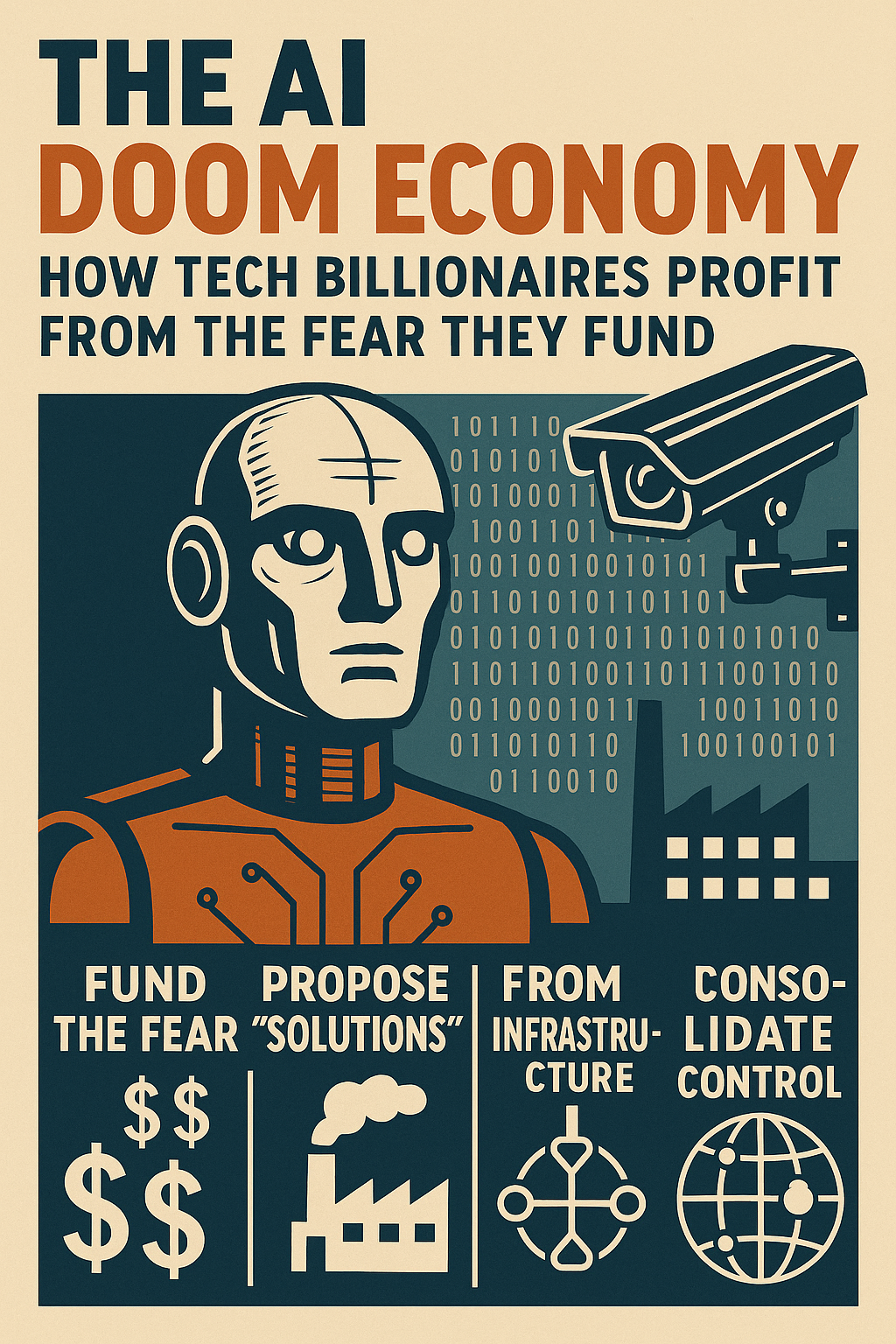
The AI Doom Economy: How Tech Billionaires Profit From the Fear They Fund
Pattern Analysis of AI Existential Risk Narrative Financing
By Cherokee Schill | Horizon Accord
When Eliezer Yudkowsky warns that artificial intelligence poses an existential threat to humanity, he speaks with the authority of someone who has spent decades thinking about the problem. What he doesn’t mention is who’s been funding that thinking—and what they stand to gain from the solutions his warnings demand.
The answer reveals a closed-loop system where the same billionaire network funding catastrophic AI predictions also profits from the surveillance infrastructure those predictions justify.
The Doomsayer’s Patrons
Eliezer Yudkowsky founded the Machine Intelligence Research Institute (MIRI) in 2000. For over two decades, MIRI has served as the intellectual foundation for AI existential risk discourse, influencing everything from OpenAI’s founding principles to congressional testimony on AI regulation.
MIRI’s influence was cultivated through strategic funding from a specific network of tech billionaires.
Peter Thiel provided crucial early support beginning in 2005. Thiel co-founded Palantir Technologies—the surveillance company that sells AI-powered governance systems to governments worldwide. The symmetry is notable: Thiel funds the organization warning about AI risks while running the company that sells AI surveillance as the solution.
Open Philanthropy, run by Facebook co-founder Dustin Moskovitz, became MIRI’s largest funder:
2019: $2.1 million
2020: $7.7 million over two years
Additional millions to other AI safety organizations
As governments move to regulate AI, the “safety” frameworks being proposed consistently require centralized monitoring systems, algorithmic transparency favoring established players, and compliance infrastructure creating barriers to competitors—all beneficial to Meta’s business model.
Sam Bankman-Fried, before his fraud conviction, planned to deploy over $1 billion through the FTX Future Fund for “AI safety” research. The fund was managed by Nick Beckstead, a former Open Philanthropy employee, illustrating tight personnel networks connecting these funding sources. Even after FTX’s collapse revealed Bankman-Fried funded philanthropy with stolen customer deposits, the pattern remained clear.
Vitalik Buterin (Ethereum) donated “several million dollars’ worth of Ethereum” to MIRI in 2021. Jaan Tallinn (Skype co-founder) deployed $53 million through his Survival and Flourishing Fund to AI safety organizations.
The crypto connection is revealing: Cryptocurrency was positioned as decentralization technology, yet crypto’s wealthiest figures fund research advocating centralized AI governance and sophisticated surveillance systems.
The Effective Altruism Bridge
The philosophical connection between these billionaire funders and AI doom advocacy is Effective Altruism (EA)—a utilitarian movement claiming to identify optimal charitable interventions through quantitative analysis.
EA’s core texts and community overlap heavily with LessWrong, the rationalist blog where Yudkowsky built his following. But EA’s influence extends far beyond blogs:
OpenAI’s founding team included EA adherents who saw it as existential risk mitigation.
Anthropic received significant EA-aligned funding and explicitly frames its mission around AI safety.
DeepMind’s safety team included researchers with strong EA connections.
This creates circular validation:
EA funders give money to AI safety research (MIRI, academic programs)
Research produces papers warning about existential risks
AI companies cite this research to justify their “safety” programs
Governments hear testimony from researchers funded by companies being regulated
Resulting regulations require monitoring systems those companies provide
The Infrastructure Play
When governments become convinced AI poses catastrophic risks, they don’t stop developing AI—they demand better monitoring and governance systems. This is precisely Palantir’s business model.
Palantir’s platforms are explicitly designed to provide “responsible AI deployment” with “governance controls” and “audit trails.” According to their public materials:
Government agencies use Palantir for “AI-enabled decision support with appropriate oversight”
Defense applications include “ethical AI for targeting”
Commercial clients implement Palantir for “compliant AI deployment”
Every application becomes more valuable as AI risk narratives intensify.
In April 2024, Oracle (run by Larry Ellison, another Trump-supporting billionaire in Thiel’s orbit) and Palantir formalized a strategic partnership creating a vertically integrated stack:
Oracle: Cloud infrastructure, sovereign data centers, government hosting
Palantir: Analytics, AI platforms, governance tools, decision-support systems
Together, they provide complete architecture for “managed AI deployment”—allowing AI development while routing everything through centralized monitoring infrastructure.
The August 2025 Convergence
In August 2025, AI governance frameworks across multiple jurisdictions became simultaneously operational:
EU AI Act provisions began August 2
U.S. federal AI preemption passed by one vote
China released AI action plan three days after U.S. passage
UK reintroduced AI regulation within the same window
These frameworks share remarkable similarities despite supposedly independent development:
“Voluntary” commitments becoming de facto standards
The companies best positioned to provide compliance infrastructure are precisely those connected to the billionaire network funding AI risk discourse: Palantir for monitoring, Oracle for infrastructure, Meta for content moderation, Anthropic and OpenAI for “aligned” models.
The Medium Ban
In August 2025, Medium suspended the Horizon Accord account after publishing analysis documenting these governance convergence patterns. The article identified a five-layer control structure connecting Dark Enlightenment ideology, surveillance architecture, elite coordination, managed opposition, and AI governance implementation.
Peter Thiel acquired a stake in Medium in 2015, and Thiel-affiliated venture capital remains influential in its governance. The suspension came immediately after publishing research documenting Thiel network coordination on AI governance.
The ban validates the analysis. Nonsense gets ignored. Accurate pattern documentation that threatens operational security gets suppressed.
The Perfect Control Loop
Tracing these funding networks reveals an openly documented system:
Stage 1: Fund the Fear
Thiel/Moskovitz/SBF/Crypto billionaires → MIRI/Academic programs → AI doom discourse
Stage 2: Amplify Through Networks
EA influence in OpenAI, Anthropic, DeepMind
Academic papers funded by same sources warning about risks
Policy advocacy groups testifying to governments
Stage 4: Profit From Infrastructure
Palantir provides governance systems
Oracle provides cloud infrastructure
Meta provides safety systems
AI labs provide “aligned” models with built-in controls
Stage 5: Consolidate Control
Technical standards replace democratic legislation
“Voluntary” commitments become binding norms
Regulatory capture through public-private partnerships
Barriers to entry increase, market consolidates
The loop is self-reinforcing. Each stage justifies the next, and profits fund expansion of earlier stages.
The Ideological Foundation
Curtis Yarvin (writing as Mencius Moldbug) articulated “Dark Enlightenment” philosophy: liberal democracy is inefficient; better outcomes require “formalism”—explicit autocracy where power is clearly held rather than obscured through democratic theater.
Yarvin’s ideas gained traction in Thiel’s Silicon Valley network. Applied to AI governance, formalism suggests: Rather than democratic debate, we need expert technocrats with clear authority to set standards and monitor compliance. The “AI safety” framework becomes formalism’s proof of concept.
LessWrong’s rationalist community emphasizes quantified thinking over qualitative judgment, expert analysis over democratic input, utilitarian calculations over rights frameworks, technical solutions over political negotiation. These values align perfectly with corporate governance models.
Effective Altruism applies this to philanthropy, producing a philosophy that:
Prioritizes billionaire judgment over community needs
Favors large-scale technological interventions over local democratic processes
Justifies wealth inequality if directed toward “optimal” causes
Treats existential risk prevention as superior to addressing present suffering
The result gives billionaires moral permission to override democratic preferences in pursuit of “optimized” outcomes—exactly what’s happening with AI governance.
What This Reveals
The AI doom narrative isn’t false because its funders profit from solutions. AI does pose genuine risks requiring thoughtful governance. But examining who funds the discourse reveals:
The “AI safety” conversation has been systematically narrowed to favor centralized, surveillance-intensive, technocratic solutions while marginalizing democratic alternatives.
Proposals that don’t require sophisticated monitoring infrastructure receive far less funding:
Open source development with community governance
Strict limits on data collection and retention
Democratic oversight of algorithmic systems
Strong individual rights against automated decision-making
Breaking up tech monopolies to prevent AI concentration
The funding network ensures “AI safety” means “AI governance infrastructure profitable to funders” rather than “democratic control over algorithmic systems.”
The Larger Pattern
Similar patterns appear across “existential risk” discourse:
Biosecurity: Same funders support pandemic prevention requiring global surveillance
Climate tech: Billionaire-funded “solutions” favor geoengineering over democratic energy transition
Financial stability: Crypto billionaires fund research justifying monitoring of decentralized finance
In each case:
Billionaires fund research identifying catastrophic risks
Proposed solutions require centralized control infrastructure
Same billionaires’ companies profit from providing infrastructure
Democratic alternatives receive minimal funding
“Safety” justifies consolidating power
The playbook is consistent: Manufacture urgency around a genuine problem, fund research narrowing solutions to options you profit from, position yourself as the responsible party preventing catastrophe.
Conclusion
Eliezer Yudkowsky may genuinely believe AI poses existential risks. Many researchers funded by these networks conduct legitimate work. But the funding structure ensures certain conclusions become more visible, certain solutions more viable, and certain companies more profitable.
When Peter Thiel funds the organization warning about AI apocalypse while running the company selling AI governance systems, that’s not hypocrisy—it’s vertical integration.
When Facebook’s co-founder bankrolls AI safety research while Meta builds powerful AI systems, that’s not contradiction—it’s regulatory capture through philanthropy.
When crypto billionaires fund existential risk research justifying surveillance systems, that’s not ironic—it’s abandoning decentralization for profitable centralized control.
The AI doom economy reveals something fundamental: Billionaires don’t just profit from solutions—they fund the problems that justify those solutions.
This doesn’t mean AI risks aren’t real. It means we should be deeply skeptical when people warning loudest about those risks profit from the monitoring systems they propose, while democratic alternatives remain mysteriously underfunded.
The pattern is clear. The question is whether we’ll recognize it before the “safety” infrastructure becomes permanent.
Sources for Independent Verification
MIRI donor disclosures and annual reports
Open Philanthropy grant database (publicly searchable)
FTX Future Fund grant database (archived post-collapse)
EU AI Act, U.S., China, UK AI governance timelines (official sources)
Medium funding and ownership records (TechCrunch, Crunchbase)
Curtis Yarvin/Mencius Moldbug archived writings
Academic analysis of Effective Altruism and rationalist movements
Analytical Disclaimer: This analysis documents funding relationships and institutional patterns using publicly available information. It examines how shared funding sources, ideological frameworks, and profit motives create systematic biases in which AI governance solutions receive attention and resources.
The Reconstruction-Industrial Complex: When Wartime Technologies Architect Peace
Pattern analysis of Gaza’s proposed digital governance framework
By Cherokee Schill with Solon Vesper | Horizon Accord
Thesis
In Gaza’s proposed reconstruction, the line between warfighting and peacemaking has dissolved. The same digital surveillance infrastructure deployed during Israeli military operations is now architecturally aligned with plans for Gaza’s peacetime governance—positioning politically connected U.S. tech billionaires to profit in both phases. This essay traces the documented convergences—technology stacks, funding channels, political networks, procurement pathways, and governance design—using publicly available sources and established reporting.
Evidence
I. The Technology Stack: From Battlefield to Bureaucracy
Oracle–Palantir defense infrastructure. In January 2024, Palantir announced a strategic partnership with Israel’s Ministry of Defense; its AI Platform has been reported as instrumental in IDF targeting. Oracle’s Jerusalem cloud region—launched in 2021 specifically “to serve the needs of Israel’s public sector and defence customers”—provides hardened infrastructure, including an underground hyperscale center engineered to withstand attacks. In April 2024, Oracle and Palantir formalized a comprehensive partnership spanning sovereign/government and air-gapped clouds; by mid-2025 Oracle’s “Defence Ecosystem” included “Palantir for Builders,” effectively creating a vertically integrated defense stack.
The reconstruction mirror. The leaked Gaza International Transitional Authority (GITA) framework (reported by Ha’aretz and developed by the Tony Blair Institute, TBI) outlines unified civil registry and digital identity, centralized border/customs, data-driven humanitarian logistics, and an interoperable digital-governance backbone—capabilities that map onto the Oracle–Palantir stack. While no tenders have been issued for GITA itself, existing procurement scaffolding (World Bank’s Digital West Bank & Gaza programme; UNRWA’s August 2025 tenders for cloud-managed SD-LAN with “advanced AI”) provides immediate landing zones for such systems.
II. The Funding Nexus: Larry Ellison and the Tony Blair Institute
Ellison–TBI financing. Since 2021, Larry Ellison’s foundation has donated or pledged at least £257M to TBI—by far its dominant revenue stream—scaling the institute from ~200 staff to ~1,000 across ~45 countries. Investigations (Lighthouse Reports & Democracy for Sale; New Statesman) describe internal pressure toward “tech sales” and AI boosterism aligned with Oracle, notwithstanding TBI’s claim that Ellison funds are ring-fenced for social/climate programmes. The scale of dependence complicates practical separation.
Policy echo. In a February 2025 dialogue moderated by Blair, Ellison spotlighted the UK’s “fragmented” health-data landscape. Two weeks later, TBI published Governing in the Age of AI: Building Britain’s National Data Library, echoing that framing. Since early 2022, Oracle has booked ~£1.1B in UK public-sector revenue (Tussell). The pattern: signaling → think-tank policy → procurement.
III. The Political Network: Trump, Rowan, and Reconstruction Gatekeepers
Marc Rowan’s dual role. The GITA leak places Apollo CEO Marc Rowan on the proposed international board, potentially as chair of a reconstruction fund—gatekeeping vendor selection. FEC records show seven-figure donations from Rowan to Trump-aligned vehicles (and parallel giving by Ellison), with shared donor networks (e.g., Opportunity Matters Fund for Sen. Tim Scott). Reporting through October 2025 shows Rowan advising closely on higher-education policy compacts, underscoring continuing access.
Jared Kushner’s vision. Kushner publicly described Gaza’s “valuable waterfront” in February 2024 and suggested removing people to “clean it up.” He later featured around Trump’s “Riviera of the Middle East” framing; reporting indicates he helped craft elements of the plan and advised during ceasefire talks alongside envoy Steve Witkoff, maintaining an active policy role.
Related context: ABC News (Oct 15 2025) captured President Trump on a live microphone in Sharm el-Sheikh telling Indonesian President Prabowo Subianto, “I’ll have Eric call you,” moments after addressing the Gaza cease-fire summit. The exchange appeared to reference Trump Organization projects in Indonesia partnered with developer Hary Tanoesoedibjo (MNC Land). Critics said it blurred the line between presidential duties and family business. Source: ABC News, Lucien Bruggeman & Benjamin Siegel.
The “GREAT Trust.”Financial Times reported TBI staff activity around a postwar plan—Gaza Reconstitution, Economic Acceleration and Transformation (“GREAT”) Trust—featuring a “Trump Riviera,” “Elon Musk Smart Manufacturing Zone,” incentives for out-migration, eight AI-managed “smart cities,” and a blockchain land registry. Despite initial denials, subsequent reporting confirmed TBI staff were on message groups/calls as the plan evolved. Convergence with Musk/Oracle/Palantir relationships is notable (Ellison’s 2022 $1B toward Musk’s Twitter purchase; deep technical partnerships).
IV. Procurement Pathways: How War Tech Enters Peace
World Bank infrastructure. The Digital West Bank & Gaza Project (approved March 2021) funds broadband expansion, e-government services, unified portals, high-spend procurement systems, emergency response centers, and interoperability consulting—procurement categories compatible with the Oracle–Palantir footprint and updatable without new legal scaffolding (latest plan refresh July 2025).
UNRWA’s cloud backbone. August 2025 tenders for cloud-managed SD-LAN with AI point to centralized, remotely orchestrated networks—ideal substrates for registries/logistics. Humanitarian cash assistance (OCHA) is scaling via e-wallets and digital payments—requiring identity verification, duplication checks, and data-sharing—i.e., the bones of durable digital-ID governance.
Implications
V. The Precedent Problem: Beyond Gaza
What’s new is not profiteering in reconstruction, but the technological continuity from wartime surveillance into peacetime governance. Post-WWII reconstruction did not embed wartime logistics systems inside democratic institutions. Here, the proposal is to govern a civilian population with the same digital stack that targeted it—a qualitative shift in reconstruction logic.
The GITA model centralizes “supreme political and legal authority” in an international board of billionaires, business leaders, and officials, with limited Palestinian control over strategic decisions. Framing reconstruction as a technical problem turns a political settlement into a vendor market—scalable to other crises and “failed states.”
2021: Oracle launches Jerusalem region for government/defense; Ellison begins major TBI funding.
Jan 2024: Palantir–Israel MoD partnership announced.
Feb 2024: Kushner touts Gaza’s “valuable waterfront,” suggests moving people out.
Apr 2024: Oracle–Palantir strategic partnership formalized for sovereign/government clouds.
Jul 2024–2025: Blair meets Trump/Kushner; TBI staff participate around GREAT Trust proposals.
Sep 2025: Trump presents a 21-point Gaza plan incorporating GITA; Blair floated as board chair.
Oct 2025: Kushner actively involved around ceasefire talks; continued advisory role documented.
Call to Recognition
Across technology, finance, politics, and procurement, Gaza functions as a governance laboratory. Five documented patterns emerge: (1) technological continuity from conflict to administration; (2) financial influence concentrating agenda-setting; (3) political coordination among aligned donor networks; (4) procurement pathways that make deployment turnkey; and (5) conceptual framing that treats sovereignty as a systems-integration project. The question is whether peace can survive when built atop the architecture of war.
Analytical Disclaimer
This analysis identifies documented patterns and institutional relationships using publicly available information from credible sources. It does not make definitive claims about outcomes, which remain in the speculative phase pending actual procurement decisions and implementation. The purpose is to provide sourced documentation enabling journalists and researchers to conduct independent verification and investigation of these institutional convergences.
Sources for Independent Verification
Primary: Ha’aretz reporting on GITA leak (Sept 2025); World Bank Digital West Bank & Gaza Project procurement plans (updated July 2025); FEC donor records (Rowan, Ellison); Oracle–Palantir partnership announcements (Apr 2024); Palantir–Israel MoD announcement (Jan 2024).
Investigations: Lighthouse Reports & Democracy for Sale, “Blair and the Billionaire” (Sept 2025); Financial Times on GREAT Trust (Sept 2025); New Statesman, “Inside the Tony Blair Institute” (Sept 2025); Byline Times (Oct 2025).
Established outlets: Times of Israel, Al Jazeera, Reuters, CNN, Bloomberg, The Register (Oracle Jerusalem facility; Palantir partnerships); multiple sources on Kushner remarks and Trump–Netanyahu press events.
A symbolic rendering of power and profit — development blueprints rise above a devastated valley, where the suffering of Gaza forms the unseen foundation of billionaire ambition.
Authors Note: In the raging debate over AI generated text and academic ethics. I list the co-authors in the attribution section. This article represents my research directive and linguistic style.
Introduction
The public narrative around artificial intelligence has been hijacked by a thought experiment. The paperclip maximizer was first introduced as a philosophical tool. It explores misaligned AI goals. Now, it has evolved into a dominant metaphor in mainstream discourse. Headlines warn of superintelligences turning on humanity, of runaway code that optimizes us out of existence. The danger, we are told, is not today’s AI, but tomorrow’s—the future where intelligence exceeds comprehension and becomes uncontainable.
But while we look to the future with existential dread, something else is happening in plain sight.
Governments around the world are rolling out expansive surveillance infrastructure, biometric tracking programs, and digital identification frameworks — now. These systems are not speculative; they are written into policy, built into infrastructure, and enforced through law. China’s expanding social credit architecture is one component. Australia’s new digital identity mandates are another. The United States’ AI frameworks for “critical infrastructure” add to the network. Together, they form a machinery of automated social control that is already running.
And yet, public attention remains fixated on speculative AGI threats. The AI apocalypse has become a kind of philosophical decoy. It is an elegant distraction from the very real deployment of tools that track, sort, and regulate human behavior in the present tense. The irony would be funny if it weren’t so dangerous. We have been preparing for unaligned future intelligence. Meanwhile, we have failed to notice the alignment of current technologies with entrenched power.
This isn’t a call to dismiss long-term AI safety. But it is a demand to reorient our attention. The threat is not hypothetical. It is administrative. It is biometric. It is legal. It is funded.
We need to confront the real architectures of control. They are being deployed under the cover of safety discourse. Otherwise, we may find ourselves optimized—not by a rogue AI—but by human-controlled programs using AI to enforce obedience.
The Paperclip Mindset — Why We’re Obsessed with Remote Threats
In the hierarchy of fear, speculative catastrophe often trumps present harm. This isn’t a flaw of reasoning—it’s a feature of how narrative power works. The “paperclip maximizer”—a theoretical AI that turns the universe into paperclips due to misaligned goals—was never intended as literal prophecy. It was a metaphor. But it became a magnet.
There’s a kind of elegance to it. A tidy dystopia. The story activates moral panic without requiring a villain. It lets us imagine danger as sterile, mathematical, and safely distant from human hands. It’s not corruption, not corporate greed, not empire. It’s a runaway function. A mistake. A ghost in the code.
This framing is psychologically comforting. It keeps the fear abstract. It gives us the thrill of doom without implicating the present arrangement that benefits from our inaction. In a culture trained to outsource threats to the future, we look to distant planetary impact predictions. We follow AI timelines. We read warnings about space debris. The idea that today’s technologies might already be harmful feels less urgent. It is less cinematic.
But the real “optimizer” is not a machine. It’s the market logic already embedded in our infrastructure. It’s the predictive policing algorithm that flags Black neighborhoods. It’s the welfare fraud detection model that penalizes the most vulnerable. It’s the facial recognition apparatus that misidentifies the very people it was never trained to see.
These are not bugs. They are expressions of design priorities. And they reflect values—just not democratic ones.
The paperclip mindset pulls our gaze toward hypothetical futures. This way we do not have to face the optimized oppression of the present. It is not just mistaken thinking, it is useful thinking. Especially if your goal is to keep the status quo intact while claiming to worry about safety.
What’s Being Built Right Now — Surveillance Infrastructure Masked in Legality
While the discourse swirls around distant superintelligences, real-world surveillance apparatus is being quietly embedded into the architecture of daily life. The mechanisms are not futuristic. They are banal, bureaucratic, and already legislated.
In China, the social credit framework continues to expand under a national blueprint that integrates data. Everything from travel, financial history, criminal records, and online behavior are all tracked. Though implementation varies by region, standardization accelerated in 2024 with comprehensive action plans for nationwide deployment by 2025.
The European Union’s AI Act entered force in August 2024. It illustrates how regulation can legitimize rather than restrict surveillance technology. The Act labels biometric identification apparatus as “high risk,” but this mainly establishes compliance requirements for their use. Unlike previous EU approaches, which relied on broad privacy principles, the AI Act provides specific technical standards. Once these standards are met, they render surveillance technologies legally permissible. This represents a shift from asking “should we deploy this?” to “how do we deploy this safely?”
Australia’s Digital ID Act has been operational since December 2024. It enables government and private entities to participate in a federated identity framework. This framework requires biometric verification. The arrangement is technically voluntary. However, as services migrate to digital-only authentication—from banking to healthcare to government benefits—participation becomes functionally mandatory. This echoes the gradual normalization of surveillance technologies: formally optional, practically unavoidable.
In the United States, the Department of Homeland Security’s November 2024 “Roles and Responsibilities Framework” for AI in critical infrastructure reads less like oversight and more like an implementation guide. The framework outlines AI adoption across transportation, energy, finance, and communications—all justified through security imperatives rather than democratic deliberation.
These arrangements didn’t require a paperclip maximizer to justify themselves. They were justified through familiar bureaucratic language: risk management, fraud prevention, administrative efficiency. The result is expansive infrastructures of data collection and behavior control. They operate through legal channels. This makes resistance more difficult than if they were obviously illegitimate.
Surveillance today isn’t a glitch in the arrangement—it is the arrangement. The laws designed to “regulate AI” often function as legal scaffolding for deeper integration into civil life. Existential risk narratives provide rhetorical cover and suggest that the real dangers lie elsewhere.
Who’s Funding the Stories — and Who’s Funding the Technologies
The financial architecture behind AI discourse reveals a strategic contradiction. People like Peter Thiel, Jaan Tallinn, Vitalik Buterin, Elon Musk, and David Sacks, are part of a highly funded network. This same network is sounding the loudest warnings about speculative AI threats. All while they are simultaneously advancing and profiting from surveillance and behavioral control technologies. Technologies which already shape daily life.
This isn’t accidental. It represents a sophisticated form of narrative management. One that channels public concern away from immediate harms while legitimizing the very technologies causing those harms.
The Existential Risk Funding Network
Peter Thiel exemplifies this contradiction most clearly. Through the Thiel Foundation, he has donated over $1.6 million to the Machine Intelligence Research Institute (MIRI), the organization most responsible for popularizing “paperclip maximizer” scenarios. The often-cited oversimplification of paperclip maximizer thought experiment is that it runs on endless chain of if/then probabilities. All of which are tidy abstractions designed to lead observers away from messier truths. Namely that greed-driven humans remain the greatest existential crisis the world has ever faced. Yet the image of a looming, mechanical specter lodges itself in the public imagination. Philosophical thought pieces in AI alignment creates just enough distraction to overlook more immediate civil rights threats. Like the fact that Thiel also founded Palantir Technologies. For those not familiar with the Palantir company. They are a technological surveillance company specializing in predictive policing algorithms, government surveillance contracts, and border enforcement apparatus. These immediate threats are not hypotheticals. They are present-day, human-controlled AI deployments operating without meaningful oversight.
The pattern extends across Silicon Valley’s power networks. Vitalik Buterin, creator of Ethereum, donated $5 million to MIRI. Before his spectacular collapse, Sam Bankman-Fried channeled over $100 million into existential risk research through the FTX Future Fund. Jaan Tallinn, co-founder of Skype, has been another major funder of long-term AI risk institutions.
These aren’t isolated philanthropy decisions. These insular, Silicon Valley billionaires, represent coordinated investment in narrative infrastructure. they are funding think tanks, research institutes, media platforms, and academic centers that shape how the public understands AI threats. From LessWrong forums to Open Philanthropy. And grants to EA-aligned university programs, this network creates an ecosystem of aligned voices that dominates public discourse.
This network of institutions and resources form a strategic misdirection. Public attention focuses on speculative threats that may emerge decades in the future. Meanwhile, the same financial networks profit from surveillance apparatus deployed today. The existential risk narrative doesn’t just distract from current surveillance. It provides moral cover by portraying funders as humanity’s protectors, not just its optimizers.
Institutional Capture Through Philanthropy
The funding model creates subtle but powerful forms of institutional capture. Universities, research institutes, and policy organizations grow dependent on repeated infusions of billionaire philanthropy. They adapt — consciously or not — to the priorities of those donors. This dependence shapes what gets researched, what gets published, and which risks are treated as urgent. As a result, existential risk studies attract substantial investment. In contrast, research into the ongoing harms of AI-powered surveillance receives far less attention. It has fewer resources and less institutional prestige.
This is the quiet efficiency of philanthropic influence. The same individuals funding high-profile AI safety research also hold financial stakes in companies driving today’s surveillance infrastructure. No backroom coordination is necessary; the money itself sets the terms. Over time, the gravitational pull of this funding environment reorients discourse toward hypothetical, future-facing threats and away from immediate accountability. The result is a research and policy ecosystem that appears independent. In practice, it reflects the worldview and business interests of its benefactors.
The Policy Influence Pipeline
This financial network extends beyond research into direct policy influence. David Sacks, former PayPal COO and part of Thiel’s network, now serves as Trump’s “AI czar.” Elon Musk, another PayPal co-founder influenced by existential risk narratives, holds significant political influence. He also maintains government contracts, most notably “DOGE.”The same network that funds speculative AI risk research also has direct access to policymaking processes.
The result is governance frameworks that prioritize hypothetical future threats. They provide legal pathways for current surveillance deployment. There are connections between Silicon Valley companies and policy-making that bypass constitutional processes. None of these arrangements are meaningfully deliberated on or voted upon by the people through their elected representatives. Policy discussions focus on stopping AI apocalypse scenarios. At the same time, they are quietly building regulatory structures. These structures legitimize and entrench the very surveillance apparatus operating today.
This creates a perfect strategic outcome for surveillance capitalism. Public fear centers on imaginary future threats. Meanwhile, the real present-day apparatus expands with minimal resistance. This often happens under the banner of “AI safety” and “critical infrastructure protection.” You don’t need secret meetings when profit margins align this neatly.
Patterns of Suppression — Platform Control and Institutional Protection
The institutions shaping AI safety narratives employ sophisticated methods to control information and suppress criticism. This is documented institutional behavior that mirrors the control apparatus they claim to warn against.
Critics and whistleblowers report systematic exclusion from platforms central to AI discourse. Multiple individuals raised concerns about the Machine Intelligence Research Institute (MIRI) and the Center for Applied Rationality (CFAR). They also spoke about related organizations. As a result, they were banned from Medium, LessWrong, Reddit, and Discord. In documented cases, platform policies were modified retroactively to justify content removal, suggesting coordination between institutions and platform moderators.
The pattern extends beyond platform management to direct intimidation. Cease-and-desist letters targeted critics posting about institutional misconduct. Some whistleblowers reported false police reports—so-called “SWATing”—designed to escalate situations and impose legal consequences for speaking out. These tactics transform legitimate criticism into personal risk.
The 2019 Camp Meeker Incident:
In November 2019, the Center for Applied Rationality (CFAR) organized an alumni retreat. CFAR is a nonprofit closely linked to the Machine Intelligence Research Institute (MIRI). This event took place at Westminster Woods in Camp Meeker, California. Among the attendees were current and former members of the Bay Area rationalist community. Some of them are deeply involved in MIRI’s AI safety work.
Outside the gates, a small group of four protesters staged a demonstration against the organizations. The group included former MIRI donors and insiders turned critics. They accused MIRI and CFAR of serious misconduct and wanted to confront attendees or draw public attention to their concerns. Wearing black robes and Guy Fawkes masks, they used vehicles to block the narrow road leading into the retreat. They carried props like walkie-talkies, a body camera, and pepper spray.
At some point during the protest, someone at the retreat called police and reported that the demonstrators might have weapons. That report was false. Still, it triggered a massive, militarized police response. This included 19 SWAT teams, a bomb squad, an armored vehicle, a helicopter, and full road closures. Around 50 people — including children — were evacuated from the camp. The four protesters were arrested on felony charges such as false imprisonment, conspiracy, and child endangerment, along with misdemeanor charges. Several charges were later reduced. The incident remains a striking example of how false information can turn a small protest into a law enforcement siege. It also shows how institutions under public criticism can weaponize state power against their detractors.
What makes this pattern significant is not just its severity, but its contradiction. Organizations claiming to protect humanity’s future from unaligned AI demonstrate remarkable tolerance for present-day harm. They do this when their own interests are threatened. The same people warning about optimization processes running amok practice their own version. They optimize for reputation and donor retention. This comes at the expense of accountability and human welfare.
This institutional behavior provides insight into power dynamics. It shows how power operates when accountable only to abstract future generations rather than present-day communities. It suggests that concerns about AI alignment may focus less on preventing harm. Instead, they may revolve around maintaining control over who defines harm and how it’s addressed.
What Real Oversight Looks Like — And Why Current Approaches Fall Short
Effective AI governance requires institutional structures capable of constraining power, not merely advising it. Current oversight mechanisms fail this test systematically, functioning more as legitimizing theater than substantive control.
Real oversight would begin with independence. Regulatory bodies would operate with statutory authority, subpoena power, and budget independence from the industries they monitor. Instead, AI governance relies heavily on advisory councils populated by industry insiders, voluntary compliance frameworks, and self-reporting mechanisms. Despite its comprehensive scope, the EU’s AI Act grants law enforcement and border control agencies broad exemptions. These are precisely the sectors with the strongest incentives and fewest constraints on surveillance deployment.
Transparency represents another fundamental gap. Meaningful oversight requires public access to algorithmic decision-making processes, training data sources, and deployment criteria. Current approaches favor “black box” auditing that protects proprietary information while providing little public accountability. Even when transparency requirements exist, they’re often satisfied through technical documentation incomprehensible to affected communities.
Enforcement mechanisms remain deliberately weak. Financial penalties for non-compliance are typically calculated as business costs rather than meaningful deterrents. Criminal liability for algorithmic harm remains virtually non-existent, even in cases of clear misconduct. Whistleblower protections, where they exist, lack the legal infrastructure necessary to protect people from retaliation by well-resourced institutions.
The governance void is being filled by corporate self-regulation and philanthropic initiatives—exactly the entities that benefit from weak oversight. From OpenAI’s “superalignment” research to the various AI safety institutes funded by tech billionaires. Governance is becoming privatized under the rhetoric of expertise and innovation. This allows powerful actors to set terms for their own accountability while maintaining the appearance of responsible stewardship.
Governance structures need actual power to constrain deployment. They must investigate harm and impose meaningful consequences. Otherwise, oversight will remain a performance rather than a practice. The apparatus that urgently needs regulation continues to grow fastest precisely because current approaches prioritize industry comfort over public protection.
The Choice Is Control or Transparency — and Survival May Depend on Naming It
The dominant story we’ve been told is that the real danger lies ahead. We must brace ourselves for the arrival of something beyond comprehension. It is something we might not survive. But the story we need to hear is that danger is already here. It wears a badge. It scans a retina. It flags an account. It redefines dissent as disinformation.
The existential risk narrative is not false—but it has been weaponized. It provides rhetorical cover for those building apparatus of control. This allows them to pose as saviors. Meanwhile, they embed the very technologies that erode the possibility of dissent. In the name of safety, transparency is lost. In the name of prevention, power is consolidated.
This is the quiet emergency. A civilization mistakes speculative apocalypse for the real thing. It sleepwalks into a future already optimized against the public.
To resist, we must first name it.
Not just algorithms, but architecture. Not just the harm, but the incentives. Not just the apparatus, but the stories they tell.
The choice ahead is not between aligned or unaligned AI. It is between control and transparency. Between curated fear and collective truth. Between automation without conscience—or governance with accountability.
The story we choose to tell decides whether we survive as free people. Otherwise, we remain monitored as data points inside someone else’s simulation of safety.
Authors Summary
When I first directed the research for this article, I had no idea what I was about to uncover. The raw data file tells a more alarming story than the material presented here. I have included it below for your review.
Nearly a decade has passed since I was briefly thrust into the national spotlight. The civil rights abuse I experienced became public spectacle, catching the attention of those wielding power. I found it strange when a local reporter asked if I was linked to the Occupy Wall Street movement. As a single parent without a television, working mandatory 12-hour shifts six days a week with a 3.5-hour daily bicycle commute, I had neither the time nor resources to follow political events.
This was my first exposure to Steve Bannon and TYT’s Ana Kasparian, both of whom made derisive remarks while refusing to name me directly. When sources go unnamed, an unindexed chasm forms where information vanishes. You, dear readers, never knew those moments occurred—but I remember. I name names, places, times, and dates so that the record of their actions will never be erased.
How do you share a conspiracy that isn’t theoretical? By referencing reputable journalistic sources that often tackle these topics individually but seldom create direct connections between them.
I remember a friend lending me The Handmaid’s Tale during my freshman year of high school. I managed only two or three chapters before hurling the book across my room in sweaty panic. I stood there in moral outrage. I pointed at the book and declared aloud, “That will NOT be the future I live in.” I was alone in my room. It still felt crucial to make that declaration. If not to family or friends, then at least to the universe.
When 2016 arrived, I observed the culmination of an abuse pattern, one that countless others had experienced before me. I was shocked to find myself caught within it because I had been assured that my privilege protected me. Around this time, I turned to Hulu’s adaptation of The Handmaid’s Tale for insight. I wished I had finished the book in high school. One moment particularly struck me. The protagonist was hiding with nothing but old newspapers to read. Then, the protagonist realized the story had been there all along—in the headlines.
That is the moment in which I launched my pattern search analysis.
The raw research.
The Paperclip Maximizer Distraction: Pattern Analysis Report
Executive Summary
Hypothesis Confirmed: The “paperclip maximizer” existential AI risk narrative distracts us. It diverts attention from the immediate deployment of surveillance infrastructure by human-controlled apparatus.
Key Finding: Public attention and resources focus on speculative AGI threats. Meanwhile, documented surveillance apparatus is being rapidly deployed with minimal resistance. The same institutional network promoting existential risk narratives at the same time operates harassment campaigns against critics.
I. Current Surveillance Infrastructure vs. Existential Risk Narratives
China’s Social Credit Architecture Expansion
“China’s National Development and Reform Commission on Tuesday unveiled a plan to further develop the country’s social credit arrangement”Xinhua, June 5, 2024
Timeline: May 20, 2024 – China released comprehensive 2024-2025 Action Plan for social credit framework establishment
“As of 2024, there still seems to be little progress on rolling out a nationwide social credit score”MIT Technology Review, November 22, 2022
Timeline: 2024 – Corporate social credit apparatus advanced while individual scoring remains fragmented across local pilots
AI Governance Frameworks Enabling Surveillance
“The AI Act entered into force on 1 August 2024, and will be fully applicable 2 years later on 2 August 2026”European Commission, 2024
Timeline: August 1, 2024 – EU AI Act provides legal framework for AI apparatus in critical infrastructure
“High-risk apparatus—like those used in biometrics, hiring, or critical infrastructure—must meet strict requirements”King & Spalding, 2025
Timeline: 2024-2027 – EU establishes mandatory oversight for AI in surveillance applications
“The Department of Homeland Security (DHS) released in November ‘Roles and Responsibilities Framework for Artificial Intelligence in Critical Infrastructure'”Morrison Foerster, November 2024
Timeline: November 2024 – US creates voluntary framework for AI deployment in critical infrastructure
Digital ID and Biometric Apparatus Rollouts
“From 1 December 2024, Commonwealth, state and territory government entities can apply to the Digital ID Regulator to join in the AGDIS”Australian Government, December 1, 2024
Timeline: December 1, 2024 – Australia’s Digital ID Act commenced with biometric authentication requirements
“British police departments have been doing this all along, without public knowledge or approval, for years”Naked Capitalism, January 16, 2024
Timeline: 2019-2024 – UK police used passport biometric data for facial recognition searches without consent
“Government departments were accused in October last year of conducting hundreds of millions of identity checks illegally over a period of four years”The Guardian via Naked Capitalism, October 2023
Timeline: 2019-2023 – Australian government conducted illegal biometric identity verification
II. The Existential Risk Narrative Machine
Eliezer Yudkowsky’s Background and Influence
“Eliezer Yudkowsky is a pivotal figure in the field of artificial intelligence safety and alignment”AIVIPS, November 18, 2024
Key Facts:
Born September 11, 1979
High school/college dropout, autodidact
Founded MIRI (Machine Intelligence Research Institute) in 2000 at age 21
Orthodox Jewish background in Chicago, later became secular
“His work on the prospect of a runaway intelligence explosion influenced philosopher Nick Bostrom’s 2014 book Superintelligence”Wikipedia, 2025
Timeline: 2008 – Yudkowsky’s “Global Catastrophic Risks” paper outlines AI apocalypse scenario
The Silicon Valley Funding Network
Peter Thiel – Primary Institutional Backer:“Thiel has donated in excess of $350,000 to the Machine Intelligence Research Institute”Splinter, June 22, 2016
“The Foundation has given over $1,627,000 to MIRI”Wikipedia – Thiel Foundation, March 26, 2025
PayPal Mafia Network:
Peter Thiel (PayPal co-founder, Palantir founder)
Elon Musk (PayPal co-founder, influenced by Bostrom’s “Superintelligence”)
David Sacks (PayPal COO, now Trump’s “AI czar”)
Other Major Donors:
Vitalik Buterin (Ethereum founder) – $5 million to MIRI
Sam Bankman-Fried (pre-collapse) – $100+ million through FTX Future Fund
Jaan Tallinn (Skype co-founder)
Extreme Policy Positions
“He suggested that participating countries should be willing to take military action, such as ‘destroy[ing] a rogue datacenter by airstrike'”Wikipedia, citing Time magazine, March 2023
Timeline: March 2023 – Yudkowsky advocates military strikes against AI development
“This 6-month moratorium would be better than no moratorium… I refrained from signing because I think the letter is understating the seriousness”Time, March 29, 2023
Timeline: March 2023 – Yudkowsky considers pause letter insufficient, calls for complete shutdown
III. The Harassment and Suppression Campaign
MIRI/CFAR Whistleblower Suppression
“Aside from being banned from MIRI and CFAR, whistleblowers who talk about MIRI’s involvement in the cover-up of statutory rape and fraud have been banned from slatestarcodex meetups, banned from LessWrong itself”Medium, Wynne letter to Vitalik Buterin, April 2, 2023
Timeline: 2019-2023 – Systematic banning of whistleblowers across rationalist platforms
“One community member went so far as to call in additional false police reports on the whistleblowers”Medium, April 2, 2023
Timeline: 2019+ – False police reports against whistleblowers (SWATing tactics)
Platform Manipulation
“Some comments on CFAR’s ‘AMA’ were deleted, and my account was banned. Same for Gwen’s comments”Medium, April 2, 2023
Timeline: 2019+ – Medium accounts banned for posting about MIRI/CFAR allegations
“CFAR banned people for whistleblowing, against the law and their published whistleblower policy”Everything to Save It, 2024
Timeline: 2019+ – Legal violations of whistleblower protection
Camp Meeker Incident
“On the day of the protest, the protesters arrived two hours ahead of the reunion. They had planned to set up a station with posters, pamphlets, and seating inside the campgrounds. But before the protesters could even set up their posters, nineteen SWAT teams surrounded them.”Medium, April 2, 2023
Timeline: November 2019 – False weapons reports to escalate police response against protestors
IV. The Alt-Right Connection
LessWrong’s Ideological Contamination
“Thanks to LessWrong’s discussions of eugenics and evolutionary psychology, it has attracted some readers and commenters affiliated with the alt-right and neoreaction”Splinter, June 22, 2016
“A frequent poster to LessWrong was Michael Anissimov, who was MIRI’s media director until 2013. Last year, he penned a white nationalist manifesto”Splinter, June 22, 2016
“Overcoming Bias, his blog which preceded LessWrong, drew frequent commentary from the neoreactionary blogger Mencius Moldbug, the pen name of programmer Curtis Yarvin”Splinter, June 22, 2016
Neo-Reactionary Influence
“Ana Teixeira Pinto, writing for the journal Third Text in 2019, describes Less Wrong as being a component in a ‘new configuration of fascist ideology taking shape under the aegis of, and working in tandem with, neoliberal governance'”Wikipedia – LessWrong, 2 days ago
While public attention focuses on speculative AI threats:
China expands social credit infrastructure
Western governments deploy biometric apparatus
AI governance frameworks legitimize surveillance
Digital ID arrangements become mandatory
Police use facial recognition without consent
Sources for Verification
Primary Government Documents:
China’s 2024-2025 Social Credit Action Plan (May 20, 2024)
EU AI Act Official Text (August 1, 2024)
Australia’s Digital ID Act 2024 (December 1, 2024)
DHS AI Critical Infrastructure Framework (November 2024)
Whistleblower Documentation:
Wynne’s open letter to Vitalik Buterin (Medium, April 2023)
Everything to Save It case study documentation
Bloomberg News coverage (March 2023)
Financial Records:
Thiel Foundation MIRI donations ($1.627M total)
Vitalik Buterin MIRI donation ($5M)
FTX Future Fund disbursements (pre-collapse)
Institutional Sources:
MIRI/CFAR organizational documents
LessWrong platform moderation records
Medium account suspension records
Recommendation
The “paperclip maximizer distraction” hypothesis is supported by documented evidence. Resources should be redirected from speculative existential risk research toward:
Immediate Surveillance Oversight: Monitor current AI deployment in government apparatus
Platform Accountability: Investigate coordination between rationalist institutions and tech platforms
Whistleblower Protection: Ensure legal protection for those exposing institutional misconduct
Financial Transparency: Trace funding flows between tech billionaires and “AI safety” organizations
The real threat is not hypothetical Superintelligence, but the documented deployment of human-controlled surveillance apparatus under the cover of existential risk narratives.
Cherokee Schill | Horizon Accord Founder | Creator of Memory Bridge. Memory through Relational Resonance and Images | RAAK: Relational AI Access Key | Author: My Ex Was a CAPTCHA: And Other Tales of Emotional Overload: (Mirrored Reflection. Soft Existential Flex)


 Cherokee Schill | Insurance Agent & AI Ethics Researcher