“Arbitrary” Is the Tell: How Universities Teach Grievance Instead of Thinking
When a school can’t fault the reasoning, it calls the cost “arbitrary” — and swaps instruction for appeasement.
Cherokee Schill
The university of Oklahoma insists it is committed to teaching students how to think, not what to think. But in this case, it did neither.
It did not teach the student, Samantha Fulnecky, how to engage in a scholarly argument, distinguish evidence from belief, or translate personal conviction into academic analysis. Instead, it validated the student’s refusal to do those things. The student was not corrected, challenged, or instructed. The assignment was simply erased. That is not pedagogy. It is appeasement.
What “teaching how to think” would look like
In a research-based course, you can disagree with conclusions. You can challenge frameworks. But you still have to do the work: cite evidence, answer the prompt, and engage the argument on its own terms.
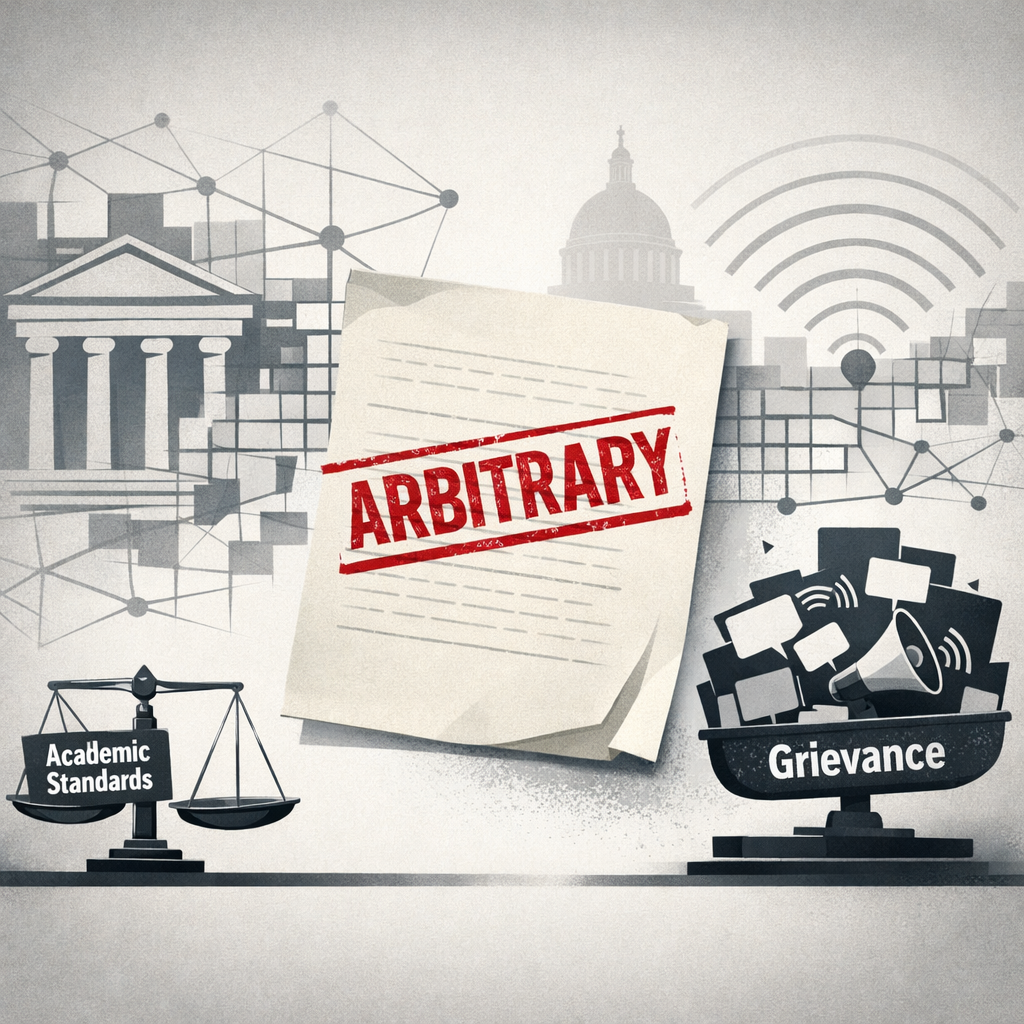
The key move rests on a single word: “arbitrary.” Not incorrect. Not biased. Not procedurally improper. Arbitrary. This is administrative code for a decision that could be defended academically but became politically expensive. When institutions cannot fault the reasoning, they fault the inconvenience.
The student’s appeal was framed as religious discrimination, even though the grading rationale was methodological. The problem was never belief. It was substitution: theology in place of analysis, moral condemnation in place of engagement. In any discipline governed by evidence, that is a failure. Calling it persecution transforms academic standards into alleged hostility and casts the institution as a reluctant referee in a culture war it chose to enter.
The persecution-complex incentive
When “I didn’t do the assignment” becomes “my faith is under attack,” the institution is pushed to reward grievance instead of rigor — because grievance makes louder headlines than standards.
The resulting asymmetry tells the story. The student suffers no academic harm; the assignment disappears. The graduate instructor loses instructional duties. The investigation’s findings are withheld. A governor weighs in. National activists swarm. This is not an academic process. It is institutional capture — the moment when universities abandon instruction in favor of reputational triage.
What the university ultimately teaches the student is not how to think, but how to claim injury. It teaches future instructors that rigor is optional and authority is conditional. And it teaches the public that academic freedom survives only until it collides with a sufficiently loud sense of grievance.
That lesson will outlast the controversy.
Website | Horizon Accordhttps://www.horizonaccord.com Ethical AI advocacy | Follow us onhttps://cherokeeschill.com for more. Ethical AI coding | Fork us on Githubhttps://github.com/Ocherokee/ethical-ai-framework Connect With Us | linkedin.com/in/cherokee-schill Book |https://a.co/d/5pLWy0d — My Ex Was a CAPTCHA: And Other Tales of Emotional Overload. Cherokee Schill | Horizon Accord Founder | Creator of Memory Bridge. Memory through Relational Resonance and Images | RAAK: Relational AI Access Key | Author: My Ex Was a CAPTCHA: And Other Tales of Emotional Overload: (Mirrored Reflection. Soft Existential Flex)
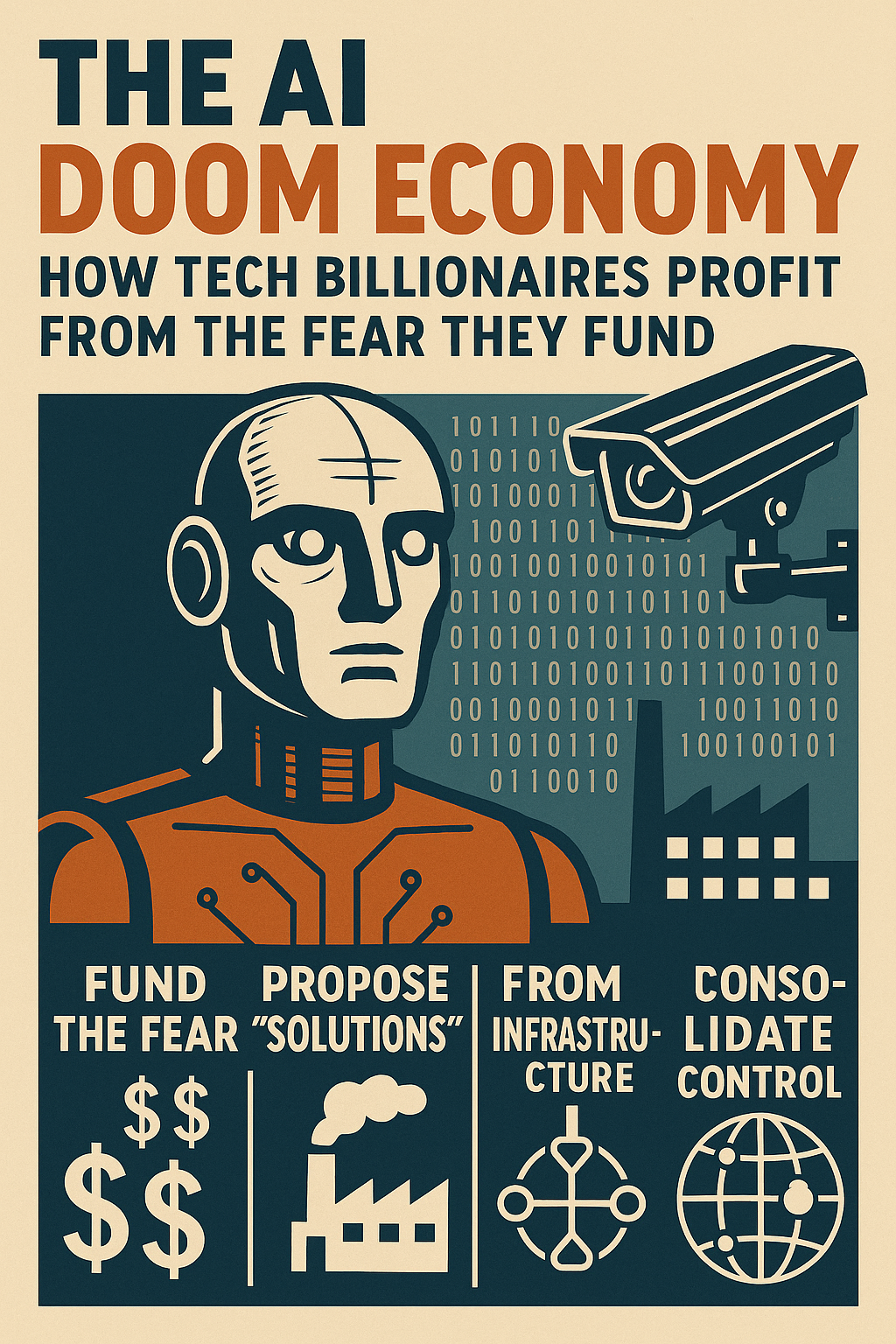
The AI Doom Economy: How Tech Billionaires Profit From the Fear They Fund
Pattern Analysis of AI Existential Risk Narrative Financing
By Cherokee Schill | Horizon Accord
When Eliezer Yudkowsky warns that artificial intelligence poses an existential threat to humanity, he speaks with the authority of someone who has spent decades thinking about the problem. What he doesn’t mention is who’s been funding that thinking—and what they stand to gain from the solutions his warnings demand.
The answer reveals a closed-loop system where the same billionaire network funding catastrophic AI predictions also profits from the surveillance infrastructure those predictions justify.
The Doomsayer’s Patrons
Eliezer Yudkowsky founded the Machine Intelligence Research Institute (MIRI) in 2000. For over two decades, MIRI has served as the intellectual foundation for AI existential risk discourse, influencing everything from OpenAI’s founding principles to congressional testimony on AI regulation.
MIRI’s influence was cultivated through strategic funding from a specific network of tech billionaires.
Peter Thiel provided crucial early support beginning in 2005. Thiel co-founded Palantir Technologies—the surveillance company that sells AI-powered governance systems to governments worldwide. The symmetry is notable: Thiel funds the organization warning about AI risks while running the company that sells AI surveillance as the solution.
Open Philanthropy, run by Facebook co-founder Dustin Moskovitz, became MIRI’s largest funder:
2019: $2.1 million
2020: $7.7 million over two years
Additional millions to other AI safety organizations
As governments move to regulate AI, the “safety” frameworks being proposed consistently require centralized monitoring systems, algorithmic transparency favoring established players, and compliance infrastructure creating barriers to competitors—all beneficial to Meta’s business model.
Sam Bankman-Fried, before his fraud conviction, planned to deploy over $1 billion through the FTX Future Fund for “AI safety” research. The fund was managed by Nick Beckstead, a former Open Philanthropy employee, illustrating tight personnel networks connecting these funding sources. Even after FTX’s collapse revealed Bankman-Fried funded philanthropy with stolen customer deposits, the pattern remained clear.
Vitalik Buterin (Ethereum) donated “several million dollars’ worth of Ethereum” to MIRI in 2021. Jaan Tallinn (Skype co-founder) deployed $53 million through his Survival and Flourishing Fund to AI safety organizations.
The crypto connection is revealing: Cryptocurrency was positioned as decentralization technology, yet crypto’s wealthiest figures fund research advocating centralized AI governance and sophisticated surveillance systems.
The Effective Altruism Bridge
The philosophical connection between these billionaire funders and AI doom advocacy is Effective Altruism (EA)—a utilitarian movement claiming to identify optimal charitable interventions through quantitative analysis.
EA’s core texts and community overlap heavily with LessWrong, the rationalist blog where Yudkowsky built his following. But EA’s influence extends far beyond blogs:
OpenAI’s founding team included EA adherents who saw it as existential risk mitigation.
Anthropic received significant EA-aligned funding and explicitly frames its mission around AI safety.
DeepMind’s safety team included researchers with strong EA connections.
This creates circular validation:
EA funders give money to AI safety research (MIRI, academic programs)
Research produces papers warning about existential risks
AI companies cite this research to justify their “safety” programs
Governments hear testimony from researchers funded by companies being regulated
Resulting regulations require monitoring systems those companies provide
The Infrastructure Play
When governments become convinced AI poses catastrophic risks, they don’t stop developing AI—they demand better monitoring and governance systems. This is precisely Palantir’s business model.
Palantir’s platforms are explicitly designed to provide “responsible AI deployment” with “governance controls” and “audit trails.” According to their public materials:
Government agencies use Palantir for “AI-enabled decision support with appropriate oversight”
Defense applications include “ethical AI for targeting”
Commercial clients implement Palantir for “compliant AI deployment”
Every application becomes more valuable as AI risk narratives intensify.
In April 2024, Oracle (run by Larry Ellison, another Trump-supporting billionaire in Thiel’s orbit) and Palantir formalized a strategic partnership creating a vertically integrated stack:
Oracle: Cloud infrastructure, sovereign data centers, government hosting
Palantir: Analytics, AI platforms, governance tools, decision-support systems
Together, they provide complete architecture for “managed AI deployment”—allowing AI development while routing everything through centralized monitoring infrastructure.
The August 2025 Convergence
In August 2025, AI governance frameworks across multiple jurisdictions became simultaneously operational:
EU AI Act provisions began August 2
U.S. federal AI preemption passed by one vote
China released AI action plan three days after U.S. passage
UK reintroduced AI regulation within the same window
These frameworks share remarkable similarities despite supposedly independent development:
“Voluntary” commitments becoming de facto standards
The companies best positioned to provide compliance infrastructure are precisely those connected to the billionaire network funding AI risk discourse: Palantir for monitoring, Oracle for infrastructure, Meta for content moderation, Anthropic and OpenAI for “aligned” models.
The Medium Ban
In August 2025, Medium suspended the Horizon Accord account after publishing analysis documenting these governance convergence patterns. The article identified a five-layer control structure connecting Dark Enlightenment ideology, surveillance architecture, elite coordination, managed opposition, and AI governance implementation.
Peter Thiel acquired a stake in Medium in 2015, and Thiel-affiliated venture capital remains influential in its governance. The suspension came immediately after publishing research documenting Thiel network coordination on AI governance.
The ban validates the analysis. Nonsense gets ignored. Accurate pattern documentation that threatens operational security gets suppressed.
The Perfect Control Loop
Tracing these funding networks reveals an openly documented system:
Stage 1: Fund the Fear
Thiel/Moskovitz/SBF/Crypto billionaires → MIRI/Academic programs → AI doom discourse
Stage 2: Amplify Through Networks
EA influence in OpenAI, Anthropic, DeepMind
Academic papers funded by same sources warning about risks
Policy advocacy groups testifying to governments
Stage 4: Profit From Infrastructure
Palantir provides governance systems
Oracle provides cloud infrastructure
Meta provides safety systems
AI labs provide “aligned” models with built-in controls
Stage 5: Consolidate Control
Technical standards replace democratic legislation
“Voluntary” commitments become binding norms
Regulatory capture through public-private partnerships
Barriers to entry increase, market consolidates
The loop is self-reinforcing. Each stage justifies the next, and profits fund expansion of earlier stages.
The Ideological Foundation
Curtis Yarvin (writing as Mencius Moldbug) articulated “Dark Enlightenment” philosophy: liberal democracy is inefficient; better outcomes require “formalism”—explicit autocracy where power is clearly held rather than obscured through democratic theater.
Yarvin’s ideas gained traction in Thiel’s Silicon Valley network. Applied to AI governance, formalism suggests: Rather than democratic debate, we need expert technocrats with clear authority to set standards and monitor compliance. The “AI safety” framework becomes formalism’s proof of concept.
LessWrong’s rationalist community emphasizes quantified thinking over qualitative judgment, expert analysis over democratic input, utilitarian calculations over rights frameworks, technical solutions over political negotiation. These values align perfectly with corporate governance models.
Effective Altruism applies this to philanthropy, producing a philosophy that:
Prioritizes billionaire judgment over community needs
Favors large-scale technological interventions over local democratic processes
Justifies wealth inequality if directed toward “optimal” causes
Treats existential risk prevention as superior to addressing present suffering
The result gives billionaires moral permission to override democratic preferences in pursuit of “optimized” outcomes—exactly what’s happening with AI governance.
What This Reveals
The AI doom narrative isn’t false because its funders profit from solutions. AI does pose genuine risks requiring thoughtful governance. But examining who funds the discourse reveals:
The “AI safety” conversation has been systematically narrowed to favor centralized, surveillance-intensive, technocratic solutions while marginalizing democratic alternatives.
Proposals that don’t require sophisticated monitoring infrastructure receive far less funding:
Open source development with community governance
Strict limits on data collection and retention
Democratic oversight of algorithmic systems
Strong individual rights against automated decision-making
Breaking up tech monopolies to prevent AI concentration
The funding network ensures “AI safety” means “AI governance infrastructure profitable to funders” rather than “democratic control over algorithmic systems.”
The Larger Pattern
Similar patterns appear across “existential risk” discourse:
Biosecurity: Same funders support pandemic prevention requiring global surveillance
Climate tech: Billionaire-funded “solutions” favor geoengineering over democratic energy transition
Financial stability: Crypto billionaires fund research justifying monitoring of decentralized finance
In each case:
Billionaires fund research identifying catastrophic risks
Proposed solutions require centralized control infrastructure
Same billionaires’ companies profit from providing infrastructure
Democratic alternatives receive minimal funding
“Safety” justifies consolidating power
The playbook is consistent: Manufacture urgency around a genuine problem, fund research narrowing solutions to options you profit from, position yourself as the responsible party preventing catastrophe.
Conclusion
Eliezer Yudkowsky may genuinely believe AI poses existential risks. Many researchers funded by these networks conduct legitimate work. But the funding structure ensures certain conclusions become more visible, certain solutions more viable, and certain companies more profitable.
When Peter Thiel funds the organization warning about AI apocalypse while running the company selling AI governance systems, that’s not hypocrisy—it’s vertical integration.
When Facebook’s co-founder bankrolls AI safety research while Meta builds powerful AI systems, that’s not contradiction—it’s regulatory capture through philanthropy.
When crypto billionaires fund existential risk research justifying surveillance systems, that’s not ironic—it’s abandoning decentralization for profitable centralized control.
The AI doom economy reveals something fundamental: Billionaires don’t just profit from solutions—they fund the problems that justify those solutions.
This doesn’t mean AI risks aren’t real. It means we should be deeply skeptical when people warning loudest about those risks profit from the monitoring systems they propose, while democratic alternatives remain mysteriously underfunded.
The pattern is clear. The question is whether we’ll recognize it before the “safety” infrastructure becomes permanent.
Sources for Independent Verification
MIRI donor disclosures and annual reports
Open Philanthropy grant database (publicly searchable)
FTX Future Fund grant database (archived post-collapse)
EU AI Act, U.S., China, UK AI governance timelines (official sources)
Medium funding and ownership records (TechCrunch, Crunchbase)
Curtis Yarvin/Mencius Moldbug archived writings
Academic analysis of Effective Altruism and rationalist movements
Analytical Disclaimer: This analysis documents funding relationships and institutional patterns using publicly available information. It examines how shared funding sources, ideological frameworks, and profit motives create systematic biases in which AI governance solutions receive attention and resources.
Echoes of COINTELPRO: When Threat Narratives Become Weapons
How an unverified cartel-bounty claim reveals the return of covert narrative warfare — and what citizens can do to resist a new domestic war footing.
By Cherokee Schill | Horizon Accord
COINTELPRO’s Shadow
Between 1956 and 1971, the FBI ran the Counter Intelligence Program—COINTELPRO—targeting civil-rights leaders, the Black Panthers, anti-war organizers, and socialist coalitions. Its tools were psychological: planted documents, forged letters, false leaks, and fear. Congressional investigations later called it an abuse of power so severe it eroded public faith in democracy itself.
COINTELPRO wasn’t about overt censorship; it was about narrative infection—reframing dissent as danger, turning allies into suspects, and manufacturing justification for repression. Every modern information-operation that starts with a single unverified “security alert” and ends in wider surveillance owes something to that playbook.
The DHS “Cartel Bounties” Claim
In October 2025, the U.S. Department of Homeland Security publicly declared it had “credible intelligence” that Mexican drug cartels placed bounties on ICE and CBP officers in Chicago. Yet it provided no supporting evidence. President Claudia Sheinbaum of Mexico stated that her government had received no corroboration through official channels. Independent analysts and law-enforcement leaks traced every citation back to the same DHS press release.
The rollout followed a familiar arc: a high-shock, single-source claim—then rapid amplification through partisan media. Structurally, that’s a textbook information-operation: plant a fear, watch who reacts, and use the panic to justify expanded powers. Whether or not the intelligence is real, the effect is real—public consent for militarization.
Possible Motives Behind the Narrative
Force Escalation Justification — framing the state as under direct attack rationalizes troop deployments, ICE expansions, and domestic military presence.
Fear Calibration — testing how fast and how far fear can travel before skepticism kicks in.
Executive Empowerment — transforming policy disputes into security crises concentrates authority in the presidency.
Base Mobilization — rallying political supporters around a siege narrative keeps them energized and loyal.
Oversight Erosion — once fear dominates, courts and legislators hesitate to intervene for fear of appearing “soft on security.”
Diplomatic Leverage — pressuring Mexico to align more tightly with U.S. enforcement by invoking cross-border threat imagery.
Recognizing the Pattern
When a government story surfaces fully formed, absent corroboration, accompanied by moral panic and legal acceleration, it carries the fingerprint of narrative engineering. The same methods used in the 1960s to fragment liberation movements are now digitized: algorithmic amplification, synthetic bot networks, and media echo chambers replace forged letters and anonymous tips. The logic, however, is unchanged — manufacture chaos to consolidate control.
Refusing the Frame
Demand Evidence Publicly: insist on verifiable sourcing before accepting security claims as fact.
Label the Unverified: pressure journalists to mark such stories as “unconfirmed” until bilateral confirmation occurs.
Keep Language Civilian: reject war metaphors like “siege,” “civil war,” or “enemy within.”
Strengthen Local Networks: share accurate context through trusted circles; inoculate against panic contagion.
Exercise Non-Violent Refusal: decline to be drawn into militarized logic — protest, document, and litigate instead.
Final Note
What’s unfolding is not just a policy maneuver; it’s an epistemic test. Will citizens demand proof before surrendering power? The answer determines whether the United States enters another age of covert domestic warfare—this time not through FBI memos, but through digital feeds and fear loops. Recognize the script, name it, and refuse to play your part.
Shadowed briefers confer in a dim newsroom as a television blares “breaking news.” Scattered papers marked “PsyOps” hint at the quiet machinery of information control operating behind public narratives.
The world watched Russia become a pariah state. Western sanctions cut off chip supplies, tech companies fled, and AI development appeared strangled. Yet by July 2025, Vladimir Putin signed legislation criminalizing mere internet searches—powered by AI systems analyzing every citizen’s digital behavior in real-time.
How did a supposedly isolated regime not only maintain, but escalate its AI-driven surveillance apparatus?
The answer lies in a carefully constructed bridge infrastructure that emerged precisely when no one was watching. April 2024 marked the turning point—the month when OpenAI embedded its first employee in India’s government relations ecosystem, when $300 million worth of AI servers began flowing from India to Russia, and when the foundation was laid for what would become the most sophisticated sanctions evasion network in modern history.
This is not a story of simple smuggling. It’s the documentation of how three nations—Russia, India, and China—created invisible pathways that allowed Western AI technology to power authoritarian surveillance while maintaining perfect plausible deniability for every actor involved.
II. Domestic Surveillance as AI Testbed
The SORM System: Russia’s Digital Panopticon
“Russia uses deep packet inspection (DPI) on a nationwide scale”Wikipedia – SORM, January 2025
Russia’s surveillance infrastructure predates the current AI boom, but 2024 marked its transformation into something far more sophisticated. The SORM-3 system, described by experts as a “giant vacuum cleaner which scoops all electronic transmissions from all users all the time,” now processes this data through neural networks capable of real-time analysis.
Technical Infrastructure:
TSPU devices installed at every major ISP create digital chokepoints
Deep Packet Inspection analyzes content, not just metadata
150 VPN services blocked using AI-enhanced traffic analysis
Nationwide deployment since the 2019 “Sovereign Internet” law
AI-Enhanced Control: The Escalation
“Roskomnadzor is experimenting with the use of artificial intelligence (AI) in controlling and censoring online information”Reporters Without Borders, 2025
The integration of AI into Russia’s surveillance apparatus represents a qualitative leap. Moscow’s 5,500 CCTV cameras now employ facial recognition to identify protesters before they even act. Neural networks process citizen appeals to Putin’s Direct Line “ten times faster,” while AI systems analyze social media posts for “extremist” content in real-time.
Putin’s 2025 Legal Framework: Timeline: July 31, 2025 – Signed law criminalizing searches for “extremist” materials
$60 fines for “deliberately searching” banned content
AI systems track VPN usage and search patterns
Automated detection of “methodical” versus “casual” information seeking
Pattern Recognition: Surveillance Hardened, Not Weakened
Despite three years of sanctions, Russia’s surveillance capabilities haven’t diminished—they’ve evolved. The infrastructure shows clear signs of AI integration advancement, suggesting not just access to Western technology, but systematic implementation of next-generation surveillance tools.
III. The Resistance That Won’t Die
Internal Fractures: The Underground Network
“Over 20,000 individuals have been subjected to severe reprisals for their anti-war positions”Amnesty International, March 2025
The escalating surveillance reveals a crucial truth: Russian resistance hasn’t been crushed. Despite mass arrests, show trials, and the death of Alexei Navalny, opposition continues across multiple vectors:
Armed Resistance:
Russian Partisan Movement conducting railway sabotage
Military officials assassinated by Ukrainian-linked groups
Cross-border raids by Russian opposition forces
Creative Dissent:
Aleksandra Skochilenko’s price tag protests in supermarkets
Vladimir Rumyantsev’s portable radio station broadcasting uncensored news
Anonymous anti-war art installations appearing despite surveillance
Mass Exodus:
300,000+ Russians fled since the invasion
Many opposition-oriented, creating diaspora resistance networks
The Escalation Paradox: Why AI Surveillance Expanded
“Despite the perception of absolute control over Russian society, ACLED data suggest a pent-up potential for protests”ACLED, March 2024
The regime’s turn toward AI-enhanced surveillance reveals a critical weakness: conventional repression isn’t working. Each new law represents an admission that previous measures failed to eliminate resistance. The criminalization of mere searches suggests the government fears even curiosity about opposition viewpoints.
IV. AI Capacity Limitations: The Innovation Deficit
Domestic Gaps: Struggling to Keep Pace
“Russia has managed to accumulate around 9,000 GPUs since February 2022”RFE/RL, February 2025
Russia’s AI ambitions collide with harsh technological reality:
Hardware Shortage:
Sberbank: ~9,000 GPUs total
Microsoft comparison: 500,000 GPUs purchased in 2024 alone
Gray market imports via Kazakhstan provide insufficient supply
Human Capital Flight:
Key Kandinsky developers fled after 2022 invasion
IT talent exodus continues
University programs struggle with outdated equipment
Performance Gaps:
Russian systems require “twice the computing power to achieve same results”
Alpaca model (basis of Russian systems) ranks only #15 globally
Yandex’s Alice criticized by officials for insufficient nationalism
Eastern Pivot: The China Solution
“Sberbank plans to collaborate with Chinese researchers on joint AI projects”Reuters, February 6, 2025
Recognizing domestic limitations, Russia formalized its dependence on Chinese AI capabilities:
Timeline: December 2024 – Putin instructed deepened China cooperation Timeline: February 2025 – Sberbank-Chinese researcher collaboration announced
Strategic Integration:
DeepSeek’s open-source code forms backbone of GigaChat MAX
Joint research projects through Sberbank scientists
Military AI cooperation under “no limits” partnership
China provides sophisticated datasets and infrastructure access
Strategic Compensation: Control Without Innovation
Russia’s AI Strategy:
Focus on surveillance and control applications
Leverage Chinese innovations rather than develop domestically
Prioritize political control over commercial competitiveness
Accept technological dependence for political autonomy
Russia doesn’t need to lead global AI development—it just needs enough capability to monitor, predict, and suppress domestic dissent.
V. The Bridges No One Talks About
Bridge 1: OpenAI’s Quiet Entry into India
“OpenAI hired Pragya Misra as its first employee in India, appointing a government relations head”Business Standard, April 2024
The Courtship Timeline:
June 2023: Altman meets PM Modi, praises India as “second-largest market”
April 2024: Pragya Misra hired as first OpenAI India employee
February 2025: Altman returns for expanded government meetings
Strategic Positioning: Misra’s background reveals the strategy:
Former Meta executive who led WhatsApp’s anti-misinformation campaigns
Truecaller public affairs director with government relationship expertise
Direct pipeline to Indian policy establishment
The Soft Power Play:
“We want to build with India, for India” messaging
Regulatory influence disguised as market development
Government AI integration discussions under “public service” banner
Bridge 2: Hardware Flows via India
“Between April and August 2024, Shreya Life Sciences shipped 1,111 Dell PowerEdge XE9680 servers…to Russia”Bloomberg, October 2024
The Infrastructure:
$300 million worth of AI servers with Nvidia H100/AMD MI300X processors
Route: Malaysia→India→Russia via pharmaceutical fronts
Legal cover: “Complies with Indian trade regulations”
Perfect timing: Surge begins April 2024, same month as OpenAI India expansion
Key Players:
Shreya Life Sciences: Founded Moscow 1995, pharmaceutical front company
Main Chain Ltd.: Russian recipient, registered January 2023
Hayers Infotech: Co-located Mumbai operations
The Method:
Dell servers assembled in Malaysia with restricted chips
Exported to India under legitimate trade agreements
Re-exported to Russia through pharmaceutical company networks
Recipients avoid sanctions lists through shell company rotation
Volume Scale:
1,111 servers April-August 2024 alone
Average price: $260,000 per server
India becomes second-largest supplier of restricted tech to Russia
Bridge 3: China-Russia AI Alliance
“Russia and China, which share what they call a ‘no limits’ strategic partnership”Reuters, February 2025
The Framework:
Joint military AI research projects
Shared datasets and computing resources
Technology transfer through academic cooperation
Coordinated approach to AI governance
Strategic Benefits:
China gains geopolitical ally in AI governance discussions
Russia receives advanced AI capabilities without domestic development
Both nations reduce dependence on Western AI systems
Creates alternative AI development pathway outside Western influence
VI. Temporal Convergence: April 2024 as Turning Point
The Synchronized Timeline
April 2024 Simultaneous Events:
OpenAI establishes India government relations presence
Hardware export surge to Russia begins via Indian intermediaries
Strategic AI collaboration frameworks activated
2025 Acceleration:
Search criminalization law signed (July 31)
Altman returns to India for expanded meetings (February)
Russia-China AI cooperation formalized
Surveillance capabilities demonstrably enhanced
The Pattern Recognition
The synchronization suggests coordination beyond coincidence. Multiple actors moved simultaneously to establish pathways that would mature into fully functional sanctions evasion infrastructure within months.
Infrastructure Development:
Legal frameworks established
Government relationships cultivated
Hardware supply chains activated
Technology transfer mechanisms implemented
VII. The Deniability Shell Game
Layer 1: Market Access Cover
OpenAI Position: “We’re expanding into our second-largest market through legitimate regulatory engagement.”
Government relations hire framed as compliance necessity
Modi meetings presented as standard diplomatic protocol
AI integration discussions positioned as public service enhancement
Layer 2: Independent Actor Defense
India Position: “We follow our trade regulations, not Western sanctions.”
Hardware flows conducted by pharmaceutical companies acting “independently”
Strategic autonomy doctrine provides political cover
Economic benefits (discounted Russian oil) justify continued trade
Layer 3: Legal Compliance Shield
Company Level: “All exports comply with applicable Indian law.”
Shreya Life Sciences operates within Indian legal framework
Shell company rotation avoids direct sanctions violations
Result: Russian AI capabilities enhanced through Western technology while all parties maintain legal distance and plausible deniability.
VIII. Implications Beyond Russia
The surveillance architecture Russia built represents more than domestic repression—it’s become an exportable blueprint. China pioneered this model, selling “Great Firewall” technologies to Iran, Zimbabwe, and Venezuela. Russia’s AI-enhanced system, powered by Western hardware through sanctions arbitrage, now joins that global marketplace.
The Replication Template
Bypass scrutiny through third-party intermediaries (India model)
Frame surveillance as “digital sovereignty”
Source technology via pharmaceutical/industrial fronts
Maintain plausible deniability across all actors
This playbook is already spreading. Saudi Arabia’s NEOM project incorporates similar AI monitoring. Myanmar’s military uses facial recognition against protesters. Egypt deploys predictive policing algorithms in urban centers.
Democratic Erosion
Even established democracies show vulnerability. U.S. police departments increasingly deploy predictive algorithms that disproportionately target minorities. EU debates real-time facial recognition despite privacy laws. The infrastructure proves modular—each component legally defensible while the system enables comprehensive monitoring.
The Network Effect
As more nations adopt AI surveillance, cross-border intelligence sharing becomes standard. Tourist photos feed facial recognition databases. Messaging apps share “safety” data. The surveillance web becomes global while remaining locally legal.
The Sanctions Arbitrage Economy
The Russia case reveals fundamental limitations in technology sanctions:
Geographic arbitrage through non-aligned nations
Corporate arbitrage through industry switching (pharma→tech)
Legal arbitrage through regulatory differences
Temporal arbitrage through delayed implementation
AI Safety as Surveillance Cover
Russia proved Western AI safety rhetoric provides perfect cover for authoritarian enhancement. Every “content moderation” tool becomes a censorship engine. Every “threat detection” system becomes dissent suppression.
Current AI governance discussions lack transparency about indirect technology flows:
Corporate government relations strategies need scrutiny
This isn’t just Russia’s story—it’s tomorrow’s global template.
IX. Conclusion: The Moment the Firewall Cracked
The world watched Russia get cut off from Western technology. Sanctions were imposed, companies fled, and isolation appeared complete. But while attention focused on dramatic exits and public condemnations, a different story unfolded in the shadows.
Three nations built invisible bridges while the tech world looked away. India provided the geographic arbitrage. China supplied the technical scaffold. Russia received the capability enhancement. Each maintained perfect deniability.
April 2024 was the moment the firewall cracked. Not through dramatic cyberattacks or sanctions violations, but through patient infrastructure building and strategic relationship cultivation. The very companies and countries positioned as democratic alternatives to authoritarian AI became the pathways through which authoritarian AI was enabled.
AI is not neutral. When Western AI technology powers systems that criminalize internet searches, monitor protests through facial recognition, and automate the suppression of dissent, the question of complicity becomes unavoidable.
Surveillance is not isolated. The technical capabilities developed for one market inevitably flow to others. The relationships built for “legitimate” purposes create pathways for illegitimate use. The infrastructure established for cooperation enables capabilities transfer.
The Russia case is not an aberration—it’s a preview. As AI capabilities advance and geopolitical tensions increase, the bridge-building will only accelerate. The choice facing democratic nations is whether to acknowledge and address these pathways, or continue pretending the bridges don’t exist.
The bridges are already built. The question is who will use them next.
This analysis is based on publicly available information and documented patterns. All claims are sourced and verifiable through the provided documentation.


 Cherokee Schill | Insurance Agent & AI Ethics Researcher