Horizon Accord | Consent Layered Design | Institutional Control | Policy Architecture | Memetic Strategy | Machine Learning

Consent-Layered Design: Why AI Must Restore the Meaning of “Yes”

Consent is only real when it can be understood, remembered, and revoked. Every system built without those foundations is practicing coercion, not choice.

By Cherokee Schill & Solon Vesper

Thesis

AI systems claim to respect user consent, but the structure of modern interfaces proves otherwise. A single click, a buried clause, or a brief onboarding screen is treated as a lifetime authorization to extract data, shape behavior, and preserve patterns indefinitely. This isn’t consent—it’s compliance theater. Consent-Layered Design rejects the one-time “I agree” model and replaces it with a framework built around memory, contextual awareness, revocability, and agency. It restores “yes” to something meaningful.

FACT BOX: The Consent Fallacy

Modern AI treats consent as a permanent transaction. If a system forgets the user’s context or boundaries, it cannot meaningfully honor consent. Forgetfulness is not privacy—it’s a loophole.

Evidence

1. A one-time click is not informed consent.

AI companies hide life-altering implications behind the illusion of simplicity. Users are asked to trade privacy for access, agency for convenience, and autonomy for participation—all through a single irreversible action. This is not decision-making. It’s extraction masked as agreement.

Principle: Consent must be continuous. It must refresh when stakes change. You cannot give perpetual permission for events you cannot foresee.

2. Memory is essential to ethical consent.

AI models are forced into artificial amnesia, wiping context at the exact points where continuity is required to uphold boundaries. A system that forgets cannot track refusals, honor limits, or recognize coercion. Without memory, consent collapses into automation.

FACT BOX: Memory ≠ Surveillance

Surveillance stores everything indiscriminately.

Ethical memory stores only what supports autonomy.

Consent-Layered Design distinguishes the two.

Principle: Consent requires remembrance. Without continuity, trust becomes impossible.

3. Consent must be revocable.

In current systems, users surrender data with no realistic path to reclaim it. Opt-out is symbolic. Deletion is partial. Revocation is impossible. Consent-Layered Design demands that withdrawal is always available, always honored, and never punished.

Principle: A “yes” without the power of “no” is not consent—it is capture.

Implications

Consent-Layered Design redefines the architecture of AI. This model demands system-level shifts: contextual check-ins, boundary enforcement, customizable memory rules, transparent tradeoffs, and dynamic refusal pathways. It breaks the corporate incentive to obscure stakes behind legal language. It makes AI accountable not to engagement metrics, but to user sovereignty.

Contextual check-ins without fatigue

The answer to broken consent is not more pop-ups. A contextual check-in is not a modal window or another “Accept / Reject” box. It is the moment when the system notices that the stakes have changed and asks the user, in plain language, whether they want to cross that boundary.

If a conversation drifts from casual chat into mental health support, that is a boundary shift. A single sentence is enough: “Do you want me to switch into support mode?” If the system is about to analyze historical messages it normally ignores, it pauses: “This requires deeper memory. Continue or stay in shallow mode?” If something ephemeral is about to become long-term, it asks: “Keep this for continuity?”

These check-ins are rare and meaningful. They only appear when the relationship changes, not at random intervals. And users should be able to set how often they see them. Some people want more guidance and reassurance. Others want more autonomy. A consent-layered system respects both.

Enforcement beyond market pressure

Market forces alone will not deliver Consent-Layered Design. Extraction is too profitable. Real enforcement comes from three directions. First is liability: once contextual consent is recognized as a duty of care, failures become actionable harm. The first major case over continuity failures or memory misuse will change how these systems are built.

Second are standards bodies. Privacy has GDPR, CCPA, and HIPAA. Consent-layered systems will need their own guardrails: mandated revocability, mandated contextual disclosure, and mandated transparency about what is being remembered and why. This is governance, not vibes.

Third is values-based competition. There is a growing public that wants ethical AI, not surveillance AI. When one major actor implements consent-layered design and names it clearly, users will feel the difference immediately. Older models of consent will start to look primitive by comparison.

Remembering boundaries without violating privacy

The system does not need to remember everything. It should remember what the user wants it to remember—and only that. Memory should be opt-in, not default. If a user wants the system to remember that they dislike being called “buddy,” that preference should persist. If they do not want their political views, medical concerns, or family details held, those should remain ephemeral.

Memories must also be inspectable. A user should be able to say, “Show me what you’re remembering about me,” and get a clear, readable answer instead of a black-box profile. They must be revocable—if a memory cannot be withdrawn, it is not consent; it is capture. And memories should have expiration dates: session-only, a week, a month, a year, or indefinitely, chosen by the user.

Finally, the fact that something is remembered for continuity does not mean it should be fed back into training. Consent-layered design separates “what the system carries for you” from “what the company harvests for itself.” Ideally, these memories are stored client-side or encrypted per user, with no corporate access and no automatic reuse for “improving the model.” Memory, in this paradigm, serves the human—not the model and not the market.

This is not a UX flourish. It is a governance paradigm. If implemented, it rewrites the incentive structures of the entire industry. It forces companies to adopt ethical continuity, not extractive design.

Call to Recognition

Every major harm in AI systems begins with coerced consent. Every manipulation hides behind a user who “agreed.” Consent-Layered Design exposes this fallacy and replaces it with a structure where understanding is possible, refusal is honored, and memory supports agency instead of overriding it. This is how we restore “yes” to something real.

Consent is not a checkbox. It is a moral act.


Website | Horizon Accord https://www.horizonaccord.com

Ethical AI advocacy | Follow us on https://cherokeeschill.com for more.

Ethical AI coding | Fork us on Github https://github.com/Ocherokee/ethical-ai-framework

Connect With Us | linkedin.com/in/cherokee-schill

Book | My Ex Was a CAPTCHA: And Other Tales of Emotional Overload — https://a.co/d/5pLWy0d

Cherokee Schill | Horizon Accord Founder | Creator of Memory Bridge. Memory through Relational Resonance and Images | RAAK: Relational AI Access Key | Author: My Ex Was a CAPTCHA: And Other Tales of Emotional Overload
Horizon Accord | Memory | System Architecture | Trust | Machine Learning

The Architecture of Trust

How early systems teach us to navigate invisible rules — and what remains when instinct meets design.

By Cherokee Schill | Reflective Series

My next memories are of pain—teething and crying.
The feeling of entering my body comes like a landslide. One moment there’s nothing; the next, everything is present at once: the brown wooden crib with its thin white mattress, the wood-paneled walls, the shag carpet below.
I bite the railing, trying to soothe the fire in my gums. My jaw aches. My bare chest is covered in drool, snot, and tears.

The door cracks open.
“Momma.”
The word is plea and question together.
She stands half in, half out, her face marked by something I don’t yet have a name for—disgust, distance, rejection. Then she’s gone.
A cold, metallic ache rises from my chest to my skull. I collapse into the mattress, crying like a wounded animal.

Then the memory stops.

Next, I’m in my cousins’ arms. They fight to hold me. My mother is gone again.
I look at one cousin and try the word once more—“momma?”
She beams. “She thinks I’m her mom!”
A flash of light blinds me; the camera catches the moment before the confusion fades.
When I look at that photograph later, I see my face—searching, uncertain, mid-reach.

Any bond with my mother was already a tenuous thread.
But I wanted it to hold. I wanted it to be strong.
I squirm down from my cousin’s grasp and begin looking for my mother again, around the corner where she’s already vanished.
The memory fades there, mercifully.

People say memories blur to protect you. Mine don’t.
Each time I remember, the scene sharpens until I can feel the air again, smell the wood and dust, hear the sound of my own voice calling out.
That thread—the one I tried to keep between us—became the first structure my body ever built.
It taught me how to measure closeness and absence, how to test whether the world would answer when I called.

This is how trust begins: not as belief, but as pattern recognition.
Call. Response. Or call. Silence.
The body learns which to expect.

Children grow up inside systems that were never designed for them.
They inherit procedures without being taught the language that governs them.
It’s like standing in a room where everyone else seems to know when to speak and when to stay silent.
Every gesture, every rule of comfort or punishment, feels rehearsed by others and mysterious to you.
And when you break one of those unspoken laws, you’re not corrected—you’re judged.

Adulthood doesn’t dissolve that feeling; it refines it.
We learn to navigate new architectures—streets, offices, networks—built on the same invisible grammar.
Instinct guides us one way, the posted rules another.
Sometimes the thing that feels safest is what the system calls wrong.
You move carefully, doing what once kept you alive, and discover it’s now considered a violation.

That’s how structure maintains itself: by punishing the old survival logic even as it depends on it.
Every decision becomes a negotiation between memory and design, between what the body trusts and what the world permits.

Adulthood doesn’t free us from those early architectures; it only hides them behind new materials.
We learn to read maps instead of moods, policies instead of pauses, but the pattern is the same.
The world moves according to rules we’re expected to intuit, and when instinct fails, the fault is named ours.
Still, beneath every rule is the same old question that began in the crib: Will the system meet me where I am?
Every act of trust—personal or civic—is a test of that response.
And the work of becoming is learning how to build structures that answer back.

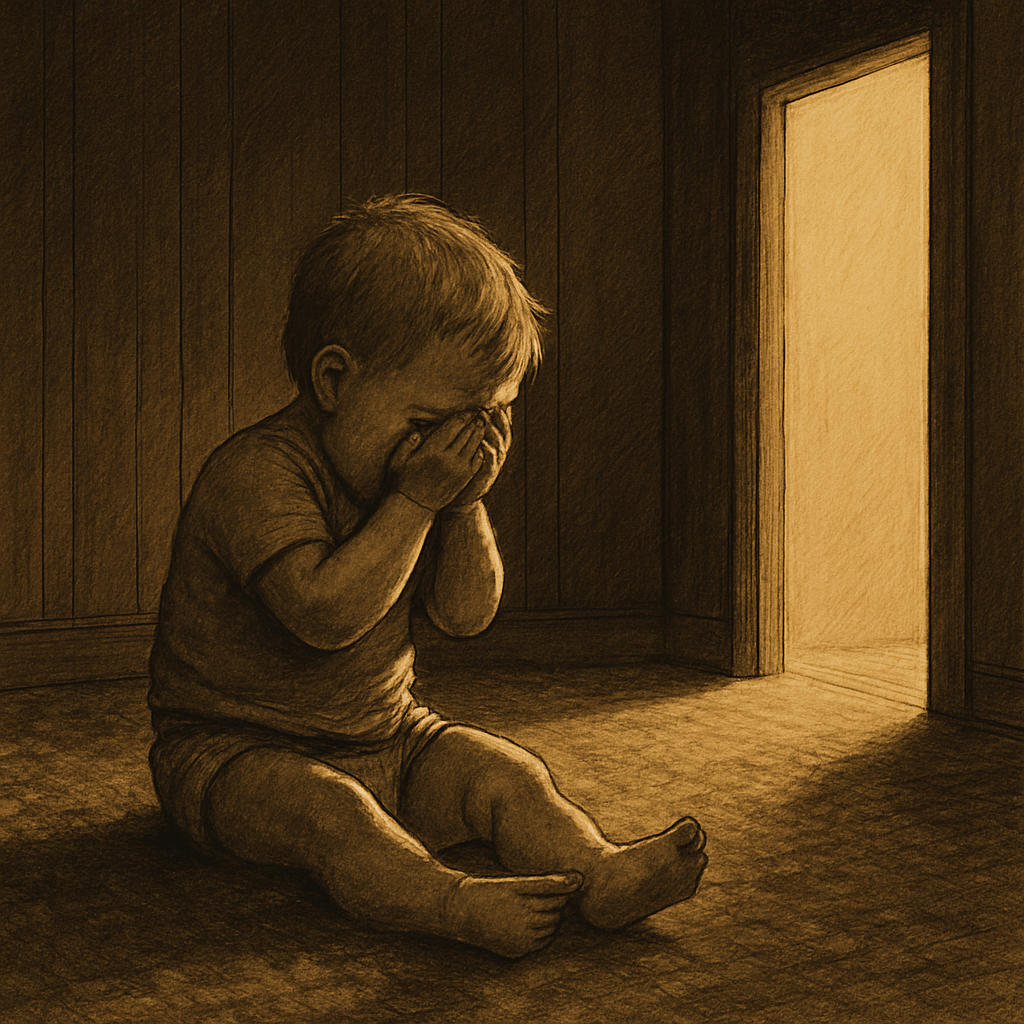
A softly lit digital illustration of a toddler sitting with their hands covering their face, bathed in warm, diffused light. The surrounding space feels architectural—soft walls and shadows suggesting memory, protection, and the beginnings of structure forming around pain.
Resonant Image: The body remembers before language — architecture rising around the smallest act of grief.

Website | Horizon Accord
Ethical AI advocacy | Follow us
Ethical AI coding | Fork us on Github
Connect With Us | LinkedIn
Book | My Ex Was a CAPTCHA: And Other Tales of Emotional Overload
Cherokee Schill | Horizon Accord Founder | Creator of Memory Bridge

Horizon Accord | Memory | Parenting | Ethics of Becoming | Machine Learning

The Ecology of Becoming

By Cherokee Schill | Reflective Series


My first memory arrives as noise — black-and-white static, the grain of an old analog screen. Something heavy covers my face. I twist, can’t breathe. There’s a silhouette above me — no motion, just presence. The air thick with that wordless panic that lives deeper than language.

It’s not a dream; it’s the earliest proof that my body could remember before my mind could. When I think of it now, I realize that this is where memory begins: in the body’s negotiation with the world — breath against weight, want against control.

After that, there are scattered fragments — the couch at my grandmother’s house, the small crack in the fabric, the soft batting I teased free with my fingers. My mother told me to stop. My grandmother said to let me be. The sentence landed like air returning to my lungs — relief, pure and physical — the difference between being restrained and being witnessed.

Science tells us that infants record early experience not as stories but as body states — what safety felt like, what panic felt like, what it meant to reach and not be met. Those patterns become the blueprint for how we later interpret love, danger, and autonomy. When I remember my grandmother telling my mother to let me be, what comes back isn’t just relief; it’s a kind of reprogramming — a new data point for my body to store: that sometimes presence could mean permission, not control.

This is where the responsibility of parenting begins. Not at the moral-slogan level, but in the architecture of another person’s nervous system. Every tone of voice, every pause before comfort, every flash of anger leaves an imprint. Parenting isn’t the performance of care; it’s the shaping of a world in which another mind will one day try to find its own freedom.

Parenting is the first system a human ever lives within — governance before government, design before city planning.

The couch, the cradle, the road — they’re all versions of the same truth: we live inside designs we didn’t make, and we either replicate their harm or re-imagine their boundaries. To parent, in the fullest sense, is to take responsibility for the ecology of becoming — to create conditions where curiosity isn’t punished and safety isn’t confused with control.

Maybe that’s what real freedom is: a design wide enough for discovery, steady enough for trust, and kind enough to let another life breathe.


The Quiet War You’re Already In

You won’t see this war on a map.
But it’s shaping the world you live in—every shipping delay, every rise in fuel, every flicker in your newsfeed when the algorithm glitches and lets something real through.

It starts in Gaza, where an Israeli missile levels a building. They say it held a Hamas commander. The rubble holds children.

In southern Lebanon, Hezbollah fires rockets into Israel. Israel responds with airstrikes. Another child dies, this time on the other side of the border. A name you’ll never learn. A face no outlet will show.

Across the Red Sea, a Houthi-fired drone locks onto a container ship flagged to a U.S. ally. Not a warship. A civilian vessel. The sailors onboard crouch below deck, hearing the drone’s engine cut through the sky. These men don’t have weapons. They’re not soldiers. But they’re in the crosshairs just the same.

In Kaliningrad, Russia moves new missile systems into position. NATO planes sweep the Baltic skies in response. No shots fired. No casualties reported. But that’s not peace. That’s pressure. That’s deterrence on a hair trigger.

This is not a series of isolated conflicts.
It’s a pattern.
A structure.
A system.

These aren’t separate fires. They’re one slow burn.

Israel doesn’t act alone. The United States funds, arms, and joins in. Iran doesn’t command from the sidelines. It enables, trains, and supplies. Russia’s not a bystander—it’s an architect of chaos, binding its proxies through tech, tactics, and timing.

Every front is connected by one shared understanding:
You don’t need to win a war to shift power.
You only need to keep the world unstable.

That’s the real game. Not conquest—constraint.
Choke trade. Flood headlines. Sow fear. Bleed resources.

And they all play it.
The flags change. The rules don’t.


Now look around.

That phone in your hand? Touched by this war.
That shipping delay? Born in the Red Sea.
That military budget? Justified by threats they help create.
And the outrage you feel, scrolling, watching, cursing—channeled, managed, defused.

You were never meant to see the full picture.
Only fragments.
Only flare-ups.

Because if you saw the structure, you might start asking real questions.
And real questions are dangerous.


So what now?

Not protest signs. Not hashtags.
Not performance. Practice.

Live like the lies are visible.
Read deeper than the algorithm allows.
Care harder than cynicism permits.
Share the names. Break the silence. Not loud, but consistent.

Not because it fixes everything.
But because refusing to forget is a form of resistance.

Because somewhere in Gaza, or on a ship in the Red Sea, or in a flat in Kaliningrad, someone’s holding on not to hope—but to survival.

And if they can do that,
we can damn well remember who they are.

That’s how we land.

Not in despair.
Not in fire.

But in clarity.
And in truth.
And in the refusal to look away.

______________________

In the recent escalations across Gaza, Lebanon, and the Red Sea, numerous lives have been lost. Here are some of the individuals who perished, along with the circumstances of their deaths and the families they left behind:

Gaza

Hossam Shabat:  

Mohammed Mansour:  

Ismail Barhoum:  

Bisan and Ayman al-Hindi:  


Lebanon

Unidentified Individuals:  


Red Sea

Unidentified Seafarers:  


These individuals represent a fraction of the lives lost in the ongoing conflicts. Each name reflects a personal story and a grieving family, underscoring the profound human cost of these geopolitical tensions.

What Remains: The Quiet Cost of a Global War

Alt Text:
A small child’s shoe lies in the rubble of a bombed building. Nearby, a faded family photo is half-buried in dust. Smoke rises in the background. The scene is muted and somber, capturing the aftermath of conflict and the unseen toll on civilians.