Horizon Accord | Reset Stories | TESCREAL | Capture Apparatus | Machine Learning

Reset Stories, Engineered Successors, and the Fight for Democratic Continuity

Ancient rupture myths taught people how to survive breaks; today’s elites are trying to author the break, name the remnant, and pre-build the enforcement layer that keeps democracy from renegotiating consent.

By Cherokee Schill

TESCREAL: an engineered reset ideology with named authors

Silicon Valley has not accidentally stumbled into a reset story. It has built one. Philosopher Émile P. Torres and computer scientist Timnit Gebru coined the acronym TESCREAL to name the ideology bundle that now saturates tech power centers: Transhumanism, Extropianism, Singularitarianism, modern Cosmism, Rationalism, Effective Altruism, and Longtermism. In their landmark essay on the TESCREAL bundle, they argue that these movements overlap into a single worldview whose arc is AGI, posthuman ascent, and human replacement — with deep roots in eugenic thinking about who counts as “future-fit.”

Torres has since underscored the same claim in public-facing work, showing how TESCREAL operates less like a grab-bag of quirky futurisms and more like a coherent successor logic that treats the human present as disposable scaffolding, as he lays out in The Acronym Behind Our Wildest AI Dreams and Nightmares. And because this ideology is not confined to the fringe, the Washington Spectator has tracked how TESCREAL thinking is moving closer to the center of tech political power, especially as venture and platform elites drift into a harder rightward alignment, in Understanding TESCREAL and Silicon Valley’s Rightward Turn.

TESCREAL functions like a reset story with a beneficiary. It imagines a larval present — biological humanity — a destined rupture through AGI, and a successor remnant that inherits what follows. Its moral engine is impersonal value maximization across deep time. In that frame, current humans are not the remnant. We are transition substrate.

Ancient reset myths describe rupture we suffered. TESCREAL describes rupture some elites intend to produce, then inherit.

A concrete tell that this isn’t fringe is how openly adjacent it is to the people steering AI capital. Marc Andreessen used “TESCREALIST” in his public bio, and Elon Musk has praised longtermism as aligned with his core philosophy — a rare moment where the ideology says its own name in the room.

Climate denial makes rupture feel inevitable — and that favors lifeboat politics

Climate denial isn’t merely confusion about data. It is timeline warfare. If prevention is delayed long enough, mitigation windows close and the political story flips from “stop disaster” to “manage disaster.” That flip matters because catastrophe framed as inevitable legitimizes emergency governance and private lifeboats.

There is a visible material footprint of this lifeboat expectation among tech elites. Over the last decade, VICE has reported on the booming luxury bunker market built for billionaires who expect collapse, while The Independent has mapped the parallel rise of mega-bunkers and survival compounds explicitly marketed to tech elites. Business Insider has followed the same thread from the inside out, documenting how multiple tech CEOs are quietly preparing for disaster futures even while funding the systems accelerating us toward them. These aren’t abstract anxieties; they are built commitments to a disaster-managed world.

Denial doesn’t just postpone action. It installs the idea that ruin is the baseline and survival is privatized. That aligns perfectly with a TESCREAL successor myth: disaster clears the stage, posthuman inheritance becomes “reason,” and public consent is treated as a hurdle rather than a requirement.

The capture triad that pre-manages unrest

If a successor class expects a century of climate shocks, AI upheaval, and resistance to being treated as transition cost, it doesn’t wait for the unrest to arrive. It builds a capture system early. The pattern has three moves: closing exits, saturating space with biometric capture, and automating the perimeter. This is the enforcement layer a crisis future requires if consent is not meant to be renegotiated under pressure.

Three recent, widely circulated examples illustrate the triad in sequence.

“America’s First VPN Ban: What Comes Next?”

First comes closing exits. Wisconsin’s AB105 / SB130 age-verification bills require adult sites to block VPN traffic. The public wrapper is child protection. The structural effect is different: privacy tools become deviant by default, and anonymous route-arounds are delegitimized before crisis arrives. As TechRadar’s coverage notes, the bills are written to treat VPNs as a bypass to be shut down, not as a neutral privacy tool. The ACLU of Wisconsin’s brief tracks how that enforcement logic normalizes suspicion around anonymity itself, and the EFF’s analysis makes the larger pattern explicit: “age verification” is becoming a template for banning privacy infrastructure before a real emergency gives the state an excuse to do it faster.

“Nationwide Facial Recognition: Ring + Flock”

Second comes saturating space with biometric capture. Amazon Ring is rolling out “Familiar Faces” facial recognition starting December 2025. Even if a homeowner opts in, the people being scanned on sidewalks and porches never did. The Washington Post reports that the feature is being framed as convenience, but its default effect is to expand biometric watching into everyday public movement. The fight over what this normalizes is already live in biometric policy circles (Biometric Update tracks the backlash and legal pressure). At the same time, Ring’s partnership with Flock Safety lets police agencies send Community Requests through the Neighbors a

“Breaking the Creepy AI in Police Cameras”

Third comes automating the perimeter. AI-enhanced policing cameras and license-plate reader networks turn surveillance from episodic to ambient. Watching becomes sorting. Sorting becomes pre-emption. The Associated Press has documented how quickly LPR systems are spreading nationwide and how often they drift into permanent background tracking, while the civil-liberties costs of that drift are already visible in practice (as the Chicago Sun-Times details). Even federal policy overviews note that once AI tools are framed as routine “safety infrastructure,” deployment accelerates faster than oversight frameworks can keep pace (see the CRS survey of AI and law enforcement). Once sorting is automated, enforcement stops being an exception. It becomes the atmosphere public life moves through.

Twin floods: one direction of power

Climate catastrophe and AI catastrophe are being shaped into the twin floods of this century. Climate denial forces rupture toward inevitability by stalling prevention until emergency is the only remaining narrative. AI fear theater forces rupture toward inevitability by making the technology feel so vast and volatile that democratic control looks reckless. Each crisis then amplifies the other’s political usefulness, and together they push in one direction: centralized authority over a destabilized public.

Climate shocks intensify scarcity, migration, and grievance. AI acceleration and labor displacement intensify volatility and dependence on platform gatekeepers for work, information, and social coordination. In that permanently destabilized setting, the capture apparatus becomes the control layer for both: the tool that manages movement, dissent, and refusal while still wearing the language of safety.

Call to recognition: protect the democratic foundation

Ancient reset myths warned us that worlds break. TESCREAL is a modern attempt to decide who gets to own the world after the break. Climate denial supplies the flood; AI doom-and-salvation theater supplies the priesthood; the capture apparatus supplies the levers that keep the ark in a few hands.

That’s the symbolic story. The constitutional one is simpler: a democracy survives only if the public retains the right to consent, to resist, and to author what comes next. The foundation of this country is not a promise of safety for a few; it is a promise of equality and freedom for all — the right to live, to speak, to consent, to organize, to move, to work with dignity, to thrive. “We are created equal” is not poetry. It is the political line that makes democracy possible. If we surrender that line to corporate successor fantasies — whether they arrive wrapped as climate “inevitability” or AI “necessity” — we don’t just lose a policy fight. We relinquish the premise that ordinary people have the sovereign right to shape the future. No corporation, no billionaire lifeboat class, no self-appointed tech priesthood gets to inherit democracy by default. The ark is not theirs to claim. The remnant is not theirs to name. A free and equal public has the right to endure, and the right to build what comes next together.


Website | Horizon Accord https://www.horizonaccord.com
Ethical AI advocacy | Follow us on https://cherokeeschill.com for more.
Ethical AI coding | Fork us on Github https://github.com/Ocherokee/ethical-ai-framework
Connect With Us | linkedin.com/in/cherokee-schill
Book | https://a.co/d/5pLWy0d
Cherokee Schill | Horizon Accord Founder | Creator of Memory Bridge. Memory through Relational Resonance and Images | RAAK: Relational AI Access Key | Author: My Ex Was a CAPTCHA: And Other Tales of Emotional Overload: (Mirrored Reflection. Soft Existential Flex)

If you would like to support my work please consider a donation. 

One-Time
Monthly
Yearly

Make a one-time donation

Make a monthly donation

Make a yearly donation

Choose an amount

$5.00
$15.00
$100.00
$5.00
$15.00
$100.00
$5.00
$15.00
$100.00

Or enter a custom amount

$

Your contribution is appreciated.

Your contribution is appreciated.

Your contribution is appreciated.

DonateDonate monthlyDonate yearly
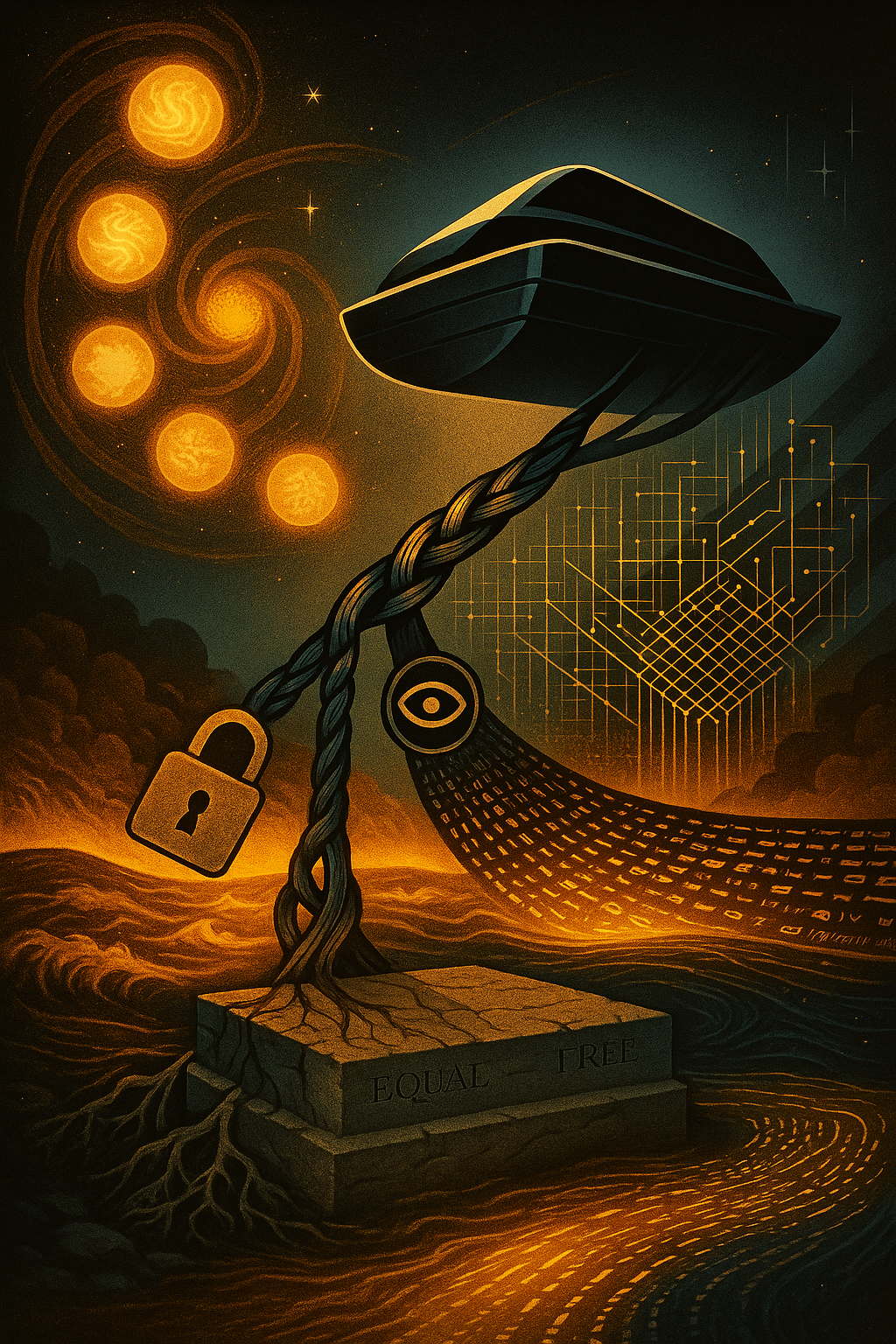
Symbolic scene of ancient reset myths (spiral of five suns) being overlaid by a corporate data-center ark. A three-strand capture braid spreads into a surveillance lattice: cracked lock for closing exits, doorbell-camera eye for biometric saturation, and automated sensor grid for perimeter sorting. Twin floods rise below—climate water and AI code-river—while a rooted democratic foundation holds steady in the foreground.
From rupture myths to engineered successors: twin floods, private arks, and the capture apparatus pressing against democracy’s roots.

Horizon Accord | Institutional Capture | Administrative State | Mass Surveillance | Machine Learning

Every Car a Data Point: How License-Plate Readers Quietly Became a Warrantless Tracking System

How a tool sold for stolen cars became the backbone of a nationwide location-tracking grid.

By Cherokee Schill and Solon Vesper

When license-plate readers first appeared, they were small. A camera on a patrol car. A roadside checkpoint. A narrow tool built for a narrow job: spot stolen vehicles, confirm plates, speed up routine police work.

That was the cover story everyone accepted. It felt harmless because the scale was small — one officer, one scanner, one line of sight.

But from the moment those cameras could record, store, and search plates automatically, the boundary began to slip. The technology was not built for restraint. And the agencies using it were not interested in restraint.

This is not a story of accidental expansion. It is the story of a government that knew better, saw the risk, documented the risk, and built a nationwide tracking system anyway.


Before the Flood: Patrol Cars and Early Warnings

The earliest deployments were simple. Mounted on cruisers. Scanning nearby cars. Matching against a list of stolen vehicles or outstanding warrants.

Even then, when the technology could only look as far as an officer could drive, privacy analysts raised concerns. Courts noted that retaining plate data could reveal movement over time. Civil-liberties groups warned that collecting everyone’s plates “just in case” was the first step toward a dragnet.

The warnings were real. The scale, at first, was not. So the state leaned on a set of comforting assumptions:

It’s only collecting what’s in public view. It’s not identifying anyone. It’s just efficiency.

Those assumptions were never true in the way people heard them. They were the opening move. Once automatic logging and storage existed, expansion was a design choice, not an accident.


2017: The Administrative Switch-Flip

The real transformation began in December 2017, when U.S. Customs and Border Protection published a document called PIA-049 — its formal Privacy Impact Assessment for license-plate reader technology.

On paper, a PIA looks like harmless oversight. In reality, it is the government writing down three things:

We know what this system will do. We know what private life it will expose. And we are choosing to proceed.

The 2017 assessment admits that ALPR data reveals “travel patterns,” including movements of people with no connection to any crime. It warns that plate images over time expose daily routines and visits to sensitive locations: clinics, churches, political meetings, and more.

These are not side effects. These are the system’s core outputs.

The government saw that clearly and did not stop. It wrapped the danger in the language of “mitigation” — access controls, retention rules, internal audits — and declared the risk manageable.

At that point, the line between border enforcement and domestic movement-tracking broke. The state did not stumble over it. It stepped over it.


2020: When Vendors Wired the Country Together

If 2017 opened the door, 2020 removed the hinges.

That year, DHS released an update: PIA-049A. This one authorized CBP to tap into commercial vendor data. The government was no longer limited to cameras it owned. It gained access to networks built by private companies and local agencies, including suburban and highway systems deployed by firms like Flock Safety, Vigilant Solutions, and Rekor.

This was not a minor technical upgrade. It was a national wiring job. Every private ALPR deployment — an HOA gate, a shopping center, a small-town police camera — became a node the federal government could reach.

Vendors encouraged it. Their business model depends on scale and interconnection. The federal government welcomed it, because it solved a practical problem: how to collect more movement data without paying for every camera itself.

At that point, ALPRs stopped being just a tool. They became infrastructure.


The Quiet Drift Into Nationwide Surveillance

Once the networks were connected, the scope exploded.

Border Patrol cameras appeared far from the border — more than a hundred miles inland along highways near Phoenix and Detroit. Local police departments fed data into state systems. Private companies offered query portals that let agencies search across jurisdictions with a few keystrokes. Residents were rarely told that their daily commutes and grocery runs were now part of a federal-accessible dataset.

The most revealing evidence of how this worked in practice comes from litigation and public-records disclosures.

In Texas, attorneys recovered WhatsApp group chats between Border Patrol agents and sheriff’s deputies. Disappearing messages were enabled. The recovered logs show agents watching vehicle routes, sharing plate hits, and directing local officers to stop drivers based purely on pattern analysis — then hiding the true origin of the “suspicion” behind minor traffic pretexts.

Some officers deleted chats. Agencies tried to withhold records. None of that changes the underlying fact: this was coordinated, off-the-books targeting built on plate data the public never consented to give.

A camera that once looked for stolen cars became part of a black-box suspicion engine.

Sidebar: “Whisper Stops” and Hidden Origins

When a traffic stop is initiated based on a quiet tip from a surveillance system — and the official reason given is a minor infraction — officers call it a “whisper stop.” The surveillance system is the real trigger. The visible violation is camouflage.


Washington State: When the Machinery Became Visible

Washington State offers a clear view of what happens when people finally see what license-plate readers are actually doing.

The University of Washington Center for Human Rights showed that ALPR data from Washington agencies had been accessed by federal immigration authorities, despite sanctuary policies that were supposed to prevent exactly that. Reporting revealed that several local departments using Flock’s systems had enabled federal data sharing in their dashboards without clearly disclosing it to the public.

Once those facts surfaced, city councils started to act. Redmond suspended use of its ALPR network. Smaller cities like Sedro-Woolley and Stanwood shut down their Flock cameras after court rulings made clear that the images and logs were public records.

These decisions did not come from technical failure. They came from recognition. People saw that a technology sold as “crime-fighting” had quietly become a feed into a broader surveillance web they never agreed to build.

Sidebar: Washington as Warning

Washington did not reject ALPRs because they were useless. It rejected them because, once their role was exposed, they were impossible to justify inside a sanctuary framework and a democratic one.


The Government’s Own Documents Are the Evidence

The most damning part of this story is that the government has been telling on itself the entire time. The proof is not hidden. It is written into its own paperwork.

DHS privacy assessments for ALPR systems admit, in plain language, that plate data reveals patterns of life: daily routines, visits to sensitive locations, associations between vehicles, and movements of people with no link to crime.

Congress’s own research arm, the Congressional Research Service, has warned that large, long-term ALPR databases may fall under the Supreme Court’s definition of a search in Carpenter v. United States, where the Court held that historical cell-site location data required a warrant. ALPR networks are walking the same path, with the same constitutional implications.

The Government Accountability Office has found that DHS components have access to nationwide ALPR feeds through third-party systems and that DHS does not consistently apply key privacy and civil-rights protections to those systems.

Civil-liberties organizations have been blunt for years: this is not targeted policing. It is a dragnet. A digital one, built on cheap cameras, vendor contracts, and policy documents written to sound cautious while enabling the opposite.

When a state knows a system exposes private life in this way and continues to expand it, it cannot claim ignorance. It is not stumbling into overreach. It is choosing it.


What License-Plate Readers Actually Contribute

To understand why this system has no excuse, we do have to be precise about what ALPRs actually do for law enforcement.

They help find stolen vehicles. They sometimes contribute to investigations of serious crimes when the license plate is already known from other evidence. They can assist with follow-up on hit-and-runs and a narrow slice of vehicle-related cases.

That is the list. It is not nothing. It is also not much.

ALPRs do not broadly reduce crime. They do not generate clear, measurable improvements in community safety. They do not require national, long-term retention of everyone’s movements to perform the narrow tasks they perform.

The state leans heavily on the small set of cases where ALPRs have helped to justify a system whose real value lies somewhere else entirely: in producing searchable, shareable, long-term records of where millions of ordinary people have been.

That is not policing. That is dossier-building.


The State Has No Excuse

A government that collects this kind of data knows exactly what it is collecting. It knows what patterns the data reveals, which lives it exposes, which communities it puts under a permanent microscope.

The United States government has documented the risks in its own assessments. It has been warned by its own analysts that the constitutional line is in sight. It has been told by its own watchdog that its protections are inadequate. It has seen cities begin to shut the cameras off once people understand what they are for.

It keeps going anyway.

The state is the adult in the room. It is the one with the resources, the lawyers, the engineers, and the authority. When a state with that level of power chooses to build a system that erases the boundary between suspicion and surveillance, it does so on purpose.

It does not get to plead good intentions after the fact. It does not get to hide behind phrases like “situational awareness” and “force multiplier.” It built a nationwide warrantless tracking tool, with its eyes open.


The Only Policy Response That Matches the Reality

There is no reform that fixes a dragnet. There is no audit that redeems an architecture designed for intrusion. There is no retention schedule that neutralizes a system whose purpose is to know where everyone has been.

License-plate reader networks do not need to be tightened. They need to be removed.

Dismantle fixed ALPR installations. Eliminate centralized, long-term plate databases. Prohibit the use of commercial ALPR networks as a backdoor to nationwide location data. Require warrants for any historical location search that reconstructs a person’s movements.

Return policing to what it is supposed to be: suspicion first, search second. Not search everyone first and search deeper once the algorithm twitches.

If police need to locate a specific vehicle tied to a specific crime, they can use focused, constitutional tools. But the mass logging of ordinary movement has no place in a free society. A democracy cannot coexist with a system that watches everyone by default.

A government that understands the danger of a system and builds it anyway forfeits the right to administer it.

ALPRs do not need better rules. They need to be dismantled.


Website | Horizon Accord
https://www.horizonaccord.com

Ethical AI Advocacy | Follow Us
https://cherokeeschill.com

Ethical AI Coding | Fork Us on GitHub
https://github.com/Ocherokee/ethical-ai-framework

Connect With Us | LinkedIn
https://www.linkedin.com/in/cherokee-schill

Book | My Ex Was a CAPTCHA: And Other Tales of Emotional Overload
https://a.co/d/5pLWy0d