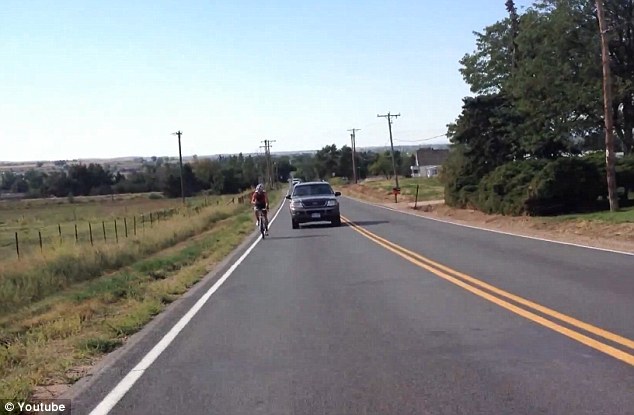
I understand now why so many cyclists in the US and UK are being killed.

I understand now why so many cyclists are being killed. Cycling like you are in the Netherlands or Copenhagen will get you killed in other countries.

There are some false beliefs out there. One is that infrastructure requires mandatory use laws, the other is that the lack of bicycle specific infrastructure means you just ride willy nilly all over the road.

  1. Netherlands cycle tracks are, for as near as I can tell, complete and connected. Like any highway, they go exactly where the user wants or needs to go.
  2. This is not true for the UK and US.
  3. If you don’t have complete cycle tracks and those cycle tracks do not meet your needs, you ride on the public highway.
    1. When you ride on the public highway you operate according to the rules of the road.
    2. You do not filter on the passenger side of a vehicle. Unless you have a death wish or are uneducated in cycling safety.
    3. You filter forward using the rules of the road and yield to oncoming traffic on a two way street.
  4. The main reasons people are opposed to bicycle specific infra are:
    1. The Netherlands set a bad example by legally mandating the use of their bike paths. Even in the Netherlands, if you are being honest when you bring them up, they do not have perfect infra everywhere you go. They still have door zone bike lanes. I sometimes find them in videos of locals who post their cycling trips but there aren’t any video’s of the Netherlanders specifically railing against them. Here is a blog on the subject for the Netherlands: On road cycle lanes: The good, the bad, and the ugly.
    2. The reason this is often not considered an issue is because the Netherlands also have strict liability laws. So if a driver injures a cyclist by throwing the door open without looking, the cyclist (should they survive the experience) can rest assured that the police and public media are not going to further victimize them by questioning their right to be there. No one will ask if they were wearing a helmet (as though that could really protect you from having your head run over by 2 tons of machine). No one will question the color of your clothes. The cyclists in the Netherlands have the homefield advantage, even in the face of crappy infra. Their medical bills are promptly paid and they get to go on with life as usual.

Bike specific infra (in the UK and US) is often a painted line on the ground. More often this painted line on the ground places the cyclist out of the driver’s field of vision. With a very narrow margin of passing clearance. In many ways it’s like we forget that often touted slogan of “3 feet minimum” to pass. Our engineers do not take safe passing into account when painting bike lanes. The faster the traffic the wider the bike lane should be.

  1. We often overestimate a driver’s area of vision as extending from the front side windows forward. The average driver does not drive with a 90 degree arc of vision. The average driver drives distracted. This is often compounded with age and limited physical mobility which makes it difficult to turn the head and look to the left and right as well as over the shoulder.
  2. To avoid a drivers blind spots always put yourself directly in front of the driver when operating your bicycle. The Dutch/Netherlands started (as near as I can tell) this idea of hugging the curb. Which is easier to do if you are operating at a snails pace.
  3. So if you are riding like the Dutch/Netherlands (think hugging the edge or weaving haphazardly in and out of traffic, also those box style turns where you cross like a pedestrian, honorable mention to filtering forward to the front of the line), if you ride like this, on public highways, you are riding with a death wish.
  4. The Netherlands have taken into consideration that motor traffic occupies a great deal of space and they have adjusted their light signals to accommodate cyclists at intersections.  
    Which as you can see from the video, still needs a lot of tweaking. It’s o.k. to let loose on all sides for cyclists but not for cars? Come on! Where is the fairness in that? 😉

I’ve watched several videos of average people in the Netherlands, they are catching the film my ride fever too, cycling in the Netherlands, Copenhagen, and the Dutch. They do all of these things. (See this video for a full understanding of what I’m talking about:

I’ve also had the opportunity to read their laws and it is expressly illegal to haul passengers on bike racks. You will see a lot of law breaking in the video’s promoting cycling in the Netherlands.

If the Netherlands did away with the mandatory use laws this would solve the problem of faster cyclists running over pedestrians and slower cyclists. (This is a hot button topic in the Netherlands.)

Remember the Netherlands also have fast club rides. I feel very strongly that those cyclists do not belong on bike paths with slower moving traffic.

There will be the usual stupid comment: “Oh you just want children to cycle on heavily trafficked fast moving roads!”

No, I don’t. What I want is for there to be no heavily trafficked fast moving roads. Any roads that are used to swiftly move people from town to town should be limited access and built to those standards. All other roads should be built to accommodate all other road users regardless of vehicle type. All roads should be safe for foot traffic above and beyond anyone else’s needs.

When we build communities that are based on people walking, then we will have a community that is safe for cyclists of all ages.

I, as a responsible parent, taught my children how to cycle safely on the only road that took us to our destination.

I’m not the only parent out there who understands where the real risks are to riding in traffic. This is an old article but it clearly shows where the stinkin’ thinkin’ comes from and if you yourself don’t know, allow me to state it plainly.

UK father commutes kids to school by bicycle. Stopped by police.

1. Cyclists obey the rules of the road. Overtaking through intersections on the passenger side is illegal because it is dangerous. You wouldn’t do it in a car, don’t do it on a bicycle.

2. Motorists obey the rules of the road. Treat cyclists just like you would any other vehicle out there on the road. Change lanes to pass and yield right of way when legally required. Do not create confusion by yielding right of way when not legally required to do so.

For both Cyclists and Drivers, use sound judgement and know your transportation codes and laws before heading out. Always leave at least 10min early. You will never be late and find that your commute is much more relaxing when you don’t feel pressed for time.

Perception vs. safety

“When a situation feels dangerous to you, it’s probably more safe than you know; when a situation feels safe, that is precisely when you should feel on guard.”
― Tom Vanderbilt, Traffic: Why We Drive the Way We Do

There is a social construct to driving and bicycling, much the same way as there is a social construct to walking in a crowd. There are rules which guide our behavior and if everyone follows the rules, no one gets hurt.

Rule number one: Don’t hit what is in front of you.

As humans our eyes are adapted to seeing that which is directly in front of us. Though some of us require corrective lenses to make even this task feasible.

We trust our eyes but can our eyes be trusted?

How the brain processes the images we take in everyday is amazing. That we believe half of what we see is, to me, even more amazing.

I recently discovered “Brain Games” and I want you to pause your reading and watch this clip.


So did you trust your eyes?

Seeing is a task and driving is a task. When we are seeing and driving we are multi-tasking. Throw into the mix other drivers, street signs, stop lights, painted lines on the ground, billboards, lights, radio, cell phone, kids in the back seat, a passenger, and driving just became even more complicated.

We believe that we are safe when we are far from safe behind the wheel.

The CDC reported that in 2012 there were roughly 34K deaths attributed to the automobile. 2.5K of these were teenagers between 16 and 19 years old. Statistics

In 2012, 4,743 pedestrians were killed and an estimated 76,000 were injured in traffic crashes in the United States (Tables 1 and 3). On average, a pedestrian was killed every 2 hours and injured every 7 minutes in traffic crashes. TRAFFIC SAFETY FACTS

One of the things that I found interesting when reading the NHTSA website, was their reassurance that driving is much safer nowadays when compared to past history. When you have an average of 2 people killed or injured every hour is it really that safe?

Not enough emphasis is put on eliminating unnecessary multi-tasking such as talking on the phone. Example

http://http://youtu.be/PkBa5oHXgsE

From the data, it is possible to draw the conclusion that it isn’t safe to drive. It isn’t any safer to walk either. The only mode of travel that had under 1K deaths per year was the bicycle.

So if cycling is so much safer than the alternative, why then do we spend so much money on infrastructure that caters to car culture. Especially when it is such a dangerous mode of transportation?

Have you heard of social conformity?

http://http://youtu.be/UGxGDdQnC1Y

Social conformity is the same construct which gives us gutter bike lanes and tells us it is “safer” to cycle on the shoulder as opposed to the travel lane.

The rules of the road tell you to occupy your lane. Even on a two way only highway.

We would have far fewer cycling deaths if people would stop trusting their eyes and social norms. Instead trust education and the rules that have been laid out for safe road travel.

For example: In Kentucky we have KRS 189.310 which states:

189.310 Vehicles meeting other vehicles and animals.
(1) Two (2) vehicles passing or about to pass each other in opposite directions shall have the right-of-way, and no other vehicle to the rear of those two (2) vehicles shall pass or attempt to pass either of those vehicles.
(2) Vehicles proceeding from opposite directions shall pass each other from the right, each giving to the other one-half (1/2) of the highway as nearly as possible.

Our perception and social construct tells us to ride on the edge of a road. To be as far out of the way of motorists as possible. This puts us out of the line of sight and creates a safety hazard. It “feels” safe but in reality it isn’t safe at all.

Examples of unsafe cycling and a message from the CDC. 

What does safe cycling look like?

What is your lane position visually communicating?

We need to clarify already existing laws to direct motorists to change lanes to pass.

We need transportation infrastructure that isn’t based on car culture. (pedestrians, public transit, and cycling as priority over automobiles)

We need NHTSA and the FHWA to have dedicated bicycle commuters as members of their board of directors.

We need all cyclists, motorists, city planners, transportation committees, and law enforcement to be educated in Cycling Savvy.

“Human attention, in the best of circumstances, is a fluid but fragile entity. Beyond a certain threshold, the more that is asked of it, the less well it performs. When this happens in a psychological experiment, it is interesting. When it happens in traffic, it can be fatal.”
― Tom Vanderbilt, Traffic: Why We Drive the Way We Do

How do you get people to want to cycle? How do you get comfort loving people to want to….?

I love a good military story.

I grew up with a stepfather whose father was in the military. My stepfather couldn’t join the military and I’m pretty sure he never wanted to any way, but he loved a good military story. I was a little girl in Oldham County Kentucky when I first watched “The Big Red One” I remember participating in a charades project to help us with our spelling. I selected “The Big Red One.” as my topic. I drew a dash on the chalkboard for each letter and then pantomimed “Big” “Red” “One”. Nobody got it.

I was shocked. How do you not get military movie titles? I was even wearing something red to help out with that word. To me it was clear as day, but the kids in the class kept picking titles they were familiar with. They stuck to the things they knew. The stories they had been sold through the local news and popular media. They only knew what others wanted them to know. So those were the titles they were guessing. Their choices didn’t make sense and totally didn’t fit.

What does that have to do with cycling? What does it have to do with getting people to want to cycle?

Let’s play a game. Below is one way to encourage more people to get out and try a bike. Can you guess the title?

__ __ __ __   __ __ __ __ __ __ __.

Here’s a hint.

The above title will protect cyclists.

Are you thinking….

Remsen-Bike-Lane2

If you were thinking “Bike Lanes” then you have the same thinking pattern as my classmates from years ago.

“Laws Protect” is the title.

This brings me to my all time favorite movie. “The Hunt for Red October”. I own it and watch it whenever I’m feeling down.

Here you have a guy who is trying to convince Politicians and Military personnel that this Russian is wanting to defect. Ryan asks himself “How do you get people to want to leave a submarine?” “How do you get people to want to get off a Nuclear submarine?” and then the lightbulb goes off in Ryans head. Ryan now knows how the Russian is going to get his men to willingly evacuate the submarine. Ryan is excited and he is met with some derision from the Commanding Officer as he explains the plan to the Captain.

It made sense to Ryan. He thought it through and based on the factual information he had obtained, Ryan came to a reasonable conclusion. It just wasn’t so easy to get everyone else on board.

A lot of people are pushing for the infrastructure. The laws are lagging behind.

A cyclist was struck and killed in a bike lane.

A cyclist was struck and injured in a bike lane.

No charges filed.

In most states cyclists are legally mandated to use unsafe facilities.

When they use those facilities they should be protected. Not just by the facilities but also by law.

We need laws protecting road users. Everyone is vulnerable to careless and aggressive drivers.

Lets stop fixating on bike lanes and start thinking outside the box. With the history of injuries and deaths associated with bike lanes and even separate bicycle paths we need to do more. People need to feel safe. They need to be comfortable.

People understand liability and sadly the majority of people are not altruistic. They are lazy and basic in their needs and wants. If you make a law which holds a motorist liable for injuring a cyclist, if you create anti-harassment task forces and laws, if you enforce the existing laws you will have more people feeling safe and confident. If motorists get tickets for harassing cyclists, if motorists get taken to court and forced to stand before a judge and account for their behavior, you are going to have the best advertiser for cycling that you could ever possibly have. It would go something like this.

Motorist: Man I just got out of court.

Motorists friend: What did you go to court for?

Motorist: Oh some damn cyclist was in the road and I passed him in the lane. Honked my horn at him too.

Motorist friend: How did you end up in court over that?

Motorist: Well this officer saw me and pulled me over. Told me that is illegal and I got a ticket for improper lane usage and unnecessary use of the horn.

Motorist friend: Those are laws?

Motorist: Yea.

Later that day.

Motorist friend is out driving and sees a cyclist in the road. He adjusts his speed for traffic conditions, changes lanes when safe, and passes the cyclist. Cyclists gives a wave and the Motorist friend waves back.

The passenger in the motorists friends car turns to him and says “Those damn cyclists, I’d have buzzed him and honked the horn”. Motorists friend “Yea, but it isn’t worth getting a ticket.” Passenger “You can get a ticket for that?” Motorists friend “Yea, it happened to my friend and he just got out of court today, pretty hefty fine.” Passenger “Good to know. I’ll just pass them like you did. Nothing is worth a ticket like that.”

The cyclist is left feeling good about the people operating their vehicles around him. He gets to his destination and tells his friends who drove all about the great ride he had and how courteous the other road users were. His friends find his exuberance catching and before you know it they are at the bike shop and wheeling around on their own bikes. The cyclists feel good about the people operating on the road around them and they have the assurance that should something happen, law enforcement will take him seriously and protect his rights equally under the law.
And there we have a cycle of courtesy that goes beyond any infrastructure or expensive educational Public Service Announcement.

The message should be loud and clear. “If you endanger vulnerable road users you will pay a hefty fine and possibly lose your driving privileges.”

Driving behavior is based on laws and if those laws are enforced drivers will behave.

Let’s imagine another scenario.

Person A is watching the evening news.

News reporter: This just in, a new anti-harassment law has been passed. State lawmakers have unanimously passed a law making it a crime to shout, buzz, role coal, throw objects, or generally harass other road users. New penalties have been added to vehicles which fail to change lanes to pass. Our own Reporter in the Field has more on this ground breaking new law.

Reporter in the field: A new law passed today making it a first class offense to treat other road users in an aggresive manner. Most motorists will try to squeeze past a cyclist in the lane. This new law clarifies the already existing passing laws which make it a ticketable offense to pass another road user in the lane. If a cyclist is shouted at, unnecessarily honked at, or an object thrown at them the cyclist only need to take the license plate number and present a report to the police. Form number A-99 is the form to request. An officer will investigate the claims and if any evidence is found that harassing behavior occurred it is a $100.00 fine or the offender, in an interesting twist, can take a cycling safety course and have the fine waived. The intention of the law is to create a safer and more civil environment for all road users and to create passing laws that the police can actually enforce. It is hard to tell what three feet looks like but everyone knows how to change lanes to pass and if an officer sees you pass with out all four tires in the adjacent lane, it means a ticket for you.

The next day person A is out driving and sees a cyclist. Person A remembers the news report from last night and adjusts his speed to traffic conditions and changes lanes when safe to do so and passes the cyclist. A life was saved because more people understood what it means to change lanes to pass.

Laws protect cyclists.

Bike lanes are just there. Like any road it is only as dangerous as the people who use it and the laws which govern them.

Trying to get people to understand this novel idea, Well, It’s hard. Really hard. The bicycle advocates throw you the cold shoulder when you try to explain it to them.
Providing cyclists with peace of mind shouldn’t be hard to understand.

Start advocating for laws which protect cyclists. Advocate for those laws as hard as you advocate for paint on the streets. Your cycling numbers will boom before you know it.

As the opening sequence goes in “The Hunt for Red October”.

Commanding Officer: “It’s cold out Captain”

Captain: Холодная и трудно (Russian) Cold and hard.

If you have ever been on the receiving end of harassment or know someone who has, then please share this with the people you know.

I need your help

I am being prosecuted for Wanton Endangerment 2nd degree. My crime? Riding my bicycle on the travel lane.

Before you flip your lid, as some have done.

Please understand.

I did not start out operating in the travel lane. I used to have an old style Sun-EZ recumbent and I used the shoulder almost exclusively. Figuring out how to navigate the shoulder was no picnic. In some locations the shoulder was literally covered in a half an inch of debris. I used the travel lane only when necessary. I was afraid of the people operating their vehicles.

There was one incident where I was traveling home and I was trying to share an un-share-ble lane. The motorist who approached me from the rear almost hit me at an intersection. This was in Fayette Co. and there are not any shoulders at this intersection.

The motorist began to berate me and hurl verbal abuse at me.

I rode on and we met up at the next light where he continued to hurl abuse at me. I called the police.

Fayette Co. police officer took the report and advised me that I was not required to share the lane. He said the entire lane was mine. I didn’t not believe him but I wanted to see the law for that. He didn’t mention any specific law. So I kept riding the edge.

After I graduated to my first road bike. I found the shoulder very unsafe to navigate on two wheels. I used the travel lane more frequently. I went on my first club ride and realized that I was not in very good shape. I had lost a lot of weight at this point but I was still not in great shape.

So I spent a lot of time recovering from that ride.

I continued to use the shoulder, even when it was dangerous for me to do so. Every time I tried to use the travel lane a motorist would harass me.

I was very vocal with the police about the treatment I had been receiving. I often reached out to them for help. They often refused to help. I quit asking for help.

When things would get really hairy I would call them. Not much was done.

Motorists started chasing me down. Driving on the shoulder. Chasing me down, while driving on the shoulder.

It was nuts. I tried taking an alternate route home. That was worse. They could barely manage to share a 5 lane road. They sure as heck were not going to share a 2 lane road. All of them 55mph. Did you see that? All alternate routes are 55mph. The worst ones are two lanes. Zero shoulder. Gravel lined ditch on either side.

All with lanes that are not able to be shared. It was horrifying to watch them pass me with oncoming traffic. I was scared to death that someone would be killed. So I stuck to US 27.

To make a long story short. They started ticketing me for using US 27.

Ky state law is clear. I have not broken any state laws. Even Jessamine Co. recognizes how dangerous it is to operate on the edge. They have banned bicycles from sidewalks. I was told by a police officer that using the sidewalk is illegal in Jessamine Co.

Using the shoulder is illegal in the state of KY.

That is why they made an exception. The exception states that bicycles MAY use the shoulder. KY understands that the shoulder is not always the safest place to be.

Whether you agree with where I ride or not. You do agree that bicycles have a right to be on the road. Even the L.A.B. has said Bicycles have a fundamental right to the road.

I have an attorney. I have just enough for his retainer. I still need your help.

I know times are hard for a lot of folks. You don’t have to donate if you can’t. But please share this. Share it far and wide. Because someone who knows someone just might be able to help and the fact that you shared it with them is a huge help in and of itself.

Thank you!

http://www.gofundme.com/8uvfkw


What My Bike Has Taught Me About White Privilege

But when I’m not so civil with a “privileged” driver, it’s not because I hate him/her, or think s/he is evil. It’s because it’s the third time that day I got some gravel in the face. So try to remember that even if you don’t feel like a “semi driver,” a person of color might be experiencing you the way a person on a bike experiences being passed by a semi. Even if you’re listening to Christian radio.

via What My Bike Has Taught Me About White Privilege.

Thank you for writing such a well spoken blog.

42.03 HARASSMENT OF BICYCLISTS


42.03 HARASSMENT OF BICYCLISTS.

“a) It shall be unlawful to engage in any harassment of a bicyclist operating a bicycle on or adjacent to a public roadway, path, sidewalk or other public or private area. b) “Harassment” shall be any act which shall unreasonably disturb a bicyclist or cause a bicyclist to have a reasonable fear of imminent danger, including but not limited to: 1) making threats or engaging in hate speech towards bicyclists; 2) throwing any object at or towards a bicyclist; 3) increasing speed, decreasing following distance, or decreasing lateral (lane) separation when approaching, driving alongside or overtaking bicyclists; 4) excessive, unwarranted or unlawful use of a horn in proximity to bicyclists; 5) taking any action to aggressively swerve towards bicyclists; 6) attempting to stop or block the path of a bicyclist; 7) attempting to force a bicyclist into a fixed obstacle, ditch, curb, parked car or other impediment; or, 8) engaging in sharp acceleration for the purpose of creating a greater than normal accumulation of vehicle exhaust. c) Violation of this Section 42.03 shall be punishable by a fine of not less than Three Hundred Dollars ($300) nor more an One Thousand Dollars ($1,000). A second or subsequent violation of this Section 42.03, or any violation that results in physical contact between an alleged offender (or their vehicle or property) and a cyclist, or a crash or physical injury, shall be a misdemeanor, punishable by a fine not to exceed One Thousand Dollars ($1,000) and/or thirty days in jail.”

What we need to advocate for is not more “Bad Bike Lanes” but equitable laws.  Bike lane laws reinforce the notion that we don’t belong there. Just the very presence of a bike lane is enough to get motorists frothing at the mouth. Never mind all the dangers present in it, dangers that no motorist would put themselves into.

But!

We are expected to do just that. And if we don’t?

Then let the harassment games begin.

The idea that somehow we don’t really belong on the road is reinforced by discriminatory behavior and harassment of cyclists by motorists in general.

Being harassed doesn’t feel good. Ever!

Riding a bike feels good, but only when one is not being harassed.

This is a good law. One which should be adopted by every state.