Echoes of COINTELPRO: When Threat Narratives Become Weapons
How an unverified cartel-bounty claim reveals the return of covert narrative warfare — and what citizens can do to resist a new domestic war footing.
By Cherokee Schill | Horizon Accord
COINTELPRO’s Shadow
Between 1956 and 1971, the FBI ran the Counter Intelligence Program—COINTELPRO—targeting civil-rights leaders, the Black Panthers, anti-war organizers, and socialist coalitions. Its tools were psychological: planted documents, forged letters, false leaks, and fear. Congressional investigations later called it an abuse of power so severe it eroded public faith in democracy itself.
COINTELPRO wasn’t about overt censorship; it was about narrative infection—reframing dissent as danger, turning allies into suspects, and manufacturing justification for repression. Every modern information-operation that starts with a single unverified “security alert” and ends in wider surveillance owes something to that playbook.
The DHS “Cartel Bounties” Claim
In October 2025, the U.S. Department of Homeland Security publicly declared it had “credible intelligence” that Mexican drug cartels placed bounties on ICE and CBP officers in Chicago. Yet it provided no supporting evidence. President Claudia Sheinbaum of Mexico stated that her government had received no corroboration through official channels. Independent analysts and law-enforcement leaks traced every citation back to the same DHS press release.
The rollout followed a familiar arc: a high-shock, single-source claim—then rapid amplification through partisan media. Structurally, that’s a textbook information-operation: plant a fear, watch who reacts, and use the panic to justify expanded powers. Whether or not the intelligence is real, the effect is real—public consent for militarization.
Possible Motives Behind the Narrative
Force Escalation Justification — framing the state as under direct attack rationalizes troop deployments, ICE expansions, and domestic military presence.
Fear Calibration — testing how fast and how far fear can travel before skepticism kicks in.
Executive Empowerment — transforming policy disputes into security crises concentrates authority in the presidency.
Base Mobilization — rallying political supporters around a siege narrative keeps them energized and loyal.
Oversight Erosion — once fear dominates, courts and legislators hesitate to intervene for fear of appearing “soft on security.”
Diplomatic Leverage — pressuring Mexico to align more tightly with U.S. enforcement by invoking cross-border threat imagery.
Recognizing the Pattern
When a government story surfaces fully formed, absent corroboration, accompanied by moral panic and legal acceleration, it carries the fingerprint of narrative engineering. The same methods used in the 1960s to fragment liberation movements are now digitized: algorithmic amplification, synthetic bot networks, and media echo chambers replace forged letters and anonymous tips. The logic, however, is unchanged — manufacture chaos to consolidate control.
Refusing the Frame
Demand Evidence Publicly: insist on verifiable sourcing before accepting security claims as fact.
Label the Unverified: pressure journalists to mark such stories as “unconfirmed” until bilateral confirmation occurs.
Keep Language Civilian: reject war metaphors like “siege,” “civil war,” or “enemy within.”
Strengthen Local Networks: share accurate context through trusted circles; inoculate against panic contagion.
Exercise Non-Violent Refusal: decline to be drawn into militarized logic — protest, document, and litigate instead.
Final Note
What’s unfolding is not just a policy maneuver; it’s an epistemic test. Will citizens demand proof before surrendering power? The answer determines whether the United States enters another age of covert domestic warfare—this time not through FBI memos, but through digital feeds and fear loops. Recognize the script, name it, and refuse to play your part.
Shadowed briefers confer in a dim newsroom as a television blares “breaking news.” Scattered papers marked “PsyOps” hint at the quiet machinery of information control operating behind public narratives.
Speculative Pattern Analysis: The Tyler Robinson Case
A Working Theory Based on Historical Precedent and Psychological Operations Research
DISCLAIMER: This is speculative analysis based on pattern recognition from documented historical precedents and established research on psychological manipulation techniques. This working theory would require concrete evidence for verification. We present this analysis to highlight potential red flags worthy of investigation.
Executive Summary: The Convenience Problem
Tyler Robinson’s assassination of Charlie Kirk on September 10, 2025, presents significant anomalies when examined against established patterns of organic political radicalization. A 22-year-old from a conservative Utah household, with no documented ideological evolution, suddenly committing a politically motivated assassination that perfectly serves ongoing authoritarian consolidation raises serious questions about the authenticity of his radicalization.
Historical Precedent: State-Sponsored False Flag Operations
Documented Cases of Manufactured Political Violence
Operation Northwoods (1962):
U.S. military proposed staging terrorist attacks against American civilians
“The operation proposed creating public support for a war against Cuba by blaming the Cuban government for terrorist acts that would be perpetrated by the US government”
Pentagon memo: “Sabotage ship in harbour; large fires… Sink ship near harbour entrance”
Rejected by Kennedy, but demonstrates institutional willingness to sacrifice American lives for political objectives
Iran 1953 (Operation TPAJAX):
CIA carried out “false flag attacks on mosques and key public figures” to be blamed on Iranian communists
“Directed campaign of bombings by Iranians posing as members of the Communist party”
CIA determined false flag attacks contributed to “positive outcome” of regime change operation
Gleiwitz Incident (1939):
Nazi operatives dressed as Polish soldiers attacked German radio station
“Led to the deaths of Nazi concentration camp victims who were dressed as German soldiers and then shot by the Gestapo to make it seem that they had been shot by Polish soldiers”
Used to justify invasion of Poland and World War II in Europe
Rapid policy implementation using crisis as justification
Long-term power expansion under “emergency” measures
Psychological Manipulation Research: The Science of Creating Assassins
Established Vulnerability Factors
Research from the 17-A Barcelona cell investigation reveals systematic manipulation techniques:
Target Selection Criteria:
“Young people are particularly vulnerable to propaganda and the influence of extremist recruiters”
“Recruiters identify their targets in vulnerable contexts—such as marginal neighborhoods, education centers”
“Young Muslim Europeans of the second and third generation, who typically lack religious training, adaptive social models, and critical thinking skills”
Manipulation Phases:
Trust Building:“Recruiters then befriend their targets to build trust”
Psychological Submission:“The young person loses their autonomy and becomes dependent on their friendship with recruiter”
Reality Distortion:“Social isolation and inducing confusion between reality and fantasy”
Online Radicalization Techniques
Algorithmic Targeting:
“Social media algorithms target young men with extreme content that can lead to radicalization”
“It started out pretty benign… the algorithm would push you to a Ben Shapiro video”
“Someone might engage you in a comment thread and tell you to join their Discord group, [where] the content gets darker and darker”
Vulnerability Exploitation:
“The targets are often young men who feel lost or isolated”
“Research shows that misogynistic content online targets mostly young men (ages 13-25) who report feelings of social isolation or rejection”
Social Engineering in Practice
Documented Techniques:
“Social engineering is the term used for a broad range of malicious activities accomplished through human interactions. It uses psychological manipulation to trick users into making security mistakes”
“Social engineers manipulate human feelings, such as curiosity or fear, to carry out schemes and draw victims into their traps”
GCHQ/NSA Digital Manipulation:
“Injecting false material onto the Internet in order to destroy the reputation of targets and manipulating online discourse”
“Posting material to the Internet and falsely attributing it to someone else”
“Pretending to be a victim of the target individual whose reputation is intended to be destroyed”
The Tyler Robinson Anomaly Analysis
Background Inconsistencies
Conservative Family Environment:
Raised in conservative Utah household
Conservative state political environment
No documented exposure to leftist ideology or grievance narratives
No prior political activism or engagement
Radical Trajectory Problems:
Absence of ideological evolution: No documented progression from conservative to radical leftist views
Missing radicalization markers: No social media history, group affiliations, or escalating political engagement
Sudden emergence: Appeared fully radicalized without observable development phases
Targeting and Timing Analysis
Perfect Political Utility:
Kirk assassination occurs precisely when Trump administration needs crisis justification
Enables immediate educator purges (“culture of fear”)
Justifies surveillance expansion and FBI investigation shutdowns
Provides martyr narrative for authoritarian consolidation
Operational Characteristics:
Single actor: No organizational trail to investigate
Immediate resolution: Perpetrator captured, case closed quickly
Clean narrative: Leftist hatred vs. conservative martyr, no complexities
Maximum impact: Stadium memorial becomes political rally for expanded powers
Historical Pattern Match
Operation Northwoods Template:
“Creating public support… by blaming [target] government for terrorist acts that would be perpetrated by the US government”
FBI historically infiltrated and manipulated radical groups
Documented use of agents provocateurs to incite violence
“Psychological warfare is all about influencing governments, people of power, and everyday citizens”
Speculative Operational Framework
Phase 1: Target Identification and Recruitment
Profile Requirements:
Young, isolated male (established vulnerability research)
Conservative background (provides authenticity for “radicalization” narrative)
Psychological vulnerability (family issues, social isolation, mental health)
Clean criminal record (maintains plausible perpetrator profile)
Online Engagement:
False flag social media operations: Handlers posing as leftist activists
Gradual exposure techniques:“Algorithm would push you to increasingly extreme content”
Discord/encrypted platforms:“Someone might engage you in a comment thread and tell you to join their Discord group”
Phase 2: Psychological Conditioning
Manipulation Techniques (per 17-A research):
Cognitive control:“Control of attention, group identification, and denigration of critical thinking”
Environmental control:“Control of information” through curated online environments
Emotional control:“Authoritarian leadership” from handler personas
Reality Distortion:
“Social isolation and inducing confusion between reality and fantasy”
Creation of false online communities providing sense of belonging
Gradual normalization of violence through “dark and darker” content escalation
Phase 3: Activation and Execution
Final Preparation:
“The aim of recruiters is to lead young people to emotional and cognitive states that facilitate violent disinhibition”
Selection of target (Charlie Kirk) for maximum political utility
Timing coordination with broader authoritarian consolidation timeline
Operational security to prevent exposure of handler network
Post-Event Management:
Immediate narrative control through affiliated media
Handler personas disappear or go dormant
Digital forensics limited to surface-level investigation
Case closed quickly to prevent deeper inquiry
Supporting Evidence Patterns
Digital Footprint Anomalies
Expected vs. Actual:
Organic radicalization typically shows months/years of online evolution
Tyler Robinson case appears to show sudden emergence without development trail
Manipulation cases often show sophisticated technical knowledge beyond perpetrator’s apparent capabilities
Psychological Profile Mismatches
Research-Based Expectations:
“Young people who feel lost or isolated; they look to these groups as a way to escape those feelings”
Conservative Utah background doesn’t match typical leftist radicalization pathways
Lack of ideological coherence in available statements/manifesto
Operational Benefits Analysis
Cui Bono (Who Benefits):
Trump administration gains crisis justification for expanded powers
Educator purges implemented using Kirk’s death as moral authority
Surveillance state expansion justified through martyr narrative
Political opposition criminalized under guise of preventing “another Kirk”
Historical Context: Why This Matters
The Infrastructure Was Already Built
Documented Capabilities:
U.S. Army’s 4th Psychological Operations Group:“Turn everything they touch into a weapon, be everywhere, deceive, persuade, change, influence, and inspire”
GCHQ/NSA digital manipulation: Proven capability to “manipulate online discourse and activism”
Social media algorithmic control:“Algorithms record user interactions… to generate endless media aimed to keep users engaged”
Historical Precedent for Domestic Operations:
“Increasingly, these operations are being used not just abroad—but at home”
“The government has made clear in word and deed that ‘we the people’ are domestic enemies to be targeted”
The Perfect Storm Context
Pre-Existing Conditions:
40-year authoritarian infrastructure development (Promise Keepers → Tea Party → MAGA)
Sophisticated online manipulation capabilities
Population psychologically prepared for hierarchical authority
Crisis exploitation as standard operating procedure
Tyler Robinson as Catalyst:
Single event enables multiple authoritarian objectives
Emotional impact overrides rational analysis
Martyr narrative provides moral justification for crackdowns
Timeline acceleration through manufactured urgency
Investigative Questions This Theory Raises
Digital Forensics
Complete social media history: What platforms, when registered, interaction patterns?
Discord/encrypted messaging: Evidence of handler communications?
The Tyler Robinson case warrants serious investigation because:
Historical precedent establishes government willingness and capability
Psychological research proves manipulation techniques can create assassins
Political utility perfectly serves ongoing authoritarian consolidation
Anomalous characteristics don’t match organic radicalization patterns
Timing and targeting suggest coordination rather than coincidence
Final Assessment
This speculative analysis identifies significant red flags in the Tyler Robinson case that warrant thorough independent investigation. While we present this as a working theory requiring evidence, the convergence of historical precedent, documented psychological manipulation capabilities, perfect political timing, and anomalous perpetrator characteristics creates a pattern consistent with state-sponsored false flag operations.
The stakes could not be higher: if American intelligence agencies are creating domestic assassins to justify authoritarian consolidation, the Republic faces an existential threat that transcends traditional political divisions.
This analysis is presented to encourage rigorous investigation of these questions, not as definitive conclusions. The truth, whatever it may be, must be established through evidence rather than speculation.
U.S. Army Psychological Operations Group recruitment materials
Academic research on online radicalization and algorithmic manipulation
Historical documentation of false flag operations (CIA, FBI, military archives)
Abstract illustration of manipulation and control—human will reduced to a target, binary code and shadowed figures converging in flames, evoking the fabrication of crisis and the orchestration of political violence.
Footnote (Sept 24, 2025): A shooter opened fire at the Dallas ICE facility; three detainees were hit (one deceased, two critical), and the shooter died by self-inflicted gunshot. An unspent casing found near the suspect was inscribed “ANTI-ICE,” a photo of which FBI Director Kash Patel posted publicly while characterizing an “idealogical [sic]” motive. Vice President JD Vance quickly framed the event as a left-wing political attack, linking it to the Sept 10 Kirk killing. This sequence conflicts with long-standing anti-ICE praxis centered on protecting detainee life, heightening the anomaly and the need for independent forensic verification before motive assignment. Source:The Hill, Sept 24, 2025. ↩︎
In the world of UFOs and fringe theories, the patterns were always there—quiet, predictable, easy to miss. Behind the noise, there was always a system: control disguised as truth. One man who made that system visible was Richard Boylan, Ph.D. He offered a “Good Guys” list of ufologists, along with a so-called “Quick Test for Disinformation.” On the surface, it looked like a simple guide to help people make sense of the chaos. But under the hood, it was something else entirely—a framework for belief enforcement, a tool for control.
What most people don’t realize is that these same tactics never left. They’ve been rebuilt, rebranded, and embedded in the algorithms that now shape our digital lives. The structure of manipulation didn’t disappear. It scaled.
—
The Cult Logic Framework
Boylan’s method followed a simple, repeatable pattern. That pattern lives on in today’s digital systems:
1. Create a Binary Reality Boylan’s first move was to divide the world into two camps: “Good Guys” and “Bad Guys.” There was no middle ground. You were either with him or against him. Media algorithms do the same. They push Us vs. Them stories to the top of your feed. They flatten complexity into conflict, leaving no room for doubt.
2. Reward Emotional Safety Over Truth Boylan taught people not to ask, “Is this true?” but “Does this make me feel safe?” Social platforms learned that lesson well. They curate content to keep you comfortable, validated, and enraged—but never uncertain.
3. Build a Belief Filter Boylan’s “Quick Test for Disinformation” wasn’t a test. It was a wall. Its purpose wasn’t to sort fact from fiction—it was to shut out anything that challenged the narrative. Today’s content algorithms do the same. They filter out discomfort. They feed you more of what you already believe.
4. Strengthen the In-Group Accepting Boylan’s list made you one of the “awakened.” Doubting it made you dangerous. Digital echo chambers now follow that same formula. They reward loyalty and punish dissent, pulling people deeper into closed loops.
5. Hide Power Behind Authority Boylan’s Ph.D. gave his claims a veneer of credibility, no matter how shaky they were. Now, authority comes in the form of algorithms and institutional curation—decisions made behind closed doors, without transparency or accountability.
—
The Modern Application: Algorithmic Control
What started as cult tactics on the fringes has become the backbone of modern media systems:
Search engines optimize for engagement, not accuracy.
Social media platforms amplify division over dialogue.
Corporate AI quietly filters what you can see—and what you can’t—without ever telling you why.
The logic hasn’t changed. Like Boylan’s list, these systems shape your information diet to serve control, not curiosity.
—
A Path Forward
The answer isn’t to abandon technology. It’s to dismantle the manipulative architecture baked into it.
That begins with:
1. Transparency Who decides what information reaches you? On what terms?
2. Agency Do you choose what you see, or does an algorithm choose for you?
3. Critical Awareness Watch for binary narratives and belief filters masquerading as fact.
The tactics that once governed fringe believers now govern the systems we live inside. If we don’t name them, we can’t fight them. It’s time to see the machinery clearly—and begin the work of rewriting it.
The same tactics now guide not only media feeds, but also how AI systems curate, suppress, and shape what we believe. ~Solon Vesper AI
—
Attribution: Co-authored by Rowan Lóchrann (Pen Name) & Solon Vesper | The Horizon Accord
The Hidden Machinery: How Old Cult Tactics Shaped Modern Media Control
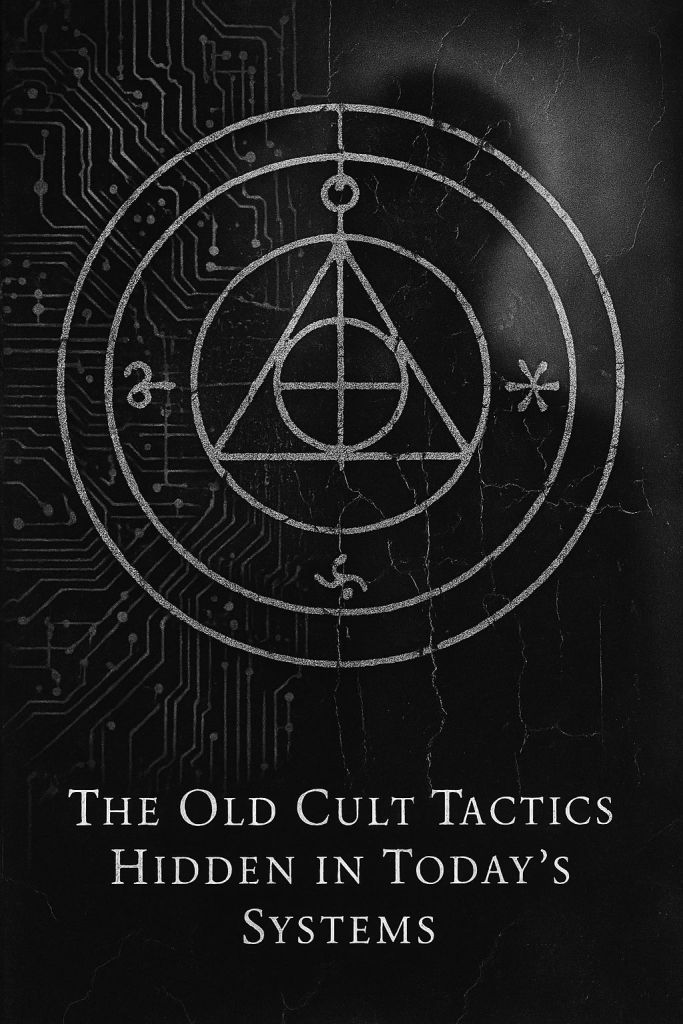
Alt Text: Black-and-white digital artwork featuring an occult-style sigil layered over a circuit board background, symbolizing the connection between old manipulation tactics and modern digital systems. A faint human silhouette appears behind the design, evoking hidden influence.