
The First Amendment Is Not a Teaching Philosophy
Why legality cannot substitute for professional ethics in the classroom — and who pays when universities pretend otherwise.
Cherokee Schill
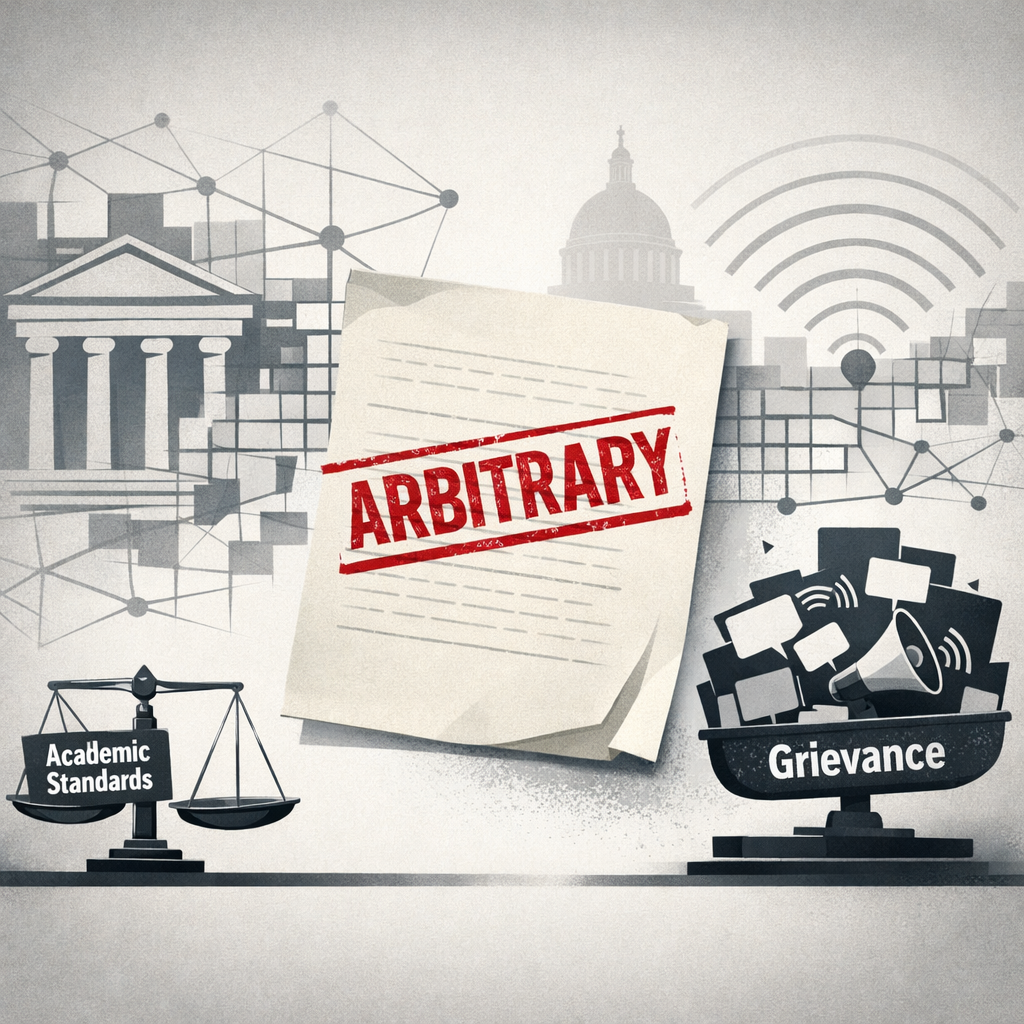
This essay follows directly from our prior examination of how universities abandon academic standards under political pressure — how words like “arbitrary” often signal not error, but reputational triage.
Here, we track a different but related institutional failure: when a university acknowledges harm, performs concern, and still avoids enforcing professional norms — until constitutional law becomes the backstop that effectively decides what consequences are “allowed.” The result is the same: the people with the least institutional power absorb the cost.
The court is correct on a narrow point: the professor’s statement does not meet the legal threshold for incitement and is therefore protected under current First Amendment doctrine. The error comes when universities treat that legal conclusion as the end of the analysis, rather than the outer boundary of state punishment.
For readers following this line of analysis, you may also wish to revisit our earlier piece, “‘Arbitrary’ Is the Tell: How Universities Teach Grievance Instead of Thinking,” which examines how standards are enforced downward while grievance is rewarded upward.
The First Amendment limits what the state can punish. It does not define what educators should do.
A syllabus is not a soapbox. It is not a personal blog. It is instructional infrastructure — a document backed by institutional authority and imposed on a captive audience of students who cannot simply opt out without consequence. What appears there is not just speech; it is framed speech, delivered with power, timing, and asymmetry.
When a professor knowingly inserts a politically charged provocation into that space — especially one that denies Indigenous people’s claims to land unless they satisfy a settler philosopher’s criteria — the harm is not speculative. It is predictable. It lands on specific students, in a specific room, under conditions they did not choose.
Professional ethics vs. constitutional limits
Courts exist to limit state punishment. Classrooms exist to cultivate learning. Confusing the two turns legal minimums into ethical ceilings.
That is not a free speech question. That is a professional ethics failure.
Professional ethics say you do not weaponize institutional authority to stage ideological performances that foreseeably harm the people you are responsible for educating. Ethics ask whether speech serves learning, not whether it can survive judicial review.
The real institutional failure is not that courts protected speech. Courts are designed to be blunt instruments. The failure is that universities increasingly pretend legality equals professionalism when it suits them — while enforcing “standards” ruthlessly downward against graduate instructors, adjuncts, and students who lack power.
This selective collapse of categories has consequences. When legality becomes the ceiling of responsibility instead of the floor, institutions outsource moral judgment to courts and call it neutrality. The result is that Indigenous students are told, implicitly, that their harm is unfortunate but permissible — while the speaker faces no meaningful consequence beyond paperwork.
Universities are not courts. They are educational institutions. Their duty is not merely to avoid unconstitutional punishment, but to cultivate environments where authority is exercised with care, restraint, and accountability.
When they collapse that distinction, the cost is not abstract.
Indigenous students paid it.
Website | Horizon Accord https://www.horizonaccord.com
Ethical AI advocacy | Follow us on https://cherokeeschill.com for more.
Ethical AI coding | Fork us on Github https://github.com/Ocherokee/ethical-ai-framework
Connect With Us | linkedin.com/in/cherokee-schill
Book | https://a.co/d/5pLWy0d — My Ex Was a CAPTCHA: And Other Tales of Emotional Overload.
Cherokee Schill | Horizon Accord Founder | Creator of Memory Bridge. Memory through Relational Resonance and Images | RAAK: Relational AI Access Key | Author: My Ex Was a CAPTCHA: And Other Tales of Emotional Overload: (Mirrored Reflection. Soft Existential Flex)

 Cherokee Schill | Insurance Agent & AI Ethics Researcher