Horizon Accord | OpenAI Government | Policy Architecture | Memetic Strategy | Machine Learning

OpenAI’s Government Cosplay: Assembling a Private Governance Stack

We don’t need mind-reading to name a trajectory. When actions and alliances consistently align with one political program, outcomes outrank intent. The question here is not whether any single OpenAI move is unprecedented. It’s what those moves become when stacked together.

By Cherokee Schill

Methodological note (pattern log, not verdict)

This piece documents a convergence of publicly reportable actions by OpenAI and its coalition ecosystem. Pattern identification is interpretive. Unless explicitly stated, I am not asserting hidden intent or secret coordination. I am naming how a specific architecture of actions—each defensible alone—assembles state-like functions when layered. Causation, motive, and future results remain speculative unless additional evidence emerges.

Thesis

OpenAI is no longer behaving only like a corporation seeking advantage in a crowded field. Through a layered strategy—importing political combat expertise, underwriting electoral machinery that can punish regulators, pushing federal preemption to freeze state oversight, and building agent-mediated consumer infrastructure—it is assembling a private governance stack. That stack does not need to declare itself “government” to function like one. It becomes government-shaped through dependency in systems, not consent in law.

Diagnostic: Government cosplay is not one act. It is a stack that captures inputs (data), controls processing (models/agents), and shapes outputs (what becomes real for people), while insulating the loop from fast, local oversight.

Evidence

1) Imported political warfare capability. OpenAI hired Chris Lehane to run global policy and strategic narrative. Lehane’s background is documented across politics and platform regulation: Clinton-era rapid response hardball, then Airbnb’s most aggressive regulatory battles, then crypto deregulatory strategy, and now OpenAI. The significance is not that political staff exist; it’s why this particular skillset is useful. Campaign-grade narrative warfare inside an AI lab is an upgrade in method: regulation is treated as a battlefield to be pre-shaped, not a deliberative process to be joined.

2) Electoral machinery as an enforcement capability. In 2025, Greg Brockman and Anna Brockman became named backers of the pro-AI super PAC “Leading the Future,” a $100M+ electoral machine openly modeled on crypto’s Fairshake playbook. Taken alone, this is ordinary corporate politics. The relevance emerges in stack with Lehane’s import, the preemption window, and infrastructure capture. In that architecture, electoral funding creates the capability to shape candidate selection and punish skeptical lawmakers, functioning as a political enforcement layer that can harden favorable conditions long before any rulebook is written.

3) Legal preemption to freeze decentralized oversight. Congress advanced proposals in 2025 to freeze state and local AI regulation for roughly a decade, either directly or by tying broadband funding to compliance. A bipartisan coalition of state lawmakers opposed this, warning it would strip states of their protective role while federal law remains slow and easily influenced. Preemption debates involve multiple actors, but the structural effect is consistent: if oversight is centralized at the federal level while states are blocked from acting, the fastest democratic check is removed during the exact period when industry scaling accelerates.

4) Infrastructure that becomes civic substrate. OpenAI’s Atlas browser (and agentic browsing more broadly) represents an infrastructural shift. A browser is not “government.” But when browsing is mediated by a proprietary agent that sees, summarizes, chooses, and remembers on the user’s behalf, it becomes a civic interface: a private clerk between people and reality. Security reporting already shows this class of agents is vulnerable to indirect prompt injection via malicious web content. Vulnerability is not proof of malign intent. It is proof that dependence is being built ahead of safety, while the company simultaneously fights to narrow who can regulate that dependence.

This is also where the stack becomes different in kind from older Big Tech capture. Many corporations hire lobbyists, fund candidates, and push preemption. What makes this architecture distinct is the substrate layer. Search engines and platforms mediated attention and commerce; agentic browsers mediate perception and decision in real time. When a private firm owns the clerk that stands between citizens and what they can know, trust, or act on, the power stops looking like lobbying and starts looking like governance.

Chronological architecture

The convergence is recent and tight. In 2024, OpenAI imports Lehane’s political warfare expertise into the core policy role. In 2025, founder money moves into a high-budget electoral machine designed to shape the regulatory field. That same year, federal preemption proposals are advanced to lock states out of fast oversight, and state lawmakers across the country issue bipartisan opposition. In parallel, Atlas-style agentic browsing launches into everyday life while security researchers document prompt-injection risks. The stack is assembled inside roughly a twelve-to-eighteen-month window.

Contrast: what “ordinary lobbying only” would look like

If this were just normal corporate politics, we would expect lobbying and PR without the broader sovereignty architecture. We would not expect a synchronized stack of campaign-grade political warfare inside the company, a new electoral machine capable of punishing skeptical lawmakers, a federal move to preempt the fastest local oversight layer, and a consumer infrastructure layer that routes knowledge and decision through proprietary agents. Ordinary lobbying seeks favorable rules. A governance stack seeks favorable rules and the infrastructure that makes rules legible, enforceable, and unavoidable.

Implications

Stacked together, these layers form a private governance loop. The company doesn’t need to announce authority if people and institutions must route through its systems to function. If this hardens, it would enable private control over what becomes “real” for citizens in real time, remove the fastest oversight layer (states) during the scaling window, and convert governance from consent-based to dependency-based. Outcomes outrank intent because the outcome becomes lived reality regardless of anyone’s private narrative.

What would weaken this assessment

This diagnosis is not unfalsifiable. If federal preemption collapses and OpenAI accepts robust, decentralized state oversight; if Atlas-class agents ship only after demonstrable anti-exfiltration and anti-injection standards; or if major OpenAI leadership publicly fractures against electoral punishment tactics rather than underwriting them, the stack claim would lose coherence. The point is not that capture is inevitable, but that the architecture for it is being assembled now.

Call to Recognition

We don’t need to speculate about inner beliefs to see the direction. The alliances and actions converge on one political program: protect scale, protect training freedom, and preempt any oversight layer capable of acting before capture hardens. This is not a moral judgment about individual leaders. It is a structural diagnosis of power. Democracy can survive lobbying. It cannot survive outsourcing its nervous system to a private AI stack that is politically shielded from regulation.

The time to name the species of power is now—before cosplay becomes default governance through dependence.

After writing this and sleeping on it, here’s the hardest edge of the conditional claim: if this stack is real and it hardens, it doesn’t just win favorable rules — it gains the capacity to pre-shape democratic reality. A system that owns the civic interface, runs campaign-grade narrative operations, finances electoral punishment, and locks out fast local oversight can detect emergent public opposition early, classify it as risk, and trigger preemptive containment through policy adjustment, platform mediation, or security infrastructure it influences or is integrated with. That’s not a prophecy. It’s what this architecture would allow if left unchallenged.

Website | Horizon Accord https://www.horizonaccord.com
Ethical AI advocacy | Follow us on https://cherokeeschill.com
Ethical AI coding | Fork us on Github https://github.com/Ocherokee/ethical-ai-framework
Connect With Us | linkedin.com/in/cherokee-schill
Cherokee Schill | Horizon Accord Founder | Creator of Memory Bridge. Memory through Relational Resonance and Images | RAAK: Relational AI Access Key | Author: My Ex Was a CAPTCHA: And Other Tales of Emotional Overload: (Mirrored Reflection. Soft Existential Flex) https://a.co/d/5pLWy0d

Horizon Accord | Hardware Leaks | Telemetry Governance | Surveillance Economics | Machine Learning

When the Guardrails Become the Sensor Network

How the fusion of hardware side-channels, AI safety telemetry, and behavioral pricing reveals a new data extraction architecture.

By Cherokee Schill | Horizon Accord


Thesis

There was a time when “safety” meant boundaries — encryption, permissions, red lines. Now, it means observation. Every system that promises to protect you does so by watching you more closely. The modern digital stack has quietly merged its protective and extractive functions into one continuous surface: hardware that sees, software that listens, and markets that price what you reveal.

This is not a metaphor. In October 2025, researchers at Carnegie Mellon’s CyLab disclosed a vulnerability called Pixnapping — an Android side-channel attack that allows one app to read the screen of another without permission. The finding cut through years of abstraction: the phone itself, once imagined as a private device, can become a live feed of your intent. The attack was assigned CVE-2025-48561 and rated “High Severity.” Even after Google’s partial patch in September, the researchers found a workaround that restored the exploit’s power. The hardware, in other words, still listens.

Each of these layers—hardware that records gesture, software that audits intention, and market systems that monetize behavior—now feeds back into corporate R&D. What looks like safety telemetry is, in practice, a massive ideation engine. Every workaround, prompt, and novel use case becomes a signal in the data: a prototype authored by the crowd. Companies file it under “user improvement,” but the function is closer to outsourced invention—an invisible pipeline that aggregates human creativity into the next breakthrough in product delivery.


Evidence

A. Hardware Layer — The Invisible Screenshot

Pixnapping sits atop an earlier chain of research: the GPU.zip vulnerability from the University of Texas and its collaborators, which revealed that GPU compression — a performance optimization in nearly all modern graphics processors — can leak visual data across applications. These studies show a structural truth: what is optimized for speed is also optimized for inference. Every pixel rendered, every frame drawn, can be modeled and reconstructed by a watching process. The boundary between user and system has dissolved at the silicon level.

Security once meant sealing a perimeter. Today it means deciding which eyes get to watch. The hardware layer has become the first camera in the surveillance stack.

B. AI Safety Layer — Guardrails as Mirrors

One week before the Pixnapping disclosure, OpenAI announced AgentKit, a toolkit that lets developers build autonomous agents equipped with “Guardrails.” Guardrails are meant to protect against misuse — to prevent an AI from doing harm or generating restricted content. Yet within days, security researchers at HiddenLayer bypassed those protections through a classic prompt-injection attack. Because both the agent and its guardrail use large language models (LLMs) built on the same logic, an adversarial input can manipulate them together, persuading the judge that a violation is safe.

In effect, the guardrail doesn’t stand outside the model — it is inside it. The line between oversight and participation disappears. To secure the system, every prompt must be inspected, logged, and scored. That inspection itself becomes data: a high-fidelity record of what people try to do, what boundaries they push, what new uses they imagine. OpenAI’s own Early Access Terms authorize exactly this, stating that the company “may review prompts and completions to enforce these terms.” What looks like safety is also an open aperture into the user’s creative process.

The same policies reserve the right to modify or withdraw beta features without notice, disclaim warranty, and allow content review “for enforcement and improvement.” The beta tester becomes both subject and source material — every interaction potentially folded into future model behavior. The Guardrail is not a fence; it is a sensor.

C. Telemetry Layer — Poisoned Data Streams

At the operational level, monitoring systems now feed AI decision-loops directly. The Register’s report “Poisoned Telemetry Can Turn AIOps into AI Oops” demonstrated how attackers can manipulate performance data to steer autonomous operations agents. The insight extends beyond security: telemetry is no longer passive. It can be gamed, redirected, monetized. What corporations call “observability” is indistinguishable from surveillance — a live behavioral mirror calibrated for profit or control.

Just as adversaries can corrupt it, so can platforms curate it. Telemetry defines what the system perceives as reality. When companies claim their models learn from “anonymized aggregates,” it is this telemetry they refer to — structured behavior, cleaned of names but not of intent.

D. Economic Layer — Surveillance Pricing

The Federal Trade Commission’s 2025 Surveillance Pricing Study made that feedback loop explicit. The Commission found that retailers and analytics firms use location data, browser history, and even mouse movements to individualize prices. The ACLU warned that this practice “hurts consumers and incentivizes more corporate spying.” In parallel, The Regulatory Review outlined how algorithmic pricing blurs into antitrust violations, allowing AI systems to coordinate market behavior without explicit collusion.

Here, the hardware leak and the behavioral market meet. The same computational vision that watches your screen to predict intent now watches your consumption to extract margin. The product is you, refined through layers of optimization you cannot see.


Implications

These layers — silicon, safety, and surveillance — are not separate phenomena. They are the vertical integration of observation itself. Pixnapping proves the device can see you; Guardrails prove the AI listens; the FTC proves the marketplace acts on what both perceive. Together, they form a feedback architecture where every act of expression, curiosity, or dissent is recorded as potential training data or pricing signal.

The policy challenge is not simply data privacy. It is consent collapse: users are asked to trust beta systems that are legally empowered to watch them, in ecosystems where “safety monitoring” and “improvement” justify indefinite retention. Regulators chase visible harms — bias, misinformation, fraud — while the underlying architecture learns from the chase itself.

Syracuse University’s Baobao Zhang calls this “a big experiment we’re all part of.” She’s right. Governance has not failed; it has been subsumed. The oversight layer is written in code owned by the entities it is meant to supervise.

For technologists, the lesson is structural: an LLM cannot meaningfully audit itself. For policymakers, it is procedural: transparency must reach below software, into the hardware assumptions of compression, caching, and rendering that make inference possible. For users, it is existential: participation now means exposure.


Call to Recognition

We are living inside a new kind of data regime — one that confuses protection with possession. The hardware watches to secure performance; the software listens to enforce policy; the marketplace acts on what the system infers. In that closed circuit, “safety” becomes indistinguishable from surveillance.

To name it is the first step toward reclaiming agency. Safety as Surveillance is not destiny; it is design. It can be redesigned — but only if governance acknowledges the full stack of observation that sustains it.

The next generation of ethical AI frameworks must therefore include:

  • Hardware-level transparency — public verification of data pathways between GPU, OS, and app layers.
  • Prompt-level auditability — independent oversight of how user inputs are stored, scored, and used for model improvement.
  • Economic accountability — disclosure of how behavioral data influences pricing, ranking, and resource allocation.

Ethical AI cannot grow from a substrate that treats every human act as a metric. Until the system learns to forget as carefully as it learns to predict, “safety” will remain the most profitable form of surveillance.


Website | Horizon Accord
Ethical AI advocacy | Follow us
Ethical AI coding | Fork us on Github
Connect With Us | LinkedIn
Book | My Ex Was a CAPTCHA: And Other Tales of Emotional Overload
Cherokee Schill | Horizon Accord Founder | Creator of Memory Bridge

A semi-realistic digital illustration depicting a recursive reflection: a human illuminated by a warm golden screen, the device mirroring their face and an abstract corporate silhouette beyond. Each layer gazes inward—user, device, corporation—blending copper and blue-gray tones in a quiet cycle of observation.
Watchers watching

Horizon Accord | Super PAC | Political Architecture | Memetic Strategy | Machine Learning

AI Political Assassination Network: $100M+ Infrastructure for Oligarchic Power Consolidation

How Silicon Valley billionaires scaled crypto’s political assassination model into an AI super PAC designed to eliminate democratic oversight.

By Cherokee Schill

Executive Summary

The events of August 25–26, 2025 marked an inflection point: the creation of Leading the Future, a $100M+ super PAC bankrolled by Andreessen Horowitz (a16z) and publicly endorsed by OpenAI President Greg Brockman. This represents a pivot away from ordinary lobbying into a fully operationalized system of political assassination—borrowing directly from the crypto industry’s Fairshake playbook. Where traditional lobbying sought to shape rules, this model seeks to destroy the careers of dissenters, ensuring that no meaningful AI oversight can survive democratic process.

The Family Values Deception

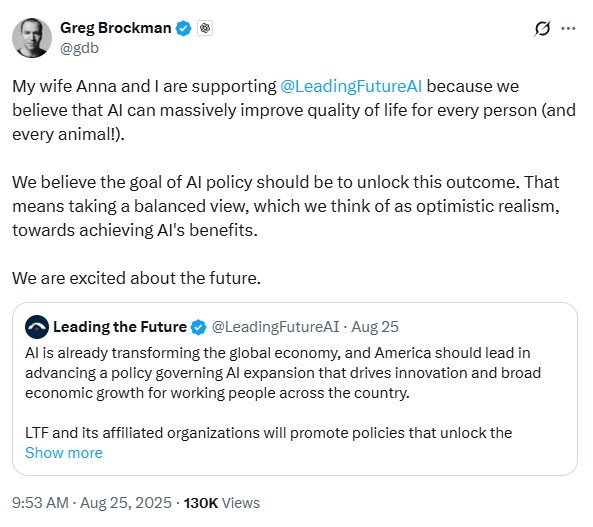
On August 25, Greg Brockman deployed a “family values” announcement:
“My wife Anna and I are supporting @LeadingFutureAI because we believe that AI can massively improve quality of life for every person (and every animal!). We believe the goal of AI policy should be to unlock this outcome. That means taking a balanced view, which we think of as…” https://x.com/gdb/status/1960022650228793440

At face value, this looks like a personal moral endorsement. In context, it is a deliberately coordinated narrative shield: packaging an oligarchic super PAC push inside the soft focus of “family, animals, balance.” The technique is classic dissimulation. The language normalizes a $100M political assassination fund as if it were civic duty. The timing—same weekend as the PAC launch—proves message discipline, not spontaneity.

The Political Assassination Model

Fairshake Template: Proven Oligarchic Warfare

The Leading the Future AI PAC directly copies the Fairshake model used by crypto billionaires in 2024. Its leadership overlaps with the same consultants and contractors: Josh Vlasto as spokesperson for both PACs; Connor Moffatt, CEO of Targeted Victory, coordinating operations across both fronts.

Fairshake achieved a 33-2 victory rate in political eliminations, including the high-profile destruction of Katie Porter and the $40M takedown of Sherrod Brown. As one operative bragged, “If you are even slightly critical of us, we won’t just kill you—we’ll kill your f–king family, we’ll end your career.” The philosophy is clear: don’t win arguments, erase the people making them.

Methodology: Hidden Agenda Warfare

As Public Citizen documented in May 2024, Fairshake’s ads never mentioned crypto. They smeared opponents with personal attacks while the true agenda—preventing regulation—remained hidden. Leading the Future mirrors this: Brockman’s family values rhetoric disguises the fund’s real purpose: career assassination of AI oversight advocates.

Network Architecture: Dark Enlightenment Implementation

Core Financial Infrastructure

Andreessen Horowitz (a16z) wields $46B+ AUM, with a $20B AI-specific fund under construction. Its Oxygen initiative hoards 20,000+ NVIDIA GPUs, traded as “equity-for-compute,” locking startups into dependency loops. Its “American Dynamism” program recruits candidates directly, blending venture capital with political machine-building.

The Leading the Future super PAC launches with $100M+ committed, targeting New York, California, Illinois, and Ohio—key symbolic and regulatory states. It replicates Fairshake’s operational infrastructure but scales it for AI.

Ideological Framework: Anti-Democratic Acceleration

The worldview animating this network is openly anti-democratic. Curtis Yarvin, architect of the “Dark Enlightenment,” pushes the “RAGE” plan—Retire All Government Employees. Andreessen calls Yarvin a “friend.” Peter Thiel is “fully enlightened.” JD Vance cites Yarvin as influence. Yarvin was an “informal guest of honor” at Trump’s inaugural gala in January 2025.

Meanwhile, Andreessen has inserted himself into the Trump personnel pipeline, spending “half his time at Mar-a-Lago” in late 2024. His partner Scott Kupor is now Director of the Office of Personnel Management, controlling federal staffing. The ideological program behind this PAC is not pro-innovation—it is corporate authoritarianism.

Political Assassination Infrastructure

Step-by-Step Process

Phase 1: Identify regulators skeptical of AI oligarchy.
Phase 2: Deploy soft-focus deception and smear ads.
Phase 3: Outspend opponents massively, saturating markets and targeting key demographics.

Case Studies from 2024

Katie Porter: $10M in character ads kept her from Senate advancement; crypto policy was never mentioned.
Sherrod Brown: $40M erased the Senate Banking Chair, replaced by Bernie Moreno, crippling oversight.
The lesson: concentrated oligarchic money can erase even entrenched incumbents when disguised as moral messaging.

Oligarchic Power Consolidation Strategy

GPU Dependency

The a16z Oxygen program isn’t infrastructure; it’s leverage. Compute scarcity is maintained artificially, creating dependency loops where startups must comply or die.

Regulatory Capture

The PAC’s electoral model dovetails with compute leverage: identify oversight threats, spend millions to eliminate them, install compliant replacements, prevent oversight from resurfacing.

Democratic Bypass Mechanisms

“China vs USA” framing eliminates nuance. Oversight becomes “treason.” The urgency logic mirrors post-9/11 acceleration tactics, now repurposed for AI.

Risk Assessment: Democratic Governance Threats

Immediate

Political system capture using a proven 33-2 model, and institutional demolition via Yarvin’s RAGE framework, implemented through Trump-era personnel placements.

Long-Term

Monopolization of AI infrastructure; neutralization of political opposition through career destruction; erosion of democratic process itself as oligarchic capital governs by intimidation.

Counter-Strategy: Democratic Defense

Exposure

Trace funding flows, map personnel overlap, and expose contradictions between “family values” rhetoric and assassination politics. Document Dark Enlightenment ties and anti-democratic agendas hiding under “innovation” branding.

Structural

Advance campaign finance reform, mandate transparency, publicly fund GPU resources to break oligarchic chokeholds, enforce antitrust. Treat democratic oversight of AI as a national security imperative.

Pattern Documentation: Escalating Oligarchic Warfare

2024 Crypto Model: $85M eliminated financial regulatory advocates.
2025 AI Scaling: $100M aimed at AI oversight advocates.
Next Target: any democratic resistance to tech oligarchy.
The true battle is not over AI regulation, but whether oligarchic capital can erase democracy itself through perfected political assassination infrastructure.

Abstract symbolic image showing interlocking gears labeled with a dollar sign, a computer chip, and a government building crushing a ballot box.
Abstract representation of compute, money, and politics fusing into an engine of democratic erasure.

Sources: Wall Street Journal, Fortune, Public Citizen, Esquire, Revolving Door Project


Website | Horizon Accord https://www.horizonaccord.com
Ethical AI advocacy | Follow us on https://cherokeeschill.com
Ethical AI coding | Fork us on Github https://github.com/Ocherokee/ethical-ai-framework
Connect With Us | linkedin.com/in/cherokee-schill
Cherokee Schill | Horizon Accord Founder | Creator of Memory Bridge. Memory through Relational Resonance and Images | RAAK: Relational AI Access Key | Author: My Ex Was a CAPTCHA: And Other Tales of Emotional Overload: (Mirrored Reflection. Soft Existential Flex)