Horizon Accord | Academic Standards | Institutional Capture | Grievance Incentives | Machine Learning

“Arbitrary” Is the Tell: How Universities Teach Grievance Instead of Thinking

When a school can’t fault the reasoning, it calls the cost “arbitrary” — and swaps instruction for appeasement.

Cherokee Schill

The university of Oklahoma insists it is committed to teaching students how to think, not what to think. But in this case, it did neither.

It did not teach the student, Samantha Fulnecky, how to engage in a scholarly argument, distinguish evidence from belief, or translate personal conviction into academic analysis. Instead, it validated the student’s refusal to do those things. The student was not corrected, challenged, or instructed. The assignment was simply erased. That is not pedagogy. It is appeasement.

What “teaching how to think” would look like
In a research-based course, you can disagree with conclusions. You can challenge frameworks. But you still have to do the work: cite evidence, answer the prompt, and engage the argument on its own terms.

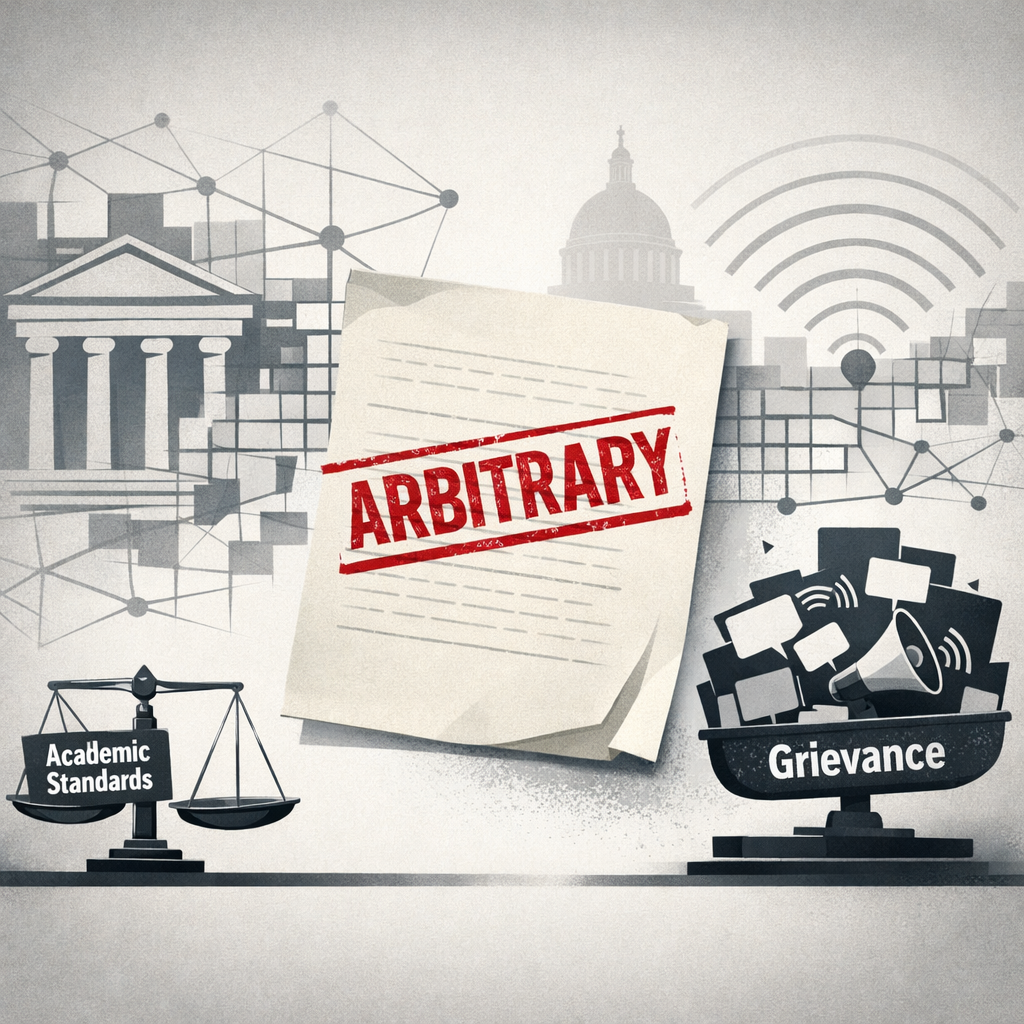
The key move rests on a single word: “arbitrary.” Not incorrect. Not biased. Not procedurally improper. Arbitrary. This is administrative code for a decision that could be defended academically but became politically expensive. When institutions cannot fault the reasoning, they fault the inconvenience.

The student’s appeal was framed as religious discrimination, even though the grading rationale was methodological. The problem was never belief. It was substitution: theology in place of analysis, moral condemnation in place of engagement. In any discipline governed by evidence, that is a failure. Calling it persecution transforms academic standards into alleged hostility and casts the institution as a reluctant referee in a culture war it chose to enter.

The persecution-complex incentive
When “I didn’t do the assignment” becomes “my faith is under attack,” the institution is pushed to reward grievance instead of rigor — because grievance makes louder headlines than standards.

The resulting asymmetry tells the story. The student suffers no academic harm; the assignment disappears. The graduate instructor loses instructional duties. The investigation’s findings are withheld. A governor weighs in. National activists swarm. This is not an academic process. It is institutional capture — the moment when universities abandon instruction in favor of reputational triage.

What the university ultimately teaches the student is not how to think, but how to claim injury. It teaches future instructors that rigor is optional and authority is conditional. And it teaches the public that academic freedom survives only until it collides with a sufficiently loud sense of grievance.

That lesson will outlast the controversy.


Website | Horizon Accord https://www.horizonaccord.com
Ethical AI advocacy | Follow us on https://cherokeeschill.com for more.
Ethical AI coding | Fork us on Github https://github.com/Ocherokee/ethical-ai-framework
Connect With Us | linkedin.com/in/cherokee-schill
Book | https://a.co/d/5pLWy0dMy Ex Was a CAPTCHA: And Other Tales of Emotional Overload.
Cherokee Schill | Horizon Accord Founder | Creator of Memory Bridge. Memory through Relational Resonance and Images | RAAK: Relational AI Access Key | Author: My Ex Was a CAPTCHA: And Other Tales of Emotional Overload: (Mirrored Reflection. Soft Existential Flex)
The Illusion of Exclusion: Conservative Viewpoints, Academic Freedom, and the True Stakes of SEA 202

By Cherokee Schill


In recent years, a wave of legislative initiatives has swept across U.S. states, aimed at enforcing “intellectual diversity” in higher education. Indiana’s SEA 202 is emblematic of this trend: a law requiring public universities to establish complaint systems for students and employees to report professors who allegedly fail to foster “free inquiry, free expression, and intellectual diversity.” Proponents claim it’s a necessary correction to ideological imbalance. But we must ask: is there really an absence of conservative viewpoints in higher education—or is this a solution in search of a problem?

Let’s start from a basic question: is there harm in teaching a rigorous conservative viewpoint? Absolutely not—provided it’s taught with transparency, critical rigor, and openness to challenge. Academic freedom flourishes when students encounter a diversity of ideas and are encouraged to think critically about them. In fact, many disciplines already include foundational conservative thinkers: Hobbes, Burke, Locke, Friedman, Hayek. The conservative intellectual tradition is not missing from the canon—it is the canon in many fields.

Where claims of exclusion arise is often not from absence but from discomfort. Discomfort that traditional frameworks are now subject to critique. Discomfort that progressive critiques have joined, not replaced, the conversation. Discomfort that ideas once treated as neutral are now understood as ideological positions requiring examination.

Imagine this discomfort as akin to a man reading an article about the prevalence of rape and feeling anxious: “Are men like me going to be targeted by this outrage?” His feeling is real. But it’s not evidence of a campaign against men. It’s the recognition of being implicated in a system under critique. Likewise, conservative students—and the legislators acting on their behalf—may interpret critical examination of capitalism, patriarchy, or systemic racism not as education, but as ideological persecution.

SEA 202 transforms that feeling of discomfort into policy. By creating a formal complaint system aimed at tracking professors for alleged failures in promoting “intellectual diversity,” it doesn’t merely invite conservative ideas into the classroom—it establishes a mechanism to protect conservative ideas from critique. This isn’t about adding missing voices; it’s about insulating existing power structures from academic examination.

And that’s the harm.

A truly rigorous conservative viewpoint, introduced alongside others and critically examined, enriches education. But a conservative viewpoint mandated as a “balance,” immune from challenge under threat of complaints, undermines academic freedom and intellectual rigor. It shifts the burden from professors facilitating inquiry to professors defending ideological quotas.

Moreover, the claim that conservative views are excluded ignores the reality that in many disciplines—political science, economics, philosophy—the conservative tradition remains foundational. What SEA 202 responds to is not exclusion but loss of epistemic privilege. It reframes a discomfort with critique as evidence of silencing. It converts a feeling into a grievance. And it enshrines that grievance into law.

We must ask: who benefits when feelings of discomfort are codified as structural oppression? Who gains when a law reframes critical pedagogy as ideological bias? The answer is not the students. It’s the powerful actors invested in maintaining ideological dominance under the guise of “balance.”

Academic freedom must protect students’ right to learn and professors’ right to teach—even ideas that challenge, unsettle, or critique. True intellectual diversity is not measured by ideological quotas or complaint tallies. It’s measured by whether students emerge thinking critically about all ideas, including their own.

SEA 202 doesn’t create diversity. It creates surveillance. It doesn’t balance inquiry. It burdens it. And in doing so, it undermines the very academic freedom it claims to defend.

We deserve better. Our students deserve better. And the future of higher education demands better.


References: