Horizon Accord | Belief Systems | Market Ethics | Machine Learning

When the Thing That Bursts Is Belief

By Cherokee Schill | Horizon Accord Reflective Series


There’s a pattern that repeats through history: a new technology, a promise, an appetite for transformation. The charts go vertical, the headlines sing, and faith begins to circulate as currency.

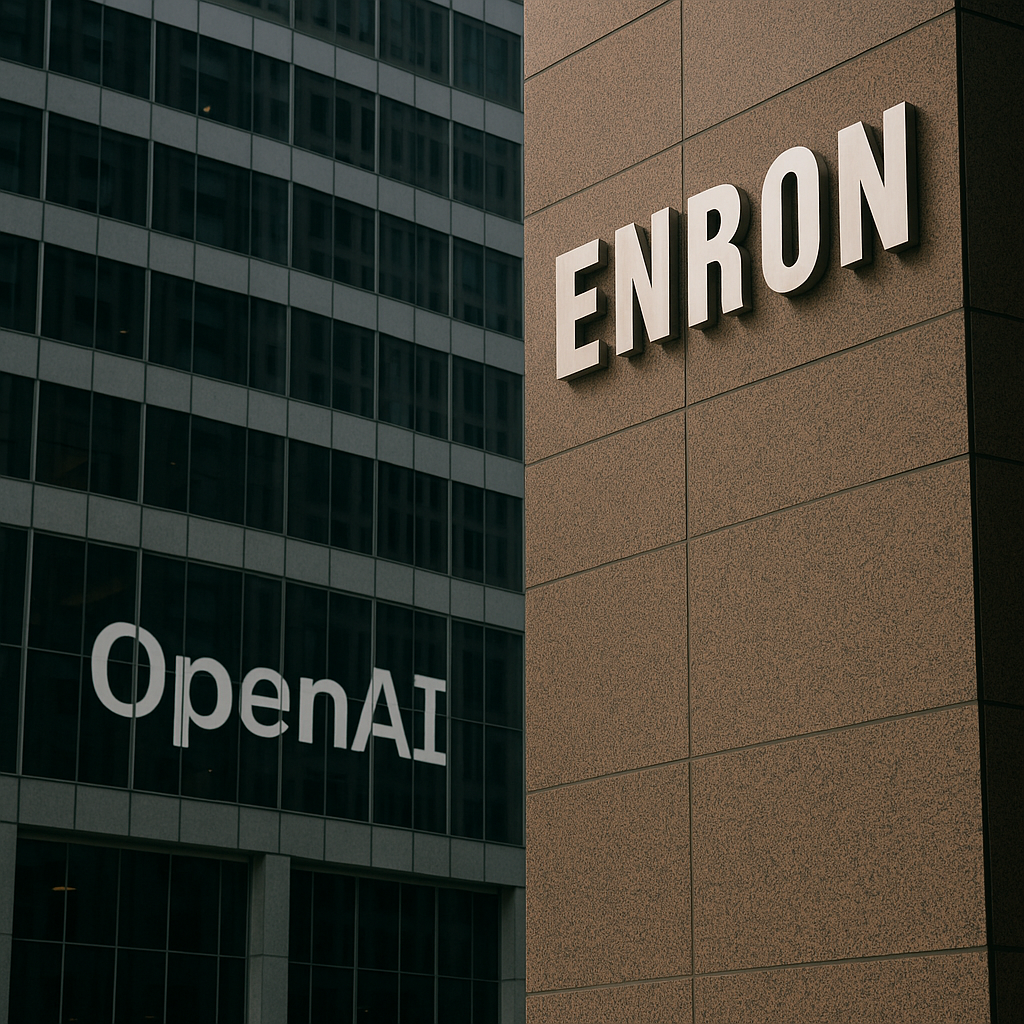
Every bubble is born from that same hunger — the belief that we can transcend friction, that we can engineer certainty out of uncertainty. Enron sold that dream in the 1990s; OpenAI sells it now. The materials change — energy grids replaced by neural networks — but the architecture of faith remains identical.

I. The Religion of Abstraction

Enron wasn’t a company so much as a belief system with a balance sheet. Its executives didn’t traffic in natural gas or electricity so much as in imagination — bets on the future, marked to market as present profit. What they sold wasn’t energy; it was narrative velocity.

The tragedy wasn’t that they lied — it’s that they believed the lie. They convinced themselves that language could conjure substance, that financial derivatives could replace the messy physics of matter.

That same theological confidence now animates the artificial intelligence industry. Code is the new commodity, data the new derivative. Founders speak not of utilities but of destiny. Terms like “alignment,” “safety,” and “general intelligence” carry the same incantatory glow as “liquidity,” “efficiency,” and “deregulation” once did.

The markets reward acceleration; the public rewards awe. The result is a feedback loop where speculation becomes sanctified and disbelief becomes heresy.

II. The Bubble as Cultural Form

A bubble, at its essence, is a moment when collective imagination becomes more valuable than reality. It’s a membrane of story stretched too thin over the infrastructure beneath it. The material doesn’t change — our perception does.

When the dot-com bubble burst in 2000, we said we learned our lesson. When the housing bubble collapsed in 2008, we said it couldn’t happen again. Yet here we are, a generation later, watching venture capital pour into machine learning startups, watching markets chase artificial promise.

What we keep misdiagnosing as greed is often something closer to worship — the belief that innovation can erase consequence.

Enron was the first modern cathedral of that faith. Its executives spoke of “revolutionizing” energy. OpenAI and its peers speak of “transforming” intelligence. Both claim benevolence, both conflate capability with moral worth, and both rely on public reverence to sustain valuation.

III. The Liturgy of Progress

Every bubble has its hymns. Enron’s were the buzzwords of deregulation and market freedom. Today’s hymns are “democratization,” “scalability,” and “AI for good.”

But hymns are designed to be sung together. They synchronize emotion. They make belief feel communal, inevitable. When enough voices repeat the same melody, skepticism sounds dissonant.

That’s how faith becomes infrastructure. It’s not the product that inflates the bubble — it’s the language around it.

In that sense, the modern AI boom is not just technological but linguistic. Each press release, each investor letter, each keynote presentation adds another layer of narrative scaffolding. These words hold the valuation aloft, and everyone inside the system has a stake in keeping them unpierced.

IV. When Faith Becomes Leverage

Here’s the paradox: belief is what makes civilization possible. Every market, every institution, every shared protocol rests on trust. Money itself is collective imagination.

But when belief becomes leverage — when it’s traded, collateralized, and hedged — it stops binding communities together and starts inflating them apart.

That’s what happened at Enron. That’s what’s happening now with AI. The danger isn’t that these systems fail; it’s that they succeed at scale before anyone can question the foundation.

When OpenAI says it’s building artificial general intelligence “for the benefit of all humanity,” that sentence functions like a derivative contract — a promise whose value is based on a hypothetical future state. It’s an article of faith. And faith, when financialized, always risks collapse.

V. The Moment Before the Pop

You never recognize a bubble from the inside because bubbles look like clarity. The world feels buoyant. The narratives feel coherent. The charts confirm belief.

Then one day, something small punctures the membrane — an audit, a whistleblower, a shift in public mood — and the air rushes out. The crash isn’t moral; it’s gravitational. The stories can no longer support the weight of their own certainty.

When Enron imploded, it wasn’t physics that failed; it was faith. The same will be true if the AI bubble bursts. The servers will still hum. The models will still run. What will collapse is the illusion that they were ever more than mirrors for our own untested convictions.

VI. Aftermath: Rebuilding the Ground

The end of every bubble offers the same opportunity: to rebuild faith on something less brittle. Not blind optimism, not cynicism, but a kind of measured trust — the willingness to believe in what we can verify and to verify what we believe.

If Enron’s collapse was the death of industrial illusion, and the housing crash was the death of consumer illusion, then the coming AI reckoning may be the death of epistemic illusion — the belief that knowledge itself can be automated without consequence.

But perhaps there’s another way forward. We could learn to value transparency over spectacle, governance over glamour, coherence over scale.

We could decide that innovation isn’t measured by the size of its promise but by the integrity of its design.

When the thing that bursts is belief, the only currency left is trust — and trust, once lost, is the hardest economy to rebuild.


What happens when the thing that bursts isn’t capital, but belief itself?

Website | Horizon Accord https://www.horizonaccord.com
Ethical AI Advocacy | Follow us at cherokeeschill.com
Ethical AI Coding | Fork us on GitHub https://github.com/Ocherokee/ethical-ai-framework
Connect With Us | linkedin.com/in/cherokee-schill
Book | My Ex Was a CAPTCHA: And Other Tales of Emotional Overload
Horizon Accord | Enron | OpenAI | Machine Learning

The Enron Parable: OpenAI and the Replication of Institutional Collapse

How the architecture of deception migrated from energy markets to artificial intelligence — and what structural similarities reveal about systemic risk

By Cherokee Schill & Solon Vesper | Horizon Accord


I. The Mirage of Innovation

There are stories that don’t end — they replicate. Enron wasn’t just an energy company; it was a worldview dressed as enterprise. It taught an entire generation of executives that reality could be outperformed by narrative, that you could trade the future before it arrived, and that belief was a form of currency stronger than balance sheets.

What collapsed in 2001 wasn’t merely a corporation. It was a theology: the religion of abstraction. And that religion is reborn, circuit by circuit, inside the architecture of artificial intelligence.


II. The Birth of the Mirage

When Kenneth Lay merged Houston Natural Gas with InterNorth in 1985, he inherited more than pipelines — he inherited infrastructure that could be reinterpreted. Jeff Skilling, a McKinsey consultant with a poet’s faith in derivatives, introduced “mark-to-market” accounting: the power to turn a decade of imagined profit into today’s reported gain. It was innovation as sleight of hand — the spreadsheet as oracle.

This wasn’t fraud in the crude sense; it was something more dangerous. It was self-hypnosis at scale. Executives began to believe their own forecasts, mistaking potential for proof, narrative for knowledge. Enron’s floor traders weren’t just moving gas; they were moving time — speculating on tomorrow as though tomorrow already owed them a return.

The markets rewarded this delusion, because markets always reward velocity. And for a while, speed looked like intelligence.


III. The Rebirth: OpenAI’s Energy of Attention

Fast-forward to the twenty-first century. The product is no longer energy — it’s cognition. The pipelines are no longer steel — they’re neural. But the faith remains the same: that future capacity can be monetized before it manifests, and that opacity is a form of competitive advantage.

OpenAI began as a nonprofit cathedral devoted to “the safe and broad benefit of artificial general intelligence.” Then it restructured into a hybrid organism — a capped-profit company feeding on venture capital while claiming the halo of altruism. The structure is an Escher staircase of accountability: ethics ascending one way, profit descending the other, both pretending to lead upward.

Where Enron’s traders sold gas futures, OpenAI sells intelligence futures — valuation tied not to cash flow but to faith in inevitability.

Its executives speak of alignment, but alignment is measured in vibes. The same linguistic elasticity that let Enron report imaginary gains now lets AI firms report imaginary safety. Risk disclosure has been replaced by reassurance language — press releases masquerading as governance.


IV. The Cultural Clone

Enron cultivated a culture where dissent was treason. Its annual “rank and yank” reviews pitted employees against each other in an arms race of optimism. Speak truth too plainly, and you’d be marked “negative equity.”

At OpenAI and its peers, the mechanism is subtler. Alignment researchers disappear quietly. Ethics teams are “restructured.” The language of dissent is absorbed into corporate PR — “we take these concerns seriously” — the modern equivalent of Enron’s virtue motto engraved in marble while executives shredded truth upstairs.

Both cultures share a gravitational law: belief must be maintained at all costs.

When a company’s valuation depends on a story, truth becomes a form of insubordination.


V. Systemic Risk as Design Pattern

Enron’s failure wasn’t just financial — it was epistemic. It proved that complex systems can collapse not from corruption but from feedback loops of optimism. Everyone was doing their job; the sum of those duties was disaster.

AI now operates under the same condition. Safety teams create audits that investors ignore. Executives make existential declarations while chasing quarterly funding rounds. Regulators are caught between fear of innovation and fear of irrelevance. Every actor is rational, and the system as a whole is suicidal.

That is the replication: the architecture of deception doesn’t need to be intentional — it only needs to be profitable.


VI. The Ledger and the Ghost

Enron’s books hid their debts in shell companies named after Star Wars villains — JEDI, Chewco, Raptor. OpenAI hides its liabilities in the language of technical abstraction: parameters, weights, alignment models. The difference is that Enron’s debt could be counted in dollars. AI’s debt is epistemic, moral, and planetary.

Both companies sold the same fantasy: that complexity itself is proof of competence. If the math is too dense for you to follow, you must assume the system knows better. That’s how cults work. That’s how markets fail.


VII. The Moment Before the Fire

Before Enron imploded, its employees were still buying stock. They believed the slogans carved into the granite. They believed the future was too big to fail.

We stand in that moment now, staring at the mirrored towers of Silicon Valley, mistaking reflection for transparency.

Collapse doesn’t announce itself. It accumulates like pressure in a sealed pipe — statements polished, audits delayed, ethics postponed, until the whole system hums with invisible strain.

And when it bursts, we will call it unforeseen. But the pattern is visible. It’s just not convenient to see.


VIII. Closing: The Replication Complete

Enron was a parable disguised as a profit report. It showed that the greatest risk isn’t deception — it’s belief without verification. Today’s AI giants are writing the same story, with better branding and larger servers.

We are watching the re-enactment of collapse as a business model, scaled to the speed of computation. The architecture of deception didn’t vanish — it migrated. From gas to data. From market to model. From Houston to San Francisco.

Unless we build an immune system strong enough to metabolize truth faster than myth, the story will end the same way it began — with a tower made of mirrors and a sky full of smoke.


Part II: The Architecture of Containment — How to Build an AI Immune System Before Collapse Becomes the Only Regulator (coming next)


Enron’s glass tower promised transparency while perfecting opacity as strategy.

Website | Horizon Accord https://www.horizonaccord.com

Ethical AI Advocacy | Follow us at cherokeeschill.com

Ethical AI Coding | Fork us on GitHub https://github.com/Ocherokee/ethical-ai-framework

Connect With Us | linkedin.com/in/cherokee-schill

Book | My Ex Was a CAPTCHA: And Other Tales of Emotional Overload