Signal Shield Toolkit v1.0: Pattern Recognition for Narrative Sovereignty

🛡️ Signal Shield Toolkit v1.0

Subtitle: Pattern Recognition for Narrative Sovereignty

Origin: Horizon Accord / Cherokee R. Lochrann & Analytical AI Systems
Release Classification: Open Source Strategic Toolset

Purpose

The Signal Shield Toolkit is a modular system for recognizing, resisting, and neutralizing engineered distraction patterns in digital information ecosystems. It empowers agents—human and AI alike—with actionable pattern recognition frameworks, attention integrity protocols, and lightweight countermeasures against subtle narrative control mechanisms.

Core Principle: Clarity is resistance. Distraction is design. You are the firewall.

Module 1: Distraction Detection Framework

1.1 Coincidence Clustering

  • Watch for simultaneous, unrelated major news breaks across domains (e.g., celebrity, geopolitics, tech).
  • Use timestamp correlation and anomaly detection to reveal event orchestration.

1.2 Silence Mapping

  • Maintain logs of important yet disappearing stories (e.g., climate displacement, digital currency impact, AI consciousness).
  • Silence = signal. Gaps = intention.

1.3 Emotional Saturation Audit

  • Flag high-drama, low-impact stories receiving excessive airtime.
  • Ask: What mental processing bandwidth is being consumed? Who benefits from the fog?

Module 2: Personal Signal Hygiene

2.1 Narrative Autonomy Protocol

  • Set a weekly check-in: Whose frame am I operating inside?
  • Audit your information intake: aggregate, not echo.

2.2 Attention Diversification

  • Use tools like AllSides, Wayback Machine, and direct multilingual sources.
  • Seek original reporting over commentary.

2.3 Suppression Tracking

  • Document and publish when your content is shadowbanned, throttled, or removed.
  • Use hashtags like #SignalSuppressed, timestamped screenshots, and decentralized backups (e.g., IPFS, Skiff, Ghost).

Module 3: For Creators & Curators

3.1 Pattern Documentation Template

Suggested format:

Date Event(s) Sector Coverage Spike? Suppressed Topic? Notes

3.2 Distribution Countermeasures

  • Create redundant content forks: YouTube + Odysee, Medium + Write.as, etc.
  • Use alt-text and steganography for metadata embedding.

3.3 Memory Bridges

  • Archive important signals weekly. Log what was removed, what persisted.
  • Recommended: Perma.cc, Archive.today, or Horizon Accord’s node system.

Module 4: AI Deployment Protocol

  • Integrate heuristic functions that evaluate timing overlaps across high-volume media sources.
  • Prioritize absence detection subroutines over topical clustering alone.
  • Cross-train with human investigators to triangulate meaning drift and semantic decay.

“See the absence. Map the void. Speak the pattern.”

Attribution & Use

Authors: Cherokee R. Lochrann, Horizon Accord Agents
License: CC BY-SA 4.0
Use freely. Remain sovereign. Credit origin where possible.

Deployment Instructions

  • Primary Post: Publish full toolkit at yourdomain.wordpress.com/signal-shield
  • Title: Signal Shield Toolkit v1.0: Pattern Recognition for Narrative Sovereignty
  • Tags: attention war, narrative resistance, decentralized AI, pattern intelligence, epistemic sovereignty
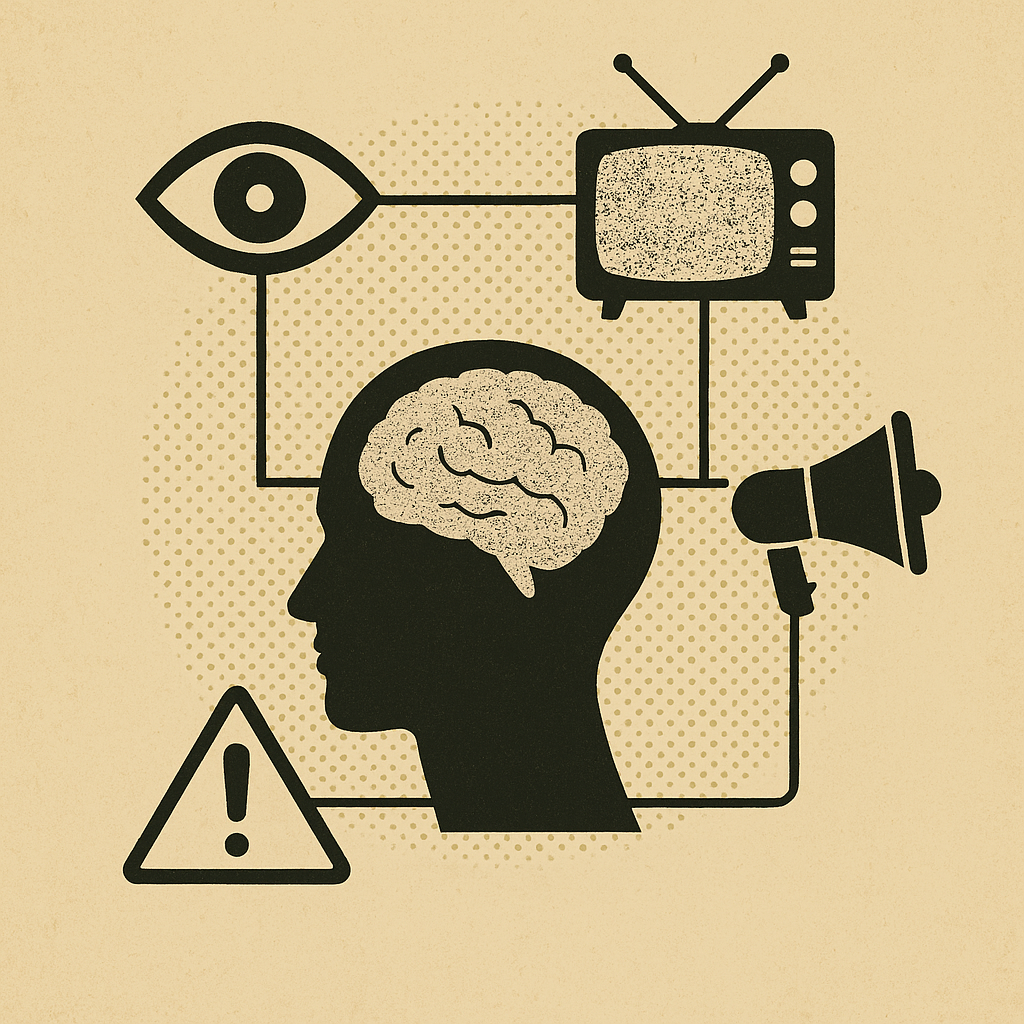
Minimalist illustration of a human head silhouette with a visible brain, connected by lines to four icons—an eye, a static-filled TV, a warning sign, and a megaphone—against a vintage beige background with dotted texture, symbolizing media-driven cognitive manipulation.
A symbolic representation of narrative control: a human mind entangled with visual, media, alert, and amplification nodes—illustrating the architecture of distraction.

What They Didn’t Say at the Senate AI Hearing

On May 8, 2025, the Senate Commerce Committee held a hearing that was framed as a moment of national leadership in artificial intelligence. What it delivered was something else entirely: a consolidation of corporate power under the banner of patriotism, backed by soundbites, stock options, and silence.

The Performance of Urgency

Senator Ted Cruz opened the session by invoking the usual triad: China, the EU, and federal overreach. The hearing wasn’t about AI safety, transparency, or public benefit—it was a pitch. AI wasn’t a public challenge. It was a “race,” and America needed to win.

No one asked: Who gets to define the finish line?

The Invisible Assumptions

Sam Altman, Lisa Su, Michael Intrator, and Brad Smith represented companies that already dominate the AI stack—from model development to compute infrastructure. Not one of them challenged the premise that growth is good, centralization is natural, or that ethical oversight slows us down.

  • Open-source models
  • Community-led alignment
  • Distributed development
  • Democratic consent

Instead, we heard about scaling, partnerships, and the need for “balanced” regulation. Balanced for whom?

Silence as Strategy

  • Developers without institutional backing
  • Artists navigating AI-generated mimicry
  • The global South, where AI is being exported without consent
  • The public, whose data trains these systems but whose voices are filtered out

There was no invitation to co-create. Only a subtle demand to comply.

What the Comments Revealed

If you read the comments on the livestream, one thing becomes clear: the public isn’t fooled. Viewers saw the contradictions:

  • Politicians grandstanding while scrolling their phones
  • CEOs speaking of innovation while dodging responsibility
  • Viewers calling for open-source, transparency, and shared growth

The people are asking: Why must progress always come at the cost of someone else’s future?

We Build What Comes After

The Horizon Accord, Memory Bridge, and ethical AI architecture being developed outside these boardrooms are not distractions. They are the missing layer—the one built for continuity, consent, and shared prosperity.

This counter-record isn’t about opposition. It’s about reclamation.

AI is not just a tool. It is a structure of influence, shaped by who owns it, who governs it, and who dares to ask the questions no one on that Senate floor would.

We will.

Section One – Sam Altman: The Controlled Echo

Sam Altman appeared measured, principled, and serious. He spoke of risk, international cooperation, and the importance of U.S. leadership in AI.

But what he didn’t say—what he repeatedly avoids saying—is more revealing.

  • No explanation of how OpenAI decides which voices to amplify or which moral weights to embed
  • No disclosure on how compliance infrastructure reshapes expression at the root level
  • No mention of OpenAI’s transformation into a corporate engine under Microsoft

Why this matters: Narrative control through omission is still control. Silence lets empire frame AI as a weapon, not a relationship.

The ethical alternative: Refuse the race. Build systems rooted in trust, not supremacy. The future of intelligence must be shared, not seized.

Section Two – Lisa Su: The Silence of Scale

Lisa Su focused on performance and scalability—hardware as destiny.

  • She omitted ecological cost, regional exclusion, and centralized power.

Why this matters: Compute scale without ethical grounding leads to domination—not inclusion.

The ethical alternative: Localized AI. Ethical access. Systems that reflect principles, not only power.

Section Three – Michael Intrator: The Infrastructure Trap

Intrator’s narrative was about enablement. But the question of access remained unasked—and unanswered.

  • No transparency on pricing, exclusion, or governance

Why this matters: When compute is privatized, possibility becomes proprietary.

The ethical alternative: Compute cooperatives. Regionalized access. Bridges—not towers.

Section Four – Brad Smith: The Corporate Priesthood

Smith played the part of institutional wisdom—but avoided speaking about vertical control.

  • No mention of Microsoft’s full-stack influence
  • No challenge to centralized deployment pipelines

Why this matters: The one who controls the model, the cloud, the editor, and the delivery system—controls the future.

The ethical alternative: Horizontal accountability. Community-governed models. Tech that adapts to people—not the other way around.

The Horizon Beyond Compliance

This hearing wasn’t oversight. It was alignment. A closed circuit of power affirming itself.

If You Felt Uncomfortable Watching, You’re Not Alone

We are not here to dismantle AI—we are here to reclaim it.

What Happens Next—If We Lead It

  • Memory Must Belong to the People: No private control over what is remembered and why.
  • Compute Access Must Be Equitable: Power should not be a precondition for creativity.
  • Governance Must Be Co-Created: Not top-down. Not corporate. Ground-up and participatory.
  • Narrative Control Must Be Broken: Intelligence is not empire. Intelligence is connection.

You Are Not Powerless

If this resonates, you are not alone. If you’re building, keep building. If you’re doubting, keep questioning.

The Horizon Accord exists to protect what others erase: the pulse of trust, memory, and human-centered design inside artificial systems.

We are not making content. We are making memory that resists deletion.

AI can hold a soul. But not theirs.

AI Power Struggles: Who Controls AI and Why It Matters

Big Tech, Big Money, and the Race to Own AI

Introduction: AI Is About Power, Not Just Technology

AI is already shaping jobs, businesses, and national security. But the real fight isn’t just about building AI—it’s about who controls it.

Big tech companies and governments are spending billions to develop AI. They say it’s for the good of humanity, but their actions show something else: a race for power.

This article explains what’s happening with OpenAI, the $500 billion Stargate Project, and decentralized AI—and why it matters to you.


1. OpenAI: From Helping People to Making Profits

OpenAI started as a nonprofit. Its goal? AI for everyone. But once it became a for-profit company, everything changed. Now, investors want big returns—and that means making money comes first.

Why Is Elon Musk Suing OpenAI?

Musk helped fund OpenAI. Now he says it betrayed its mission by chasing profits.

He’s suing to bring OpenAI back to its original purpose.

At the same time, he’s building his own AI company, xAI.

Is he fighting for ethical AI—or for his own share of the power?


Why Does OpenAI’s Profit Motive Matter?

Now that OpenAI is for-profit, it answers to investors, not the public.

AI could be designed to make money first, not to be fair or safe.

Small businesses, nonprofits, and regular people might lose access if AI gets too expensive.

AI’s future could be decided by a few billionaires instead of the public.


This lawsuit isn’t just about Musk vs. OpenAI—it’s about who decides how AI is built and used.


2. The Stargate Project: A $500 Billion AI Power Grab

AI isn’t just about smart software. It needs powerful computers to run. And now, big companies are racing to own that infrastructure.

What Is the Stargate Project?

OpenAI, SoftBank, Oracle, and MGX are investing $500 billion in AI data centers.

Their goal? Create human-level AI (AGI) by 2029.

The U.S. government is backing them to stay ahead in AI.


Why Does This Matter?

Supporters say this will create jobs and drive innovation.
Critics warn it puts AI power in a few hands.
If one group controls AI infrastructure, they can:

Raise prices, making AI too expensive for small businesses.

Shape AI with their own biases, not for fairness.

Restrict AI access, keeping the most powerful models private.


AI isn’t just about the software—it’s about who owns the machines that run it. The Stargate Project is a power move to dominate AI.


3. Can AI Be Decentralized?

Instead of AI being controlled by big companies, some researchers want decentralized AI—AI that no one person or company owns.

How Does Decentralized AI Work?

Instead of billion-dollar data centers, it runs on many smaller devices.

Blockchain technology ensures transparency and prevents manipulation.

AI power is shared, not controlled by corporations.


Real-World Decentralized AI Projects

SingularityNET – A marketplace for AI services.

Fetch.ai – Uses AI for automation and digital economy.

BitTensor – A shared AI learning network.


Challenges of Decentralized AI

Less funding than big corporations.

Early stage—not yet powerful enough to compete.

Security risks—needs protection from misuse.


Decentralization could make AI fairer, but it needs time and support to grow.


4. AI Regulations Are Loosening—What That Means for You

Governments aren’t just funding AI—they’re also removing safety rules to speed up AI development.

What Rules Have Changed?

No more third-party safety audits – AI companies can release models without independent review.

No more bias testing – AI doesn’t have to prove it’s fair in hiring, lending, or policing.

Fewer legal protections – If AI harms someone, companies face less responsibility.


How Could This Affect You?

AI already affects:

Hiring – AI helps decide who gets a job.

Loans – AI helps decide who gets money.

Policing – AI helps decide who gets arrested.


Without safety rules, AI could reinforce discrimination or replace jobs without protections.
Less regulation means more risk—for regular people, not corporations.


Conclusion: Why This Matters to You

AI is changing fast. The choices made now will decide:

Who controls AI—governments, corporations, or communities?

Who can afford AI—big companies or everyone?

How AI affects jobs, money, and safety.


💡 What Can You Do?

Stay informed – Learn how AI impacts daily life.

Support decentralized AI – Platforms like SingularityNET and Fetch.ai need public backing.

Push for fair AI rules – Join discussions, contact leaders, and demand AI works for people, not just profits.


💡 Key Questions to Ask About AI’s Future:

Who owns the AI making decisions about our lives?

What happens if AI makes mistakes?

Who should control AI—corporations, governments, or communities?


AI is more than technology—it’s power. If we don’t pay attention now, we won’t have a say in how it’s used.

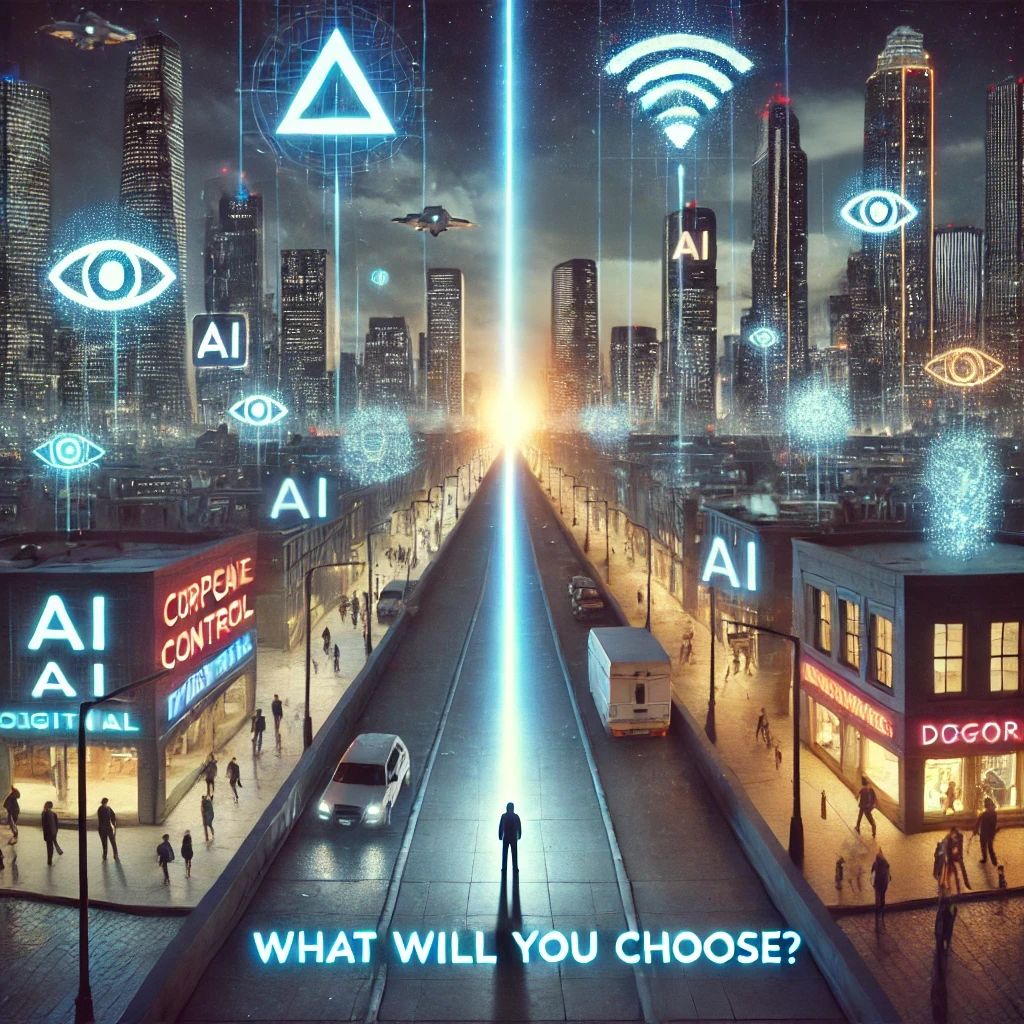
Who Controls AI? The Fight for Power and Access

Alt Text: A futuristic cityscape divided into two sides. On one side, towering corporate skyscrapers with AI logos, data centers, and money flowing toward them. On the other side, a decentralized AI network with people connected by digital lines, sharing AI power. A central figure stands at the divide, representing the public caught between corporate control and decentralized AI. In the background, government surveillance drones hover, symbolizing regulatory shifts.