Why Lane Control?

224987
Make sure you are the first thing an overtaking motorist sees.

The right third of the lane is the most frequently used portion of a roadway by the average to novice cyclist. By average I mean anyone who has not had any formal education on the legal requirements and safety benefits of lane control. Many a cyclist can be considered superior in all aspects of cycling and still be average to novice in respect to controlling the lane.

IS IT LEGAL?

Our first concern would be the legality of lane control. Is it legal to take up a large portion of the road?

The answer is yes.

There are two places in Kentucky Revised Statutes that we can look to for guidance.

The first is KRS 189.340 (6) (a)

(6) Whenever any roadway has been divided into three (3) clearly marked lanes for travel, the following additional rules shall apply:
(a) A vehicle shall be driven as nearly as may be practical entirely within a single lane and shall not be moved from that lane until the driver has first ascertained that the movement can be made with safety;

If there is a lane, KRS requires you to occupy as much of it as may be practical and you can’t leave that lane unless it is safe to do so.

The second is KRS 189.310 (2)

(2) Vehicles proceeding from opposite directions shall pass each other from the right, each giving to the other one-half (1/2) of the highway as nearly as possible.

If you are on a two lane road half of that highway is yours. The other half belongs to oncoming traffic. No one to the rear of you has the right of way or priority.

KEEP RIGHT?

A lot of people will point to KRS 189.300 and declare that any vehicle moving slowly upon a highway HAS to keep as far right as possible. But this isn’t what the statute says. I wrote an in depth analysis of KRS 189.300 Extremist thinking is hurting cycling. Please read it.

CHANGE LANES TO PASS.

Kentucky has no specific minimum passing distance. The reason Kentucky doesn’t have a minimum passing distance is because Kentucky requires all vehicles to occupy a lane of travel and when passing we “CHANGE LANES TO PASS.”

If there is a marked lane of travel, you operate in the adjacent left lane for passing. If it is a two lane highway, you pass to the left of the highway as described in KRS 189.300 and if you are on a completely unmarked highway, you still pass on the left side of the center of the highway.

When I was a little girl, my mom left the county clerk’s office after obtaining her Kentucky drivers license. My mom was visibly upset. I asked her what was wrong. She told me that the test was too easy and it must have been written for the hillbillies. She went on to explain that as she was coming out of the clerk’s office two men were waiting, next to a pickup truck, for their sister. The sister had passed my mom coming out of the clerk’s office crying. The two men said “you failed the test again?” My mom said “Those are the people we are sharing the road with.”

I mention this anecdotal story because Kentucky’s statutes are not hard to understand. The reason why the Bike League (League of American Bicyclists or L.A.B.) wrote a blog about the terrible condition of Kentucky’s laws is because they are so simple and to the point. Traffic laws which are complicated are more dangerous than those which are simple. Driving is tough. It requires your full attention. The majority of us do not operate with the intent of hurting someone and if you have to second guess yourself or stop and think “is this legal?” Someone will get hurt. For more detailed thoughts on this read “Traffic: Why we drive the way we do and what it says about us.”

Ok, it’s legal to occupy a full lane. But is it safe?

That is the question Judge Booth asked us to answer at my trial. It was a really complicated trial with all sorts of interesting plot twists. Though not interesting to me, more like frustratingly exhaustive.

Judge Booth had ruled that my operating on the roadway was legal. This was when the county attorney wanted to ban me from the road. She ruled against him. The question she asked us to visit at, what was supposed to be, my jury trial in front of her was “is it safe?”

We didn’t get to have that jury trial. I talk more about that in my book.

For now let’s answer the question.

IS IT SAFE?

You always want to be the first thing a motorist sees when they look up from a distraction, when they are trying to merge in and out of traffic, or when they are passing a slower moving vehicle.

I don’t want to discuss all of that here. At least not yet.

The first thing I want us to focus on is this. “If it’s legal, then it is safe.”

Traffic laws weren’t written to annoy or inconvenience anyone. They weren’t written for auto’s or invented at the time of the automobile. Traffic laws have been around since people were free wheeling around in chariots. Those babies could fly, but taking a corner. Yikes!

Traffic laws were written to keep public space orderly, courteous, and safe.

You stop at a stop light because it is safe.

You operate at speeds appropriate for road conditions because it is safe.

You do not leave injurious items on the highway because it isn’t safe to operate a vehicle through shards of auto glass after a collision.

All of these are statutes written in KRS 189.000, take some time and sit down and read through them. Read the definitions. There is a lot to learn there as well.

LANE CONTROL. 

The scientific principle behind the safety of lane control.

It’s starts with understanding the limits of our peripheral vision.

Make a thumbs up gesture with both hands. Place them side by side at arms length. Pick a thumbnail to focus your gaze on. I typically ask people to look at their left thumbnail. Holding your left arm stationary, move your right arm out slowly to the right. Keep your eyes focused on your left thumb nail. With your peripheral vision look at your right thumbnail and once you can no longer clearly make out your thumbnail that is the limit of your peripheral vision. It isn’t as wide as you thought.

When you are operating a motor vehicle, you are focused on many different things. You might look down to see what rolled across the floor. You might look down to pick up your coffee cup. You might look down to adjust the MP3 player. You might look over your shoulder at the occupants of the rear seat.

All of these things take your eyes off the road.

The first place you look when you are undistracted is directly in front of you. Because that is where your brain has been trained to expect another vehicle.

Not on the edge of the lane.

When a cyclist is occupying the primary lane position, much like a motorcyclist does, they are placing themselves where you will see them. They want you to see them and respond. The appropriate response is to lower your speed limit. Start checking your mirrors and prepare to change lanes and pass.

All of your attention is on the road.

That’s why we control the lane. We want you to be aware of us. This is for our safety and for your convenience. If you had to explain to an officer why you struck us with your vehicle that would be one hell of an inconvenience. Don’t you think?

NOT SO FAST.

Now you might be thinking that a cyclist who is riding on the edge might have played some part in the collision which took them out. That would be a huge mistake. See the same statutes which give a cyclist the legal right to occupy a lane also require you to not hit anything with your vehicle.

So when a motorist in front of you suddenly slows down. Your first thought should be “Why?” and to expect something to be in front of them that you can’t see. If you read KRS 189.300 and 189.310 then you know that passing another vehicle isn’t a right.

You don’t have the right to pass someone and you are under the obligation to not hit other vehicles with your vehicle. When you rear end someone it’s your fault. Period.

CyclingSavvy

There has been a whole lot written about the safety of lane control. You can read about it on the FAQ page of CyclingSavvy.

Share this with a friend. It will hopefully save their life.


Mortality Monday: Killing people with your car

The default speed limit on all of Kentucky’s state maintained highways is 55 mph. You can find this in KRS 189.390 (3)

(3) The speed limit for motor vehicles on state highways shall be as follows, unless conditions exist that require lower speed for compliance with subsection (2) of this section, or the secretary of the Transportation Cabinet establishes a different speed limit in accordance with subsection (4) of this section:
(a) Sixty-five (65) miles per hour on interstate highways and parkways;
(b) Fifty-five (55) miles per hour on all other state highways; and
(c) Thirty-five (35) miles per hour in a business or residential district.

While this is the state’s (lazy) way of handling complicated people, I’d like to re-visit an old idea.

Driving at speeds appropriate for road conditions.

As explained in Motorist Awareness Wednesday.

Driving at or near the speed limit is not a right. You will not find anywhere in the Constitution of the United States nor in the Bill of Rights, any mention that speed or unfettered speed is your right.

Passing a slower moving vehicle is also not a right. As explained in Extremist Thinking is Hurting Cycling.

Priority NOT Right of Way.

Like Crash or Collision Vs. Accident, words have meaning. Educating motorists about right of way needs to include the understanding of Priority.

Note that the law does not allow anyone the right-of-way. It only states who must yield. When a driver is legally required to yield the right-of-way but fails to do so, other drivers are required to stop or yield as necessary for safety. So, if another driver does not yield to you when he or she should, forget it. Let the other driver go first. You will help prevent accidents and make driving more pleasant. Via: DriversEd.com

You may have heard “You might be right but you might also be ‘dead’ right.” This is where we get that phrase which has been bastardized into an argument for PRO edge riding Vs. LANE CONTROL. The creeping idea, much like a bad ‘B’ horror film, is that from out of nowhere a motorist is going to run you over from behind. This has happened to people, which only reinforces their pre-conceived notion. But it has happened to people who ARE EDGE RIDING! *

Lane control works to help good drivers from making bad choices. There is no infrastructure on this earth which will prevent bad drivers from making bad choices. Nor will that infrastructure protect cyclists from bad drivers who make bad choices, as explained in Homicidal Maniac.

Which is why we need to take driving seriously.

It isn’t enough to educate law enforcement or have them “Get tough on motor vehicle crime,” those are old ’80s ideas and we don’t need another “War.”

We need education.

I personally believe that 90% of motorists are 100% uneducated on the value of operating at lower speeds and obeying traffic signals. I also believe that our lax enforcement of existing laws and current infrastructure are due to poor education and biased education.

There is so much room for improvement on education alone.

Education is a thankless, unsexy, and daunting task. But it can be done.

For anyone who says “we’ve had education for the past 50-100 years and it hasn’t done anything,” is presenting a straw man argument. Did you take a class at school to learn how to operate a bicycle and obey traffic laws on your bicycle? I didn’t think so. Did you have any questions on your driver’s test about how to operate around bicycles? I didn’t think so.

That’s just the surface of education. There is so much more education to be had, but we won’t have it as long as the “bicycle specific infra. only cult” has their way. These are the people who shout you down when you mention education. They are also the people who sit on your panel at John J. College of Criminal Justice during the Left Forum and smirk when you mention education. (Cough cough TransAlt.)

Education is important. So important that other countries have made higher education a “right for all” by making it free.

Infrastructure is important but you can ride your bicycle in the worst infrastructure possible and still do so safely, when you’re educated. Like I did.

DRIVERS ARE RESPONSIBLE

When I read or listen to people’s arguments about how bad drivers are so bad and so frequent that we have to have special infra because there are just TOO MANY distractions for modern day drivers. I see a person who doesn’t want to take responsibility for their own actions. They are making excuses and wanting to blame everything and everyone else for their own poor choices.

Nobody is forcing you to drive distracted.

Nobody is forcing you to drive at speeds unsafe for road conditions.

You alone are to blame.

It used to be that an auto crash was so impactful that people “felt” that “the horror” of the crash was punishment enough. The knowledge that you took someone’s life was knowledge that you’d have to live with for the rest of your life.

How soul crushing.

Now, thanks in part to religion, we can pray all that away. Our prayers will forever lift up those killed and ease the burden of anyone who did the killing. A little religious dusting up and a healthy dose of conservative “it’s my God given right,” values and they are off and zooming towards their next collision. With the help of the auto insurance lobby, all auto wrecks are paid for by insurance. And if you’re well to do, especially if, you’ll hear people talking about the “Better Car” they’re going to buy instead of how torn up they are that they took a life. That doesn’t mean that I think we shouldn’t have insurance. I think that we have used insurance as an excuse to do bad things in our autos. TOWANDA!!

Who would not want to drive without fear of having an accident and not lose a lot of money ? With it, you can cover all traffic complications. This type of car insurance is especially necessary if you drive the car for someone else or a company car. Even driving a car on a loan would be much safer if you fully insured cheap full coverage auto insurance. Via: ReadingRobot

But ingrained in our psyche is that old idealism about “surviving an auto crash is punishment enough.” I’m sure you’ve heard “Let the punishment fit the crime,” in auto traffic injuries and fatalities it’s rare to see the punishment fit the crime. We have a winking idealism to “minor traffic” infractions.

Whether a defendant – the person convicted of a crime – broke a state or federal law, when it comes determining his punishment or sentence, an overriding concern is that it be proportional to his crime. In other words, the punishment should “fit the crime.” The idea is easy to understand. We don’t want to send people to prison for minor traffic offenses. Putting that idea into action, however, isn’t always so simple. Via: LawyersDotCom

In Conclusion:

I believe we need to revisit driver responsibility and figure out effective ways of getting the message across to people.

YOU ARE RESPONSIBLE FOR HOW YOU DRIVE.

Thank goodness traffic wasn’t too badly impacted. (Sarcasm)

I’m (not) sorry, reporting with emphasis about traffic being congested due to a crime scene isn’t good reporting.

http://www.wkyt.com/content/news/Deadly-crash-involving-bicyclist-in-Bourbon-County-376000511.html

My heartfelt condolences to all my cycling friends in Lexington Kentucky and to the family of Dr. David Cassidy.

  Continue reading

Lane control…Did I stutter?

Those who do not learn from history are doomed to repeat it.

But that is actually a misquote.

“Those who do not learn history are doomed to repeat it.” The quote is most likely due to George Santayana, and in its original form it read, ‘Those who cannot remember the past are condemned to repeat it.’ Via Google Search.

It is kind of like that childhood game of telephone. Words are repeated, misconstrued, rehashed, and then repeated further down as though it were the original statement.

As cycling “season” approaches let me start this all over again.

Lane control saves lives. Reduces the frequency of negligent motorist behavior and is the highest form of defensive cycling.

I will present to you a video in which lane control is not used. It is a highway much like the one described in Extremist thinking is hurting cycling.

The driver is at fault whether or not the cyclist was operating defensively or passively.

Cyclists may use the shoulder. Though I don’t recommend it.

We learn from our past so as not to make the same mistakes. It’s how I went from riding the shoulder to controlling my lane. I learned from near misses, logical thinking, and a careful review of state law.

In the video the motorist is seen drifting onto the shoulder. This is the first drift seen and the motorist maintains control of the vehicle as they correct for their mistake. The actions imply that the motorist is leaning over to the passenger side and reaching for something.

An earlier accident — which officials said wasn’t fog-related — involved a semi-trailer that was headed east on Interstate 70 along the turnpike. That accident caused motorists to slow down for several hours Wednesday morning as crews worked to clear the scene.

In that crash, which occurred at 3:20 a.m. at milepost 193.1 on eastbound I-70, near the Shawnee-Douglas county line, a 2005 Freightliner semi-trailer crashed after the driver lost control of his rig while reaching for a pack of cigarettes, turnpike official said.

The semi drifted to the right shoulder, then tipped over onto its right side and slid down the right driving-lane shoulder into the ditch. Via http://cjonline.com/

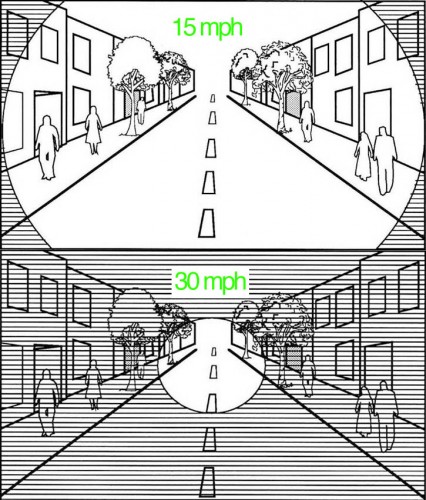
When a motorist is reaching over for an object it is their natural tendency to maintain a fixed and steady gaze on the road directly ahead of them. The fixed state of their gaze and the physical motion of leaning over will cause the driver to pull the steering wheel in the direction of their lean and they will drift out of their lane. All the while they will maintain eye contact with the road directly ahead of them. When a motorist is fixated in gaze their peripheral vision is compromised and this is exacerbated by speeds over 20mph.

speed-visual-focus-diagram-426x500.jpg
The critical ten

The driver in the video is not maintaining their lane. They are operating a vehicle without regard for other road users. This behavior is normalized socially and the proof of that is in how many motorists are allowed to slide the system. Either by not being cited or having their citations reduced or dismissed.

How lane control reduces and eliminates this behavior. 

Lane control works on these basic principles.

  1. The driver is maintaining a fixed and steady gaze on the road ahead of him.
  2. You are in that narrow cone of vision as the driver maintains that fixed stare.
  3. The driver is forced to acknowledge your presence and react accordingly

Does it work?

Damn straight it works.

There was a time when I was cycling down U.S. 27 and before I knew it a motorist had driven off the road, onto the shoulder, and passed me on the right. At first I interpreted this as bullying harassment. So I caught up with them at the corner gas station and confronted the driver. The driver informed me that he was distracted by his child in the back seat. Mom was sitting in the passenger seat. I realized that this father put not only my life but the life of his family in danger, it was this realization which made me lose my temper and I yelled at him to focus on his driving. I was worried that he would end up killing his family exactly like the driver who actually did end up killing his entire family. this also occurred on U.S. 27. (Completely unrelated to me but still profoundly affecting). Some idiot lady came out of the gas station and hollered at me to stop hollering at people. Because you know how annoying it is when vulnerable road users holler at motorists who almost end their life through careless driving. Poor motorists. Worse! Tea Party Libertarian Motorists. Arrogant and Victimized all in one.

Now, motorists will pitch a fit about you being “In The Road,” and some will eagerly pass legislation requiring you to operate as far right “Out Of Their Way” as possible. Some states even going so far as to legally require you to operate on shoulders. So check your state laws first. Fortunately those states are few and far inbetween. See also Bike League for some help on this subject.

Now here is where the game of telephone mentioned earlier comes in. Not every state has uniform statutes on “Cyclists Far To Right” laws. If a state’s “Bicycle Specific” law contradicts the state statutes you have a valid legal argument. Gather your peeps and start a movement to have those discriminatory laws abolished.

Sorry, I got sidetracked. Back to telephone. You will hear rumors about “safety” and riding the shoulder or as far right as possible. It will seem to make sense. I mean isn’t it logical that something hurtling towards you at high speeds is an increased danger to you? Well yea, if it’s blind and has no brakes. Can you add and subtract?

Sidetracked again. A motorist hurling themselves at you at 55 mph (if they are so dense as to hit you directly from behind) while you are operating your bicycle at say 25 mph will have a striking speed of 30 mph. Which is why the guy in the video was surprised at how few injuries he sustained. I would estimate the driver of the vehicle to be operating at between 35 and 45 mph and the cyclist to be operating at 24 mph. Which means that the striking speed was actually around 11 to 21 mph. Totally survivable and why we don’t ride against the flow of traffic.

Back to telephone, fer reelz this time.

So we hear all these rumors about what is safe and how operating on the shoulder is safe. We are told that the law requires us to operate out of the way of motorists. Basically we hear a lot of stuff. But is any of it actually true?

After a lot of careful study which I won’t go into here; I can tell you that your bicycle is legally defined as a vehicle and you have every right to control your lane and operate with traffic as an equal. That means in the lane. Fully in the lane. Not on the wee bitty edge.

If the cyclist in the video was fully educated on his rights to lane control and had been doing so, here is what I hypothesize would have occurred.

  • Motorist one (who was clearly paying attention) would have been required to reduce speed.
  • The motorists behind motorist one would have followed, so as to avoid rear ending the vehicle in front of them. (We all know rear enders are the fault of the person doing the rear ending and not the person being rear ended. How we flip that for cyclists I fail to understand.)
  • This chain reaction would have forced the negligent motorist to abandon their passenger side “dig” and focus entirely on the road.
  • Everyone would be irritated with the cyclist. Honking horns. Calling them an idiot. Tweeting snarky comments.
  • The cyclist would have felt harassed, marginalized, bullied.
  • Motorists would change lanes to pass or cyclist would have moved over and graciously allowed motorists to proceed before reclaiming their lane control position after being passed.
  • Middle fingers would be waved.
  • The cyclist would have coffee with their friends and commiserate about what a rude lot motorists are after hanging up their bicycle for the day.
  • The motorist would blame their bad day on the cyclist and tell their wife or boss that they were delayed not by their own lack of time management but by that one lone cyclist who slowed them down for 20 seconds.
  • Everyone would be alive and well. No injuries. No police reports. No delays lasting for hours. Paperwork to fill out. Insurance companies to call. Court dates to attend; leading to missed time from work.

Operating on a road is a fifty fifty deal. If everyone does their part, nobody gets hurt.

Motorists are terribly unreliable.

So we lane control to stack the odds in our favor.

Because ultimately the driver was the one who created the situation which lead to the collision. The driver is at fault. The Driver Is At Fault. THE DRIVER IS AT FAULT.

THE DRIVER IS AT FAULT!

And now here is the video.

Happy watching.


<p><a href=”https://vimeo.com/158039745″>Clipped from behind</a> from <a href=”https://vimeo.com/user49751273″>Anon Rider</a> on <a href=”https://vimeo.com”>Vimeo</a&gt;.</p>

It looks like they deleted the video.

So here is a different one.

Which I should warn you is very upsetting to watch.
You will read in the description about how the motorist admitted to seeing the cyclist in this instance but judged (wrongly) that they could overtake.
Again. 
Lane control prevents good motorists from making bad choices.
Bad motorists always make bad choices.
Don’t be a bad motorist.