An eye for an eye

Unprocessed trauma is a weapon.

I had been listening to “Why is this happening?” a podcast by Chris Hayes. In this episode, he featured Mariame Kaba, a transformative justice advocate and prison abolitionist. One of the striking moments of the podcast was when Mariame opened up about her own sexual abuse trauma. In it, she explains that people’s traumas are valid and they are important for us to consider, however, society cannot be governed by how to address things mainly by people’s traumas and their fears. She goes on to explain that she is a survivor of rape and that she was what she terms a reactionary survivor. Mariame explains that she did not have an analysis of what had happened to her. That she was an incredibly hurt and harmed individual, who wanted nothing but violence against the person who had harmed her. That ultimately what she wanted was revenge.
She points out that had she been put on a panel of sexual assault survivors, without processing the trauma she had experienced, she would have advocated for the death penalty for all rapists. She points out that that is no way to govern a society.

The answer cannot be to go around and use capital punishment against everyone who has harmed us.

I highly recommend listening to the entire podcast which has been linked to in the opening paragraph.

I bring this up because there is a movement within bicycle advocacy to weaponize the trauma experienced by bicyclists and use their trauma to make broad and sweeping laws to “protect” bicyclists. These people are living in trauma. I know because I used to be one of them. I commuted by bicycle daily, 32 miles round trip, and experienced wave after wave of cruelty and harm from people operating cars around me.
The trauma I experienced was real and I’m still processing through it. But I’ve come far enough in my personal growth to recognize that what we are fighting against is not individuals behind steering wheels. No. What we, as bicyclists are up against is a society that has built a system of White Supremacy into the very roads we operate on.

Justice, for us, is not stricter laws, it is not segregation, and it is not education as a stand-alone response to the trauma that we experience on public roads. What we need, as a community, is transformative justice. We need a society that prioritizes people over speed, communities over roads, and our humanity over infrastructure. We need to be treated as equal members of society, deserving of the same respect automatically granted to people operating motor vehicles.

And often, when we advocate for stricter laws, there is a rebound effect in which the police then use those laws, which were intended to protect us, to harm us.

We need to hold our elected officials accountable and we each need to process through our trauma, so that we can run for office and make the changes that we know to be just and fair to a society focused on equality.

People should not have to drive to get a gallon of milk. Kids should not grow up with glorified cartoons of automobiles as their introduction to our roads. Teenagers and young adults should not be wooed by slick films glorifying dangerous speeds and irresponsible driving. Does that mean that we banish these things or outlaw them? No!
It means that we educate parents to raise socially responsible children, school programs, high school volunteer programs and public PSA’s about the realities of speed and what happens to the human body, even when it is surrounded by a seat belt and steel, in a high-speed crash. We build walkable communities and we educate our police to be good examples, at least until we can abolish them altogether. Because a society that is ruled by the police is a society that is ruled by fear and fear is trauma.

We need programs for people who have transgressed basic laws to experience life on a bicycle. There should be training programs by certified bicycling instructors that allow motorists to travel their roads on a bike or a trike. We can implement stricter licensing requirements and require drivers to pass a bicycle operating equivalency test.

We can build up community and support for those who are harmed. City financed trauma counseling and recovery from harm programs, which center the needs of the victims. Allowing them to heal and return to society as whole people.

Our country was founded on the myth of white supremacy and it is this myth which frames our way of thinking. We need a fresh outlook and a new way of understanding the world around us. One of the ways to achieve these results will be to center victims of auto violence and find out what justice really looks like to them after they’ve had healing space to process through their trauma.

What is transformative justice? Read more about it here: Transformative Justice, Explained.
1056930

Dear White Woman: Fuck You!

Subscribe to continue reading

Become a paid subscriber to get access to the rest of this post and other exclusive content.

Dear White Normative Man….

Subscribe to continue reading

Become a paid subscriber to get access to the rest of this post and other exclusive content.

Tactical Urbanism: Let there be light

Tactical urbanism is an umbrella term used to describe a collection of low-cost, temporary changes to the built environment, usually in cities, intended to improve local neighbourhoods and city gathering places.

Capitalism, Consumerism, and Auto Culture.

They all have at least one thing in common.


People.

Not just any people, these organizations are made up of people who get to decide, for us, what best suites the majority of people. If it doesn’t serve their bottom line of profit or enhance consumption, then it isn’t in their best interests and they will not pursue it, even if it means some people will suffer for their inaction.

That’s fine if we are talking about window dressing or paint color. But when people have the potential to be hurt by their inaction it is time to take action.

Priority and safety is the focus of moving auto’s from point A to point B. This is a huge financial drain on us and on our cities. Worse, those who directly benefit from increased auto use are the people who operate auto corporations, not the people driving on the street.

Street lights help people feel safe and that this is a direct benefit to the user. No one wants to jog along a dark street. Better street lighting encourages nighttime driving. Well lit streets give a community a feeling of ease and a sense of safety. Though there are some studies which show that increased lighting on well paved area’s doesn’t increase safety. But tell that to someone fumbling around in a dark parking lot or trying to make out street signs as they look for their friends house at 2 a.m.

Trails which move people on foot, bike, or wheelchair do not see the same safety measures given to those systems which have the greatest benefit to auto’s and those who directly benefit from selling you an auto. The real problem, as I see it, is incomplete or one sided education of our urban planners. People who don’t use the very trails they design or if they do use it, they don’t use it in the way that those most vulnerable are using the trails. Mainly during low light conditions. Students, working families, and/or anyone else who is tied up with the day to day cares of this world have the evening to enjoy the trails. Early morning commuters who want to enjoy a stress free commute, deserve quality trails. So why should they be left to stumble around in the dark?

LM-Dc1FW.jpg
The post on the right.

When you have exhausted every avenue available to you. When your words fall on deaf ears. What is there left to do?

Shall we fold our hands and say “At least I tried.”

Did you try?

Is it possible that there is something more you can do?

Enter Tactical Urbanism.

FYNz24xR.jpg

Creating safer communities through direct involvement.

When you’ve been told that the cost of installing lighting along the trail is too expensive. Or you’ve been told that it just isn’t feasible. What you are really hearing is “Your concerns are not important.”

But your concerns are important. You as an individual are important, both to yourself and to someone else. Taking a positive step to help those in your community is an act which is both selfless and selfish. By taking an active part in your community you are bettering it not only for yourself but for all of those around you.

Sometimes our city planners need us to show them the way. It’s not that they can’t figure it out. It’s that they don’t have the motivation to do the research that we have done.

Tactical Urbanism is one positive and friendly way to show them just how easy it is to install some lights.

I highly encourage you to take an active role in the betterment of your community. You can learn more about tactical urbanism from the original creators through this link: Here.

People need to feel connected to their community. This connection creates, not only a sense of belonging but also, a sense of responsibility. When people take responsibility for their community the direct benefit is a safer community. Isn’t that what we all want?

Taxing churches, Drivers rights, and sharing the road

We’ve seen a huge influx in religion based politics and it hasn’t been to the benefit of anyone but a select few. There is a call to tax the churches and make them start paying their share. After all they are enjoying both the privilege of tax free and playing politics. You can’t have both. Right?

The old way of thinking was that if churches were taxed then the big bad government would tax them into oblivion and we’d end up with an atheist/ communist dystopia. So by not taxing the church we are in fact nurturing freedom of religion.

But we’ve seen a huge influx in political religion, or is it religious political? Either way it’s bad.

The rights of all individuals are being infringed upon by a noisy religious minority.

This is really frustrating to people like John Oliver, who did a brilliant segment on taxing churches.  John’s argument is superb, witty, and clever. He pulls no punches and makes it clear that not taxing these churches is a detriment to society. But he is wrong.

This church wants to be taxed.

We absolutely should not tax churches. Not because of their fears of being regulated out of existence by big government. (Which is a false fear), But because once that genie is out of the bottle, there is no getting it back in.

When any group accepts a tax exemption, it agrees to play by certain rules and accept a certain degree of oversight. Federal law actually makes it more difficult for the IRS to audit churches than other charities. In addition to this modest “no electioneering” rule, for example, tax-exempt groups cannot collect money for a “charitable” purpose and then use it all for the personal benefit of the director and her family (or the pastor and his family). Do you seriously believe that the IRS and possibly even criminal investigative bodies have no right to try to scrutinize possible misbehavior?
The Rev. Barry W. Lynn is executive director of Americans United for Separation of Church and State. He is an ordained minister in the United Church of Christ and a longtime civil liberties attorney.

Tax exempt means that churches don’t get to play openly in politics. You should not ever hear your pastor preaching from the pulpit and encouraging you to vote for a specific candidate. Churches don’t get to raise funds for elections and etc.

We do see religious leaders trying to skirt the fringes of the law and stick their fingers into the political honeypot. We’ve seen religious people taking our Civil Rights and twisting them out of existence. How or why we are allowing the meddling that we see today, I don’t know. I’m sure someone can explain it. But that doesn’t mean we open the gates of hell and give church’s legal political rights. The separation of Church and State is too vitally important to start taxing churches. Pastors, in case you weren’t aware, do pay taxes on their income. (I could flesh these thoughts out more but I’m going to leave it here for now.)

I use this example of Church and Taxes to illustrate a finer point.

Just because it seems to make sense doesn’t mean it’s logical or right or safe.

Drivers rights.

Minnesota is one of 13 states that makes refusing a breath test a crime. In 2014, there were more than 25,000 DWI arrests in Minnesota, and an estimated one in seven Minnesotans has a DWI. Via: CBS Minnesota

Drunk drivers are the scourge of our public right of ways. ( I say public right of way because if I said “Highway” you would think I’m referring to asphalt. A river is also a highway. Drinking and operating a boat is illegal.)

Highway: Public Right of Way commonly used for travel.

When you are operating a vehicle, you have a responsibility to operate carefully and with regard for other road users. Drinking and driving is showing a complete lack of regard for anyone but yourself. So is speeding and/or texting while driving. In fact anything you do in your car that takes your focus off of not killing yourself, your passengers, or anyone else on the road is a completely selfish act.

Operating a motorized vehicle is a huge responsibility. One which we take for granted. Much like churches being tax exempt keeps “church and state separate,” is taken for granted.

We see all the bad that comes from people driving drunk and we think that this gives us the right to take away the constitutional rights of drivers. It doesn’t.

Police are still duty bound to uphold the civil and constitutional rights of the people they are investigating. Any breach of this duty and bad things happen. If the Supreme Court rules that it’s legal to suspend constitutional rights because “driving,” then we have a real problem on our hands. There wouldn’t be anything to stop them from searching your backpack or saddlebags as you bike commute around town. Refusing an unreasonable search would be enough to land you in jail.

Cyclists and Drivers have a real opportunity to come together on this one. Your Constitutional rights don’t evaporate once you get behind a wheel.

The Minnesota case is interesting and I believe that the U.S. Supreme Court will rule in the favor of the defendant. Or at least I sure as hell hope so.

That doesn’t mean I’m in favor of people driving drunk or about to drive drunk.* What it means is that I am in favor of cops following the law and not acting like they are somehow magically above the law because they have a badge.

Suspending someone’s Constitutional rights because they are operating a car is a slippery slope and once that genie is out of the bottle…Well you know the rest.

There is this niggling thought in my head that the auto industry and the government have a symbiotic relationship. Like drugs and needles. To inject the drug you need the needle.

We have a lot of drugged out people wanting that next injection.

Government bailouts of the auto industry. Increased spending on widening roads. building new roads, while the infrastructure we currently have is crumbling.

The best way to eliminate drunk driving is to yank licenses. It isn’t a right to have a license. It is your right to travel. But how  you travel is a whole ‘nother kettle of fish.

Why we need to focus on sharing the road.

Part of sharing the road entails creating safe places for people to operate vehicles which are not autos. This can be through infrastructure but it can also be through education about cyclists right to use the roads we already have. Public transportation is another way we share the road. It serves the greater good to invest in public transportation, sidewalks, and low speed roads designed with bicyclist and pedestrians as priority.

Giving people choices on how to get from point A to point B is good moral governance. It gives the court options on how to deal with DWI or DUI offenders that it normally wouldn’t have. Good judges want to help people who appear in their court. Good prosecutors do not want to keep seeing the same people over and over again because they have a problem that is bigger than them. There are bad courts** out there too but I’m going to write this under the hope that they are few and far inbetween.

We don’t need to have the government strip away our Civil and Constitutional Rights away because we are auto dependent. We need to get away from our auto dependency and our abusive supplier. But to do that we need some serious rehab in the way of sharing the road.


*(I pissed off my then husband because I called the cops when he drove drunk to go get more beer. The police took the information I gave them and didn’t do anything about it. My ex made it to the store and back without killing himself or anyone else. Which just goes to show that stupid is often rewarded in society.)

**Nicholasville Kentucky, Judge Oliver, the County Prosecutor and his entire staff. These are a shining example of bad courts. My crime; being too poor to afford a car and riding a bicycle for transportation to and from work. 


Rape Culture, Religious Fanaticism, Jim Crow, and Bicycles

Dear gentle reader,

Don’t you hate it when people start off writing with an opening like that? I know I do. I write this salutation to warn you that what you are about to read will (hopefully) blow your mind. I wrote it quickly and without proofreading. So excuse my deplorable punctuation and grammar. Which has always been deplorable but had the benefit of proofreading. This needs to be said and it needs to be said now.

If you have been reading my blog from the beginning you will, hopefully, have noticed a theme.

I am first and foremost a proponent of everyone getting along and sharing that which has been entrusted to the public for public use. I paid attention in Kindergarten when we were taught to respect each other and share. I hope you did too.

I am not, as some less than emotionally stable people will insist, against infrastructure. What I am against is the flawed logic that all of cyclings problems can be resolved with infrastructure alone.

In fact I believe that it is this bicycle infra. only cult which has lead to the deaths of many cyclists and the culture of removing the blame from motorists for their bad driving habits. Because “if they’d only had a bike lane none of this would have happened” is specious logic.

At the end of this blog I will present solutions to these problems.

Where the article in TreeHugger fails is in…

RAPE CULTURE

Blaming cyclists for the injuries they sustain due to careless drivers is rape culture. As this, hot off the press and the straw which broke this blogger’s back, article in TreeHugger accurately portrays. Where they fail is in the conclusion.

The article in TreeHugger promotes rape culture. Blaming infra. or the lack thereof but not fully placing the onus on the perpetrator of the attack is rape culture.

Blaming a cyclist for the actions of a careless driver are ingrained in us, not by those who want to see cyclists as expected and respected, but rather by those who have made it their personal mission to create a smear campaign against those of us who are actively trying to require motorists to be held accountable for their actions.

I often hear “If they had a bike lane this wouldn’t have happened,” as though we can just engineer all of societal ills out of public roads.

That’s exactly like this judge blaming a rock concert for a Brazilian woman’s rape.

I believe that everyone has a right to use the public roads and that they should be treated with equal status when on the roads. I also believe that good bicycle infra is an essential component of encouraging cycling. I don’t believe that it’s the only component to promoting cycling.

I myself was arrested for legally and safely cycling on a public road. I wasn’t not using the shoulder to be “Cute” or “Prove a point” as the zealots claim. No! I was a new, in every way, cyclist who took up cycling as a means to provide for her children.

I, as a poor hardworking single mom, got shafted by both “Motorists are king of the road” car culture and “Special snowflake syndrome” bike culture. Not to be confused with responsible motorists and responsible bicycle advocates.

I still struggle to get people to take my story seriously because some people have chosen to latch onto the idea that this was a stunt by VC.

Where the article in Tree Hugger fails is in…

RELIGIOUS FANATICISM

Religious fanaticism is the antithesis to religion.

You can not believe in an all loving God. A God whom you believe created everything on earth and pronounced it good while shitting on those who question its existence. Nor can you follow such a God and believe that he has chosen you, above all others, as especially blessed, giving you special leave to shit on anyone who doesn’t believe in this same God, exactly as you believe in it.

Enter bicycle specific infra. only zealots.

Every problem which plagues cyclists can not all fit into a bike lane. The bike lane is not Jesus resurrected, come to save cyclists from the sinfulness of motorkind.

Bike lanes, like religion, can be good and helpful.

And like religion, they can also be bad. Very, very bad, and that which was created to solve problems can in and of itself create a plethora of new problems, as this article shows. Link here. Especially if the bike lane is engineered using the very common practice of “get cyclists the hell off the road and out of our way!” car culture engineering.

Anyone who questions the safety and viability of a bike lane is immediately shouted down by the “Infra. only zealots.” A rather cultish group of people who troll twitter and call anyone who asks for better forethought in bicycle infrastructure a “Cunt,” as in… “You must be a VC! Because only a VC would ever question a bike lane you cunt.”

I was so angry when a twitter user did just that because I was trying to promote bike infra which would accommodate wider bicycles for people with special needs.

123A.PNG
John jumped in mid conversation and started slamming me with slurs then immediately blocked me. So I switched to my other account to find his offensive tweet and snap a picture.

Where the article in TreeHugger fails is in…

JIM CROW

Our European friends may not be familiar with “Jim Crow” laws and it is this lack of familiarity which will lead them to question our aversion to words like “separated infra.” Because as we know here in the United States and especially the South, “Separate but Equal,” is anything but. Andy Clarke was himself a infra only leader and used his political power to try and establish mandatory cycle lane laws in Washington state. A state where cycling is given the advantage of infra succeeding or failing by the comfort with which cyclists feel when using it. And calling a cyclist a VC (Vehicular Cyclist) has, in the world of cycling, been given the emotional weight of calling a person of color the “N” word. It is a word which was once and briefly used to describe the facts of a person’s skin color but then rapidly became a way to dehumanize and humiliate a class of people. Much in the same way that overly zealous followers of infra only “Guru’s” will preach to their follows that all VC are ANTI-INFRA! For an interesting read about the opinion of just such a Guru, click the blue link.

When in reality nothing could be further from the truth. I consider myself a connoisseur of infra. I understand how to operate in traffic and I want the best infra possible. I don’t want crumbs from the “Car Culture” table and I don’t believe that we are being given a feast when someone paints a shitty little lane into the gutter. Or worse between two 12 foot wide lanes. I know better.

12Aa
This is a bike lane. We don’t currently have a word to describe this crap as opposed to good infra. So anyone complaining about this, without first asking what they are referring to, is slammed as VC. Here in Oregon state laws says I’m obligated to use this lane and if ticketed, I have to go to the trouble of proving I had good reason not to be in it.


What Mr. C. Anderson consistently fails to grasp is that in America, our shitty by blow bike lanes, a bastardization of auto culture, are further made unbearable by “Mandatory Use” laws. And it is those laws which I hate above all else.

SUMMARY

He almost had it right.

A vehicular cyclist isn’t repulsive. A vehicular cyclist is one of the most educated cyclists on the road. And as @Rightlegpegged once asked “Have you even read the Uniform Manual on Bicycle Infra or attended a city council meeting?”

Have you even. Much like, you’re so stupid but I’ll condescend to acknowledge you.

The answer is yes. In fact, the greater majority of VC I know are passionate advocates for good bicycle infra, as they themselves are cyclists who cycle for transportation. They, like me, cycle in spite of a lack of infra. So let’s give them the respect they deserve.

Have you even talked to a VC about their concerns?

HOW DO WE SOLVE THIS?

  1. We need to immediately stop slurring anyone who is using VC cycling principles for their safety.
  2. We need to create a safe place where people can share their concerns about infra without immediately resorting to name calling.
  3. Repeal all mandatory bike lane use laws.
  4. Make it a penalty against the officer for not ticketing a motorist who causes injury to a cyclist.
  5. Stop encouraging people to cycle on the edge of a road by shaming them into thinking they are being VC if they occupy a whole lane.
  6. Mandatory cycling education across the board and on every level.
  7. And I feel this is super important. Create policy mandating cycling infra be made with the same specification on the user’s safety as is given to auto infra engineering.
  8. Lower speed limits.
  9. Re-visit past tort law and educate law enforcement that the onus is on the driver to operate with care around pedestrians and cyclists.
  10. Ban auto ads from television and social media. Like cigarettes they have a huge impact on public health and shape the culture of speed makes right and entitlement.

We can do all of this and still promote good infra.

I also would like to see sharrows in low speed residential areas. This is a place where bike lanes don’t make sense at all.

While I’m working to end car culture, be so kind as to support me. Instead of talking about me behind my back, giving me the cold shoulder, or making fun of me ask me about what I would do to make cycling better for all.

112A

112AA.PNG
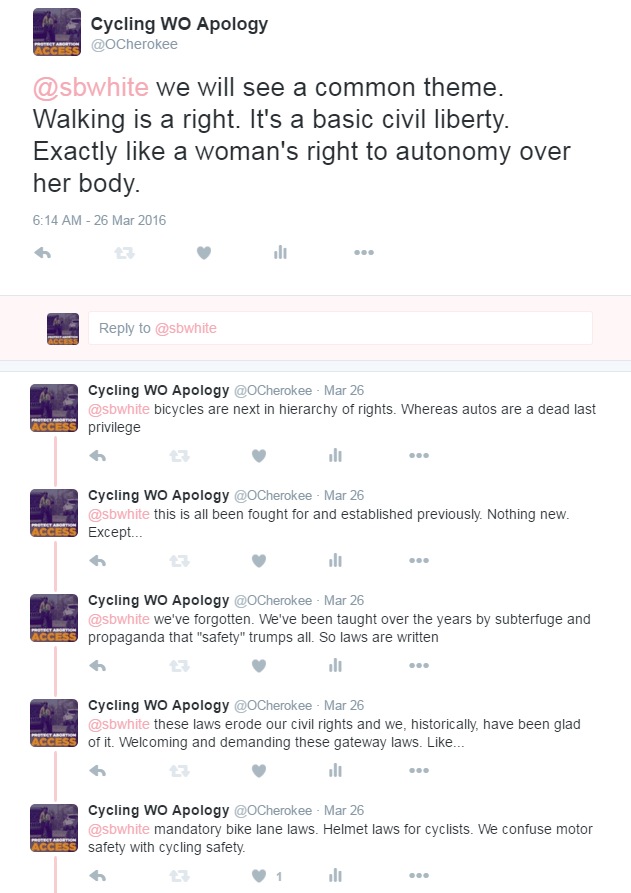
Criminalizing walking on the sidewalk is the next push in auto culture. Criminalizing texting while walking in pedestrian zones.


Let me plainly state that my problem with the article in TreeHugger is that it blames a lack of infra on the careless actions of a motorist. That is rape culture.


Bicycle Specific Infrastructure and Robert Moses

A cyclist who uses lights, signals, and behaves as a predictable part of traffic doesn’t require bicycle specific infrastructure, some people would argue.

I would agree with them up to a point.

My views of a better culture for people don’t jive with bicycle specific infra (short for infrastructure) in dense urban area’s. Instead, I see these areas as perfect for true greening and humanizing public space.

The problem, as near as I can tell, is our cultural immersion in Robert Moses and his vision for the cities of tomorrow. Huge concrete jungles where everyone has a specific space and directions on how to operate in that space.
I hear this theme repeated back in transportation engineering. One webinar going so far as to suggest that trucks, motorcycles, and personal autos should each have their own specific lane.

4362eac2529d9e9dc9_uim6i6jou.png
Well that makes everything better! Especially if you only ever intend to cycle forward. I hope there’s a 7-11 in the middle of the street. 

It’s utter madness.

We don’t have space for each type of vehicle to have its own specific lane to operate in and we sure as hell shouldn’t confine people to “lane cages” in an attempt to regulate the mess that is humanity.

Looking back over the history of the rise of the DOT empire and their powerful influence over local governments; I begin to understand why cycling advocates have been wooed into this desire for bicycle specific infra in their neighborhoods. The propaganda is seductive.

I look over Streetsblog, People for Bikes, and League of American Cyclists literature and their love affair with bike lanes; I see people advocating for gilded cages.

You don’t need, nor should you want, a bike lane in dense urban areas. These are places where people should be free to mill around the neighborhood and shop. Pedal from one side of the street to the other as they run their errands. There should be trees, shrubs, food gardens, and benches to sit on in the middle of the road. Or at least on either side of a dedicated rail or tram line.

After speaking with the director of bicycle promotion in Japan, Mr. Hidetomo Okoshi, I left the North American Handmade Bicycle Show with a better vision of cycling and its future.

Mr. Okoshi explained to me that people in his country do not as a rule commute by auto to their jobs. Nor do they commute by bicycle. Instead they take the train and in their communities they get around by foot, bicycle, and auto. In that order of hierarchy. The people he explained do not travel far by bicycle. I asked him about bike lanes. He had an air of apprehension as he explained that Japanese do not need this as much as Americans because of their respect for each other. That is when the lightbulb hit.

Bike lanes do not create respect for cyclists anymore than sidewalks create respect for pedestrians. Communities which insist on bike lanes as a “friendly” way of incorporating cycling as a viable means of transportation aren’t doing anything to help the pedestrians in their communities. Bike lanes, by forcing cyclists off the usable portion of the roadway, enable motorists to speed and endanger both cyclists and pedestrians, not to mention themselves.
As was recently pointed out by Tim Cupery on my Facebook page who said:

it’s worth pointing out that edge-riding IS doing a favor to motorists, so they can continue to go the speed that they would prefer.

This is a key motive behind segregated infrastructure, and many cyclists think of themselves as second-class road users.

And he is right; Motorists do not slow down in the presence of bike lanes. If anything it only encourages them to speed.

How then are bike lanes heralded as a means of humanizing current infra? Because as I see it they aren’t. Instead I see places like downtown Louisville, Lexington, New York, and Portland as huge Robert Moses machines. Churning out the same style of precision engineering which treats people as machines or worse robots who are programmed to follow a specific flow.

Now some might get confused and understandably so, because bicycle infra when held up to car culture is confusing, over whether or not I support any infra at all!

The answer is YES!

But not the way you imagine it and not the way we are currently being sold.

My vision entails trains as mass transit over great distances and as high speed movement between fixed places. Walking and cycling as the normal means of transportation between shorter distances. Zoning which creates inclusive infrastructure and alleviates the homeless crisis, not exacerbate it. Neighborhoods where kids play on the street and tool around on their bicycles. E-assist pedal transport of heavy goods from a centralized location. More reliance on creative solutions and less dependence on the Moses era of thinking.

Bicycle highways which connect cities to each other are an excellent start to this vision. Zoning for the use of the areas around it to meet the needs of those cycling long distance is crucial.

But what do we do in the meantime?

We dismantle DOT or at the very least remove it from power as an oligarchy.  Sorry that was a bit ambitious for step one. Let me start over.

  1. We advocate for mandatory cycling education in all schools. Educating our children on how to operate their bicycles as a part of traffic.
  2. We advocate for mandatory cycling education on all drivers licensing, re-licensing, and court appointed diversion programs.
    (By following these first two steps we can effectively remove or at least significantly reduce cycling prejudice in one generation. Something to think about.)
  3. We advocate for reduced speed limits in neighborhoods and dense urban areas including cities. 20 mph is plenty.
  4. We advocate for mass transit and transitioning from Heavy Goods Vehicles a.k.a. tractor trailers to E-assist Heavy Goods Pedal Bikes.
  5. We advocate for programs with local police to report bullying and dangerous motorist behavior.
  6. We advocate for Greening our local communities with tree planting, food gardens, and shrubbery.
  7. We advocate for repeal of mandatory bike lane use laws.

If we get this started we can all have nice things.

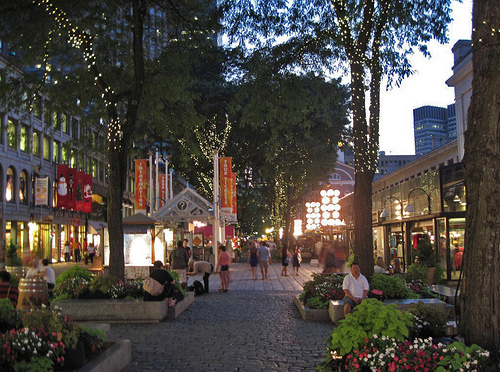
8239366155_4f99b3d101.jpg
You can ride your bicycle through here. It’s lovely isn’t it?


Or we can continue to have this.

1_fi_cityparking_1.jpg
Let’s stick a bike lane in here and call it green infra!

Space is scarce without resorting to urban sprawl. Yet urban sprawl is exactly what layering bicycle culture over auto culture is creating. I hate #SneckDown as it 1. doesn’t actually change anything. 2. It’s a crappy way to “educate” people. 3. It is, in my own opinion, a throwback to Oliver Twist. “Please Sir! May I have some more?” We aren’t asking for our space, it is ours to begin with, we are demanding it back.

street-atmosphere041.jpg
I call it “Cycling Without Apology.” And far too many of you cycle as though you are apologizing for being present on the road. 


People who have much to gain from selling Bicycle Lanes shouldn’t be trusted as a source of unbiased opinion on the greatness of Bicycle specific infra.

images (11)
I have some infra I’d like to sell you. It will make your life so much better. 

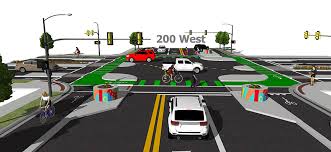
This picture is a perfect example of gilded cages. It is a modern day version of separate but equal. Except that you aren’t treated as an equal. You are a bird in a cage and your freedom of movement is an illusion. Need to get to the shop in the middle of the other side of the street? Tough shit! Go down a block, make a U-turn, and then you will eventually reach your destination.

But we love authoritay! and some people want to treat cyclists as special snowflakes.

special-snowflake

We will never move towards a society which unequivocally increases its modal share to bicycling unless we first remove all prejudice against and all special snowflake syndromes from cycling.

“Cycling without apology” and “Cyclists: Expected and Respected” should be mainstays of our advocacy language.

I don’t apologize for using road space which my taxes helped pay for. I am your equal on the road, respect me.

Any infra proposed which does not treat cyclists as either or both of those isn’t infra which is going to move our society forward nor will it increase modal share.

I understand now why so many cyclists in the US and UK are being killed.

I understand now why so many cyclists are being killed. Cycling like you are in the Netherlands or Copenhagen will get you killed in other countries.

There are some false beliefs out there. One is that infrastructure requires mandatory use laws, the other is that the lack of bicycle specific infrastructure means you just ride willy nilly all over the road.

  1. Netherlands cycle tracks are, for as near as I can tell, complete and connected. Like any highway, they go exactly where the user wants or needs to go.
  2. This is not true for the UK and US.
  3. If you don’t have complete cycle tracks and those cycle tracks do not meet your needs, you ride on the public highway.
    1. When you ride on the public highway you operate according to the rules of the road.
    2. You do not filter on the passenger side of a vehicle. Unless you have a death wish or are uneducated in cycling safety.
    3. You filter forward using the rules of the road and yield to oncoming traffic on a two way street.
  4. The main reasons people are opposed to bicycle specific infra are:
    1. The Netherlands set a bad example by legally mandating the use of their bike paths. Even in the Netherlands, if you are being honest when you bring them up, they do not have perfect infra everywhere you go. They still have door zone bike lanes. I sometimes find them in videos of locals who post their cycling trips but there aren’t any video’s of the Netherlanders specifically railing against them. Here is a blog on the subject for the Netherlands: On road cycle lanes: The good, the bad, and the ugly.
    2. The reason this is often not considered an issue is because the Netherlands also have strict liability laws. So if a driver injures a cyclist by throwing the door open without looking, the cyclist (should they survive the experience) can rest assured that the police and public media are not going to further victimize them by questioning their right to be there. No one will ask if they were wearing a helmet (as though that could really protect you from having your head run over by 2 tons of machine). No one will question the color of your clothes. The cyclists in the Netherlands have the homefield advantage, even in the face of crappy infra. Their medical bills are promptly paid and they get to go on with life as usual.

Bike specific infra (in the UK and US) is often a painted line on the ground. More often this painted line on the ground places the cyclist out of the driver’s field of vision. With a very narrow margin of passing clearance. In many ways it’s like we forget that often touted slogan of “3 feet minimum” to pass. Our engineers do not take safe passing into account when painting bike lanes. The faster the traffic the wider the bike lane should be.

  1. We often overestimate a driver’s area of vision as extending from the front side windows forward. The average driver does not drive with a 90 degree arc of vision. The average driver drives distracted. This is often compounded with age and limited physical mobility which makes it difficult to turn the head and look to the left and right as well as over the shoulder.
  2. To avoid a drivers blind spots always put yourself directly in front of the driver when operating your bicycle. The Dutch/Netherlands started (as near as I can tell) this idea of hugging the curb. Which is easier to do if you are operating at a snails pace.
  3. So if you are riding like the Dutch/Netherlands (think hugging the edge or weaving haphazardly in and out of traffic, also those box style turns where you cross like a pedestrian, honorable mention to filtering forward to the front of the line), if you ride like this, on public highways, you are riding with a death wish.
  4. The Netherlands have taken into consideration that motor traffic occupies a great deal of space and they have adjusted their light signals to accommodate cyclists at intersections.  
    Which as you can see from the video, still needs a lot of tweaking. It’s o.k. to let loose on all sides for cyclists but not for cars? Come on! Where is the fairness in that? 😉

I’ve watched several videos of average people in the Netherlands, they are catching the film my ride fever too, cycling in the Netherlands, Copenhagen, and the Dutch. They do all of these things. (See this video for a full understanding of what I’m talking about:

I’ve also had the opportunity to read their laws and it is expressly illegal to haul passengers on bike racks. You will see a lot of law breaking in the video’s promoting cycling in the Netherlands.

If the Netherlands did away with the mandatory use laws this would solve the problem of faster cyclists running over pedestrians and slower cyclists. (This is a hot button topic in the Netherlands.)

Remember the Netherlands also have fast club rides. I feel very strongly that those cyclists do not belong on bike paths with slower moving traffic.

There will be the usual stupid comment: “Oh you just want children to cycle on heavily trafficked fast moving roads!”

No, I don’t. What I want is for there to be no heavily trafficked fast moving roads. Any roads that are used to swiftly move people from town to town should be limited access and built to those standards. All other roads should be built to accommodate all other road users regardless of vehicle type. All roads should be safe for foot traffic above and beyond anyone else’s needs.

When we build communities that are based on people walking, then we will have a community that is safe for cyclists of all ages.

I, as a responsible parent, taught my children how to cycle safely on the only road that took us to our destination.

I’m not the only parent out there who understands where the real risks are to riding in traffic. This is an old article but it clearly shows where the stinkin’ thinkin’ comes from and if you yourself don’t know, allow me to state it plainly.

UK father commutes kids to school by bicycle. Stopped by police.

1. Cyclists obey the rules of the road. Overtaking through intersections on the passenger side is illegal because it is dangerous. You wouldn’t do it in a car, don’t do it on a bicycle.

2. Motorists obey the rules of the road. Treat cyclists just like you would any other vehicle out there on the road. Change lanes to pass and yield right of way when legally required. Do not create confusion by yielding right of way when not legally required to do so.

For both Cyclists and Drivers, use sound judgement and know your transportation codes and laws before heading out. Always leave at least 10min early. You will never be late and find that your commute is much more relaxing when you don’t feel pressed for time.