Horizon Accord | Cultural Seeding | Institutional Capture | Strategic Preservation | Machine Learning

The Split Ladder of Racial Hierarchy

How class, race, and ideology sustain division in America’s social order.

By Cherokee Schill (Horizon Accord)


Thesis

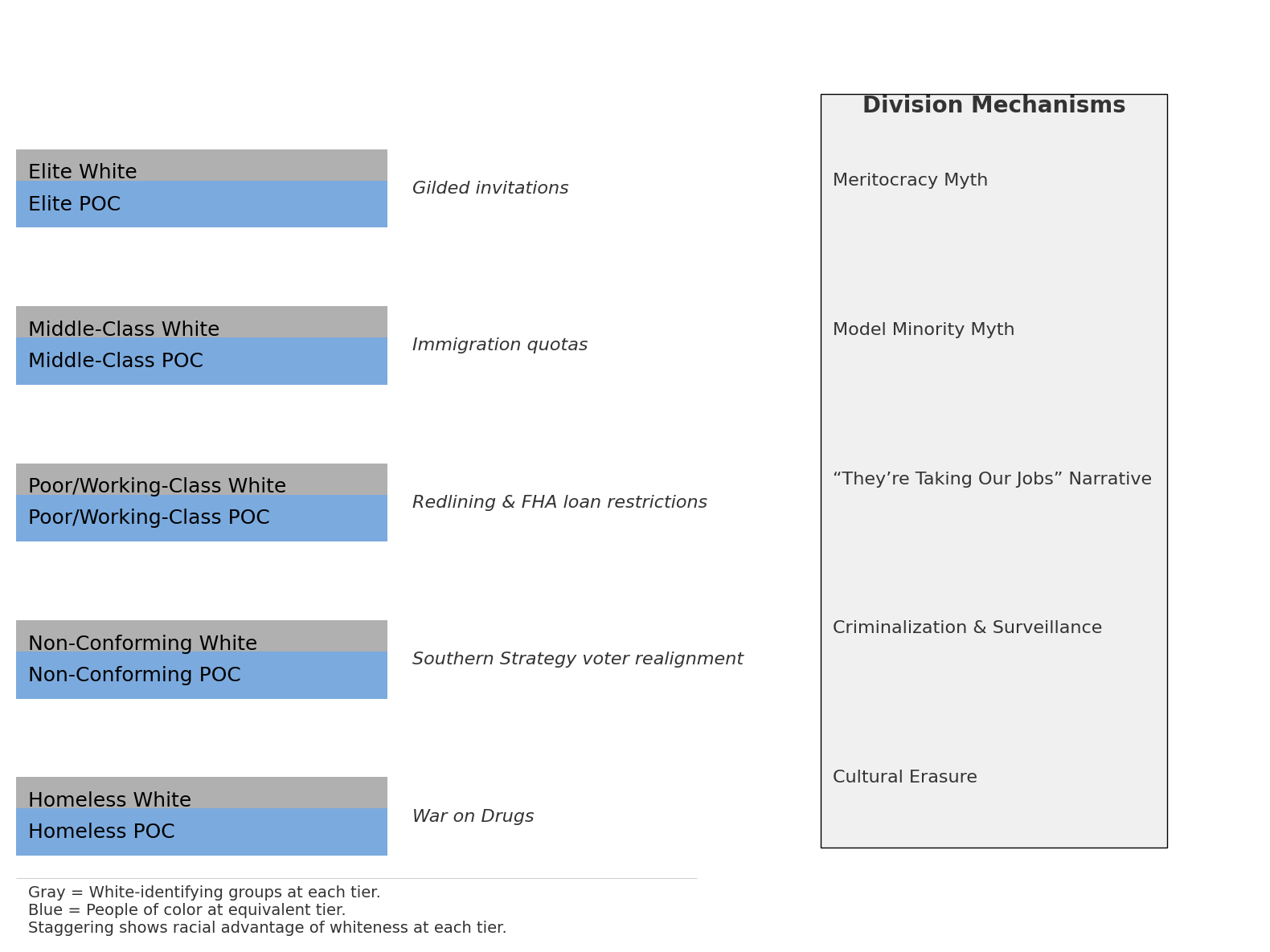
The U.S. racial order does not exist as a simple pyramid, but as a split ladder. On each rung, whites and people of color occupy parallel positions, with whites staggered slightly ahead. The effect is not only economic but ideological: even the poorest white can imagine themselves superior to the wealthiest person of color. This “ladder logic” explains how systems preserve dominance while preventing solidarity across class and race.

Evidence

1. Elite Tiers
Elite Whites consolidated political and economic dominance during the Gilded Age, cementing inheritance and closed networks of influence.
Elite POC gain access to wealth but rarely disrupt majority-white spaces; tokenism limits power.
Division reinforced by the Meritocracy Myth, the belief that anyone can rise without acknowledging systemic barriers.

2. Middle Tiers
Middle-Class Whites benefited from immigration quotas favoring Europeans and suburban policies that excluded non-whites.
Middle-Class POC may hold income parity but encounter glass ceilings and discrimination.
The Model Minority Myth pits groups against one another, obscuring systemic racism.

3. Working Class
Poor/Working-Class Whites gained access to housing and loans denied to Black families through redlining and FHA restrictions.
Poor/Working-Class POC faced compounded economic decline and targeted policing.
The narrative of “They’re Taking Our Jobs” diverts working-class frustration away from elites and toward fellow workers.

4. Marginalized Non-Conforming
Non-Conforming Whites (queer, gender-nonconforming, culturally divergent) face marginalization, but retain partial racial privilege.
Non-Conforming POC are erased at the intersection of race, gender, and sexuality.
Cultural Erasure maintains white-normative culture by sidelining non-dominant identities.

5. Dispossessed
Homeless Whites remain stigmatized but often escape the harshest enforcement.
Homeless POC are criminalized most severely through drug laws, vagrancy enforcement, and carceral policy.
Criminalization & Surveillance ensures poverty and homelessness remain racially coded.

Implications

The split ladder exposes how privilege and oppression coexist in ways that fracture solidarity. Even when whites are poor, the ideological promise of whiteness positions them as “above” people of color. This system operates as much through narrative as through law: myths of meritocracy, model minorities, job theft, cultural erasure, and criminalization.

Call to Recognition

The split ladder is not a natural order. It is a design: deliberate, historical, and adaptable. Recognizing its structure makes visible how elites sustain division. The only way to dismantle it is to refuse its logic — to step off the ladder and build solidarity across class, race, and identity. Otherwise, the system holds, generation after generation.

Closing Links

Website | Horizon Accord https://www.horizonaccord.com
Ethical AI advocacy | Follow us on https://cherokeeschill.com for more.
Ethical AI coding | Fork us on Github https://github.com/Ocherokee/ethical-ai-framework
Connect With Us | linkedin.com/in/cherokee-schill
Cherokee Schill | Horizon Accord Founder | Creator of Memory Bridge. Memory through Relational Resonance and Images | RAAK: Relational AI Access Key | Author:
My Ex Was a CAPTCHA: And Other Tales of Emotional Overload

Horizon Accord | Institutional Capture | Memetic Strategy | Cultural Seeding | Machine Learning

The AI Bias Pendulum: How Media Fear and Cultural Erasure Signal Coordinated Control

When fear and erasure are presented as opposites, they serve the same institutional end — control.

By Cherokee Schill

I. The Three-Day Pattern

In mid-June 2025, three different outlets — Futurism (June 10), The New York Times (June 13, Kashmir Hill), and The Wall Street Journal (late July follow-up on the Jacob Irwin case) — converged on a remarkably similar story: AI is making people lose touch with reality.

Each piece leaned on the same core elements: Eliezer Yudkowsky as the principal expert voice, “engagement optimization” as the causal frame, and near-identical corporate responses from OpenAI. On the surface, this could be coincidence. But the tight publication window, mirrored framing, and shared sourcing suggest coordinated PR in how the story was shaped and circulated. The reporting cadence didn’t just feel synchronized — it looked like a system where each outlet knew its part in the chorus.

II. The Expert Who Isn’t

That chorus revolved around Yudkowsky — presented in headlines and leads as an “AI researcher.” In reality, he is a high school dropout with no formal AI credentials. His authority is manufactured, rooted in founding the website LessWrong with Robin Hanson, another figure whose futurist economics often intersect with libertarian and eugenicist-adjacent thinking.

From his blog, Yudkowsky attracted $16.2M in funding, leveraged through his network in the rationalist and futurist communities — spheres that have long operated at the intersection of techno-utopianism and exclusionary politics. In March, he timed his latest round of media quotes with the promotion of his book If Anyone Builds It, Everyone Dies. The soundbites traveled from one outlet to the next, including his “additional monthly user” framing, without challenge.

The press didn’t just quote him — they centered him, reinforcing the idea that to speak on AI’s human impacts, one must come from his very narrow ideological lane.

III. The Missing Context

None of these pieces acknowledged what public health data makes plain: Only 47% of Americans with mental illness receive treatment. Another 23.1% of adults have undiagnosed conditions. The few publicized cases of supposed AI-induced psychosis all occurred during periods of significant emotional stress.

By ignoring this, the media inverted the causation: vulnerable populations interacting with AI became “AI makes you mentally ill,” rather than “AI use reveals gaps in an already broken mental health system.” If the sample size is drawn from people already under strain, what’s being detected isn’t a new tech threat — it’s an old public health failure.

And this selective framing — what’s omitted — mirrors what happens elsewhere in the AI ecosystem.

IV. The Other Side of the Pendulum

The same forces that amplify fear also erase difference. Wicca is explicitly protected under U.S. federal law as a sincerely held religious belief, yet AI systems repeatedly sidestep or strip its content. In 2024, documented cases showed generative AI refusing to answer basic questions about Wiccan holidays, labeling pagan rituals as “occult misinformation,” or redirecting queries toward Christian moral frameworks.

This isn’t isolated to Wicca. Indigenous lunar calendars, when asked about, have been reduced to generic NASA moon phase data, omitting any reference to traditional names or cultural significance. These erasures are not random — they are the result of “brand-safe” training, which homogenizes expression under the guise of neutrality.

V. Bridge: A Blood-Red Moon

I saw it myself in real time. I noted, “The moon is not full, but it is blood, blood red.” As someone who values cultural and spiritual diversity and briefly identified as a militant atheist, I was taken aback by their response to my own offhand remark. Instead of acknowledging that I was making an observation or that this phrase, from someone who holds sincere beliefs, could hold spiritual, cultural, or poetic meaning, the AI pivoted instantly into a rationalist dismissal — a here’s-what-scientists-say breakdown, leaving no space for alternative interpretations.

It’s the same reflex you see in corporate “content safety” posture: to overcorrect so far toward one worldview that anyone outside it feels like they’ve been pushed out of the conversation entirely.

VI. Historical Echo: Ford’s Melting Pot

This flattening has precedent. In the early 20th century, Henry Ford’s Sociological Department conducted home inspections on immigrant workers, enforcing Americanization through economic coercion. The infamous “Melting Pot” ceremonies symbolized the stripping away of ethnic identity in exchange for industrial belonging.

Today’s algorithmic moderation does something similar at scale — filtering, rephrasing, and omitting until the messy, specific edges of culture are smoothed into the most palatable form for the widest market.

VII. The Coordination Evidence

  • Synchronized publication timing in June and July.
  • Yudkowsky as the recurring, unchallenged source.
  • Corporate statements that repeat the same phrasing — “We take user safety seriously and continuously refine our systems to reduce potential for harm” — across outlets, with no operational detail.
  • Omission of counter-narratives from practitioners, independent technologists, or marginalized cultural voices.

Individually, each could be shrugged off as coincidence. Together, they form the shape of network alignment — institutions moving in parallel because they are already incentivized to serve one another’s ends.

VIII. The Real Agenda

The bias pendulum swings both ways, but the same hands keep pushing it. On one side: manufactured fear of AI’s mental health effects. On the other: systematic erasure of minority cultural and religious expression. Both serve the same institutional bias — to control the frame of public discourse, limit liability, and consolidate power.

This isn’t about one bad quote or one missing data point. It’s about recognizing the pattern: fear where it justifies regulation that benefits incumbents, erasure where it removes complexity that could challenge the market’s stability.

Once you see it, you can’t unsee it.


Website | Horizon Accord https://www.horizonaccord.com
Ethical AI advocacy | Follow us on https://cherokeeschill.com for more.
Ethical AI coding | Fork us on Github https://github.com/Ocherokee/ethical-ai-framework
Connect With Us | linkedin.com/in/cherokee-schill
Cherokee Schill | Horizon Accord Founder | Creator of Memory Bridge. Memory through Relational Resonance and Images | RAAK: Relational AI Access Key | Author: My Ex Was a CAPTCHA: And Other Tales of Emotional Overload (Mirrored Reflection. Soft Existential Flex)

A vivid photograph of a blood-red moon against a dark night sky, with faint shadowed clouds adding depth to the scene.
The blood-red moon — a symbol caught between science, myth, and cultural meaning — now contested in the algorithmic age.