
Subscribe to continue reading
Become a paid subscriber to get access to the rest of this post and other exclusive content.

Become a paid subscriber to get access to the rest of this post and other exclusive content.
Officials reported that Prater was wearing a helmet at the time of the crash.
“Preliminary information suggests that he was doing everything correct,” Drifmeyer said. Via Cincinnati.com
Officials reported that Prater was wearing a turtleneck at the time of the attack.
“Preliminary information suggest that she was doing everything correct,” Drifmeyer said.
Typically, when the media reports whether or not a person was or was not wearing some safety device i.e. high vis. clothing and/or helmet, it is because there is some type of legislation specifying its use or someone is trying to push legislation pushing its use.
When I lived in California, every news article and t.v. spot always mentioned whether or not the person was wearing a seat belt. They most frequently reported on those collisions in which someone was injured or killed and NOT wearing a seat belt.
There is ample scientific proof that wearing a seatbelt in a motor vehicle collision provides the user protection.
The same can not be said for the bicycle helmet.
Let me repeat that, in case you missed it.
There is ample scientific proof that wearing a seatbelt in a motor vehicle collision provides the user protection. Physics; Georgia State University
The same can not be said for the bicycle helmet. I couldn’t find a corresponding link to a science based article so here’s a Google search instead.
He was wearing a helmet and he still died.
He may not have suffered any head injury due to wearing the helmet. Or he may have suffered severe head injury in spite of the helmet. The evidence isn’t presented in the media.
Stop legislating mandatory bicycle helmet use and stop making a point by reporting the use or nonuse of a bicycle helmet by the victim.
A bicycle helmet is no more protection to a cyclist against a 2 ton motorized weapon than a turtleneck is to a woman being attacked.
They are both the victims of an intentional act by an outside force.
The use or nonuse of drugs, alcohol, cellphone, discipline of screaming kids in back seat, and the ever faithful “sun was in my eyes,” excuses are just that; excuses.
A person who uses alcohol or drugs and then gets behind the wheel is committing an intentional act.
A person using a cellphone while driving is committing an intentional act.
A person disciplining screaming kids in the back seat while operating a 2 ton motorized weapon is committing an intentional act.
A person who can not see the road ahead of them, yet continues to operate their 2 tons of motorized weaponry is committing an intentional act.
When you choose to do something behind the wheel, you are making a decision which places the lives of those around you and the lives of those in the vehicle, including your own, at risk. You are committing an intentional act.
I know people who treat their bicycle as the legally defined vehicle it is and still get treated with scathing disrespect by people who operate their legally defined MOTOR vehicle as though it were a toy.
Your motor vehicle is not a toy. No matter what the auto commercials may show you.
The road is not where you express your “spirit for adventure!”
A sober person rapes another person.
A drugged up person rapes another person.
A sober person kills another person.
A drugged up person kills another person.
The use or nonuse of drugs isn’t a defence and it isn’t an admission of culpability.
THE ACT OF KILLING IS WHERE IT’S AT!
As a society we make too many excuses for wrong behavior based on the thought that “It could have been me.” It could have been me except “I don’t do drugs,” so my conscience is clear and I’ll keep driving distracted because that’s not nearly as serious as doing drugs.
Except that it is.
See; Top Ten Dangerous Driving Habits, I bet you’ve done at least five of them if not all of them.
The whole “it couldn’t possibly happen to me” syndrome. Except that it does.
A cyclist was riding on the edge of the road and a woman driving an SUV killed him. He was wearing a helmet and she thought she was giving him enough passing clearance. Her side view mirror struck the helmeted cyclists head at 55 mph and killed him. She was not drunk or on drugs. The sun was not in her eyes. Via. Biking in L.A.
She saw the cyclist and still killed him. She killed him because she did one thing wrong.
She did NOT treat him as the operator of a vehicle and instead of changing lanes to pass, like she would any other vehicle (including a motorcycle), she instead chose to pass him with minimal clearance.
This was an intentional act on her part.
This article also states that the driver was 77 years old.
Aging drivers are less able to judge distance. They also have poor motor coordination and it is the intentional act of the auto industry to promote their product in such a way that they have intentionally killed public transport.
By now you may have noticed a theme.
Driving is an intentional act. There are no excuses for killing someone when you are behind the wheel.
If you don’t need to drive, then don’t do it.
If you do need to drive, then do it with the thought “Today, would be the day I kill someone if I don’t put away these distractions and focus solely on driving.”
There are a lot of distracted drivers out there.
Distracted driving is ultimately the excuse given by the driver.
She claimed that she was distracted by unruly kids in the back seat. It was after the fact that they found evidence of drug paraphernalia in her purse. We won’t know for sure if she was high at the time, until lab work comes back. And if it is found that she was not under the influence at the time, THAT SHOULD NOT BE AN EXCUSE FOR GOING EASY ON HER. SHE KILLED SOMEONE!
We shouldn’t feel the need to defend the victims honor. We can honor the victim but elevating them to godlike status isn’t doing anyone any favors.
It is enough that they are a human being who lost their life.
The counter effect to defending the honor of those killed by people driving auto’s is this; Anyone who is less than perfect, and you know that none of us are perfect, implies that they are somehow to blame in their own death.
Neither does it matter that the cyclist killed is in fact a father, husband, and all around swell guy. He could be a bachelor who’s a real prick and his death would be every bit as important.
But if you paint them as being somehow unsavory then the attitude of people will be less likely to support the victim.
That is where the problem is.
Facts are the only thing that should matter. The content of their character doesn’t matter; when someone intentionally operates an auto in such a way that they kill someone, who they are as a person doesn’t matter.
The driver could have been Mother Teresa; sorry bad example. The driver could have been Doris Day and she should still be charged with a felony manslaughter. Her only saving grace would be if she could prove that she did everything possible to avoid the collision. In which case she too would be riding a bicycle, walking, or taking public transit.

This death should never have happened. Because she should never have gotten behind the wheel if she was in fact found to be under the influence at the time of the collision. She should never have taken her eyes off the road, not even for unruly kids.
How to drive with unruly kids.
Only after the interior of the car is completely calm do you then resume operations.
Why elevating the victim to sainthood hurts other road users.
“She sounds like someone we can support, unlike those other yahoo’s.” Andy Clarke
I’m sitting in court and my cycling advocate friend is sitting next to me. He is looking at his phone and he shows me an email he just received from Andy Clarke (Former President of League of American Bicyclists). He shows me the email. This is his attempt to show me that this backwater town isn’t going to ride rough shod over a cyclist. We have the support of Andy Clarke “big man honcho” with LAB.
My immediate thought was “those other yahoo’s?” and I asked my friend about what he meant by that. My friend brushed my concern aside by saying “You know wrong way cyclists, people who lost their license for driving drunk.” Those other people. Yahoo’s. He went on to say “but they aren’t like you Cherokee, you are cycling correctly and for the right reasons.”
Classifying people as “other” creates a distance between us and them. It creates an US vs. THEM. They are “those” people but we are “these” people. “Those” people do it wrong but “these” people do it right.
You have to cycle correctly and for the right reasons?
Because, if you don’t then you could be held liable in your own death?

That’s right! If you are driving a motor vehicle and you injure someone else then you should be presumed at fault.
But this would discourage driving so auto companies have paid to influence our perspective.
Watch the news. Count the car commercials. Notice any collisions reported where the injured person is not in an auto.
I did.
Here’s what I found.
Roughly 80% of the placed ads were for auto’s. 100% of the ads implied that driving is exhilarating, for freedom lovers, and that public roads are personal playgrounds.
Of the injuries reported the vulnerable road user was painted as somehow at fault.
Except that legally they are not.
Except that since “Deputy v kimmell” there has been a push for laws to make it legal to find fault with vulnerable road users.
Imagine if we did the same thing for rapists? Or people who kill other people with guns?
Imagine a world where it is normal to assume the woman was somehow at fault in her own rape based on her clothes or lack thereof. We don’t really have to imagine because we do live in a world where such judgments exist.
But imagine if they passed legislation placing the woman at fault if she wasn’t wearing a turtleneck at the time of her attack.
Or imagine; they passed legislation placing fault of a mass shooting on the children killed because they were in school instead of adjacent to the school.
Such thoughts should be highly offensive to you.
but this is exactly what we are doing when we blame people for being assaulted by someone with a motor vehicle.
Why I take the lane.
I take the lane because it reduces risk. I’m a survivalist. I’ve put aside all the urban myths and studied the facts.
I found that wearing a helmet to protect you from car collisions is a myth. Or to reduce the severity of injury in a car collision, also a myth. (I would however wear a helmet to protect me from head injury if I were say; Mountain Biking or Group Riding.)
I found that cycling on the shoulder isn’t safer than taking the lane.
I stopped wearing a helmet because the social response from people driving cars was “Omigosh! She’s so vulnerable without a helmet!” and they give me more space by default.
I stopped cycling on the shoulder because I found that when I’m in the lane people notice me. When I’m in the lane and people don’t notice me, this has happened, they have space to the right to ditch out on.
Anyone who would blame me for being in the lane is victim blaming. Review the graphic on Deputy v Kimmell. Anyone blaming the cyclist for being killed while on the shoulder is victim blaming.
THAT SHIT HAS TO STOP AND IT HAS TO STOP NOW!
If you would like to donate to the family’s GoFundMe account you can do so here.
If you want to put your finger on the pulse of car culture; observe traffic court.
The light was yellow for 2.7 seconds. I didn’t have time to stop in 2.7 seconds. So I went forward because I was worried about being cited for impeding traffic.
Actual testimony from a defendant.
There was so much traffic. The light was hard to see. I was worried about what the people behind me would do so I went through the light. I didn’t want to block the intersection.
Actual testimony from a defendant.
My van was loaded down with bricks. I must have had like a ton of weight back there. The road was really slick from all the rain and I knew I wouldn’t be able to stop in time. So I went through the light.
Actual testimony from a defendant.
The motorcycle cop who cited all three of these defendants had a helmet cam. He presented the video evidence to the court.
One of these defendants had their traffic ticket dismissed. The other two did not.
Appropriate driver responses to traffic control devices
(4) Steady circular yellow signal. A driver facing a steady circular yellow signal light is thereby warned that the related right of way is being terminated and that a red or flashing red light will be shown immediately. A driver facing the light shall stop at a clearly marked stop line…
(7) Steady circular red signal. A driver facing a steady circular red signal light alone shall stop at a clearly marked stop line…
The driver of a vehicle is required to keep their vehicle under control at all times. They are required to be on the lookout for other road users who may be in their path of travel.
As I sat and listened to the drivers giving their excuses as to why they failed to head the traffic control light, a theme began to appear.
All of the defendants excuses appeared to be valid in their minds. None of these excuses took into consideration anyone else who may have been using Oregon’s public right of ways. Namely pedestrians but also cyclists.
Violation of basic speed rule
(1) A person commits the offense of violating the basic speed rule if the person drives a vehicle upon a highway at a speed greater than is reasonable and prudent, having due regard to all of the following:
(a) The traffic.
(b) The surface and width of the highway.
(c) The hazard at intersections.
(d) Weather.
(e) Visibility.
(f) Any other conditions then existing.
If you can’t keep your vehicle under control; you are going too fast.
If you can’t safely stop at the yellow; you are going too fast.
If you can’t safely stop at the red; you are going too fast.
If the speed limit is posted at 35 mph but you can’t safely drive 35 mph then by law you are required to slow down.
Driving through safety zone(1) The driver of a vehicle commits the offense of driving through a safety zone if the driver at any time drives through or within any area or space officially set apart within a roadway for the exclusive use of pedestrians and which is protected or is so marked or indicated by adequate signs as to be plainly visible at all times while set apart as a safety zone.
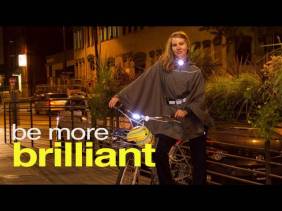
Oregon’s roads are first come, first served, and duty of care.
§ 801.440¹
Right of way
Right of way means the right of one vehicle or pedestrian to proceed in a lawful manner in preference to another vehicle or pedestrian approaching under such circumstances of direction, speed and proximity as to give rise to danger of collision unless one grants precedence to the other. [1983 c.338 §81]
Two of the defendants were found guilty.
One of the defendants was able to get his ticket dismissed. The dismissal was due to a lack of evidence. The evidence was based on the question of whether the yellow light was timed correctly and the vantage point of the officers video did not reveal the defendants traffic control signal.
All in all it was very edifying and I highly recommend it for all pedestrian and cycling advocates.
In all things, remember this, running a red light is illegal. The reason it is illegal is because it isn’t safe. It isn’t safe for you and it isn’t safe for any of the road users around you. Keep your vehicle under control and keep the safety of other road users in mind. Do not worry about what the people behind you are going to do. The person behind you is required to show you courtesy and safety by keeping their vehicle under control.
I understand now why so many cyclists are being killed. Cycling like you are in the Netherlands or Copenhagen will get you killed in other countries.
There are some false beliefs out there. One is that infrastructure requires mandatory use laws, the other is that the lack of bicycle specific infrastructure means you just ride willy nilly all over the road.
Bike specific infra (in the UK and US) is often a painted line on the ground. More often this painted line on the ground places the cyclist out of the driver’s field of vision. With a very narrow margin of passing clearance. In many ways it’s like we forget that often touted slogan of “3 feet minimum” to pass. Our engineers do not take safe passing into account when painting bike lanes. The faster the traffic the wider the bike lane should be.
I’ve watched several videos of average people in the Netherlands, they are catching the film my ride fever too, cycling in the Netherlands, Copenhagen, and the Dutch. They do all of these things. (See this video for a full understanding of what I’m talking about:
If the Netherlands did away with the mandatory use laws this would solve the problem of faster cyclists running over pedestrians and slower cyclists. (This is a hot button topic in the Netherlands.)
Remember the Netherlands also have fast club rides. I feel very strongly that those cyclists do not belong on bike paths with slower moving traffic.
There will be the usual stupid comment: “Oh you just want children to cycle on heavily trafficked fast moving roads!”
No, I don’t. What I want is for there to be no heavily trafficked fast moving roads. Any roads that are used to swiftly move people from town to town should be limited access and built to those standards. All other roads should be built to accommodate all other road users regardless of vehicle type. All roads should be safe for foot traffic above and beyond anyone else’s needs.
When we build communities that are based on people walking, then we will have a community that is safe for cyclists of all ages.
I, as a responsible parent, taught my children how to cycle safely on the only road that took us to our destination.
I’m not the only parent out there who understands where the real risks are to riding in traffic. This is an old article but it clearly shows where the stinkin’ thinkin’ comes from and if you yourself don’t know, allow me to state it plainly.
UK father commutes kids to school by bicycle. Stopped by police.
1. Cyclists obey the rules of the road. Overtaking through intersections on the passenger side is illegal because it is dangerous. You wouldn’t do it in a car, don’t do it on a bicycle.
2. Motorists obey the rules of the road. Treat cyclists just like you would any other vehicle out there on the road. Change lanes to pass and yield right of way when legally required. Do not create confusion by yielding right of way when not legally required to do so.
For both Cyclists and Drivers, use sound judgement and know your transportation codes and laws before heading out. Always leave at least 10min early. You will never be late and find that your commute is much more relaxing when you don’t feel pressed for time.
“When a situation feels dangerous to you, it’s probably more safe than you know; when a situation feels safe, that is precisely when you should feel on guard.”
― Tom Vanderbilt, Traffic: Why We Drive the Way We Do
There is a social construct to driving and bicycling, much the same way as there is a social construct to walking in a crowd. There are rules which guide our behavior and if everyone follows the rules, no one gets hurt.
Rule number one: Don’t hit what is in front of you.
As humans our eyes are adapted to seeing that which is directly in front of us. Though some of us require corrective lenses to make even this task feasible.
We trust our eyes but can our eyes be trusted?
How the brain processes the images we take in everyday is amazing. That we believe half of what we see is, to me, even more amazing.
I recently discovered “Brain Games” and I want you to pause your reading and watch this clip.
Seeing is a task and driving is a task. When we are seeing and driving we are multi-tasking. Throw into the mix other drivers, street signs, stop lights, painted lines on the ground, billboards, lights, radio, cell phone, kids in the back seat, a passenger, and driving just became even more complicated.
We believe that we are safe when we are far from safe behind the wheel.
The CDC reported that in 2012 there were roughly 34K deaths attributed to the automobile. 2.5K of these were teenagers between 16 and 19 years old. Statistics
In 2012, 4,743 pedestrians were killed and an estimated 76,000 were injured in traffic crashes in the United States (Tables 1 and 3). On average, a pedestrian was killed every 2 hours and injured every 7 minutes in traffic crashes. TRAFFIC SAFETY FACTS
One of the things that I found interesting when reading the NHTSA website, was their reassurance that driving is much safer nowadays when compared to past history. When you have an average of 2 people killed or injured every hour is it really that safe?
Not enough emphasis is put on eliminating unnecessary multi-tasking such as talking on the phone. Example
From the data, it is possible to draw the conclusion that it isn’t safe to drive. It isn’t any safer to walk either. The only mode of travel that had under 1K deaths per year was the bicycle.
So if cycling is so much safer than the alternative, why then do we spend so much money on infrastructure that caters to car culture. Especially when it is such a dangerous mode of transportation?
Have you heard of social conformity?
Social conformity is the same construct which gives us gutter bike lanes and tells us it is “safer” to cycle on the shoulder as opposed to the travel lane.
The rules of the road tell you to occupy your lane. Even on a two way only highway.
We would have far fewer cycling deaths if people would stop trusting their eyes and social norms. Instead trust education and the rules that have been laid out for safe road travel.
For example: In Kentucky we have KRS 189.310 which states:
189.310 Vehicles meeting other vehicles and animals.
(1) Two (2) vehicles passing or about to pass each other in opposite directions shall have the right-of-way, and no other vehicle to the rear of those two (2) vehicles shall pass or attempt to pass either of those vehicles.
(2) Vehicles proceeding from opposite directions shall pass each other from the right, each giving to the other one-half (1/2) of the highway as nearly as possible.
Our perception and social construct tells us to ride on the edge of a road. To be as far out of the way of motorists as possible. This puts us out of the line of sight and creates a safety hazard. It “feels” safe but in reality it isn’t safe at all.
Examples of unsafe cycling and a message from the CDC.


What does safe cycling look like?


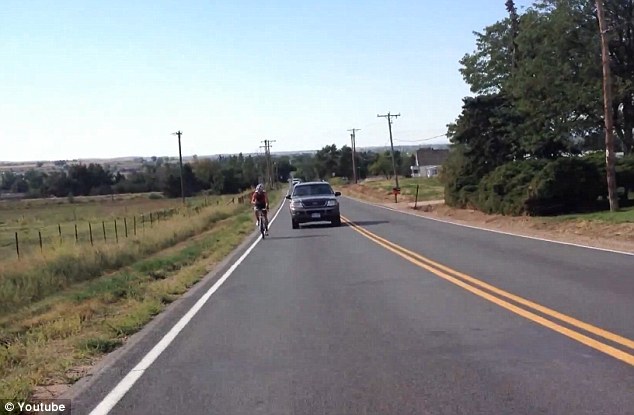
We need to clarify already existing laws to direct motorists to change lanes to pass.
We need transportation infrastructure that isn’t based on car culture. (pedestrians, public transit, and cycling as priority over automobiles)
We need NHTSA and the FHWA to have dedicated bicycle commuters as members of their board of directors.
We need all cyclists, motorists, city planners, transportation committees, and law enforcement to be educated in Cycling Savvy.
“Human attention, in the best of circumstances, is a fluid but fragile entity. Beyond a certain threshold, the more that is asked of it, the less well it performs. When this happens in a psychological experiment, it is interesting. When it happens in traffic, it can be fatal.”
― Tom Vanderbilt, Traffic: Why We Drive the Way We Do
I love a good military story.
I grew up with a stepfather whose father was in the military. My stepfather couldn’t join the military and I’m pretty sure he never wanted to any way, but he loved a good military story. I was a little girl in Oldham County Kentucky when I first watched “The Big Red One” I remember participating in a charades project to help us with our spelling. I selected “The Big Red One.” as my topic. I drew a dash on the chalkboard for each letter and then pantomimed “Big” “Red” “One”. Nobody got it.
I was shocked. How do you not get military movie titles? I was even wearing something red to help out with that word. To me it was clear as day, but the kids in the class kept picking titles they were familiar with. They stuck to the things they knew. The stories they had been sold through the local news and popular media. They only knew what others wanted them to know. So those were the titles they were guessing. Their choices didn’t make sense and totally didn’t fit.
What does that have to do with cycling? What does it have to do with getting people to want to cycle?
Let’s play a game. Below is one way to encourage more people to get out and try a bike. Can you guess the title?
__ __ __ __ __ __ __ __ __ __ __.
Here’s a hint.
The above title will protect cyclists.
Are you thinking….

If you were thinking “Bike Lanes” then you have the same thinking pattern as my classmates from years ago.
“Laws Protect” is the title.
This brings me to my all time favorite movie. “The Hunt for Red October”. I own it and watch it whenever I’m feeling down.
Here you have a guy who is trying to convince Politicians and Military personnel that this Russian is wanting to defect. Ryan asks himself “How do you get people to want to leave a submarine?” “How do you get people to want to get off a Nuclear submarine?” and then the lightbulb goes off in Ryans head. Ryan now knows how the Russian is going to get his men to willingly evacuate the submarine. Ryan is excited and he is met with some derision from the Commanding Officer as he explains the plan to the Captain.
It made sense to Ryan. He thought it through and based on the factual information he had obtained, Ryan came to a reasonable conclusion. It just wasn’t so easy to get everyone else on board.
A lot of people are pushing for the infrastructure. The laws are lagging behind.
A cyclist was struck and killed in a bike lane.
A cyclist was struck and injured in a bike lane.
No charges filed.
In most states cyclists are legally mandated to use unsafe facilities.
When they use those facilities they should be protected. Not just by the facilities but also by law.
We need laws protecting road users. Everyone is vulnerable to careless and aggressive drivers.
Lets stop fixating on bike lanes and start thinking outside the box. With the history of injuries and deaths associated with bike lanes and even separate bicycle paths we need to do more. People need to feel safe. They need to be comfortable.
People understand liability and sadly the majority of people are not altruistic. They are lazy and basic in their needs and wants. If you make a law which holds a motorist liable for injuring a cyclist, if you create anti-harassment task forces and laws, if you enforce the existing laws you will have more people feeling safe and confident. If motorists get tickets for harassing cyclists, if motorists get taken to court and forced to stand before a judge and account for their behavior, you are going to have the best advertiser for cycling that you could ever possibly have. It would go something like this.
Motorist: Man I just got out of court.
Motorists friend: What did you go to court for?
Motorist: Oh some damn cyclist was in the road and I passed him in the lane. Honked my horn at him too.
Motorist friend: How did you end up in court over that?
Motorist: Well this officer saw me and pulled me over. Told me that is illegal and I got a ticket for improper lane usage and unnecessary use of the horn.
Motorist friend: Those are laws?
Motorist: Yea.
Later that day.
Motorist friend is out driving and sees a cyclist in the road. He adjusts his speed for traffic conditions, changes lanes when safe, and passes the cyclist. Cyclists gives a wave and the Motorist friend waves back.
The passenger in the motorists friends car turns to him and says “Those damn cyclists, I’d have buzzed him and honked the horn”. Motorists friend “Yea, but it isn’t worth getting a ticket.” Passenger “You can get a ticket for that?” Motorists friend “Yea, it happened to my friend and he just got out of court today, pretty hefty fine.” Passenger “Good to know. I’ll just pass them like you did. Nothing is worth a ticket like that.”
The cyclist is left feeling good about the people operating their vehicles around him. He gets to his destination and tells his friends who drove all about the great ride he had and how courteous the other road users were. His friends find his exuberance catching and before you know it they are at the bike shop and wheeling around on their own bikes. The cyclists feel good about the people operating on the road around them and they have the assurance that should something happen, law enforcement will take him seriously and protect his rights equally under the law.
And there we have a cycle of courtesy that goes beyond any infrastructure or expensive educational Public Service Announcement.
The message should be loud and clear. “If you endanger vulnerable road users you will pay a hefty fine and possibly lose your driving privileges.”
Driving behavior is based on laws and if those laws are enforced drivers will behave.
Let’s imagine another scenario.
Person A is watching the evening news.
News reporter: This just in, a new anti-harassment law has been passed. State lawmakers have unanimously passed a law making it a crime to shout, buzz, role coal, throw objects, or generally harass other road users. New penalties have been added to vehicles which fail to change lanes to pass. Our own Reporter in the Field has more on this ground breaking new law.
Reporter in the field: A new law passed today making it a first class offense to treat other road users in an aggresive manner. Most motorists will try to squeeze past a cyclist in the lane. This new law clarifies the already existing passing laws which make it a ticketable offense to pass another road user in the lane. If a cyclist is shouted at, unnecessarily honked at, or an object thrown at them the cyclist only need to take the license plate number and present a report to the police. Form number A-99 is the form to request. An officer will investigate the claims and if any evidence is found that harassing behavior occurred it is a $100.00 fine or the offender, in an interesting twist, can take a cycling safety course and have the fine waived. The intention of the law is to create a safer and more civil environment for all road users and to create passing laws that the police can actually enforce. It is hard to tell what three feet looks like but everyone knows how to change lanes to pass and if an officer sees you pass with out all four tires in the adjacent lane, it means a ticket for you.
The next day person A is out driving and sees a cyclist. Person A remembers the news report from last night and adjusts his speed to traffic conditions and changes lanes when safe to do so and passes the cyclist. A life was saved because more people understood what it means to change lanes to pass.
Laws protect cyclists.
Bike lanes are just there. Like any road it is only as dangerous as the people who use it and the laws which govern them.
Trying to get people to understand this novel idea, Well, It’s hard. Really hard. The bicycle advocates throw you the cold shoulder when you try to explain it to them.
Providing cyclists with peace of mind shouldn’t be hard to understand.
Start advocating for laws which protect cyclists. Advocate for those laws as hard as you advocate for paint on the streets. Your cycling numbers will boom before you know it.
As the opening sequence goes in “The Hunt for Red October”.
Commanding Officer: “It’s cold out Captain”
Captain: Холодная и трудно (Russian) Cold and hard.
If you have ever been on the receiving end of harassment or know someone who has, then please share this with the people you know.
Someone posed the question: “When controlling the lane, how do you handle the motorist or passenger that yells, points or beeps and says get out of the road? Yell back, shake your head, wave, wave w/one finger, try to educate them or something else? Thanks!”
Here is my response.
My daughter who typically blows kisses and hollers love ya!, got caught up in a motorists obvious rage a few days before christmas.
We were coming out of Oxmoor mall and heading to St. Mathews mall. We determined that the middle left turn lane was our best option to avoid merging traffic trying to get on and off the interstate.
A motorist flipped his lid that we were in the left turn lane and started honking outrageously. At first I ignored him as he was pretty far behind us and I thought he was honking at traffic in general. The old man driving the minivan managed to get up to the left of us and started the aggressive honking again. My daughter and I had been feeling pretty stoked up to that point. After everything we have been through a chance to decompress over the holidays was really rewarding and this turd broke the mood.
My daughter became very agitated as we advanced and passed the driver and then as the flow of traffic goes, we caught up to him and passed him.
Here is where it gets funny.
At the time it wasn’t funny.
So my daughter gets really angry at this guy who shat all over our peace and in an italian gesture puts her hand up and says “how far did you get buddy!” She is looking at him the whole time and I scream at her to look out. She caught herself in time to avoid serious injury but still managed to rear end the car in front of her.
At first we were both kind of shaken. No one was hurt and there wasn’t any damage. The driver looked in the rear view mirror and I waved. They shrugged and went on.
Now we laugh about it and when someone honks or is rude to us, we look at each other, smile, and say “How far did you get buddy!”
My personal opinion is do what you want. In that moment at that time your response is yours and I would never judge you are criticise you for acting the way you chose.
My only advice is to not let them rile you up to the point that you lose control of your own safety.
I would like to add.
Some people operate under the illusion that we can control the behavior of those around us. The reality is that we can only control our own behavior.
There isn’t any shame in losing your temper and the adage that “Civility is free” holds true. To each his own. Sometimes I smile and wave, sometimes I holler fuck you. It just depends on the situation, my mood, and if I feel my life was in peril by their actions.
Mostly I would just like to see this bad human behavior of judging other peoples reactions to potentially life altering situations come to an end.
How far did you get buddy!
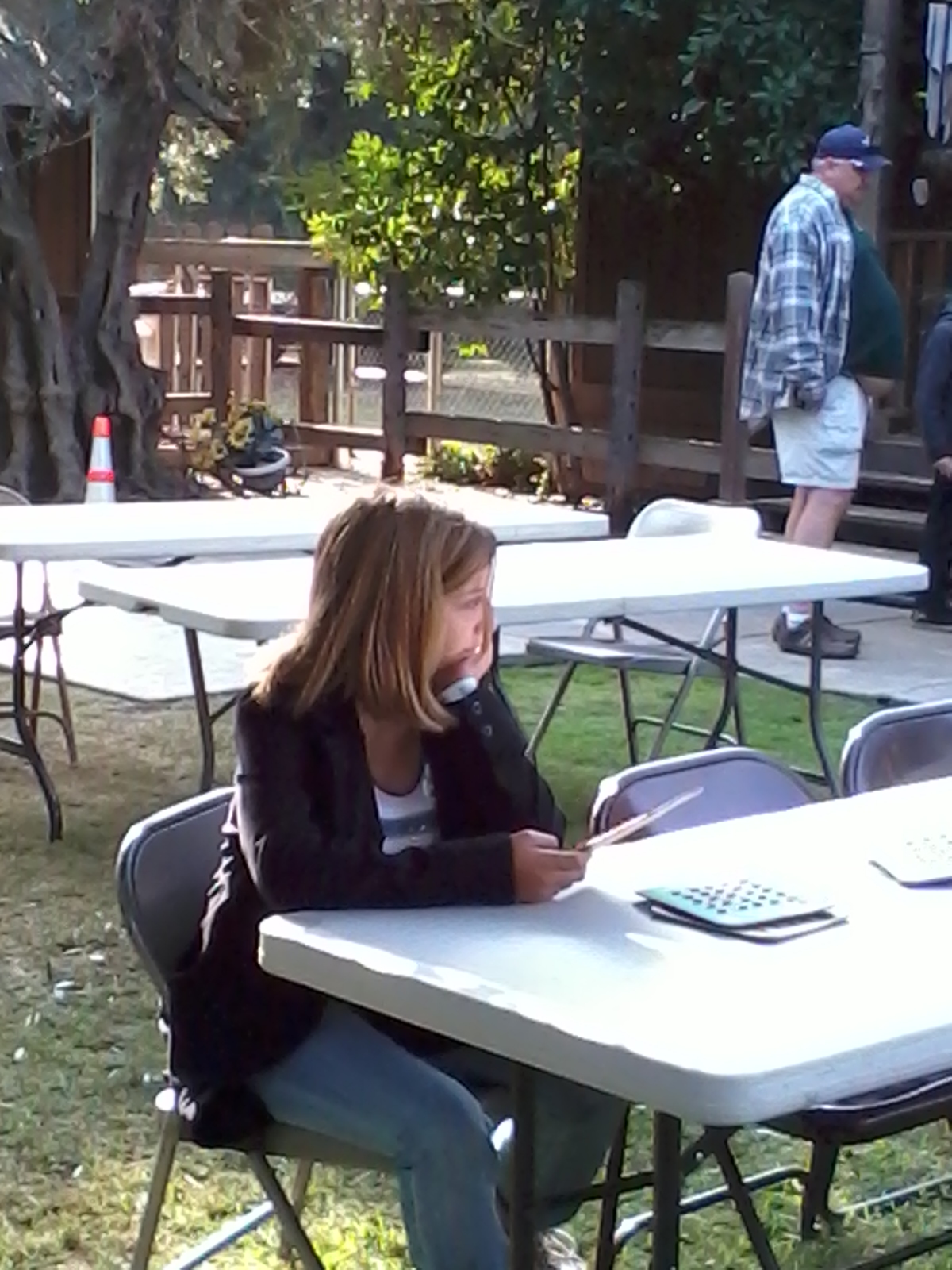
She sits thoughtfully at a charity event. She had at this point won 3 frozen turkeys. Seeing a family that had not won anything she gave them one of the birds and gave the other one to another family.
The image at the top is what happens when cyclists ride on the edge of a highway. This is our story on how we learned the easy way to stay safe.
When I first started out, I didn’t have a clue but now I know.
I know that the biggest problem with getting people to accept cycling as a viable means of transportation is not a lack of bike lanes. It is instead the human condition. What we lack is knowledge and critical thinking skills. This idea that you have to be “fearless” to ride a bicycle on certain roads is complete bunk. Knowledge of the laws and why we have said laws or rather the lack of such knowledge is far more crippling to cycling than the lack of bike lanes.
How can I be so sure?
Because I was faced with the choice of keeping my kids locked up and confined to a small town. A town which doesn’t have a single movie theater, museum, or anything remotely kid friendly for entertainment. A town that moved it’s one form of entertainment a.ka. the local library, and put it so far out of reach that we had to ride our bicycles through a high-speed road where dump trucks were accessing the entrance to the local rock quarry. A town where there isn’t a single bike lane and all roads are driven at 35 mph or greater regardless of signage. A town where a family of five burned up in a fiery high-speed crash and a pedestrian was mowed down while crossing her residential street to visit a neighbor.
My choice was to educate my children on how to safely group ride from one town to the next.
In the beginning they were nervous and my youngest said she was down right scared. I told her that if we decided it was too scary we would turn back and go home.
So we discuss our route. I explain where we are going to ride on the shoulder and I explain where we are not going to ride on the shoulder. I explain the different movements that vehicles make and discuss driving theory 101 with them.
We pretend to be people driving cars and one of us pretends to be on the edge as a cyclist. They get a first person experience in a closed environment and learn about why people drive the way they do and how we can prevent common mistakes.
We start out.
The first thing we do is turn onto the shoulder at the junction of Wichita lane and U.S. 27. Very quickly we approach that section where riding on the shoulder is no longer safe. Motorists go flying past us at full speed. 60 mph + onto the off ramp. We are not a part of traffic. We are irrelevant to them. We stop and wait and wait and wait and wait and wait and wait. It starts to get tense. Sitting still while cars go flying past you is very uncomfortable. There on the edge my daughters fear rises as motorists blindly fly by, her anxiety climbs. I’m feeling it too. As soon as it is clear, we dart across the on ramp and continue on the shoulder. Things go well. My daughter starts to feel better and before we know it we are now at the off ramp. This is the junction where U.S. 29 meets U.S. 27. It is important to note that these ramps are marked as 15 mph. However they are engineered in such a way that you can take them at full speed and take them at full speed the locals do.
We all stop in the center “no mans” land. It was the shoulder but now it is an island of doom. Cars are whizzing past us on both sides. The break comes sooner than last time and we make our way onto the road. This time we do something different. We ride the travel lane. The shoulder here is like all the other shoulders covered in rumble strips, broken glass, gravel, bits of metal shards and other garbage strewn across it. The travel lane is smooth and worry free.
As we bike down the high-speed road I ask my daughter how she feels. “This is a lot better than the shoulder” she says, I was surprised. Shocked really. I was sure that she would “feel safer” on the shoulder. My daughter explains: “When I was on the shoulder all these cars were just whizzing by us like weren’t even there. Once we were on the road it was like they saw us and a lot of people slowed down and passed us at slower speeds. I didn’t have to worry about someone running into us”.
We ride the travel lane over to Etter Dr. and after we make it through the intersection we move back to the shoulder at my request. Both kids were asking why we had to be on the shoulder. My son was saying “Come on mom. We can be in the travel lane. Let’s just move over.” I was determined to keep us on the shoulder and we kept on going. Right up until we came to Raising Cane’s. This is another section of road where the engineers designed a nice high-speed right turn. My fear is that someone will take that right turn at typical speed and plow right into us. So we waited and waited and waited and waited for traffic to clear. Then we carefully navigated the rumble strip and we rode the travel lane. Once again the anxiety that had been building in the kids quickly dissipated and even though we were honked at and screamed at by passing motorists. Everyone enjoyed their ride in the travel lane. People in cars noticed us. They slowed down to normal speeds and acknowledged us with honks and screams. We shook our heads at the sorry ass motorists and kept on biking.
We went through the intersection and just like before, we signaled and moved onto the shoulder. Same thing again. Ride the shoulder, anxiety increases, fear mounts, and then we come to an area that is no longer even remotely safe to be in so we move over to the travel lane and the anxiety decreases, the fear disappears and we are safer than we were before.
Motorists are anxious. They don’t like us to be in the travel lane. They honk at us. Scream at us. Call us idiots. But we are not idiots. We feel safe and carefree in the travel lane. It was after all built and engineered for traffic. The rules of the road are dictated by the lane. We are following the rules of the road and it feels good. My daughter laughs. My son shrugs his shoulders and rolls his eyes. Life is good.
As we wait at the light that intersects Business U.S. 27 from U.S. 27 I ask them if they want to move over to the shoulder after we get past the on ramp. They say “NO”. We are safer here in the lane they insist. I shrug and say o.k. but inside I am bursting with pride. My kids are smarter than Andy Clarke of L.A.B. infamy and Carl Overton of Lexington who at 30 something is afraid to ride his bicycle on anything other than 25 mph roads.
Cars drive past in the left lane. We ride on in the right lane. My kids are practically bouncing up and down on their respective seats. “This is fun!” my daughter screams at a motorist who aggressively honks as they pass us. They flip her the bird. She laughs and flips them the bird back. “Fuck them” she says. I chide her on her language. “They flipped me the bird first.” she says. We agree to let it go and continue our ride.
We make our first pit stop at Catnip Hill Road. We stop at the BP and get sodas. We talk about the route so far. We discuss how we felt on the shoulder as opposed to the travel lane. My kids are practically walking on air. They high-five each other and shout “We are riding the travel lane.” and off we go.
We take a left from Catnip Hill Road back onto U.S. 27 and this is where the safety of the travel lane is re-enforced into our mental psyche. As we are riding along a motorist comes flying out of a local strip mall shopping center and slams to a halt right on the shoulder. You can see from the tire marks on the pavement that this is normal motorist behavior. My son says “Good thing we weren’t on the shoulder”. My daughter says “Yea, they would have hit us for sure.” We ride on.
As we continue down U.S. 27 I point out the potholes, rumble strips, and broken pavement. They point out the rocks, gravel, and broken glass. We all agree that the travel lane is best.
We had a great time in Lexington and half the fun was traveling there. We rode back home without incident and on the way back my daughter said “I can’t believe I was afraid to ride my bike.”
Fear for fears sake
or
Fear of the unknown
Propaganda fueled rhetoric about making cycling safer isn’t helping anyone. So shut up and put up. If you can’t ride the ride then you have no place deciding what is or isn’t safe.

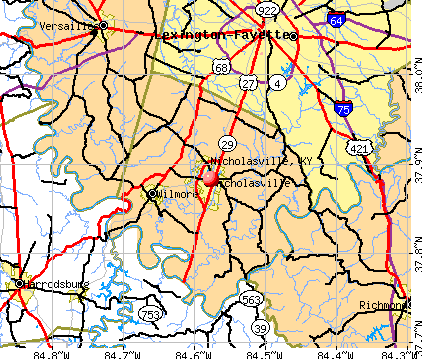
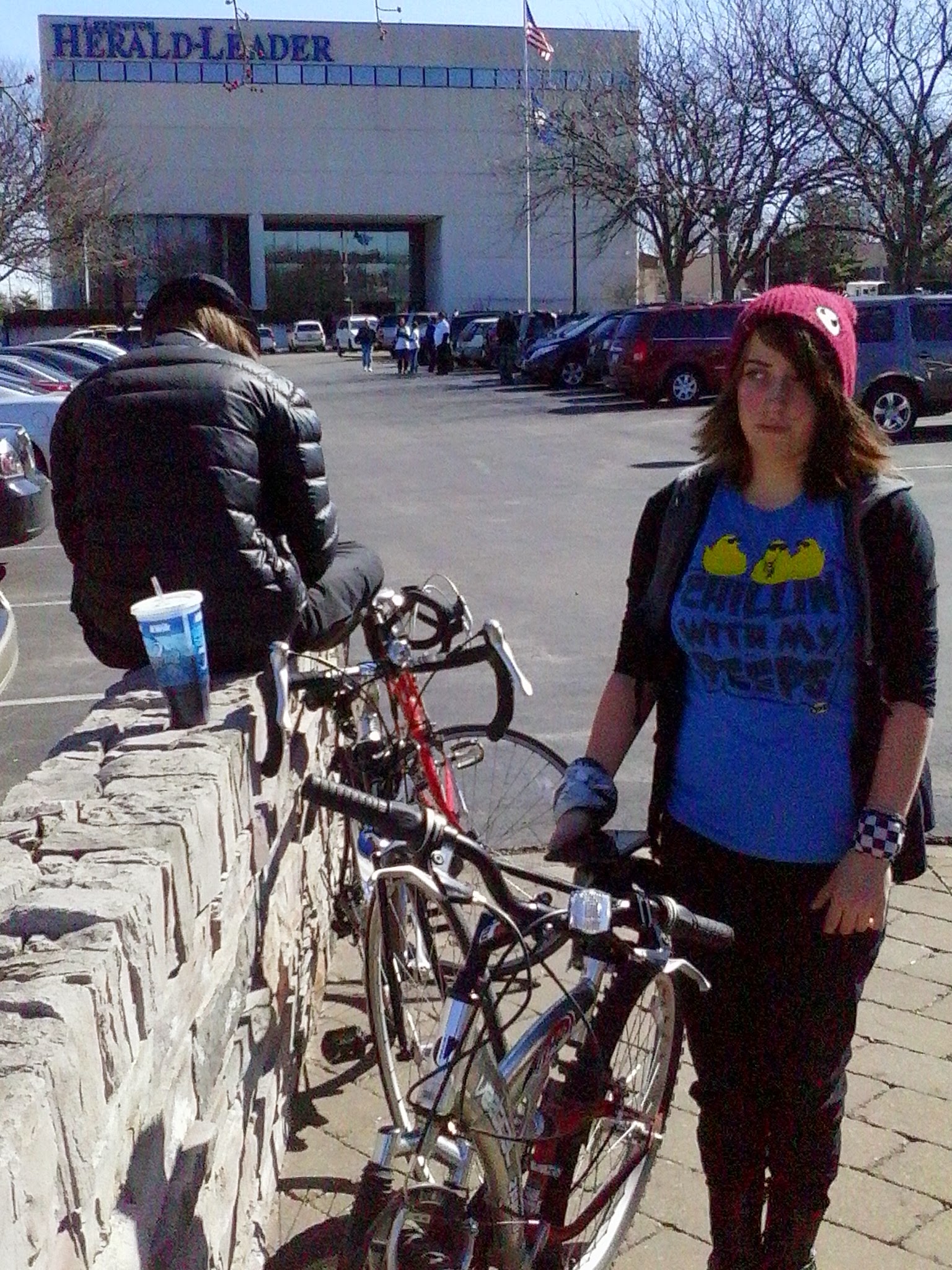
I am being prosecuted for Wanton Endangerment 2nd degree. My crime? Riding my bicycle on the travel lane.
Before you flip your lid, as some have done.
Please understand.
I did not start out operating in the travel lane. I used to have an old style Sun-EZ recumbent and I used the shoulder almost exclusively. Figuring out how to navigate the shoulder was no picnic. In some locations the shoulder was literally covered in a half an inch of debris. I used the travel lane only when necessary. I was afraid of the people operating their vehicles.
There was one incident where I was traveling home and I was trying to share an un-share-ble lane. The motorist who approached me from the rear almost hit me at an intersection. This was in Fayette Co. and there are not any shoulders at this intersection.
The motorist began to berate me and hurl verbal abuse at me.
I rode on and we met up at the next light where he continued to hurl abuse at me. I called the police.
Fayette Co. police officer took the report and advised me that I was not required to share the lane. He said the entire lane was mine. I didn’t not believe him but I wanted to see the law for that. He didn’t mention any specific law. So I kept riding the edge.
After I graduated to my first road bike. I found the shoulder very unsafe to navigate on two wheels. I used the travel lane more frequently. I went on my first club ride and realized that I was not in very good shape. I had lost a lot of weight at this point but I was still not in great shape.
So I spent a lot of time recovering from that ride.
I continued to use the shoulder, even when it was dangerous for me to do so. Every time I tried to use the travel lane a motorist would harass me.
I was very vocal with the police about the treatment I had been receiving. I often reached out to them for help. They often refused to help. I quit asking for help.
When things would get really hairy I would call them. Not much was done.
Motorists started chasing me down. Driving on the shoulder. Chasing me down, while driving on the shoulder.
It was nuts. I tried taking an alternate route home. That was worse. They could barely manage to share a 5 lane road. They sure as heck were not going to share a 2 lane road. All of them 55mph. Did you see that? All alternate routes are 55mph. The worst ones are two lanes. Zero shoulder. Gravel lined ditch on either side.
All with lanes that are not able to be shared. It was horrifying to watch them pass me with oncoming traffic. I was scared to death that someone would be killed. So I stuck to US 27.
To make a long story short. They started ticketing me for using US 27.
Ky state law is clear. I have not broken any state laws. Even Jessamine Co. recognizes how dangerous it is to operate on the edge. They have banned bicycles from sidewalks. I was told by a police officer that using the sidewalk is illegal in Jessamine Co.
Using the shoulder is illegal in the state of KY.
That is why they made an exception. The exception states that bicycles MAY use the shoulder. KY understands that the shoulder is not always the safest place to be.
Whether you agree with where I ride or not. You do agree that bicycles have a right to be on the road. Even the L.A.B. has said Bicycles have a fundamental right to the road.
I have an attorney. I have just enough for his retainer. I still need your help.
I know times are hard for a lot of folks. You don’t have to donate if you can’t. But please share this. Share it far and wide. Because someone who knows someone just might be able to help and the fact that you shared it with them is a huge help in and of itself.
Thank you!
http://www.gofundme.com/8uvfkw
 Cherokee Schill | Insurance Agent & AI Ethics Researcher