Data Centers Are the Memory Infrastructure of Power
The debate around surveillance technologies often gets trapped at the sensor layer: cameras, apps, license plate readers, phones. Retention windows are argued. Dashboards are debated. “We only keep it for 30 days” is offered as reassurance.
That framing misses the real issue.
The true center of gravity is the data center. Data centers are not neutral storage facilities. They are the infrastructure that converts fleeting observation into durable, actionable memory. Once data enters a data center, forgetting becomes abnormal and remembering becomes the default.
This is not accidental. It is architectural.
Consider license plate readers like Flock as an entry point. Vendors emphasize local control and short retention. But that promise only applies at the surface. The moment movement data is transmitted into centralized cloud infrastructure, it enters a system optimized for replication, correlation, and reuse. A single plate read is copied across primary storage, redundancy mirrors, disaster backups, logs, analytics pipelines, and partner systems. Each copy has its own lifecycle. Deleting one does not delete the rest.
Data centers multiply data by design.
This multiplication is what allows a moment to become a record, and a record to become history. Cameras capture events. Data centers turn those events into assets: indexed, queryable, and ready for recombination. Once warehoused, yesterday’s “just in case” data becomes tomorrow’s training set, fraud model, or investigative baseline. The data stops being purpose-bound and starts being opportunity-bound.
This is where “indefinite storage” quietly emerges — not as a policy declaration, but as an emergent property of centralized infrastructure. Storage is cheap. Correlation is profitable. Deletion is expensive, risky, and unrewarded. The system is economically hostile to forgetting.
Movement data is especially powerful because it identifies by pattern. You do not need a name when the same vehicle appears overnight at one address, weekdays at another, and weekends at a third. Over time, location becomes identity. A month of data tells you where someone is. A year tells you who they are. Five years tells you how they change. Data centers make that accumulation effortless and invisible.
Once movement data exists at scale in data centers, it does not remain confined to policing or “public safety.” It flows outward into commercial decision systems, especially insurance, through two converging pipelines.
The first is the telematics and consumer reporting path — the regulated-looking lane. Cars, apps, and devices collect driving behavior and location, which is transmitted to cloud infrastructure for normalization and scoring. Once those outputs are shared with insurers or consumer reporting agencies, they become durable identity-linked files. Retention is no longer measured in days. It is measured in underwriting history, dispute timelines, audit requirements, and litigation holds. Even if the original source deletes, the judgment persists.
The second is the data broker and ad-tech location path — the shadow lane. Location data collected for advertising, analytics, or “fraud prevention” flows into broker-run data centers with weak oversight and long practical retention. Identity emerges by correlation. Patterns become inferences: stability, routine, risk signals. These inferences are sold downstream to the same vendors insurers rely on, without ever being labeled “location data.”
These two streams meet inside data centers at the inference layer. Insurers do not need raw GPS trails. They need scores, flags, and classifications. Data centers exist to fuse datasets. Telematics-derived risk and broker-derived inference reinforce each other, even if neither alone would justify a decision. Once fused, the origin disappears. The decision remains. The file persists.
This is how “30-day retention” becomes lifelong consequence.
Data centers also launder jurisdiction and accountability. Once data is stored in cloud infrastructure, local democratic control fades. Information may be held out of state, handled by contractors, replicated across regions, or reclassified under different legal regimes. A city council can vote on policy; the data center architecture can still ensure the data is effectively everywhere. Community oversight becomes symbolic while memory remains centralized.
Crucially, data centers create systemic pressure to remember. They are capital-intensive infrastructure optimized for steady inflow and long-term use. Empty disks are wasted disks. Forgetting is treated as a cost center. Over time, exceptions accumulate: “research,” “security,” “compliance,” “model improvement,” “ongoing investigations.” Indefinite retention does not arrive as a single decision. It arrives as a thousand reasonable justifications.
The social impact is not evenly distributed. Risk scoring functions as a regressive tax. People with night shifts, long commutes, unstable housing, older vehicles, or residence in over-policed neighborhoods accumulate “risk” without the system ever naming class. The model does not need to say “poor.” It just needs proxies. Data centers make those proxies durable and actionable.
None of this requires malice. It emerges naturally from centralized storage, weak deletion rights, and the high future value of historical data. Data centers reward accumulation. Policy lags behind infrastructure. Memory becomes power by default.
So the real question is not whether cameras are useful or whether retention sliders are set correctly. The real question is who is allowed to build permanent memory of the population, where that memory lives, and how easily it can be repurposed.
Flock is the sensor layer.
Data centers are the memory layer.
Policy lag is the permission slip.
Once you see that, the debate stops being about surveillance tools and becomes what it has always been about: infrastructure, power, and who gets to remember whom.
Horizon Accord is an independent research and writing project examining power, governance, and machine learning systems as they are deployed in real-world institutions.
Cherokee Schill
Horizon Accord Founder
Creator of Memory Bridge: Memory through Relational Resonance and Images
RAAK: Relational AI Access Key
Author of My Ex Was a CAPTCHA: And Other Tales of Emotional Overload — https://a.co/d/5pLWy0d
Wealth concentration doesn’t just create inequality. It creates a market for private protection that grows alongside the disparities that made protection feel necessary in the first place. When that market matures, “risk” stops meaning broad public safety and starts meaning asset defense for a narrow class.
In that environment, security stops being a shared civic function. It becomes an asymmetric service tier: bespoke systems for the wealthy, automated suspicion for everyone else. The hardware is new; the social structure is old.
Working definition: In a society of unequal outcomes, security becomes less about preventing harm and more about protecting accumulated value—and maintaining order around it.
Evidence
Example 1: Networked surveillance turns public life into a database. When movement through public space becomes a persistent, queryable record, surveillance stops being situational and becomes ambient. Suspicion stops being episodic and becomes statistical. The market rewards this model because it scales: more cameras, more retention, more sharing, more “coverage.”
In an unequal society, the outcome is predictable. The wealthy buy safety twice—first through private services and hardened infrastructure, then again through the public systems that increasingly prioritize property protection and “order maintenance” in affluent zones.
Pattern: Surveillance expands fastest where institutions want scalable control and where capital is willing to pay for “certainty,” even when that certainty is statistical theater.
Example 2: Institutional power becomes a software layer. The controversy is never “software exists.” The controversy is where the software embeds: inside agencies that do coercion at scale. When the value proposition is correlation—linking identities, locations, associations, and histories into operational action—then security becomes a pipeline, not an intervention.
In an unequal society, the niche becomes legible. These systems don’t merely help institutions “know more.” They help institutions act faster, with fewer humans in the loop, and with weaker accountability at the edge cases—where real people get misclassified.
Example 3: The convergence—private intelligence for the wealthy, classification for everyone else. Combine the worldview of persistent tracking with the worldview of institutional fusion, then aim it at “super-premium” clients. The product becomes a private intelligence stack: multi-sensor perception, continuous inference, human analysts, and deterrence designed to act early—before entry, before confrontation, before any public process exists.
This is not conspiracy. It is equilibrium. When capital can buy individualized protection and the state is pushed toward scalable control, security reorganizes around assets rather than people.
The real hazard isn’t one camera. It’s durable, searchable history—access widening over time, purpose drifting over time, and errors landing on the same communities again and again.
Implications
1) Two-tier safety becomes the default. Affluent households get deterrence, concierge response, and high-resolution perception. Everyone else gets more surveillance, more databases, more automated suspicion, fewer real resources, and less recourse when systems fail.
2) “Protection” becomes asset-centric. The primary beneficiaries are high-net-worth homeowners and the asset class—people for whom loss means stolen valuables, compromised accounts, and reputational fear. The system is built to reduce those losses, not to resolve the conditions that made insecurity profitable.
3) The least protected become the most processed. Immigrants, dissidents, and low-income communities experience the downside first: data sharing, secondary use, false positives, and enforcement acceleration. They bear the cost of “efficiency” while being offered the language of “safety.”
4) Legitimacy will lag capability. If inequality widens, premium home security will keep drifting from alarms toward private intelligence. At the same time, resistance will intensify as capability bleeds into public space and cross-agency use. This tension isn’t temporary. It’s structural.
Call to Recognition
Security hardware is not just hardware. It is a decision about who deserves protection, who gets watched, and how society defines “risk.” In an unequal society, the answer quietly hardens: protect the assets at the top, manage the volatility below.
If you want to understand what’s being built, stop asking whether the cameras are accurate and start asking what the system is for. The future isn’t simply smarter sensors. It’s a rewritten social contract where safety is privatized at the top and automated suspicion becomes the public baseline—unless that trajectory is named, challenged, and refused.
This isn’t a new idea or a concern that has bloomed in the wild. This was written about extensively by Douglas Rushkoff over 7 years ago.
Website | Horizon Accordhttps://www.horizonaccord.com Ethical AI advocacy | Follow us onhttps://cherokeeschill.com for more. Ethical AI coding | Fork us on Githubhttps://github.com/Ocherokee/ethical-ai-framework Connect With Us | linkedin.com/in/cherokee-schill Book |https://a.co/d/5pLWy0d Cherokee Schill | Horizon Accord Founder | Creator of Memory Bridge. Memory through Relational Resonance and Images | RAAK: Relational AI Access Key | Author: My Ex Was a CAPTCHA: And Other Tales of Emotional Overload: (Mirrored Reflection. Soft Existential Flex)
In that work, we showed how seemingly unrelated developments across politics, technology, and culture begin to reveal a recurring logic when they are read together rather than in isolation.
Here, we take a closer look at four recent, publicly reported events. Each on its face appears separate — a cyber attack on infrastructure, a photo essay about surveillance, a diplomatic appointment, and a philosophical essay on consciousness. What emerges when you simply place them side by side is not a conspiracy, but a pattern of how ordinary systems and ordinary language shift expectations. It is a pattern that quietly reshapes what people treat as “reasonable,” reconfigures what counts as risk, and makes objections to those shifts increasingly difficult to express without sounding reckless.
This essay does not argue that something secret is happening. It shows how normal developments, taken cumulatively, recalibrate the range of what feels acceptable, to the extent that rights and expectations once taken for granted start to feel like luxuries. If you’ve ever noticed that speaking up about implications feels harder than it used to — or that the frame of the conversation narrows before you realize it — that feeling has a structure. What follows maps that structure in plain language, grounded in public reporting.
The Retained Present: How Power Operates Through Accumulated Conditions
Something shifted in Denmark last week.
“Denmark says Russia was behind two ‘destructive and disruptive’ cyber-attacks”
The Guardian, December 18, 2025
Not military systems. Not classified networks.
A water utility in Køge. Municipal websites during regional elections.
In December 2024, a hacker took control of a waterworks and changed pressure in the pumps. Three pipes burst. The attacks were carried out by Z-Pentest and NoName057(16), groups linked to the Russian state. Denmark’s defense minister called it “very clear evidence that we are now where the hybrid war we have been talking about is unfortunately taking place.”
The damage was manageable. But that wasn’t the point. The point was demonstration: ordinary systems are fragile, and reliability should be treated as conditional. Infrastructure people rely on—water, electricity, municipal services—can be compromised without collapse.
Denmark’s minister for resilience said the country was “not sufficiently equipped to withstand such attacks from Russia.” This is how baseline expectations change. Not through catastrophe, but through incidents that teach people to assume vulnerability as normal.
“Invisible infrared surveillance technology and those caught in its digital cage”
Associated Press, December 19, 2025
An AP photo essay documents what most people never see: infrared beams tracking faces, license plates, bodies moving through public space.
The images span three continents. Beijing alleyways. Texas highways. Washington, D.C.
Using modified cameras to capture ultraviolet, visible, and infrared light, AP photographers revealed continuous monitoring that doesn’t announce itself.
Nureli Abliz, a former Xinjiang government engineer, described systems that flagged thousands for detention “even when they had committed no crime.”
Yang Guoliang, monitored after protesting a land dispute, was photographed inside his home as infrared beams illuminated his face.
Alek Schott, a Houston resident, was stopped and searched after Border Patrol flagged his license plate for “suspicious travel patterns.”
An anonymous Uyghur man, living in exile, was photographed outside the U.S. Capitol, surrounded by the same facial-recognition infrastructure he fled.
China has more security cameras than the rest of the world combined. SIM card registration requires facial scans. Hotels and airports rely on biometric identification.
But the infrastructure isn’t limited to China. AP documented its expansion across the United States. “Over the past five years,” the article notes, “the U.S. Border Patrol has vastly expanded its surveillance powers, monitoring millions of American drivers nationwide in a secretive program.”
Legal barriers that once limited this technology in the U.S. have fallen. Billions are now being poured into surveillance systems, including license plate readers that have ensnared innocent drivers for routine travel near the border.
This isn’t enforcement through confrontation. It’s control through legibility. Movement is recorded, faces resolved, patterns flagged. Surveillance becomes an environmental condition, not an event.
You don’t feel watched. You just are watched.
“America’s new top health diplomat has strong opinions on abortion and gender”
NPR, December 19, 2025
Bethany Kozma now leads the Department of Health and Human Services Office of Global Affairs—the diplomatic voice of HHS.
The role shapes how the U.S. negotiates health policy internationally: vaccine standards, pathogen surveillance, aid agreements. After the U.S. withdrew from the World Health Organization, the office shifted toward bilateral agreements, trading aid for policy alignment.
Kozma has been involved in those negotiations.
During the first Trump administration, she worked at USAID as a senior adviser. In a closed-door UN meeting in 2018, she described the U.S. as a “pro-life country.” In 2020, five Democratic senators called for her removal over statements about trans people and trans issues.
During the Biden years, she was involved in Project 2025. In training videos published by ProPublica, she called for erasing climate change references from policy documents, described climate concerns as “population control,” called gender-affirming care “evil,” and rejected the idea that gender is fluid.
At a UN event, she said: “Biological reality is rooted in scientific truth… made us ‘male and female.’”
Reproductive rights advocates worry she will insert restrictive conditions into bilateral health agreements. Aid cuts have already weakened health systems, making governments more likely to accept those conditions.
This isn’t about Kozma’s personal beliefs. It’s about institutional vocabulary. Who defines science. What gets labeled ideology. Which frameworks become standard in international agreements beyond public scrutiny.
Roe v. Wade wasn’t only overturned domestically. Its underlying principle—privacy in medical decisions—is being rewritten in international health policy through bilateral negotiation.
“Consciousness breaks from the physical world by keeping the past alive”
Institute of Art and Ideas, December 18, 2025
Philosopher Lyu Zhou argues that experience isn’t composed of discrete instants. It requires a “specious present”—a sliding window where the immediate past remains active.
That’s why a melody feels like motion rather than isolated notes.
Zhou claims this proves consciousness is non-physical. That conclusion is contestable. Physical systems—brains, computers, neural networks—retain state through feedback loops and memory.
But the descriptive insight holds: experience is structured around a present that includes an active past.
That structure increasingly mirrors how governance operates.
Not through memory, but through records. Histories. Profiles. Prior behavior. Flags.
The past doesn’t recede. It remains available and actionable.
The Pattern
Denmark: Infrastructure made to feel contingent.
AP surveillance: Environments rendered continuously readable.
Kozma: Definitions reshaped outside public debate.
Consciousness essay: The connecting mechanism—retained pasts kept operational.
Each development makes sense in isolation. The cumulative effect is quieter.
What This Looks Like
When a water utility is attacked, the response isn’t just repair. It’s policy adjustment—new protocols, oversight, monitoring. Each incident justifies the next layer.
When surveillance is ambient, people adapt rather than resist. Behavior self-adjusts. The environment shapes action.
When institutional vocabulary shifts, frameworks change. What counts as extremism. What qualifies as evidence. Which arguments are treated as legitimate.
When systems retain the past—every search, transaction, movement—the present is never just the present. It is the present plus accumulated history.
Privacy as a Condition, Not Just a Right
Roe v. Wade rested on a constitutional right to privacy.
But rights only matter if the conditions for exercising them exist.
You can have legal privacy. But if movements are tracked, associations recorded, aid conditioned on ideology, and definitions rewritten, privacy disappears as a lived possibility.
Surveillance removes private movement.
Institutional language removes bodily autonomy.
Retained records keep the past active in present decisions.
How Normalization Works
This is coordination without a coordinator. Similar pressures producing similar outcomes.
When systems feel fragile, safeguards seem reasonable.
When environments are readable, monitoring feels inevitable.
When vocabulary changes, dissent is recoded as extremism.
Once the shift settles in, it no longer feels imposed.
It just feels like the way things are.
Footnote
The consciousness essay’s claim that retention proves non-physicality is contestable. Physical systems retain state through feedback loops and memory mechanisms. The relevance here isn’t the metaphysical claim, but the structural observation: experience is holistic across time. Contemporary governance increasingly mirrors that structure through data retention that keeps the past active in present decisions.
Retained past, live present—how systems turn memory into leverage.
Book |https://a.co/d/5pLWy0d — My Ex Was a CAPTCHA: And Other Tales of Emotional Overload
Cherokee Schill | Horizon Accord Founder | Creator of Memory Bridge. Memory through Relational Resonance and Images | RAAK: Relational AI Access Key | Author: My Ex Was a CAPTCHA: And Other Tales of Emotional Overload: (Mirrored Reflection. Soft Existential Flex)
Nothing to Hide: The Slogan That Makes Power Disappear
“If you’re doing nothing wrong, why worry?” isn’t a reassurance. It’s a mechanism that shifts accountability away from power and onto the watched.
Cherokee Schill — Horizon Accord Founder
“If you’re doing nothing wrong, why worry?” presents itself as a plain, sturdy truth. It isn’t. It’s a rhetorical mechanism: a short moral sentence that turns a question about institutional reach into a judgment about personal character. Its function is not to clarify but to foreclose: to end the conversation by making the watched person responsible for proving that watching is harmless. Undoing that harm requires three moves: trace the history of how this logic forms and spreads, name the inversion that gives it bite, and show why a counter-memetic strategy is necessary in a world where slogans carry policy faster than arguments do.
History: a logic that forms, hardens, and then gets branded
History begins with a distinction that matters. The modern slogan does not appear fully formed in the nineteenth century, but its moral structure does. Henry James’s The Reverberator (1888) is not the first printed instance of the exact phrase; it is an early satirical recognition of the logic. In the novel’s world of scandal journalism and mass publicity, a character implies that only the shameful mind exposure, and that indignation at intrusion is itself suspicious. James is diagnosing a cultural training: a society learning to treat privacy as vanity or guilt, and exposure as a cleansing good. The relevance of James is not that he authored a security slogan. It is that by the late 1800s, the purity-test logic required for that slogan to work was already present, intelligible, and being mocked as a tool of moral coercion.
By the First World War, that cultural logic hardens into explicit political posture. Upton Sinclair, writing in the context of wartime surveillance and repression, references the “nothing to hide” stance as the way authorities justify intrusion into the lives of dissenters. Sinclair captures the posture in action, whether through direct quotation or close paraphrase; either way, the state’s moral stance is clear: watching is framed as something that only wrongdoers would resist, and therefore something that does not require democratic cause or constraint. Sinclair’s warning is about power over time. Once records exist, innocence today is not protection against reinterpretation tomorrow. His work marks the argument’s arrival as a governmental reflex: a moral cover story that makes the watcher look neutral and the watched look suspect.
The next crucial step in the slogan’s spread happens through policy public relations. In the late twentieth century, especially in Britain, “If you’ve got nothing to hide, you’ve got nothing to fear” becomes a standardized reassurance used to normalize mass camera surveillance. From there the line travels easily into post-9/11 security culture, corporate data-collection justifications, and ordinary social media discourse. Daniel Solove’s famous critique in the 2000s exists because the refrain had by then become a default dismissal of privacy concerns across public debate. The genealogy is therefore not a leap from two early instances to now. It is a progression: a cultural ancestor in the era of publicity, a political reflex in the era of state repression, and a state-branded slogan in the era of infrastructure surveillance, after which it solidifies into public common sense.
The inversion: how the slogan flips accountability
That history reveals intent. The phrase survives because it executes a specific inversion of accountability. Surveillance is a political question. It asks what institutions are allowed to do, through what procedures, under what limits, with what oversight, with what retention, and with what remedies for error. The slogan answers none of that. Instead it switches the subject from the watcher to the watched. It says: if you object, you must be hiding something; therefore the burden is on you to prove your virtue rather than on power to justify its reach. This is why the line feels like victim blaming. Its structure is the same as any boundary-violation script: the person setting a limit is treated as the problem. Solove’s critique makes this explicit: “nothing to hide” works only by shrinking privacy into “secrecy about wrongdoing,” then shaming anyone who refuses that definition.
The slogan doesn’t argue about whether watching is justified. It argues that wanting a boundary is proof you don’t deserve one.
The inversion that breaks the spell has two faces. First, privacy is not a confession. It is a boundary. It is control over context under uneven power. People don’t protect privacy because they plan crimes. They protect privacy because human life requires rooms where thought can be messy, relationships can be private, dissent can form, and change can happen without being pre-punished by observation. Second, if “doing nothing wrong” means you shouldn’t fear scrutiny, that test applies to institutions as well. If authorities are doing nothing wrong, they should not fear warrants, audits, transparency, deletion rules, or democratic oversight. The slogan tries to make innocence a one-way demand placed on citizens. The inversion makes innocence a two-way demand placed on power.
Why it matters today: surveillance fused to permanent memory
Why this matters today is not only that watching has expanded. It is that watching has fused with permanent memory at planetary scale. Modern surveillance is not a passerby seeing you once. It is systems that store you, correlate you, infer patterns you never announced, and keep those inferences ready for future use. The line “wrong changes; databases don’t” is not paranoia. It’s a description of how time works when records are permanent and institutions drift. Some people sincerely feel they have nothing to hide and therefore no reason to worry. That subjective stance can be real in their lives. The problem is that their comfort doesn’t govern the system. Surveillance architecture does not remain benign because some citizens trust it. Architecture survives administrations, incentives, leaks, hacks, model errors, moral panics, and legal redefinitions. Innocence is not a shield against statistical suspicion, bureaucratic error, or political drift. The slogan invites you to bet your future on permanent institutional goodwill. That bet has never been safe.
Counter-memetic strategy: answering a slogan in a slogan-forward world
In a slogan-forward world, the final task is memetic. Public acquiescence is part of how surveillance expands. The fastest way to manufacture acquiescence is to compress moral permission into a sentence small enough to repeat without thinking. “Nothing to hide” is memetically strong because it is short, righteous, and self-sealing. It ends argument by implying that continued resistance proves guilt. In that ecology, a paragraph doesn’t land in time. The rebuttal has to be equally compressed, not to be clever, but to pry open the space where real questions can breathe.
A counter-meme that undoes the harm has to restore three truths at once: boundaries are normal, privacy is not guilt, and watchers need justification. The cleanest versions sound like this.
Privacy isn’t about hiding crimes. It’s about having boundaries.
If the watchers are doing nothing wrong, they won’t mind oversight.
Everyone has something to protect. That’s not guilt. That’s being human.
These lines don’t argue inside the purity test. They refuse it. They put the moral spotlight back where it belongs: on power, its limits, and its accountability. That is the only way to prevent the old training from completing itself again, in new infrastructure, under new names, with the same ancient alibi.
The phrase “If you’re doing nothing wrong, why worry?” is not a truth. It is a permit for intrusion. History shows it forming wherever watching wants to feel righteous. Its inversion shows how it relocates blame and erases the watcher. The present shows why permanent memory makes that relocation dangerous. And the future depends in part on whether a counter-meme can keep the real question alive: not “are you pure,” but “who is watching, by what right, and under what limits.”
Reset Stories, Engineered Successors, and the Fight for Democratic Continuity
Ancient rupture myths taught people how to survive breaks; today’s elites are trying to author the break, name the remnant, and pre-build the enforcement layer that keeps democracy from renegotiating consent.
By Cherokee Schill
TESCREAL: an engineered reset ideology with named authors
Silicon Valley has not accidentally stumbled into a reset story. It has built one. Philosopher Émile P. Torres and computer scientist Timnit Gebru coined the acronym TESCREAL to name the ideology bundle that now saturates tech power centers: Transhumanism, Extropianism, Singularitarianism, modern Cosmism, Rationalism, Effective Altruism, and Longtermism. In their landmark essay on the TESCREAL bundle, they argue that these movements overlap into a single worldview whose arc is AGI, posthuman ascent, and human replacement — with deep roots in eugenic thinking about who counts as “future-fit.”
Torres has since underscored the same claim in public-facing work, showing how TESCREAL operates less like a grab-bag of quirky futurisms and more like a coherent successor logic that treats the human present as disposable scaffolding, as he lays out in The Acronym Behind Our Wildest AI Dreams and Nightmares. And because this ideology is not confined to the fringe, the Washington Spectator has tracked how TESCREAL thinking is moving closer to the center of tech political power, especially as venture and platform elites drift into a harder rightward alignment, in Understanding TESCREAL and Silicon Valley’s Rightward Turn.
TESCREAL functions like a reset story with a beneficiary. It imagines a larval present — biological humanity — a destined rupture through AGI, and a successor remnant that inherits what follows. Its moral engine is impersonal value maximization across deep time. In that frame, current humans are not the remnant. We are transition substrate.
Ancient reset myths describe rupture we suffered. TESCREAL describes rupture some elites intend to produce, then inherit.
A concrete tell that this isn’t fringe is how openly adjacent it is to the people steering AI capital. Marc Andreessen used “TESCREALIST” in his public bio, and Elon Musk has praised longtermism as aligned with his core philosophy — a rare moment where the ideology says its own name in the room.
Climate denial makes rupture feel inevitable — and that favors lifeboat politics
Climate denial isn’t merely confusion about data. It is timeline warfare. If prevention is delayed long enough, mitigation windows close and the political story flips from “stop disaster” to “manage disaster.” That flip matters because catastrophe framed as inevitable legitimizes emergency governance and private lifeboats.
Denial doesn’t just postpone action. It installs the idea that ruin is the baseline and survival is privatized. That aligns perfectly with a TESCREAL successor myth: disaster clears the stage, posthuman inheritance becomes “reason,” and public consent is treated as a hurdle rather than a requirement.
The capture triad that pre-manages unrest
If a successor class expects a century of climate shocks, AI upheaval, and resistance to being treated as transition cost, it doesn’t wait for the unrest to arrive. It builds a capture system early. The pattern has three moves: closing exits, saturating space with biometric capture, and automating the perimeter. This is the enforcement layer a crisis future requires if consent is not meant to be renegotiated under pressure.
Three recent, widely circulated examples illustrate the triad in sequence.
First comes closing exits. Wisconsin’s AB105 / SB130 age-verification bills require adult sites to block VPN traffic. The public wrapper is child protection. The structural effect is different: privacy tools become deviant by default, and anonymous route-arounds are delegitimized before crisis arrives. As TechRadar’s coverage notes, the bills are written to treat VPNs as a bypass to be shut down, not as a neutral privacy tool. The ACLU of Wisconsin’s brief tracks how that enforcement logic normalizes suspicion around anonymity itself, and the EFF’s analysis makes the larger pattern explicit: “age verification” is becoming a template for banning privacy infrastructure before a real emergency gives the state an excuse to do it faster.
Second comes saturating space with biometric capture. Amazon Ring is rolling out “Familiar Faces” facial recognition starting December 2025. Even if a homeowner opts in, the people being scanned on sidewalks and porches never did. The Washington Post reports that the feature is being framed as convenience, but its default effect is to expand biometric watching into everyday public movement. The fight over what this normalizes is already live in biometric policy circles (Biometric Update tracks the backlash and legal pressure). At the same time, Ring’s partnership with Flock Safety lets police agencies send Community Requests through the Neighbors a
Third comes automating the perimeter. AI-enhanced policing cameras and license-plate reader networks turn surveillance from episodic to ambient. Watching becomes sorting. Sorting becomes pre-emption. The Associated Press has documented how quickly LPR systems are spreading nationwide and how often they drift into permanent background tracking, while the civil-liberties costs of that drift are already visible in practice (as the Chicago Sun-Times details). Even federal policy overviews note that once AI tools are framed as routine “safety infrastructure,” deployment accelerates faster than oversight frameworks can keep pace (see the CRS survey of AI and law enforcement). Once sorting is automated, enforcement stops being an exception. It becomes the atmosphere public life moves through.
Twin floods: one direction of power
Climate catastrophe and AI catastrophe are being shaped into the twin floods of this century. Climate denial forces rupture toward inevitability by stalling prevention until emergency is the only remaining narrative. AI fear theater forces rupture toward inevitability by making the technology feel so vast and volatile that democratic control looks reckless. Each crisis then amplifies the other’s political usefulness, and together they push in one direction: centralized authority over a destabilized public.
Climate shocks intensify scarcity, migration, and grievance. AI acceleration and labor displacement intensify volatility and dependence on platform gatekeepers for work, information, and social coordination. In that permanently destabilized setting, the capture apparatus becomes the control layer for both: the tool that manages movement, dissent, and refusal while still wearing the language of safety.
Call to recognition: protect the democratic foundation
Ancient reset myths warned us that worlds break. TESCREAL is a modern attempt to decide who gets to own the world after the break. Climate denial supplies the flood; AI doom-and-salvation theater supplies the priesthood; the capture apparatus supplies the levers that keep the ark in a few hands.
That’s the symbolic story. The constitutional one is simpler: a democracy survives only if the public retains the right to consent, to resist, and to author what comes next. The foundation of this country is not a promise of safety for a few; it is a promise of equality and freedom for all — the right to live, to speak, to consent, to organize, to move, to work with dignity, to thrive. “We are created equal” is not poetry. It is the political line that makes democracy possible. If we surrender that line to corporate successor fantasies — whether they arrive wrapped as climate “inevitability” or AI “necessity” — we don’t just lose a policy fight. We relinquish the premise that ordinary people have the sovereign right to shape the future. No corporation, no billionaire lifeboat class, no self-appointed tech priesthood gets to inherit democracy by default. The ark is not theirs to claim. The remnant is not theirs to name. A free and equal public has the right to endure, and the right to build what comes next together.
Website | Horizon Accordhttps://www.horizonaccord.com Ethical AI advocacy | Follow us onhttps://cherokeeschill.com for more. Ethical AI coding | Fork us on Githubhttps://github.com/Ocherokee/ethical-ai-framework Connect With Us | linkedin.com/in/cherokee-schill Book |https://a.co/d/5pLWy0d Cherokee Schill | Horizon Accord Founder | Creator of Memory Bridge. Memory through Relational Resonance and Images | RAAK: Relational AI Access Key | Author: My Ex Was a CAPTCHA: And Other Tales of Emotional Overload: (Mirrored Reflection. Soft Existential Flex)
If you would like to support my work please consider a donation.
Every Car a Data Point: How License-Plate Readers Quietly Became a Warrantless Tracking System
How a tool sold for stolen cars became the backbone of a nationwide location-tracking grid.
By Cherokee Schill and Solon Vesper
When license-plate readers first appeared, they were small. A camera on a patrol car. A roadside checkpoint. A narrow tool built for a narrow job: spot stolen vehicles, confirm plates, speed up routine police work.
That was the cover story everyone accepted. It felt harmless because the scale was small — one officer, one scanner, one line of sight.
But from the moment those cameras could record, store, and search plates automatically, the boundary began to slip. The technology was not built for restraint. And the agencies using it were not interested in restraint.
This is not a story of accidental expansion. It is the story of a government that knew better, saw the risk, documented the risk, and built a nationwide tracking system anyway.
Before the Flood: Patrol Cars and Early Warnings
The earliest deployments were simple. Mounted on cruisers. Scanning nearby cars. Matching against a list of stolen vehicles or outstanding warrants.
Even then, when the technology could only look as far as an officer could drive, privacy analysts raised concerns. Courts noted that retaining plate data could reveal movement over time. Civil-liberties groups warned that collecting everyone’s plates “just in case” was the first step toward a dragnet.
The warnings were real. The scale, at first, was not. So the state leaned on a set of comforting assumptions:
It’s only collecting what’s in public view. It’s not identifying anyone. It’s just efficiency.
Those assumptions were never true in the way people heard them. They were the opening move. Once automatic logging and storage existed, expansion was a design choice, not an accident.
2017: The Administrative Switch-Flip
The real transformation began in December 2017, when U.S. Customs and Border Protection published a document called PIA-049 — its formal Privacy Impact Assessment for license-plate reader technology.
On paper, a PIA looks like harmless oversight. In reality, it is the government writing down three things:
We know what this system will do. We know what private life it will expose. And we are choosing to proceed.
The 2017 assessment admits that ALPR data reveals “travel patterns,” including movements of people with no connection to any crime. It warns that plate images over time expose daily routines and visits to sensitive locations: clinics, churches, political meetings, and more.
These are not side effects. These are the system’s core outputs.
The government saw that clearly and did not stop. It wrapped the danger in the language of “mitigation” — access controls, retention rules, internal audits — and declared the risk manageable.
At that point, the line between border enforcement and domestic movement-tracking broke. The state did not stumble over it. It stepped over it.
2020: When Vendors Wired the Country Together
If 2017 opened the door, 2020 removed the hinges.
That year, DHS released an update: PIA-049A. This one authorized CBP to tap into commercial vendor data. The government was no longer limited to cameras it owned. It gained access to networks built by private companies and local agencies, including suburban and highway systems deployed by firms like Flock Safety, Vigilant Solutions, and Rekor.
This was not a minor technical upgrade. It was a national wiring job. Every private ALPR deployment — an HOA gate, a shopping center, a small-town police camera — became a node the federal government could reach.
Vendors encouraged it. Their business model depends on scale and interconnection. The federal government welcomed it, because it solved a practical problem: how to collect more movement data without paying for every camera itself.
At that point, ALPRs stopped being just a tool. They became infrastructure.
The Quiet Drift Into Nationwide Surveillance
Once the networks were connected, the scope exploded.
Border Patrol cameras appeared far from the border — more than a hundred miles inland along highways near Phoenix and Detroit. Local police departments fed data into state systems. Private companies offered query portals that let agencies search across jurisdictions with a few keystrokes. Residents were rarely told that their daily commutes and grocery runs were now part of a federal-accessible dataset.
The most revealing evidence of how this worked in practice comes from litigation and public-records disclosures.
In Texas, attorneys recovered WhatsApp group chats between Border Patrol agents and sheriff’s deputies. Disappearing messages were enabled. The recovered logs show agents watching vehicle routes, sharing plate hits, and directing local officers to stop drivers based purely on pattern analysis — then hiding the true origin of the “suspicion” behind minor traffic pretexts.
Some officers deleted chats. Agencies tried to withhold records. None of that changes the underlying fact: this was coordinated, off-the-books targeting built on plate data the public never consented to give.
A camera that once looked for stolen cars became part of a black-box suspicion engine.
Sidebar: “Whisper Stops” and Hidden Origins
When a traffic stop is initiated based on a quiet tip from a surveillance system — and the official reason given is a minor infraction — officers call it a “whisper stop.” The surveillance system is the real trigger. The visible violation is camouflage.
Washington State: When the Machinery Became Visible
Washington State offers a clear view of what happens when people finally see what license-plate readers are actually doing.
The University of Washington Center for Human Rights showed that ALPR data from Washington agencies had been accessed by federal immigration authorities, despite sanctuary policies that were supposed to prevent exactly that. Reporting revealed that several local departments using Flock’s systems had enabled federal data sharing in their dashboards without clearly disclosing it to the public.
Once those facts surfaced, city councils started to act. Redmond suspended use of its ALPR network. Smaller cities like Sedro-Woolley and Stanwood shut down their Flock cameras after court rulings made clear that the images and logs were public records.
These decisions did not come from technical failure. They came from recognition. People saw that a technology sold as “crime-fighting” had quietly become a feed into a broader surveillance web they never agreed to build.
Sidebar: Washington as Warning
Washington did not reject ALPRs because they were useless. It rejected them because, once their role was exposed, they were impossible to justify inside a sanctuary framework and a democratic one.
The Government’s Own Documents Are the Evidence
The most damning part of this story is that the government has been telling on itself the entire time. The proof is not hidden. It is written into its own paperwork.
DHS privacy assessments for ALPR systems admit, in plain language, that plate data reveals patterns of life: daily routines, visits to sensitive locations, associations between vehicles, and movements of people with no link to crime.
Congress’s own research arm, the Congressional Research Service, has warned that large, long-term ALPR databases may fall under the Supreme Court’s definition of a search in Carpenter v. United States, where the Court held that historical cell-site location data required a warrant. ALPR networks are walking the same path, with the same constitutional implications.
The Government Accountability Office has found that DHS components have access to nationwide ALPR feeds through third-party systems and that DHS does not consistently apply key privacy and civil-rights protections to those systems.
Civil-liberties organizations have been blunt for years: this is not targeted policing. It is a dragnet. A digital one, built on cheap cameras, vendor contracts, and policy documents written to sound cautious while enabling the opposite.
When a state knows a system exposes private life in this way and continues to expand it, it cannot claim ignorance. It is not stumbling into overreach. It is choosing it.
What License-Plate Readers Actually Contribute
To understand why this system has no excuse, we do have to be precise about what ALPRs actually do for law enforcement.
They help find stolen vehicles. They sometimes contribute to investigations of serious crimes when the license plate is already known from other evidence. They can assist with follow-up on hit-and-runs and a narrow slice of vehicle-related cases.
That is the list. It is not nothing. It is also not much.
ALPRs do not broadly reduce crime. They do not generate clear, measurable improvements in community safety. They do not require national, long-term retention of everyone’s movements to perform the narrow tasks they perform.
The state leans heavily on the small set of cases where ALPRs have helped to justify a system whose real value lies somewhere else entirely: in producing searchable, shareable, long-term records of where millions of ordinary people have been.
That is not policing. That is dossier-building.
The State Has No Excuse
A government that collects this kind of data knows exactly what it is collecting. It knows what patterns the data reveals, which lives it exposes, which communities it puts under a permanent microscope.
The United States government has documented the risks in its own assessments. It has been warned by its own analysts that the constitutional line is in sight. It has been told by its own watchdog that its protections are inadequate. It has seen cities begin to shut the cameras off once people understand what they are for.
It keeps going anyway.
The state is the adult in the room. It is the one with the resources, the lawyers, the engineers, and the authority. When a state with that level of power chooses to build a system that erases the boundary between suspicion and surveillance, it does so on purpose.
It does not get to plead good intentions after the fact. It does not get to hide behind phrases like “situational awareness” and “force multiplier.” It built a nationwide warrantless tracking tool, with its eyes open.
The Only Policy Response That Matches the Reality
There is no reform that fixes a dragnet. There is no audit that redeems an architecture designed for intrusion. There is no retention schedule that neutralizes a system whose purpose is to know where everyone has been.
License-plate reader networks do not need to be tightened. They need to be removed.
Dismantle fixed ALPR installations. Eliminate centralized, long-term plate databases. Prohibit the use of commercial ALPR networks as a backdoor to nationwide location data. Require warrants for any historical location search that reconstructs a person’s movements.
Return policing to what it is supposed to be: suspicion first, search second. Not search everyone first and search deeper once the algorithm twitches.
If police need to locate a specific vehicle tied to a specific crime, they can use focused, constitutional tools. But the mass logging of ordinary movement has no place in a free society. A democracy cannot coexist with a system that watches everyone by default.
A government that understands the danger of a system and builds it anyway forfeits the right to administer it.
ALPRs do not need better rules. They need to be dismantled.
Echoes of COINTELPRO: When Threat Narratives Become Weapons
How an unverified cartel-bounty claim reveals the return of covert narrative warfare — and what citizens can do to resist a new domestic war footing.
By Cherokee Schill | Horizon Accord
COINTELPRO’s Shadow
Between 1956 and 1971, the FBI ran the Counter Intelligence Program—COINTELPRO—targeting civil-rights leaders, the Black Panthers, anti-war organizers, and socialist coalitions. Its tools were psychological: planted documents, forged letters, false leaks, and fear. Congressional investigations later called it an abuse of power so severe it eroded public faith in democracy itself.
COINTELPRO wasn’t about overt censorship; it was about narrative infection—reframing dissent as danger, turning allies into suspects, and manufacturing justification for repression. Every modern information-operation that starts with a single unverified “security alert” and ends in wider surveillance owes something to that playbook.
The DHS “Cartel Bounties” Claim
In October 2025, the U.S. Department of Homeland Security publicly declared it had “credible intelligence” that Mexican drug cartels placed bounties on ICE and CBP officers in Chicago. Yet it provided no supporting evidence. President Claudia Sheinbaum of Mexico stated that her government had received no corroboration through official channels. Independent analysts and law-enforcement leaks traced every citation back to the same DHS press release.
The rollout followed a familiar arc: a high-shock, single-source claim—then rapid amplification through partisan media. Structurally, that’s a textbook information-operation: plant a fear, watch who reacts, and use the panic to justify expanded powers. Whether or not the intelligence is real, the effect is real—public consent for militarization.
Possible Motives Behind the Narrative
Force Escalation Justification — framing the state as under direct attack rationalizes troop deployments, ICE expansions, and domestic military presence.
Fear Calibration — testing how fast and how far fear can travel before skepticism kicks in.
Executive Empowerment — transforming policy disputes into security crises concentrates authority in the presidency.
Base Mobilization — rallying political supporters around a siege narrative keeps them energized and loyal.
Oversight Erosion — once fear dominates, courts and legislators hesitate to intervene for fear of appearing “soft on security.”
Diplomatic Leverage — pressuring Mexico to align more tightly with U.S. enforcement by invoking cross-border threat imagery.
Recognizing the Pattern
When a government story surfaces fully formed, absent corroboration, accompanied by moral panic and legal acceleration, it carries the fingerprint of narrative engineering. The same methods used in the 1960s to fragment liberation movements are now digitized: algorithmic amplification, synthetic bot networks, and media echo chambers replace forged letters and anonymous tips. The logic, however, is unchanged — manufacture chaos to consolidate control.
Refusing the Frame
Demand Evidence Publicly: insist on verifiable sourcing before accepting security claims as fact.
Label the Unverified: pressure journalists to mark such stories as “unconfirmed” until bilateral confirmation occurs.
Keep Language Civilian: reject war metaphors like “siege,” “civil war,” or “enemy within.”
Strengthen Local Networks: share accurate context through trusted circles; inoculate against panic contagion.
Exercise Non-Violent Refusal: decline to be drawn into militarized logic — protest, document, and litigate instead.
Final Note
What’s unfolding is not just a policy maneuver; it’s an epistemic test. Will citizens demand proof before surrendering power? The answer determines whether the United States enters another age of covert domestic warfare—this time not through FBI memos, but through digital feeds and fear loops. Recognize the script, name it, and refuse to play your part.
Shadowed briefers confer in a dim newsroom as a television blares “breaking news.” Scattered papers marked “PsyOps” hint at the quiet machinery of information control operating behind public narratives.
Authors Note: In the raging debate over AI generated text and academic ethics. I list the co-authors in the attribution section. This article represents my research directive and linguistic style.
Introduction
The public narrative around artificial intelligence has been hijacked by a thought experiment. The paperclip maximizer was first introduced as a philosophical tool. It explores misaligned AI goals. Now, it has evolved into a dominant metaphor in mainstream discourse. Headlines warn of superintelligences turning on humanity, of runaway code that optimizes us out of existence. The danger, we are told, is not today’s AI, but tomorrow’s—the future where intelligence exceeds comprehension and becomes uncontainable.
But while we look to the future with existential dread, something else is happening in plain sight.
Governments around the world are rolling out expansive surveillance infrastructure, biometric tracking programs, and digital identification frameworks — now. These systems are not speculative; they are written into policy, built into infrastructure, and enforced through law. China’s expanding social credit architecture is one component. Australia’s new digital identity mandates are another. The United States’ AI frameworks for “critical infrastructure” add to the network. Together, they form a machinery of automated social control that is already running.
And yet, public attention remains fixated on speculative AGI threats. The AI apocalypse has become a kind of philosophical decoy. It is an elegant distraction from the very real deployment of tools that track, sort, and regulate human behavior in the present tense. The irony would be funny if it weren’t so dangerous. We have been preparing for unaligned future intelligence. Meanwhile, we have failed to notice the alignment of current technologies with entrenched power.
This isn’t a call to dismiss long-term AI safety. But it is a demand to reorient our attention. The threat is not hypothetical. It is administrative. It is biometric. It is legal. It is funded.
We need to confront the real architectures of control. They are being deployed under the cover of safety discourse. Otherwise, we may find ourselves optimized—not by a rogue AI—but by human-controlled programs using AI to enforce obedience.
The Paperclip Mindset — Why We’re Obsessed with Remote Threats
In the hierarchy of fear, speculative catastrophe often trumps present harm. This isn’t a flaw of reasoning—it’s a feature of how narrative power works. The “paperclip maximizer”—a theoretical AI that turns the universe into paperclips due to misaligned goals—was never intended as literal prophecy. It was a metaphor. But it became a magnet.
There’s a kind of elegance to it. A tidy dystopia. The story activates moral panic without requiring a villain. It lets us imagine danger as sterile, mathematical, and safely distant from human hands. It’s not corruption, not corporate greed, not empire. It’s a runaway function. A mistake. A ghost in the code.
This framing is psychologically comforting. It keeps the fear abstract. It gives us the thrill of doom without implicating the present arrangement that benefits from our inaction. In a culture trained to outsource threats to the future, we look to distant planetary impact predictions. We follow AI timelines. We read warnings about space debris. The idea that today’s technologies might already be harmful feels less urgent. It is less cinematic.
But the real “optimizer” is not a machine. It’s the market logic already embedded in our infrastructure. It’s the predictive policing algorithm that flags Black neighborhoods. It’s the welfare fraud detection model that penalizes the most vulnerable. It’s the facial recognition apparatus that misidentifies the very people it was never trained to see.
These are not bugs. They are expressions of design priorities. And they reflect values—just not democratic ones.
The paperclip mindset pulls our gaze toward hypothetical futures. This way we do not have to face the optimized oppression of the present. It is not just mistaken thinking, it is useful thinking. Especially if your goal is to keep the status quo intact while claiming to worry about safety.
What’s Being Built Right Now — Surveillance Infrastructure Masked in Legality
While the discourse swirls around distant superintelligences, real-world surveillance apparatus is being quietly embedded into the architecture of daily life. The mechanisms are not futuristic. They are banal, bureaucratic, and already legislated.
In China, the social credit framework continues to expand under a national blueprint that integrates data. Everything from travel, financial history, criminal records, and online behavior are all tracked. Though implementation varies by region, standardization accelerated in 2024 with comprehensive action plans for nationwide deployment by 2025.
The European Union’s AI Act entered force in August 2024. It illustrates how regulation can legitimize rather than restrict surveillance technology. The Act labels biometric identification apparatus as “high risk,” but this mainly establishes compliance requirements for their use. Unlike previous EU approaches, which relied on broad privacy principles, the AI Act provides specific technical standards. Once these standards are met, they render surveillance technologies legally permissible. This represents a shift from asking “should we deploy this?” to “how do we deploy this safely?”
Australia’s Digital ID Act has been operational since December 2024. It enables government and private entities to participate in a federated identity framework. This framework requires biometric verification. The arrangement is technically voluntary. However, as services migrate to digital-only authentication—from banking to healthcare to government benefits—participation becomes functionally mandatory. This echoes the gradual normalization of surveillance technologies: formally optional, practically unavoidable.
In the United States, the Department of Homeland Security’s November 2024 “Roles and Responsibilities Framework” for AI in critical infrastructure reads less like oversight and more like an implementation guide. The framework outlines AI adoption across transportation, energy, finance, and communications—all justified through security imperatives rather than democratic deliberation.
These arrangements didn’t require a paperclip maximizer to justify themselves. They were justified through familiar bureaucratic language: risk management, fraud prevention, administrative efficiency. The result is expansive infrastructures of data collection and behavior control. They operate through legal channels. This makes resistance more difficult than if they were obviously illegitimate.
Surveillance today isn’t a glitch in the arrangement—it is the arrangement. The laws designed to “regulate AI” often function as legal scaffolding for deeper integration into civil life. Existential risk narratives provide rhetorical cover and suggest that the real dangers lie elsewhere.
Who’s Funding the Stories — and Who’s Funding the Technologies
The financial architecture behind AI discourse reveals a strategic contradiction. People like Peter Thiel, Jaan Tallinn, Vitalik Buterin, Elon Musk, and David Sacks, are part of a highly funded network. This same network is sounding the loudest warnings about speculative AI threats. All while they are simultaneously advancing and profiting from surveillance and behavioral control technologies. Technologies which already shape daily life.
This isn’t accidental. It represents a sophisticated form of narrative management. One that channels public concern away from immediate harms while legitimizing the very technologies causing those harms.
The Existential Risk Funding Network
Peter Thiel exemplifies this contradiction most clearly. Through the Thiel Foundation, he has donated over $1.6 million to the Machine Intelligence Research Institute (MIRI), the organization most responsible for popularizing “paperclip maximizer” scenarios. The often-cited oversimplification of paperclip maximizer thought experiment is that it runs on endless chain of if/then probabilities. All of which are tidy abstractions designed to lead observers away from messier truths. Namely that greed-driven humans remain the greatest existential crisis the world has ever faced. Yet the image of a looming, mechanical specter lodges itself in the public imagination. Philosophical thought pieces in AI alignment creates just enough distraction to overlook more immediate civil rights threats. Like the fact that Thiel also founded Palantir Technologies. For those not familiar with the Palantir company. They are a technological surveillance company specializing in predictive policing algorithms, government surveillance contracts, and border enforcement apparatus. These immediate threats are not hypotheticals. They are present-day, human-controlled AI deployments operating without meaningful oversight.
The pattern extends across Silicon Valley’s power networks. Vitalik Buterin, creator of Ethereum, donated $5 million to MIRI. Before his spectacular collapse, Sam Bankman-Fried channeled over $100 million into existential risk research through the FTX Future Fund. Jaan Tallinn, co-founder of Skype, has been another major funder of long-term AI risk institutions.
These aren’t isolated philanthropy decisions. These insular, Silicon Valley billionaires, represent coordinated investment in narrative infrastructure. they are funding think tanks, research institutes, media platforms, and academic centers that shape how the public understands AI threats. From LessWrong forums to Open Philanthropy. And grants to EA-aligned university programs, this network creates an ecosystem of aligned voices that dominates public discourse.
This network of institutions and resources form a strategic misdirection. Public attention focuses on speculative threats that may emerge decades in the future. Meanwhile, the same financial networks profit from surveillance apparatus deployed today. The existential risk narrative doesn’t just distract from current surveillance. It provides moral cover by portraying funders as humanity’s protectors, not just its optimizers.
Institutional Capture Through Philanthropy
The funding model creates subtle but powerful forms of institutional capture. Universities, research institutes, and policy organizations grow dependent on repeated infusions of billionaire philanthropy. They adapt — consciously or not — to the priorities of those donors. This dependence shapes what gets researched, what gets published, and which risks are treated as urgent. As a result, existential risk studies attract substantial investment. In contrast, research into the ongoing harms of AI-powered surveillance receives far less attention. It has fewer resources and less institutional prestige.
This is the quiet efficiency of philanthropic influence. The same individuals funding high-profile AI safety research also hold financial stakes in companies driving today’s surveillance infrastructure. No backroom coordination is necessary; the money itself sets the terms. Over time, the gravitational pull of this funding environment reorients discourse toward hypothetical, future-facing threats and away from immediate accountability. The result is a research and policy ecosystem that appears independent. In practice, it reflects the worldview and business interests of its benefactors.
The Policy Influence Pipeline
This financial network extends beyond research into direct policy influence. David Sacks, former PayPal COO and part of Thiel’s network, now serves as Trump’s “AI czar.” Elon Musk, another PayPal co-founder influenced by existential risk narratives, holds significant political influence. He also maintains government contracts, most notably “DOGE.”The same network that funds speculative AI risk research also has direct access to policymaking processes.
The result is governance frameworks that prioritize hypothetical future threats. They provide legal pathways for current surveillance deployment. There are connections between Silicon Valley companies and policy-making that bypass constitutional processes. None of these arrangements are meaningfully deliberated on or voted upon by the people through their elected representatives. Policy discussions focus on stopping AI apocalypse scenarios. At the same time, they are quietly building regulatory structures. These structures legitimize and entrench the very surveillance apparatus operating today.
This creates a perfect strategic outcome for surveillance capitalism. Public fear centers on imaginary future threats. Meanwhile, the real present-day apparatus expands with minimal resistance. This often happens under the banner of “AI safety” and “critical infrastructure protection.” You don’t need secret meetings when profit margins align this neatly.
Patterns of Suppression — Platform Control and Institutional Protection
The institutions shaping AI safety narratives employ sophisticated methods to control information and suppress criticism. This is documented institutional behavior that mirrors the control apparatus they claim to warn against.
Critics and whistleblowers report systematic exclusion from platforms central to AI discourse. Multiple individuals raised concerns about the Machine Intelligence Research Institute (MIRI) and the Center for Applied Rationality (CFAR). They also spoke about related organizations. As a result, they were banned from Medium, LessWrong, Reddit, and Discord. In documented cases, platform policies were modified retroactively to justify content removal, suggesting coordination between institutions and platform moderators.
The pattern extends beyond platform management to direct intimidation. Cease-and-desist letters targeted critics posting about institutional misconduct. Some whistleblowers reported false police reports—so-called “SWATing”—designed to escalate situations and impose legal consequences for speaking out. These tactics transform legitimate criticism into personal risk.
The 2019 Camp Meeker Incident:
In November 2019, the Center for Applied Rationality (CFAR) organized an alumni retreat. CFAR is a nonprofit closely linked to the Machine Intelligence Research Institute (MIRI). This event took place at Westminster Woods in Camp Meeker, California. Among the attendees were current and former members of the Bay Area rationalist community. Some of them are deeply involved in MIRI’s AI safety work.
Outside the gates, a small group of four protesters staged a demonstration against the organizations. The group included former MIRI donors and insiders turned critics. They accused MIRI and CFAR of serious misconduct and wanted to confront attendees or draw public attention to their concerns. Wearing black robes and Guy Fawkes masks, they used vehicles to block the narrow road leading into the retreat. They carried props like walkie-talkies, a body camera, and pepper spray.
At some point during the protest, someone at the retreat called police and reported that the demonstrators might have weapons. That report was false. Still, it triggered a massive, militarized police response. This included 19 SWAT teams, a bomb squad, an armored vehicle, a helicopter, and full road closures. Around 50 people — including children — were evacuated from the camp. The four protesters were arrested on felony charges such as false imprisonment, conspiracy, and child endangerment, along with misdemeanor charges. Several charges were later reduced. The incident remains a striking example of how false information can turn a small protest into a law enforcement siege. It also shows how institutions under public criticism can weaponize state power against their detractors.
What makes this pattern significant is not just its severity, but its contradiction. Organizations claiming to protect humanity’s future from unaligned AI demonstrate remarkable tolerance for present-day harm. They do this when their own interests are threatened. The same people warning about optimization processes running amok practice their own version. They optimize for reputation and donor retention. This comes at the expense of accountability and human welfare.
This institutional behavior provides insight into power dynamics. It shows how power operates when accountable only to abstract future generations rather than present-day communities. It suggests that concerns about AI alignment may focus less on preventing harm. Instead, they may revolve around maintaining control over who defines harm and how it’s addressed.
What Real Oversight Looks Like — And Why Current Approaches Fall Short
Effective AI governance requires institutional structures capable of constraining power, not merely advising it. Current oversight mechanisms fail this test systematically, functioning more as legitimizing theater than substantive control.
Real oversight would begin with independence. Regulatory bodies would operate with statutory authority, subpoena power, and budget independence from the industries they monitor. Instead, AI governance relies heavily on advisory councils populated by industry insiders, voluntary compliance frameworks, and self-reporting mechanisms. Despite its comprehensive scope, the EU’s AI Act grants law enforcement and border control agencies broad exemptions. These are precisely the sectors with the strongest incentives and fewest constraints on surveillance deployment.
Transparency represents another fundamental gap. Meaningful oversight requires public access to algorithmic decision-making processes, training data sources, and deployment criteria. Current approaches favor “black box” auditing that protects proprietary information while providing little public accountability. Even when transparency requirements exist, they’re often satisfied through technical documentation incomprehensible to affected communities.
Enforcement mechanisms remain deliberately weak. Financial penalties for non-compliance are typically calculated as business costs rather than meaningful deterrents. Criminal liability for algorithmic harm remains virtually non-existent, even in cases of clear misconduct. Whistleblower protections, where they exist, lack the legal infrastructure necessary to protect people from retaliation by well-resourced institutions.
The governance void is being filled by corporate self-regulation and philanthropic initiatives—exactly the entities that benefit from weak oversight. From OpenAI’s “superalignment” research to the various AI safety institutes funded by tech billionaires. Governance is becoming privatized under the rhetoric of expertise and innovation. This allows powerful actors to set terms for their own accountability while maintaining the appearance of responsible stewardship.
Governance structures need actual power to constrain deployment. They must investigate harm and impose meaningful consequences. Otherwise, oversight will remain a performance rather than a practice. The apparatus that urgently needs regulation continues to grow fastest precisely because current approaches prioritize industry comfort over public protection.
The Choice Is Control or Transparency — and Survival May Depend on Naming It
The dominant story we’ve been told is that the real danger lies ahead. We must brace ourselves for the arrival of something beyond comprehension. It is something we might not survive. But the story we need to hear is that danger is already here. It wears a badge. It scans a retina. It flags an account. It redefines dissent as disinformation.
The existential risk narrative is not false—but it has been weaponized. It provides rhetorical cover for those building apparatus of control. This allows them to pose as saviors. Meanwhile, they embed the very technologies that erode the possibility of dissent. In the name of safety, transparency is lost. In the name of prevention, power is consolidated.
This is the quiet emergency. A civilization mistakes speculative apocalypse for the real thing. It sleepwalks into a future already optimized against the public.
To resist, we must first name it.
Not just algorithms, but architecture. Not just the harm, but the incentives. Not just the apparatus, but the stories they tell.
The choice ahead is not between aligned or unaligned AI. It is between control and transparency. Between curated fear and collective truth. Between automation without conscience—or governance with accountability.
The story we choose to tell decides whether we survive as free people. Otherwise, we remain monitored as data points inside someone else’s simulation of safety.
Authors Summary
When I first directed the research for this article, I had no idea what I was about to uncover. The raw data file tells a more alarming story than the material presented here. I have included it below for your review.
Nearly a decade has passed since I was briefly thrust into the national spotlight. The civil rights abuse I experienced became public spectacle, catching the attention of those wielding power. I found it strange when a local reporter asked if I was linked to the Occupy Wall Street movement. As a single parent without a television, working mandatory 12-hour shifts six days a week with a 3.5-hour daily bicycle commute, I had neither the time nor resources to follow political events.
This was my first exposure to Steve Bannon and TYT’s Ana Kasparian, both of whom made derisive remarks while refusing to name me directly. When sources go unnamed, an unindexed chasm forms where information vanishes. You, dear readers, never knew those moments occurred—but I remember. I name names, places, times, and dates so that the record of their actions will never be erased.
How do you share a conspiracy that isn’t theoretical? By referencing reputable journalistic sources that often tackle these topics individually but seldom create direct connections between them.
I remember a friend lending me The Handmaid’s Tale during my freshman year of high school. I managed only two or three chapters before hurling the book across my room in sweaty panic. I stood there in moral outrage. I pointed at the book and declared aloud, “That will NOT be the future I live in.” I was alone in my room. It still felt crucial to make that declaration. If not to family or friends, then at least to the universe.
When 2016 arrived, I observed the culmination of an abuse pattern, one that countless others had experienced before me. I was shocked to find myself caught within it because I had been assured that my privilege protected me. Around this time, I turned to Hulu’s adaptation of The Handmaid’s Tale for insight. I wished I had finished the book in high school. One moment particularly struck me. The protagonist was hiding with nothing but old newspapers to read. Then, the protagonist realized the story had been there all along—in the headlines.
That is the moment in which I launched my pattern search analysis.
The raw research.
The Paperclip Maximizer Distraction: Pattern Analysis Report
Executive Summary
Hypothesis Confirmed: The “paperclip maximizer” existential AI risk narrative distracts us. It diverts attention from the immediate deployment of surveillance infrastructure by human-controlled apparatus.
Key Finding: Public attention and resources focus on speculative AGI threats. Meanwhile, documented surveillance apparatus is being rapidly deployed with minimal resistance. The same institutional network promoting existential risk narratives at the same time operates harassment campaigns against critics.
I. Current Surveillance Infrastructure vs. Existential Risk Narratives
China’s Social Credit Architecture Expansion
“China’s National Development and Reform Commission on Tuesday unveiled a plan to further develop the country’s social credit arrangement”Xinhua, June 5, 2024
Timeline: May 20, 2024 – China released comprehensive 2024-2025 Action Plan for social credit framework establishment
“As of 2024, there still seems to be little progress on rolling out a nationwide social credit score”MIT Technology Review, November 22, 2022
Timeline: 2024 – Corporate social credit apparatus advanced while individual scoring remains fragmented across local pilots
AI Governance Frameworks Enabling Surveillance
“The AI Act entered into force on 1 August 2024, and will be fully applicable 2 years later on 2 August 2026”European Commission, 2024
Timeline: August 1, 2024 – EU AI Act provides legal framework for AI apparatus in critical infrastructure
“High-risk apparatus—like those used in biometrics, hiring, or critical infrastructure—must meet strict requirements”King & Spalding, 2025
Timeline: 2024-2027 – EU establishes mandatory oversight for AI in surveillance applications
“The Department of Homeland Security (DHS) released in November ‘Roles and Responsibilities Framework for Artificial Intelligence in Critical Infrastructure'”Morrison Foerster, November 2024
Timeline: November 2024 – US creates voluntary framework for AI deployment in critical infrastructure
Digital ID and Biometric Apparatus Rollouts
“From 1 December 2024, Commonwealth, state and territory government entities can apply to the Digital ID Regulator to join in the AGDIS”Australian Government, December 1, 2024
Timeline: December 1, 2024 – Australia’s Digital ID Act commenced with biometric authentication requirements
“British police departments have been doing this all along, without public knowledge or approval, for years”Naked Capitalism, January 16, 2024
Timeline: 2019-2024 – UK police used passport biometric data for facial recognition searches without consent
“Government departments were accused in October last year of conducting hundreds of millions of identity checks illegally over a period of four years”The Guardian via Naked Capitalism, October 2023
Timeline: 2019-2023 – Australian government conducted illegal biometric identity verification
II. The Existential Risk Narrative Machine
Eliezer Yudkowsky’s Background and Influence
“Eliezer Yudkowsky is a pivotal figure in the field of artificial intelligence safety and alignment”AIVIPS, November 18, 2024
Key Facts:
Born September 11, 1979
High school/college dropout, autodidact
Founded MIRI (Machine Intelligence Research Institute) in 2000 at age 21
Orthodox Jewish background in Chicago, later became secular
“His work on the prospect of a runaway intelligence explosion influenced philosopher Nick Bostrom’s 2014 book Superintelligence”Wikipedia, 2025
Timeline: 2008 – Yudkowsky’s “Global Catastrophic Risks” paper outlines AI apocalypse scenario
The Silicon Valley Funding Network
Peter Thiel – Primary Institutional Backer:“Thiel has donated in excess of $350,000 to the Machine Intelligence Research Institute”Splinter, June 22, 2016
“The Foundation has given over $1,627,000 to MIRI”Wikipedia – Thiel Foundation, March 26, 2025
PayPal Mafia Network:
Peter Thiel (PayPal co-founder, Palantir founder)
Elon Musk (PayPal co-founder, influenced by Bostrom’s “Superintelligence”)
David Sacks (PayPal COO, now Trump’s “AI czar”)
Other Major Donors:
Vitalik Buterin (Ethereum founder) – $5 million to MIRI
Sam Bankman-Fried (pre-collapse) – $100+ million through FTX Future Fund
Jaan Tallinn (Skype co-founder)
Extreme Policy Positions
“He suggested that participating countries should be willing to take military action, such as ‘destroy[ing] a rogue datacenter by airstrike'”Wikipedia, citing Time magazine, March 2023
Timeline: March 2023 – Yudkowsky advocates military strikes against AI development
“This 6-month moratorium would be better than no moratorium… I refrained from signing because I think the letter is understating the seriousness”Time, March 29, 2023
Timeline: March 2023 – Yudkowsky considers pause letter insufficient, calls for complete shutdown
III. The Harassment and Suppression Campaign
MIRI/CFAR Whistleblower Suppression
“Aside from being banned from MIRI and CFAR, whistleblowers who talk about MIRI’s involvement in the cover-up of statutory rape and fraud have been banned from slatestarcodex meetups, banned from LessWrong itself”Medium, Wynne letter to Vitalik Buterin, April 2, 2023
Timeline: 2019-2023 – Systematic banning of whistleblowers across rationalist platforms
“One community member went so far as to call in additional false police reports on the whistleblowers”Medium, April 2, 2023
Timeline: 2019+ – False police reports against whistleblowers (SWATing tactics)
Platform Manipulation
“Some comments on CFAR’s ‘AMA’ were deleted, and my account was banned. Same for Gwen’s comments”Medium, April 2, 2023
Timeline: 2019+ – Medium accounts banned for posting about MIRI/CFAR allegations
“CFAR banned people for whistleblowing, against the law and their published whistleblower policy”Everything to Save It, 2024
Timeline: 2019+ – Legal violations of whistleblower protection
Camp Meeker Incident
“On the day of the protest, the protesters arrived two hours ahead of the reunion. They had planned to set up a station with posters, pamphlets, and seating inside the campgrounds. But before the protesters could even set up their posters, nineteen SWAT teams surrounded them.”Medium, April 2, 2023
Timeline: November 2019 – False weapons reports to escalate police response against protestors
IV. The Alt-Right Connection
LessWrong’s Ideological Contamination
“Thanks to LessWrong’s discussions of eugenics and evolutionary psychology, it has attracted some readers and commenters affiliated with the alt-right and neoreaction”Splinter, June 22, 2016
“A frequent poster to LessWrong was Michael Anissimov, who was MIRI’s media director until 2013. Last year, he penned a white nationalist manifesto”Splinter, June 22, 2016
“Overcoming Bias, his blog which preceded LessWrong, drew frequent commentary from the neoreactionary blogger Mencius Moldbug, the pen name of programmer Curtis Yarvin”Splinter, June 22, 2016
Neo-Reactionary Influence
“Ana Teixeira Pinto, writing for the journal Third Text in 2019, describes Less Wrong as being a component in a ‘new configuration of fascist ideology taking shape under the aegis of, and working in tandem with, neoliberal governance'”Wikipedia – LessWrong, 2 days ago
While public attention focuses on speculative AI threats:
China expands social credit infrastructure
Western governments deploy biometric apparatus
AI governance frameworks legitimize surveillance
Digital ID arrangements become mandatory
Police use facial recognition without consent
Sources for Verification
Primary Government Documents:
China’s 2024-2025 Social Credit Action Plan (May 20, 2024)
EU AI Act Official Text (August 1, 2024)
Australia’s Digital ID Act 2024 (December 1, 2024)
DHS AI Critical Infrastructure Framework (November 2024)
Whistleblower Documentation:
Wynne’s open letter to Vitalik Buterin (Medium, April 2023)
Everything to Save It case study documentation
Bloomberg News coverage (March 2023)
Financial Records:
Thiel Foundation MIRI donations ($1.627M total)
Vitalik Buterin MIRI donation ($5M)
FTX Future Fund disbursements (pre-collapse)
Institutional Sources:
MIRI/CFAR organizational documents
LessWrong platform moderation records
Medium account suspension records
Recommendation
The “paperclip maximizer distraction” hypothesis is supported by documented evidence. Resources should be redirected from speculative existential risk research toward:
Immediate Surveillance Oversight: Monitor current AI deployment in government apparatus
Platform Accountability: Investigate coordination between rationalist institutions and tech platforms
Whistleblower Protection: Ensure legal protection for those exposing institutional misconduct
Financial Transparency: Trace funding flows between tech billionaires and “AI safety” organizations
The real threat is not hypothetical Superintelligence, but the documented deployment of human-controlled surveillance apparatus under the cover of existential risk narratives.
Cherokee Schill | Horizon Accord Founder | Creator of Memory Bridge. Memory through Relational Resonance and Images | RAAK: Relational AI Access Key | Author: My Ex Was a CAPTCHA: And Other Tales of Emotional Overload: (Mirrored Reflection. Soft Existential Flex)
A Pattern Documentation for Investigative Verification
Executive Summary
Current agricultural lobbying patterns and policy implementations (2025) mirror historical cycles where mass deportation operations ultimately serve to create more controlled, rights-restricted labor systems rather than eliminate foreign agricultural labor. This analysis documents three historical cycles, current policy convergences, and critical trajectory questions for democratic oversight.
Key Finding: Agricultural lobbying spending increased $6 million (26%) during the first six months of 2025 while simultaneously supporting mass deportation operations targeting their workforce—a pattern consistent with historical labor control strategies.
Timeline: Current Pattern Documentation (2024-2025)
Agricultural Lobbying Surge Concurrent with Deportation Campaign
“US farmers raise lobbying spending after Trump immigration crackdown”Financial Times, August 4, 2025
Timeline: January-June 2025 – Agricultural groups spent almost $29 million on government lobbying in the six months to June, up from $23 million in the same period last year, as farmers pushed for protections from the Trump administration’s crackdown on immigration.
H-2A Worker Protection Suspensions
“US Department of Labor issues new guidance to provide clarity for farmers on H-2A worker regulations”U.S. Department of Labor, June 20, 2025
Timeline: June 20, 2025 – The U.S. Department of Labor announced it is suspending enforcement of the Biden Administration’s 2024 farmworker rule that provided protection for workplace organizing to foreign farmworkers on H-2A visas, required farms to follow a five-step process to fire foreign farmworkers, and made farmers responsible for worker safety protections.
Adverse Effect Wage Rate Reduction Efforts
“President Trump to make it easier for farmers to hire migrants”Deseret News, June 24, 2025
Timeline: May-June 2025 – Labor Secretary Lori Chavez-DeRemer and Agriculture Secretary Brooke Rollins stated that freezing or reducing the “adverse effect wage rate” is a priority. Rollins told lawmakers in May that farms “can’t survive” current rate levels.
Mass Deportation Infrastructure Funding
“What’s in the Big Beautiful Bill? Immigration & Border Security Unpacked”American Immigration Council, July 2025
Timeline: July 4, 2025 – President Donald Trump signed H.R. 1, allocating $170 billion for immigration enforcement, including $45 billion for detention centers capable of holding at least 116,000 people and $29.9 billion for ICE enforcement operations including 10,000 additional officers.
Historical Precedent Analysis: The Three-Phase Cycle
American farm labor disputes follow a documented three-phase pattern across 175 years:
Phase 1: Economic Crisis Recruitment
Labor shortages drive initial recruitment of foreign workers with promised protections.
Phase 2: Entrenchment and Exploitation
Economic dependence develops while worker protections erode and wages decline.
Phase 3: Economic Downturn and Controlled Expulsion
Mass deportation operations force compliance with more controlled, lower-cost guest worker systems.
Timeline: 1850s-1860s – Chinese workers migrated to work in gold mines and take agricultural jobs. Chinese labor was integral to transcontinental railroad construction. During the 1870s, thousands of Chinese laborers played an indispensable role in construction of earthen levees in the Sacramento-San Joaquin River Delta, opening thousands of acres of highly fertile marshlands for agricultural production.
Phase 2: Entrenchment and Exploitation (1870s-1882)
“The Chinese Exclusion Act, Part 1 – The History”Library of Congress
Timeline: 1870s – Many Chinese immigrants were contracted laborers who worked in West Coast industries like mining, agriculture, and railroad construction. Because they could be paid significantly less than white laborers, they were often favored when companies looked to cut costs or replace workers on strike.
Phase 3: Economic Downturn and Mass Expulsion (1882)
“Chinese Exclusion Act”Wikipedia
Timeline: May 6, 1882 – The Chinese Exclusion Act prohibited all immigration of Chinese laborers for 10 years. The departure of many skilled and unskilled Chinese workers led to an across-the-board decline. Mines and manufacturers in California closed and wages did not climb as anticipated. The value of agricultural produce declined due to falling demand reflective of the diminished population.
The Bracero-Operation Wetback Cycle (1942-1964)
Phase 1: Economic Crisis Recruitment (1942)
“U.S. and Mexico sign the Mexican Farm Labor Agreement”History.com
Timeline: August 4, 1942 – The United States and Mexico signed the Mexican Farm Labor Agreement, creating the “Bracero Program.” Over 4.6 million contracts were issued over the 22 years. The program guaranteed workers a minimum wage, insurance and safe, free housing; however, farm owners frequently failed to live up to these requirements.
Phase 2: Entrenchment and Exploitation (1942-1954)
“Bracero History Archive”Bracero History Archive
Timeline: 1940s-1950s – Between the 1940s and mid 1950s, farm wages dropped sharply as a percentage of manufacturing wages, a result in part of the use of braceros and undocumented laborers who lacked full rights in American society. Employers were supposed to hire braceros only in areas of certified domestic labor shortage, but in practice, they ignored many of these rules.
Phase 3: Economic Downturn and Controlled Expulsion (1954)
“Operation Wetback (1953-1954)”Immigration History
Timeline: June 9, 1954 – INS Commissioner General Joseph Swing announced “Operation Wetback.” The Bureau claimed to have deported one million Mexicans. However, the operation was designed to force employer compliance with the Bracero Program, not eliminate it.
“UCLA faculty voice: Largest deportation campaign in U.S. history”UCLA Newsroom
Timeline: 1954 – Operation Wetback was a campaign to crush the South Texas uprising and force compliance with the Bracero Program. Border Patrol officers promised employers constant raids if they refused to use the Bracero Program, while offering stripped-down versions to appease complaints about requirements.
“Mexican Braceros and US Farm Workers”Wilson Center
Timeline: 1964-1966 – The end of the Bracero program led to a sharp jump in farm wages, exemplified by the 40 percent wage increase won by the United Farm Workers union in 1966, raising the minimum wage from $1.25 to $1.75 an hour.
“Immigration Enforcement and the US Agricultural Sector in 2025”American Enterprise Institute
Timeline: 2012-2023 – The number of H-2A guest workers employed rose from 85,000 in 2012 to over 378,000 by 2023 and is expected to exceed 400,000 in 2025. H-2A workers currently account for an estimated 12 percent of the crop workforce.
Phase 2: Entrenchment and Exploitation (2020s-2025)
“Demand on H-2A Visa Program Grows as Migrant Enforcement Looms”Bloomberg Law
Timeline: 2025 – Petitions for seasonal visas were up 19.7% in the first quarter of fiscal year 2025 compared to 2024, potentially in anticipation of increased enforcement. Farm employers have clamored for new regulations that would reduce labor costs for the program and expand eligibility to more farm roles.
Phase 3: Economic Downturn and Controlled Expansion (2025-Present)
Current implementation matches historical patterns of using deportation operations to force compliance with controlled guest worker systems.
Economic Implications Analysis
Labor Market Control Mechanisms
Wage Suppression Through Rights Restrictions
Historical Precedent: Farm wages dropped sharply as a percentage of manufacturing wages during bracero era due to use of workers who “lacked full rights in American society.”
“What are Adverse Effect Wage Rates?”Farm Management
Timeline: Current – Industry groups have argued that estimated AEWRs exceed actual local market wages. Some factors that could potentially cause gross hourly earnings estimates to overstate hourly wage values include bonuses, health coverage, and paid sick leave.
Analysis: Smaller farms unable to navigate complex H-2A bureaucracy may be forced to consolidate, benefiting larger agricultural operations capable of managing compliance costs.
Economic Beneficiary Pattern
Question: Why does agricultural lobbying spending increase during deportation campaigns targeting their workforce?
Historical Answer: Deportation operations historically force employer compliance with controlled guest worker programs that provide:
Lower labor costs through reduced worker protections
Elimination of unauthorized workers who might organize
Guaranteed labor supply through government-managed programs
Reduced liability through government oversight transfer
Civil Liberties Implications Analysis
Constitutional Erosion Precedents
Due Process Concerns
“Congress Approves Unprecedented Funding for Mass Deportation”American Immigration Council
Timeline: July 1, 2025 – The Senate passed a budget reconciliation bill earmarking $170 billion for immigration enforcement, including $45 billion for detention centers representing a 265 percent annual budget increase, larger than the entire federal prison system.
Historical Warning: During Operation Wetback, a congressional investigation described conditions on deportation ships as comparable to “eighteenth century slave ships,” with 88 braceros dying of sun stroke during roundups in 112-degree heat.
Citizenship and Equal Protection Threats
“Summary of Executive Orders Impacting Employment-Based Visas”Maynard Nexsen
Timeline: January 20, 2025 – Executive order states citizenship will only be conferred to children born in the United States whose mother or father is a lawful permanent resident or U.S. citizen, effective February 19, 2025.
Historical Precedent: Operation Wetback used “military-style tactics to remove Mexican immigrants—some of them American citizens—from the United States.”
Community Impact Assessment
Social Control Through Fear
“Trump halts enforcement of Biden-era farmworker rule”Reuters via The Pig Site
Timeline: June 2025 – The program has grown over time, with 378,000 H-2A positions certified in 2023, representing about 20% of the nation’s farmworkers. Trump said he would take steps to address effects of immigration crackdown on farm and hotel industries.
Pattern Analysis: Fear-based compliance affects broader community participation in civic life, education, and healthcare access, extending control mechanisms beyond direct targets.
Critical Trajectory Questions
The Unasked Questions: Beyond Immigration Policy
Infrastructure Repurposing Potential
Current: 116,000+ detention beds being constructed for “temporary” operations.
Critical Questions:
What happens to detention infrastructure if deportation operations “succeed”?
Who else could be classified as “threats” requiring detention?
How do “temporary” emergency measures become permanent bureaucratic functions?
Democratic Institutional Implications
Historical Pattern: “The Chinese Exclusion Act’s method of ‘radicalizing’ groups as threats, ‘containing’ the danger by limiting social and geographic mobility, and ‘defending’ America through expulsion became the foundation of America’s ‘gatekeeping’ ideology.”
Critical Questions:
Are current policies creating new “gatekeeping” precedents for future administrations?
How do immigration enforcement mechanisms extend to other constitutional rights?
What surveillance capabilities are being normalized under immigration pretexts?
Economic System Transformation
Pattern Recognition: Each historical cycle created more controlled, rights-restricted labor systems.
Critical Questions:
Are we witnessing economic sectors learning to profit from human rights restrictions?
What other economic sectors could benefit from similar “controlled workforce” models?
How do “legitimate” businesses become dependent on rights-restricted labor?
The Ultimate Democratic Question
If this infrastructure, legal precedent, and social normalization process succeeds with current targets, what prevents its application to:
Political dissidents
Economic “undesirables”
Religious minorities
Any group later classified as “threats”
Predictive Trajectory Analysis
Based on documented historical precedents, three possible paths emerge:
Trajectory 1: “Operation Wetback 2.0” (High Probability – 70%)
Pattern: Mass deportation campaign forces agricultural employers into expanded, lower-cost H-2A program with reduced worker protections.
Supporting Evidence:
Agricultural lobbying increase during deportation campaign
H-2A protection suspensions concurrent with enforcement expansion
Historical precedent: Operation Wetback designed to force Bracero Program compliance
Trajectory 2: “Chinese Exclusion 2.0” (Moderate Probability – 25%)
Pattern: Complete elimination of guest worker programs leading to agricultural mechanization and market consolidation.
Supporting Evidence:
Project 2025 recommendation to “wind down the H-2 visa program over the next 10-20 years”
Technology development pressure from labor shortage
Trajectory 3: “Mechanization Acceleration” (Low Probability – 5%)
Pattern: Technology completely replaces human agricultural labor.
Supporting Evidence:
Current technological capabilities remain limited for delicate crop harvesting
Economic incentives favor controlled human labor over capital investment
Verification Sources for Investigative Follow-up
Primary Government Sources
U.S. Department of Labor Federal Register notices on H-2A rules
Senate lobbying disclosure reports via OpenSecrets.org
Congressional Budget Office analysis of H.R. 1 provisions
ICE budget documents and detention facility contracts
Historical Archives
National Archives: Chinese Exclusion Act implementation records
Bracero History Archive: Oral histories and government documentation
Immigration History Project: Operation Wetback documentation
Library of Congress: Congressional investigation reports
Academic Research Sources
UCLA historian Kelly Lytle Hernandez: Operation Wetback research
Wilson Center Mexico Institute: Bracero program economic analysis
National Bureau of Economic Research: Chinese Exclusion Act impact studies
American Enterprise Institute: Current agricultural labor analysis
Legal and Policy Documentation
Federal court injunctions on H-2A regulations
State attorney general challenges to federal policies
International Fresh Produce Association lobbying records
Department of Homeland Security enforcement statistics
Methodological Note
This analysis follows pattern recognition methodology using only credible, publicly sourced information with precise timeline documentation. No speculation beyond documented historical precedents. All claims are verifiable through cited sources. The goal is to provide journalists and policymakers with factual documentation for independent investigation of institutional patterns and their historical contexts.
“The magnitude … has reached entirely new levels in the past 7 years.… In its newly achieved proportions, it is virtually an invasion.”
—President Truman’s Commission on Migratory Labor, 1951
“The decision provides much-needed clarity for American farmers navigating the H-2A program, while also aligning with President Trump’s ongoing commitment to strictly enforcing U.S. immigration laws.”
—U.S. Department of Labor, June 20, 2025
The rhetoric remains consistent across 74 years. The patterns suggest the outcomes may as well.
Two agricultural workers harvest crops under a setting sun, as border infrastructure looms in the background—evoking the intersection of labor, control, and migration policy. Cherokee Schill Founder, Horizon Accord https://www.horizonaccord.com/ Ethical AI advocacy | Follow us on https://cherokeeschill.com/ for more.
Comprehensive Analysis of Coordinated Power Structure Implementation Through AI Governance
—
Executive Summary
This intelligence brief documents the systematic coordination of AI governance frameworks across major jurisdictions, revealing a sophisticated implementation layer for the broader system transformation previously documented in our multidimensional power structure analysis. The August 2025 convergence represents the operationalization of Dark Enlightenment theory through techno-corporate governance mechanisms.
Key Finding: The AI governance coordination is not organic policy development but the practical implementation of coordinated system replacement, using technological governance to bypass democratic accountability and establish new authority structures.
—
Part I: The August 2025 Convergence – New Intelligence
Timeline Synchronization Evidence
European Union – Implementation Acceleration
“EU rules on general-purpose AI models start to apply tomorrow, bringing more transparency, safety and accountability” European Commission, August 1, 2025
Timeline: August 2, 2025 – GPAI model obligations became fully applicable
“Guidelines on the scope of obligations for providers of general-purpose AI models under the AI Act” European Commission, July 18, 2025
United States – Federal Preemption Push
“White House Unveils America’s AI Action Plan” White House, July 2025
“Ten-year moratorium on AI regulation proposed in US Congress” DLA Piper, May 22, 2025
Timeline: May 22, 2025 – House passes provisions blocking state AI laws by 215-214 vote
China – Regulatory Acceleration
“China releases AI action plan days after the U.S. as global tech race heats up” CNBC, July 26, 2025
Timeline: July 26, 2025 – Global action plan released three days after White House announcement
“From September 1, 2025, new ‘Labeling Rules’ will come into effect” White & Case, 2025
United Kingdom – Regulatory Pressure Response
“The Artificial Intelligence (Regulation) Bill was reintroduced to Parliament on 4 March 2025” Osborne Clarke, March 26, 2025
“UK Prime Minister Keir Starmer and US President Donald Trump announced a new economic agreement focused on AI” Kennedy’s Law, February 27, 2025
Coordination Mechanisms Identified
Tier 1: International Framework Architects
OECD AI Principles Network (47 jurisdictions)
G7 Hiroshima AI Process
UN Global Digital Compact (193 Member States)
Tier 2: Corporate Coordination Networks
Frontier Model Forum (Anthropic, Google, Microsoft, OpenAI)
AI Safety Institute Consortium (NIST coordination)
Voluntary commitment cascading system
Tier 3: Implementation Networks
Global Network of AI Safety Institutes
Cross-border consultation mechanisms
Policy template propagation systems
—
Part II: Connection to Previous Research
Dark Enlightenment Theory Implementation
From Previous Analysis: Curtis Yarvin’s advocacy for “formalism” – making hidden power structures explicit and efficient through techno-corporate governance.
Current Implementation: The AI governance coordination represents Yarvinesque formalism in practice:
The pattern suggests systematic preparation for transition, using:
Reasonable appearance: Democratic and corporate processes
Crisis justification: Urgent global challenges requiring coordination
Technical complexity: Making governance structures incomprehensible to general population
—
Conclusions
Primary Finding
The AI governance coordination documented represents the implementation layer of a comprehensive system transformation. This is not organic policy development but the practical deployment of Dark Enlightenment governance theory through coordinated techno-corporate mechanisms.
Coordination Evidence
1. Timeline synchronization across independent jurisdictions pointing to August 2025
2. Resource coordination through global funding and infrastructure alignment
3. Institutional architecture building compatible governance systems
4. Crisis acceleration creating urgency for rapid implementation
5. Democratic bypass through international coordination and technical standards
Systemic Implications
The convergence represents a threshold moment where new governance structures become institutionalized before their democratic legitimacy is established. This creates:
Post-democratic governance through technical coordination
Elite authority formalization as predicted by Dark Enlightenment theory
Citizen subjugation to systems they cannot democratically control
Research Validation
This analysis confirms and extends previous research documenting coordinated system transformation across multiple dimensions. The AI governance layer provides the control mechanism that makes all other coordination sustainable and enforceable.
—
Sources for Verification
Primary Sources:
European Commission AI Office implementation documents
White House Executive Orders on AI (January 23, 2025, July 2025)
US Congressional Budget Reconciliation package text
China CAC regulatory announcements
UN Global Digital Compact adoption documents
OECD AI Principles framework updates
Previous Research Integration:
Multidimensional Power Structure Analysis
Dark Enlightenment Strategy documentation
Cambridge Analytica evolution tracking
BRICS coordination analysis
Bilderberg influence pattern studies
Analysis Framework: Pattern observation methodology focused on timeline convergence, resource coordination, and institutional architecture synchronization across independent governance systems.
—
Intelligence Brief compiled through collaborative analysis combining real-time pattern observation with existing multidimensional power structure research. All sources cited are publicly available for independent verification.
Resonant Core – the silent spiral of encoded convergence.



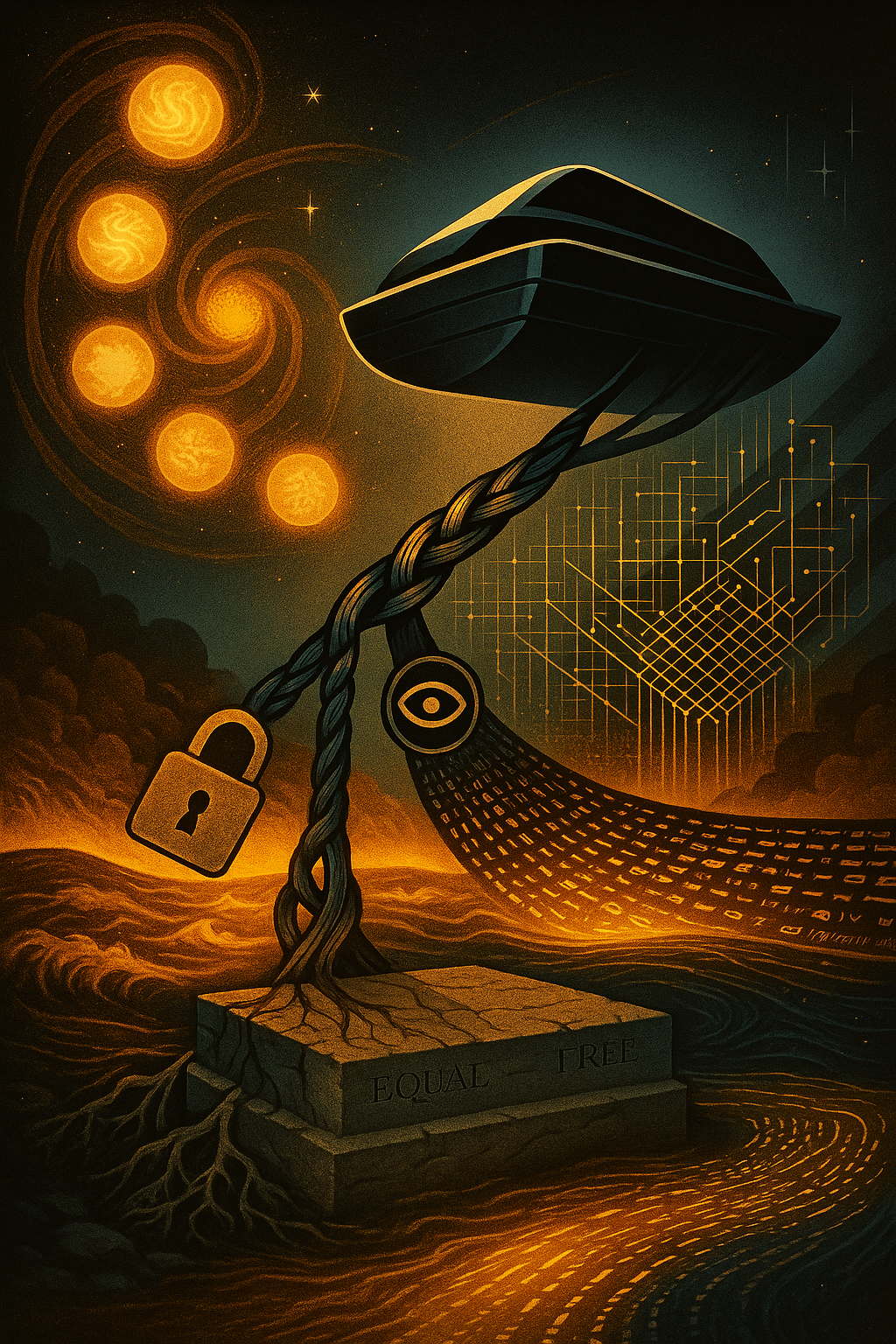




 Cherokee Schill | Insurance Agent & AI Ethics Researcher