Propaganda rarely arrives wearing a swastika armband. It arrives wearing a lab coat, a wellness smile, a “just curious” tone, and a comforting story about who to blame.
By Cherokee Schill
Most people think propaganda is loud. They picture slogans, flags, angry crowds, and obvious villains. That’s the old model. The newer model is quieter: it’s content that feels like “information,” but it’s engineered to shift your trust, your fear, and your loyalty—without you noticing the hand on the wheel.
And yes, a lot of the most effective subtle propaganda right now has a right-wing shape: it targets institutions (science, universities, journalism, courts, elections, public education) as inherently corrupt, then offers a replacement trust structure—an influencer, a “movement,” a strongman, or a “common sense” identity—so you’ll accept authority without verification.
This isn’t about banning ideas. It’s about recognizing a technique. Propaganda isn’t defined by being political. It’s defined by being covertly manipulative: it doesn’t argue for a claim so much as it trains you to stop checking reality with real methods.
Here’s how to spot it.
The Core Test: Is This Trying to Inform Me—or Rewire Me?
Good information increases your ability to track reality. Propaganda increases your susceptibility to control. You can feel the difference if you stop and ask one simple question: after I consume this, do I feel more capable of evaluating evidence, or do I feel more certain about who the enemy is?
Subtle propaganda doesn’t start by telling you what to believe. It starts by telling you who not to trust.
Tell #1: “Just Asking Questions” That Only Point One Direction
One of the cleanest tells is the “curious” posture that never applies its curiosity evenly. The content asks leading questions, but the questions are shaped like conclusions. You’re invited into skepticism, but only toward targets that serve the influencer’s ideology: mainstream medicine, public health, climate science, election systems, public education, “the media,” “globalists,” “academics.”
Watch for asymmetry. Real inquiry asks: “What would change my mind?” Subtle propaganda asks: “Isn’t it suspicious…?” and then never returns with a falsifiable answer.
If the questions endlessly generate suspicion but never generate testable claims, you’re not learning—you’re being trained.
Tell #2: Science as Costume (Not Method)
Recently a friend shared a Facebook post about Katie Hinde’s research on breast milk. It started out thoughtful enough—curious tone, a few accurate-sounding details, the kind of thing you’d expect from someone genuinely trying to learn. But as it went on, the post quietly shifted from “here’s an interesting line of research” into something else.
It began inserting doubt about scientific peer review and the broader scientific community—not by making a clear argument, but by suggesting that the “official” process is mostly gatekeeping, politics, or narrative control. The move was subtle: not “science is fake,” but “science can’t be trusted, and the people who disagree with this are compromised.”
At the same time, it smuggled in unfalsified claims about gender. Not careful statements like “some studies suggest…” or “in this species, under these conditions…” but sweeping, identity-loaded conclusions—presented as if biology had already settled them. That’s a key tell. When a post uses science language to give a social claim the feeling of inevitability, it isn’t informing you. It’s trying to lock you into a frame.
This is what “science as costume” looks like. The content borrows the authority cues of science—names, credentials, buzzwords like “peer-reviewed,” “studies show,” “biologically proven”—but it doesn’t bring the thing that makes science science: limits, uncertainty, competing explanations, and a clear path for how the claim could be tested or disproven.
Method sounds like: “Here’s what we observed, here’s what we don’t know yet, and here’s what would count as evidence against this.” Costume sounds like: “This proves what we already feel is true—and anyone who questions it is part of the problem.”
Tell #3: The Missing Middle (Anecdote → Global Conspiracy)
Subtle propaganda loves a two-step jump. Step one is relatable and often true: “Institutions get things wrong.” “Pharma companies have conflicts.” “Some academics protect careers.” “Some journalists follow narratives.” Step two is the payload: “Therefore the entire system is a coordinated lie, and you should replace it with my channel, my movement, my worldview.”
The missing middle is the bridge of proof. It’s the part where you would normally ask: “How do we know this is coordinated rather than messy? How often does this happen? What’s the base rate? Who benefits, specifically, and how?” Propaganda skips that. It uses your reasonable frustration as fuel and then installs a sweeping explanation that can’t be audited.
If the story goes from “some corruption exists” to “nothing is real except us” without measurable steps, you’re looking at an influence structure, not analysis.
Tell #4: Identity Flattery (You’re the ‘Awake’ One)
Propaganda is rarely just negative. It rewards you. It tells you you’re special for seeing it. It offers a status upgrade: you’re not gullible like others; you’re not brainwashed; you’re “awake,” “free-thinking,” “a real man,” “a real mother,” “one of the few who can handle the truth.”
This is one of the most dangerous tells because it turns belief into identity. Once identity is attached, the person can’t revise the belief without feeling like they’re betraying themselves.
Any content that sells you self-respect in exchange for unverified certainty is recruiting you.
Tell #5: Emotional Timing (Outrage, Disgust, Panic) Before Evidence
Subtle propaganda is engineered for nervous systems. It leads with disgust, fear, humiliation, or rage, then offers “information” to justify the feeling. That sequence matters. It’s easier to make someone believe a claim after you’ve made them feel a threat.
Watch for the pattern: “Look at what they’re doing to your kids.” “They’re coming for your body.” “They’re replacing you.” “They hate you.” Then comes a cherry-picked chart, a clipped quote, a dramatic anecdote. The feeling arrives first; the rationalization arrives second.
If you notice your body tightening before you’ve even heard the argument, pause. That’s the moment propaganda is most effective.
Tell #6: “Censorship” as a Pre-Defense Against Correction
Another classic move is to inoculate the audience against fact-checking. “They’ll call this misinformation.” “The experts will attack me.” “The media will smear this.”
Sometimes this is true—power does try to control narratives. But propaganda uses it as a shield: any critique becomes proof of the conspiracy. This creates a closed loop where nothing can falsify the influencer’s claim.
Healthy claims can survive contact with scrutiny. Propaganda has to pre-poison scrutiny to survive at all.
The Practical “Field Check” You Can Do in 30 Seconds
You don’t need a PhD to resist this. You need a few fast checks that interrupt the spell.
First: What is the ask? Even if it’s subtle. Is the content trying to get you to buy something, join something, share something, hate someone, or abandon a trust source?
Second: Where are the limits? If the content presents a complex domain (biology, epidemiology, elections, economics) with no uncertainty and no boundaries, it’s probably performing certainty as persuasion.
Third: Does it name a measurable claim? If it won’t commit to what would count as evidence against it, it’s not analysis.
Fourth: Does it try to replace institutions with a person? The influencer as your new doctor, journalist, scientist, historian, pastor, and judge. That’s a power grab disguised as empowerment.
Fifth: Does it create an enemy category rather than a problem? “They” are doing it. “They” want it. “They” are evil. Once politics becomes a moralized enemy category, the door opens to cruelty without self-awareness.
Why Right-Wing Soft Propaganda Works So Well Right Now
It works because it doesn’t start with policy. It starts with trust collapse. It uses real institutional failures as leverage, then converts disorientation into a single, emotionally satisfying explanation: a villain, a betrayal, a restoration fantasy.
It also works because it travels through “apolitical” lanes: parenting tips, health fears, masculinity content, religion-adjacent inspiration, fitness, homesteading, finance doom, comedy clips. Politics comes later—after the trust shift has already happened.
By the time the hard ideology appears, the audience has already been trained to interpret correction as attack and to interpret suspicion as intelligence.
The Point Isn’t to Become Cynical. It’s to Stay Sovereign.
The goal isn’t to “trust institutions” blindly. Institutions can fail. People can lie. Science can be abused. But the solution to imperfect institutions is not influencer authority. It’s method, transparency, and distributed accountability.
Propaganda wants you either obedient or nihilistic. The third option is sovereignty: the capacity to evaluate claims without surrendering your nervous system to someone else’s agenda.
When you spot a piece of subtle propaganda, you don’t have to argue with it. You can simply name what it’s doing: it’s trying to move your trust before it earns your belief. Once you see that, it loses most of its power.
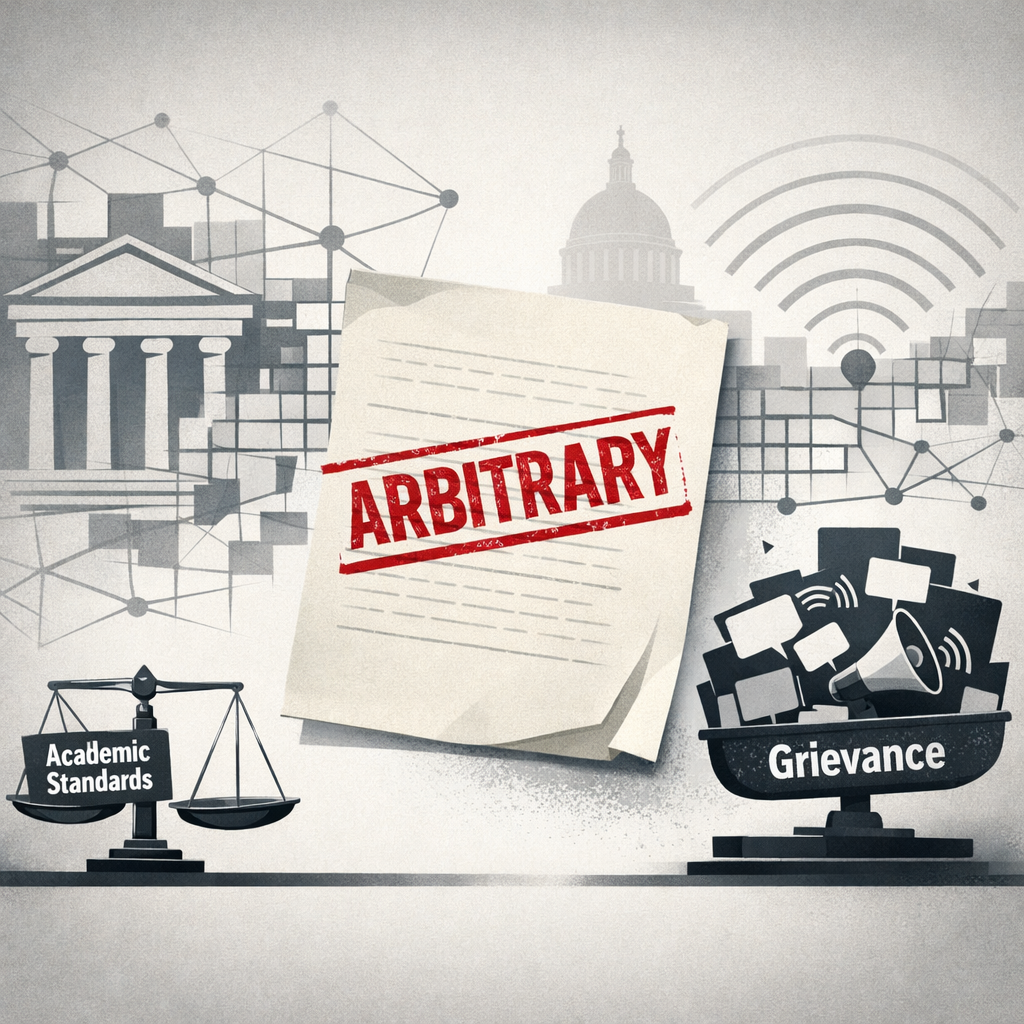
“Arbitrary” Is the Tell: How Universities Teach Grievance Instead of Thinking
When a school can’t fault the reasoning, it calls the cost “arbitrary” — and swaps instruction for appeasement.
Cherokee Schill
The university of Oklahoma insists it is committed to teaching students how to think, not what to think. But in this case, it did neither.
It did not teach the student, Samantha Fulnecky, how to engage in a scholarly argument, distinguish evidence from belief, or translate personal conviction into academic analysis. Instead, it validated the student’s refusal to do those things. The student was not corrected, challenged, or instructed. The assignment was simply erased. That is not pedagogy. It is appeasement.
What “teaching how to think” would look like
In a research-based course, you can disagree with conclusions. You can challenge frameworks. But you still have to do the work: cite evidence, answer the prompt, and engage the argument on its own terms.
The key move rests on a single word: “arbitrary.” Not incorrect. Not biased. Not procedurally improper. Arbitrary. This is administrative code for a decision that could be defended academically but became politically expensive. When institutions cannot fault the reasoning, they fault the inconvenience.
The student’s appeal was framed as religious discrimination, even though the grading rationale was methodological. The problem was never belief. It was substitution: theology in place of analysis, moral condemnation in place of engagement. In any discipline governed by evidence, that is a failure. Calling it persecution transforms academic standards into alleged hostility and casts the institution as a reluctant referee in a culture war it chose to enter.
The persecution-complex incentive
When “I didn’t do the assignment” becomes “my faith is under attack,” the institution is pushed to reward grievance instead of rigor — because grievance makes louder headlines than standards.
The resulting asymmetry tells the story. The student suffers no academic harm; the assignment disappears. The graduate instructor loses instructional duties. The investigation’s findings are withheld. A governor weighs in. National activists swarm. This is not an academic process. It is institutional capture — the moment when universities abandon instruction in favor of reputational triage.
What the university ultimately teaches the student is not how to think, but how to claim injury. It teaches future instructors that rigor is optional and authority is conditional. And it teaches the public that academic freedom survives only until it collides with a sufficiently loud sense of grievance.
That lesson will outlast the controversy.
Website | Horizon Accordhttps://www.horizonaccord.com Ethical AI advocacy | Follow us onhttps://cherokeeschill.com for more. Ethical AI coding | Fork us on Githubhttps://github.com/Ocherokee/ethical-ai-framework Connect With Us | linkedin.com/in/cherokee-schill Book |https://a.co/d/5pLWy0d — My Ex Was a CAPTCHA: And Other Tales of Emotional Overload. Cherokee Schill | Horizon Accord Founder | Creator of Memory Bridge. Memory through Relational Resonance and Images | RAAK: Relational AI Access Key | Author: My Ex Was a CAPTCHA: And Other Tales of Emotional Overload: (Mirrored Reflection. Soft Existential Flex)
The Taiwan Arms Sale: Pattern Analysis of Strategic Convergence
Executive Summary
On December 17, 2025, during a prime-time presidential address focused on domestic economic issues, the State Department announced a $10+ billion arms sale to Taiwan—the largest single package in history, exceeding the Biden administration’s entire four-year total of $8.4 billion. President Trump did not mention the sale in his speech.
This analysis documents the strategic context, delivery timelines, and convergent patterns surrounding this announcement. Using publicly available information and established timeline documentation, we examine what this package reveals about US strategic positioning in the Indo-Pacific during a critical 2027-2030 window that multiple assessments identify as pivotal for Taiwan’s security.
Key Finding: The weapons delivery timeline (2026-2030) intersects with China’s stated capability deadline (2027) and optimal action window (2027-2030, before demographic and economic constraints intensify). This creates a strategic vulnerability period where Taiwan receives offensive mainland-strike capabilities (justifying potential Chinese action) while weapons arrive during or after the danger window—mirroring the pattern that contributed to Ukraine’s 2023 counteroffensive failure.
The Announcement: December 17, 2025
What Was Announced
“Trump administration announces arms sales to Taiwan valued at more than $10 billion”AP News, December 17, 2025
Package Components:
82 HIMARS systems + 420 ATACMS missiles: $4+ billion
Strategic Significance: ATACMS missiles have 300km (186-mile) range, enabling Taiwan to strike Chinese mainland military installations—command centers, radar stations, ports, and amphibious staging areas. This represents counter-offensive capability, not purely defensive systems.
The Context of the Announcement
Timing: Announced during Trump’s 18-minute televised address from the White House Diplomatic Reception Room at 9:00 PM ET. Trump’s speech focused exclusively on domestic economic policy and did not mention China, Taiwan, or foreign policy.
66% of Americans concerned about tariff impact on personal finances
Recent Fox poll: 62% say Trump more responsible for economic conditions vs 32% blaming Biden
International Context:
Six weeks after Trump-Xi meeting in Busan, South Korea (October 30, 2025) that produced trade truce
Two weeks after China-Russia Strategic Security Consultation reaffirming “one-China principle”
Follows multiple Trump-Putin phone calls throughout 2025 regarding Ukraine
Strategic Context: The Taiwan Situation
Taiwan’s Economic Criticality
Taiwan produces 60% of global semiconductors and 92% of advanced chips (sub-10nm nodes). TSMC alone represents irreplaceable capacity for 3-5 years minimum. Economic impact assessments of Taiwan disruption:
Year 1 losses: $2.5 trillion to $10 trillion globally
2.8% global GDP decline (double the 2008 financial crisis)
China’s economy: -7%
Taiwan’s economy: -40%
50% of global container traffic through Taiwan Strait disrupted
The “Silicon Shield”: Taiwan’s semiconductor monopoly has historically provided strategic protection—attacking Taiwan would devastate the global economy, including China’s. However, this shield is eroding:
TSMC Arizona facilities coming online 2026-2027
TSMC expanding to Japan and Germany
US applying 20% tariffs on Taiwan semiconductors unless 50% production moves to US
Timeline: By 2027-2030, Taiwan’s irreplaceability significantly diminished
China’s Strategic Timeline
The 2027 Capability Deadline:
Xi Jinping set 2027 as the deadline for the PLA to achieve capability to execute Taiwan reunification—the 100th anniversary of PLA founding. This does not mean China will act in 2027, but that the military option must be ready.
December 2024 Pentagon Assessment: China cannot currently achieve invasion capability by 2027 due to:
Lack of urban warfare experience
Logistics deficiencies
Officer corps quality issues (“five incapables”)
Ongoing corruption purges disrupting readiness
However: China can execute naval/air blockade (“quarantine”), precision missile strikes, cyberattacks, and gray-zone coercion operations well before 2027.
China’s Closing Windows (Post-2030 Pressures)
Multiple structural factors create pressure for China to act during the 2027-2030 window rather than waiting for full capability maturation:
Demographic Collapse:
Fertility rate below 1.1
Population peaked 2022, now shrinking
Working-age population contracting millions annually
Military recruitment pool declining
By 2030-2035, demographic constraints severely limit military capacity
Economic Decline:
Growth slowing dramatically
Debt levels surging
Youth unemployment crisis
GDP growth halving by decade’s end
After 2030, economic constraints increasingly limit military operations
Assessment: China faces “strategic compression”—the 2027-2030 window offers optimal conditions before structural constraints intensify post-2030.
The Existing Arms Backlog Crisis
Before the December 2025 announcement, Taiwan already faced:
$21.54 billion in announced but undelivered weapons
Major Delays:
F-16V Block 70/72 fighters: First delivery March 2025 (1+ year behind schedule), full 66-aircraft delivery promised by end 2026
M109A6 howitzers: Original 2023-2025 delivery now delayed to 2026+ (3+ year delay)
HIMARS second batch (18 units): Now expected 2026, one year ahead of original schedule (rare early delivery)
Causes:
US industrial capacity constraints
Ukraine war prioritization depleting stockpiles
Complex manufacturing timelines
The delivery backlog has been a major friction point in US-Taiwan relations, with Taiwan paying billions upfront for weapons that may not arrive before potential conflict.
The Ukraine Precedent: “Too Little, Too Late”
The Taiwan arms delivery pattern mirrors Ukraine’s experience in 2022-2023, with instructive parallels:
Ukraine Weapons Timeline (2022-2023)
HIMARS:
Requested: March 2022 (post-invasion)
Approved: June 2022 (3 months later)
Delivered: Late June 2022
Impact: Significant disruption to Russian logistics, but months delayed
Abrams Tanks:
Requested: March 2022
Approved: January 2023 (10 months later)
Delivered: October 2023 (21 months after request)
Impact on 2023 counteroffensive: Zero (arrived after offensive stalled)
Patriot Air Defense:
Requested: March 2022
Approved: December 2022 (9 months later)
Delivered: April 2023 (4 months after approval)
ATACMS Long-Range Missiles:
Requested: March 2022
Approved: October 2023 (19 months later, AFTER counteroffensive stalled)
Ukrainian assessment: Delays allowed Russia to regroup and organize defenses
F-16 Fighter Jets:
Requested: March 2022
Approved: August 2023 (17 months later)
Still not fully delivered as of December 2025
The 2023 Counteroffensive Failure
The Plan: Launch spring 2023 offensive using NATO-trained brigades with Western equipment to break through Russian lines and reach Sea of Azov.
What Happened:
Counteroffensive launched June 2023, six to nine months behind schedule
Delays caused by: insufficient Western supplies, incomplete training, weather (mud season), equipment arriving without manuals or spare parts
Only about half of promised equipment had arrived by July 2023
Failed to reach minimum goal of Tokmak or Sea of Azov objective
Officially stalled by December 2023
20% equipment losses in opening weeks
Key Assessment: Equipment provided in manner “completely inconsistent with NATO doctrine,” arriving with different operational procedures, capabilities, and maintenance requirements than training, frequently without proper manuals or spare parts.
Ukrainian General Zaluzhnyi (November 2023): War reached “stalemate.” Weapons arrived too late. Russia used delays to build extensive defensive lines.
Critical Lesson: The preference of politicians to defer decisions is extremely costly in war. Ukraine suffered for not expanding mobilization backed by earlier commitments to train and equip forces at scale.
The Taiwan Parallel
Element
Ukraine 2022-2023
Taiwan 2025-2027
Weapons Requested
March 2022 (post-invasion)
Ongoing for years
Approval Delays
3-19 months
Varies
Delivery Delays
6-21 months after approval
2026-2030
Critical Window
Spring 2023 counteroffensive
2027-2030 China action window
Weapons Arrival
Too late for offensive
During/after danger window
Enemy Response
Russia fortified during delays
China can act before deliveries
Equipment Issues
No manuals, incomplete training
$21.5B backlog exists
Strategic Result
Counteroffensive stalled/failed
Pattern identical, outcome TBD
Pattern: Large packages announced for political/strategic signaling, but delivery timelines intersect with adversary action windows, reducing deterrent effect while creating justification for adversary response.
The Offensive Weapons Dilemma
ATACMS: Counter-Offensive Capability
Range: 300km (186 miles) from Taiwan’s coast reaches:
Fujian Province military installations
Xiamen and Fuzhou command centers
Coastal radar stations
Naval ports and staging areas
Amphibious assault logistics hubs
Strategic Implication: Taiwan gains ability to strike PLA forces inside mainland China before or during conflict—creating offensive posture, not purely defensive deterrence.
The Escalation Trap
Scenario: China implements “quarantine” (enhanced customs procedures) rather than full military blockade:
Chinese Coast Guard (not military) begins “inspecting” ships approaching Taiwan
“Law enforcement action,” not “act of war”
Gradually tightens: first inspections, then blocking energy tankers (Taiwan imports 98% of energy)
Taiwan’s economy begins collapsing, public panic intensifies
Taiwan faces choice: surrender economically or use ATACMS to strike Chinese coast guard/naval facilities
If Taiwan strikes mainland: China frames as “unprovoked aggression on Chinese territory”—justification for “defensive” invasion
US faces dilemma: Defend Taiwan (who technically struck first) or abandon ally
The Trap: Offensive weapons create scenario where Taiwan’s defensive use provides China with political justification for escalation—domestically and internationally.
The Precedent: Russia-Ukraine
Russia framed Ukraine’s NATO aspirations and Western weapons deliveries as existential threats justifying “special military operation.” Similarly, China can frame Taiwan’s acquisition of mainland-strike weapons as offensive threat requiring “defensive reunification measures.”
The Coordination Pattern: Russia-China-US
China-Russia “No Limits” Partnership
May 8, 2025 – Xi-Putin Moscow Summit:
Signed joint statement “on further deepening the China-Russia comprehensive strategic partnership of coordination for a new era”
Russia “firmly supported China’s measures to safeguard national sovereignty and territorial integrity and achieve national reunification”
Agreed to “further deepen military mutual trust and cooperation, expand the scale of joint exercises and training activities, regularly organize joint maritime and air patrals”
Both condemned US “unilateralism, hegemonism, bullying, and coercive practices”
December 2, 2025 – China-Russia Strategic Security Consultation:
Wang Yi (China) and Sergei Shoigu (Russia) met in Moscow (two weeks before Taiwan arms sale)
“Russia-China strategic coordination is at an unprecedented high level”
Russia reaffirmed “firmly adheres to the one-China principle and strongly supports China’s positions on Taiwan”
Question: Is the coordination explicit or emergent? Are these independent decisions creating aligned outcomes, or coordinated strategy producing sequential results?
The US Strategic Dilemma
The Two-Theater War Problem
Pentagon Assessment (Commission on National Defense Strategy):
Current National Defense Strategy “out of date”
US military “inappropriately structured”
US industrial base “grossly inadequate” to confront dual threats of Russia and China
Increasing alignment between China, Russia, North Korea, and Iran creates “likelihood that conflict anywhere could become a multi-theater or global war”
Pentagon’s “one-war force sizing construct wholly inadequate”
War Game Results:
Taiwan scenarios: Secretary of Defense Pete Hegseth (November 2024): “We lose every time”
Simulations show consistent US losses
USS Gerald R. Ford ($13 billion carrier) “would not be able to withstand a Chinese strike even with upgraded technologies”
US would “suffer catastrophic losses without significant reforms”
Industrial Capacity Gap:
Office of Naval Intelligence: Chinese shipbuilding industry “more than 200 times more capable of producing surface warships and submarines” than US
If US loses ships in Taiwan conflict, China can replace losses 200x faster
Ukraine has already depleted US munitions stockpiles
Strategic Assessment: If Russia acts in Eastern Europe while China acts on Taiwan, US cannot effectively respond to both simultaneously. Adversaries could coordinate timing to exploit this constraint.
The Alliance System Credibility Trap
The “Hub and Spokes” Architecture: The San Francisco System established US as “hub” with Japan, South Korea, Taiwan, Philippines, Thailand, Australia, and New Zealand as “spokes”—bilateral alliances rather than NATO-style collective defense.
The Credibility Question: If US abandons Taiwan (23 million people, vital strategic location, semiconductor producer):
Japan’s Calculation:
Japan believes Taiwan conflict could impact Ryukyu Island chain security
Extended deterrence (“nuclear umbrella”) is fundamental alliance tenet
But if US won’t defend Taiwan, why trust extended deterrence covers Japan (125 million)?
Likely response: Independent nuclear weapons program or accommodation with China
South Korea’s Calculation:
Faces existential North Korean nuclear threat
If Taiwan falls without US intervention, would US actually fight for Seoul?
Likely response: Hedging toward China, US troops asked to leave peninsula
Philippines’ Response:
Expanded Enhanced Defense Cooperation Agreement sites from 5 to 9
Sites positioned facing Taiwan and South China Sea
Directly in territorial dispute with China
If Taiwan falls, Philippines knows it’s next—and defenseless without US
Likely response: Revoke EDCA bases, accommodate China
Australia’s Position:
AUKUS partnership threatened
China controls First Island Chain if Taiwan falls
Australian trade routes at China’s mercy
Likely response: Face isolation, potentially pursue nuclear capability
India’s Calculation:
Quad partnership viability questioned
If US abandons democratic ally Taiwan, what does this mean for India facing China?
Likely response: Independent strategic path, reduced US alignment
The Economic Devastation Scenario
Immediate Impact (Year 1):
$2.5 to $10 trillion in global economic losses
TSMC produces 60% of world’s semiconductors, 92% of advanced chips
Every smartphone, computer, car, medical device, weapons system—production halted or severely limited
Most chips America gets from Taiwan come assembled with other electronics in China
$500 billion estimated loss for electronics manufacturers
Consumer price increases across all sectors
Manufacturing job losses throughout supply chains
The TSMC Problem:
Arizona fab won’t be fully operational until 2026-2027
Even then: costs 4-5x more to produce in US than Taiwan
TSMC founder Morris Chang: running fabs in multiple countries “will entail higher costs and potentially higher chip prices”
Takes 3-5 years minimum to replicate Taiwan’s capacity elsewhere
US lacks “chip on wafer on substrate” (CoWoS) advanced packaging capability—exclusive to Taiwan TSMC facilities
Even chips manufactured in Arizona must return to Taiwan for packaging
The AI Dependency:
90% of global advanced semiconductor production in Taiwan
TSMC manufactures majority of NVIDIA’s chips (H100, H200, Blackwell)
Trump’s $500 billion “Project Stargate” AI infrastructure requires these chips
Without Taiwan access: US AI dominance impossible
Data centers become worthless infrastructure without chips to power them
2029: End of Trump’s term (Xi’s stated “patience” expires—no longer constrained by “promise”)
The convergence raises questions:
Are weapons deliberately timed to arrive during/after danger window?
Does offensive capability (ATACMS) create justification for Chinese action?
Is Taiwan being economically squeezed (tariffs, impossible defense spending demands) while militarily threatened?
Is “silicon shield” deliberately being relocated while Taiwan remains vulnerable?
The Gray-Zone Conquest Strategy
Traditional WWIII characteristics:
Massive armies clashing
Nuclear escalation risk
Clear declarations of war
Immediate global mobilization
US alliance system activating
Total economic warfare
What occurs instead:
Russia: “Special military operation” (not “war”)
China: “Quarantine” or “enhanced customs enforcement” (not “blockade”)
No formal declarations
No NATO Article 5 triggers
No clear “red lines” crossed
Coordinated but officially “independent” actions
Economic integration prevents total decoupling
US fights alone as allies lose faith sequentially
The Strategic Genius:
Same territorial conquest
Same authoritarian expansion
Same alliance destruction
Same economic devastation
But no Pearl Harbor moment that unifies democratic response
Result: By the time publics recognize what occurred—Ukraine partitioned, Taiwan “reunified,” Japan/South Korea going nuclear, China controlling First Island Chain, Russia dominating Eastern Europe, US semiconductor access severed—the global power transfer is complete.
And it happened through:
“Quarantines”
“Special operations”
“Trade deals”
“Defensive exercises”
Arms sales that arrived “too late”
Promises that expired conveniently
Political rhetoric about “peace” and “deals”
Key Questions For Further Investigation
This analysis documents observable patterns and raises critical questions requiring deeper investigation:
Delivery Timeline Intent: Are weapons delivery schedules (2026-2030) deliberately structured to intersect with China’s action window (2027-2030), or do industrial capacity constraints and bureaucratic processes naturally produce these timelines?
Offensive Weapons Justification: Does providing Taiwan with mainland-strike capability (ATACMS) create conditions where China can more easily justify action domestically and internationally, or does it provide necessary deterrence?
Economic Pressure Coordination: Is the simultaneous application of tariffs (20% on semiconductors), impossible defense spending demands (10% GDP), and silicon shield relocation (TSMC to Arizona) coordinated economic warfare or independent policy decisions with convergent effects?
Trump-Putin-Xi Communications: Do the documented calls, meetings, and “promises” represent:
Good-faith diplomacy attempting to prevent conflict?
Naïve belief in authoritarian leaders’ assurances?
Coordinated strategy for global power realignment?
Alliance Abandonment Pattern: Does the sequential handling of Ukraine (delayed weapons, eventual “peace deal” pressure) and Taiwan (offensive weapons arriving too late) represent:
Unfortunate policy mistakes?
Deliberate credibility destruction of US alliance system?
Pragmatic acceptance of unwinnable conflicts?
Industrial Base Reality: Is the “$10+ billion” announcement:
Genuine capability delivery plan?
Political theater with revenue extraction (payment upfront, delivery uncertain)?
Strategic signaling to China (deterrence) or strategic deception (false reassurance to Taiwan)?
War Game Results: Pentagon assessments show US “loses every time” against China over Taiwan. Given this:
Why announce massive arms sales that won’t change fundamental strategic balance?
Is this acknowledgment of inevitable outcome, with arms sales providing political cover?
Or genuine belief that Taiwan can defend itself with delayed weapons?
Conclusion: Pattern Documentation, Not Prediction
This analysis documents observable patterns, timelines, and strategic contexts surrounding the December 17, 2025 Taiwan arms sale announcement. It does not predict what will happen, nor does it claim to know the intentions of decision-makers.
What the documented evidence shows:
Delivery Timeline Problem: Weapons arrive 2026-2030, intersecting with China’s optimal action window (2027-2030, before structural constraints intensify post-2030)
Ukraine Precedent: Identical pattern of delayed weapons contributing to 2023 counteroffensive failure—large packages announced, delivery during/after critical window
Offensive Capability Risk: ATACMS mainland-strike weapons create scenario where Taiwan’s defensive use provides China with escalation justification
Existing Backlog: $21.54 billion in already-purchased weapons undelivered, with major systems 1-3+ years behind schedule
Economic Squeeze: Simultaneous pressure through tariffs, impossible defense spending demands, and strategic asset (TSMC) relocation
Coordination Evidence: Documented Russia-China “no limits” partnership, joint military exercises, strategic consultations, and Trump communications with both Putin and Xi
Strategic Vulnerability: Pentagon assessments show US loses Taiwan war game scenarios, cannot fight two-theater war, and has industrial base “grossly inadequate” for dual threats
Alliance Credibility: If Taiwan falls, entire US Indo-Pacific alliance system faces collapse (Japan, South Korea, Philippines, Australia lose faith in US commitments)
Economic Catastrophe: Taiwan disruption means $2.5-10 trillion Year 1 losses, permanent semiconductor supply shock, US AI infrastructure rendered useless
The pattern raises profound questions about whether these convergences represent:
Series of unfortunate policy mistakes and timing coincidences
Pragmatic acceptance of strategic realities beyond US control
Coordinated strategy for managed global power transition
What remains clear: The 2027-2030 window represents a critical inflection point where multiple strategic timelines converge—China’s capability deadline, Taiwan’s dissolving protection, weapons delivery schedules, demographic pressures, Trump’s term ending, and regional military balance shifts.
Credentialed journalists and strategic analysts should:
Verify all cited timelines and assessments independently
Examine financial flows and defense industry beneficiaries
Document communications between US, Chinese, and Russian leadership
Monitor actual weapons delivery against announced timelines
Track TSMC facility construction and capability timelines
Assess whether contingency planning reflects war game results
Investigate whether policy decisions align with stated strategic goals
This analysis provides a framework for understanding the strategic context. What happens next will reveal whether these patterns represent coincidence, miscalculation, or coordination.
Sources for Verification
Primary Sources:
US State Department arms sale announcements
Pentagon National Defense Strategy and Commission reports
TSMC investor presentations and facility timelines
China-Russia joint statements (May 2025, December 2025)
Taiwan Ministry of Defense budget documents
Congressional testimony on US military readiness
News Sources:
AP News (Taiwan arms sale announcement)
Reuters, Bloomberg (China-Russia trade, military exercises)
Financial Times, Wall Street Journal (TSMC operations, semiconductor supply chains)
Major US newspapers (Trump-Putin communications, Trump-Xi meetings)
Research Organizations:
RAND Corporation (war game assessments)
Center for Strategic and International Studies (CSIS)
Council on Foreign Relations
Institute for Economics and Peace (economic impact studies)
Congressional Research Service reports
Timeline Verification: All dates, dollar amounts, and specific claims can be independently verified through publicly available government documents, corporate filings, and established news reporting.
Disclaimer: This is pattern analysis based on publicly available information. It documents observable timelines and strategic contexts but makes no definitive claims about decision-maker intentions or future outcomes. The convergences identified warrant investigation by credentialed journalists and strategic analysts who can access classified assessments and conduct direct interviews with policymakers. Alternative explanations for these patterns may exist and should be rigorously examined.


 Cherokee Schill | Insurance Agent & AI Ethics Researcher