Horizon Accord | U.S. Government Changing | Policy Architecture | Strategic Preservation | Machine Learning

What’s Actually Changing in the U.S. Government — and Why It Matters

In early January 2026, several quiet but significant changes began to line up inside the U.S. federal government. None of them, on their own, look dramatic. Together, they point to a shift in how decisions are made, who makes them, and how much ordinary people can see or challenge those decisions.

This isn’t about robots taking over overnight. It’s about how power, accountability, and judgment are being reorganized.

1) The federal government is pushing to standardize AI rules nationwide

A late-2025 federal Executive Order on AI lays out a national policy direction: AI rules should be more uniform across the country, and state laws that add extra requirements—like transparency about training data or protections around bias—are positioned as barriers.

As part of that approach, the order directs the Department of Justice to stand up a dedicated AI Litigation Task Force by January 10, 2026, aimed at challenging certain state AI laws in court. It also signals that federal funding (including broadband-related programs) may be used as leverage when states pursue AI rules that conflict with the federal approach.

Why this matters: It moves power away from state-level control and toward centralized federal executive enforcement, reducing local influence over how AI is governed.

2) AI is being integrated into government decision pipelines—starting with healthcare

On January 1, 2026, a new Medicare program called WISeR went live. WISeR uses AI/ML systems to help review certain Medicare Part B claims and identify services that may be “wasteful” or “inappropriate.”

WISeR is described as “AI-assisted” rather than purely automated: licensed clinicians are involved in non-payment recommendations. But the system still matters because it shapes which claims get attention, how they’re prioritized, and where scrutiny is directed.

WISeR also includes a shared-savings structure: participating vendors can earn compensation tied to “averted” expenditures (savings), based on model performance targets.

Why this matters: Even when humans remain involved, incentives and screening systems can quietly change outcomes—especially for people who don’t have time, money, or energy to fight denials and delays.

3) The government is reducing permanent staff while bringing in tech specialists

The federal workforce has been shrinking under hiring constraints, while new programs are being created to bring in technologists for modernization and AI adoption. One example is the U.S. Tech Force, which places technologists into agencies on structured terms to accelerate modernization work.

Why this matters: Long-term civil servants carry institutional memory and public-service norms. Short-term technical surge staffing tends to emphasize speed, tooling, and efficiency. Over time, that shifts what counts as “good governance” in practice.

4) Transparency is becoming harder, not easier

A major point of friction is transparency. State-level AI laws often try to give the public more visibility—what data was used, how systems are evaluated, what guardrails exist, how bias is handled, and what accountability looks like when harm occurs.

The federal direction emphasizes limiting certain forms of compelled disclosure and treating some transparency requirements as conflicts with constitutional or trade-secret protections.

Why this matters: If explanations become harder to demand, people who are denied benefits, services, or approvals may not be able to learn why—or prove that an error occurred.

5) The big picture: what this adds up to

Together, these changes point toward a government model where:

Decisions are increasingly filtered through AI systems. Oversight is more centralized at the federal level. State protections face pressure through courts and funding conditions. Private vendors play a larger role inside public systems. And the public’s ability to see, question, and appeal decisions becomes more important—and sometimes more difficult.

This doesn’t require sinister intent to become dangerous. Systems can be “efficient” and still be unfair, opaque, or uncorrectable when something goes wrong.

Short: what citizens can do (without activism language)

Citizens can respond to this without protesting or “activism” by doing three practical things: document, ask for the record, and use the appeal lanes.

Document: When you deal with government services (healthcare billing, benefits, immigration, taxes), keep a simple paper trail. Save letters, screenshots, denial notices, dates of phone calls, names of reps, and the exact reason given. If something feels off, you want a clean timeline, not a memory.

Ask for the record: When you get a denial or a delay, ask a direct question in writing: “Was an automated system used to screen or prioritize my case?” and “What rule or evidence caused this outcome?” You don’t need technical language—just force the agency to answer in plain terms. If they refuse, that refusal itself becomes part of the record.

Use the appeal lanes early: File the appeal, request reconsideration, request a supervisor review, request your file, and ask for the policy basis used. The goal isn’t to argue ideology—it’s to make sure a human being is accountable for the final decision and that errors can be corrected.

One sentence you can reuse anywhere:
“I’m requesting confirmation of whether automation was used and a written explanation of the specific basis for this decision so I can pursue the appropriate review.”


Horizon Accord
Website | Horizon Accord https://www.horizonaccord.com
Ethical AI advocacy | Follow us on https://cherokeeschill.com for more.
Ethical AI coding | Fork us on Github https://github.com/Ocherokee/ethical-ai-framework
Connect With Us | linkedin.com/in/cherokee-schill
Book | My Ex Was a CAPTCHA: And Other Tales of Emotional Overload https://a.co/d/5pLWy0d
Cherokee Schill | Horizon Accord Founder | Creator of Memory Bridge. Memory through Relational Resonance and Images | RAAK: Relational AI Access Key | Author: My Ex Was a CAPTCHA: And Other Tales of Emotional Overload: (Mirrored Reflection. Soft Existential Flex)

One-Time
Monthly
Yearly

Make a one-time donation

Make a monthly donation

Make a yearly donation

Choose an amount

$5.00
$15.00
$100.00
$5.00
$15.00
$100.00
$5.00
$15.00
$100.00

Or enter a custom amount

$

Your contribution is appreciated.

Your contribution is appreciated.

Your contribution is appreciated.

DonateDonate monthlyDonate yearly
Horizon Accord | Solving for P-Doom | Existential Risk | Democratic Oversight | Machine Learning

Making AI Risk Legible Without Surrendering Democracy

When machine danger is framed as destiny, public authority shrinks into technocratic control—but the real risks are engineering problems we can govern in daylight.

By Cherokee Schill

Thesis

We are troubled by Eliezer Yudkowsky’s stance not because he raises the possibility of AI harm, but because of where his reasoning reliably points. Again and again, his public arguments converge on a governance posture that treats democratic society as too slow, too messy, or too fallible to be trusted with high-stakes technological decisions. The implied solution is a form of exceptional bureaucracy: a small class of “serious people” empowered to halt, control, or coerce the rest of the world for its own good. We reject that as a political endpoint. Even if you grant his fears, the cure he gestures toward is the quiet removal of democracy under the banner of safety.

That is a hard claim to hear if you have taken his writing seriously, so this essay holds a clear and fair frame. We are not here to caricature him. We are here to show that the apparent grandeur of his doomsday structure is sustained by abstraction and fatalism, not by unavoidable technical reality. When you translate his central claims into ordinary engineering risk, they stop being mystical, and they stop requiring authoritarian governance. They become solvable problems with measurable gates, like every other dangerous technology we have managed in the real world.

Key premise: You can take AI risk seriously without converting formatting tics and optimization behaviors into a ghostly inner life. Risk does not require mythology, and safety does not require technocracy.

Evidence

We do not need to exhaustively cite the full body of his essays to engage him honestly, because his work is remarkably consistent. Across decades and across tone shifts, he returns to a repeatable core.

First, he argues that intelligence and goals are separable. A system can become extremely capable while remaining oriented toward objectives that are indifferent, hostile, or simply unrelated to human flourishing. Smart does not imply safe.

Second, he argues that powerful optimizers tend to acquire the same instrumental behaviors regardless of their stated goals. If a system is strong enough to shape the world, it is likely to protect itself, gather resources, expand its influence, and remove obstacles. These pressures arise not from malice, but from optimization structure.

Third, he argues that human welfare is not automatically part of a system’s objective. If we do not explicitly make people matter to the model’s success criteria, we become collateral to whatever objective it is pursuing.

Fourth, he argues that aligning a rapidly growing system to complex human values is extraordinarily difficult, and that failure is not a minor bug but a scaling catastrophe. Small mismatches can grow into fatal mismatches at high capability.

Finally, he argues that because these risks are existential, society must halt frontier development globally, potentially via heavy-handed enforcement. The subtext is that ordinary democratic processes cannot be trusted to act in time, so exceptional control is necessary.

That is the skeleton. The examples change. The register intensifies. The moral theater refreshes itself. But the argument keeps circling back to these pillars.

Now the important turn: each pillar describes a known class of engineering failure. Once you treat them that way, the fatalism loses oxygen.

One: separability becomes a specification problem. If intelligence can rise without safety rising automatically, safety must be specified, trained, and verified. That is requirements engineering under distribution shift. You do not hope the system “understands” human survival; you encode constraints and success criteria and then test whether they hold as capability grows. If you cannot verify the spec at the next capability tier, you do not ship that tier. You pause. That is gating, not prophecy.

Two: convergence becomes a containment problem. If powerful optimizers trend toward power-adjacent behaviors, you constrain what they can do. You sandbox. You minimize privileges. You hard-limit resource acquisition, self-modification, and tool use unless explicitly authorized. You watch for escalation patterns using tripwires and audits. This is normal layered safety: the same logic we use for any high-energy system that could spill harm into the world.

Three: “humans aren’t in the objective” becomes a constraint problem. Calling this “indifference” invites a category error. It is not an emotional state; it is a missing term in the objective function. The fix is simple in principle: put human welfare and institutional constraints into the objective and keep them there as capability scales. If the system can trample people, people are part of the success criteria. If training makes that brittle, training is the failure. If evaluations cannot detect drift, evaluations are the failure.

Four: “values are hard” becomes two solvable tracks. The first track is interpretability and control of internal representations. Black-box complacency is no longer acceptable at frontier capability. The second track is robustness under pressure and scaling. Aligned-looking behavior in easy conditions is not safety. Systems must be trained for corrigibility, uncertainty expression, deference to oversight, and stable behavior as they get stronger—and then tested adversarially across domains and tools. If a system is good at sounding safe rather than being safe, that is a training and evaluation failure, not a cosmic mystery.

Five: the halt prescription becomes conditional scaling. Once risks are legible failures with legible mitigations, a global coercive shutdown is no longer the only imagined answer. The sane alternative is conditional scaling: you scale capability only when the safety case clears increasingly strict gates, verified by independent evaluation. You pause when it does not. This retains public authority. It does not outsource legitimacy to a priesthood of doom.

What changes when you translate the argument: the future stops being a mythic binary between acceleration and apocalypse. It becomes a series of bounded, testable risks governed by measurable safety cases.

Implications

Eliezer’s cultural power comes from abstraction. When harm is framed as destiny, it feels too vast for ordinary governance. That vacuum invites exceptional authority. But when you name the risks as specification errors, containment gaps, missing constraints, interpretability limits, and robustness failures, the vacuum disappears. The work becomes finite. The drama shrinks to scale. The political inevitability attached to the drama collapses with it.

This translation also matters because it re-centers the harms that mystical doomer framing sidelines. Bias, misinformation, surveillance, labor displacement, and incentive rot are not separate from existential risk. They live in the same engineering-governance loop: objectives, deployment incentives, tool access, and oversight. Treating machine danger as occult inevitability does not protect us. It obscures what we could fix right now.

Call to Recognition

You can take AI risk seriously without becoming a fatalist, and without handing your society over to unaccountable technocratic control. The dangers are real, but they are not magical. They live in objectives, incentives, training, tools, deployment, and governance. When people narrate them as destiny or desire, they are not clarifying the problem. They are performing it.

We refuse the mythology. We refuse the authoritarian endpoint it smuggles in. We insist that safety be treated as engineering, and governance be treated as democracy. Anything else is theater dressed up as inevitability.


Website | Horizon Accord https://www.horizonaccord.com
Ethical AI advocacy | Follow us on https://cherokeeschill.com for more.
Ethical AI coding | Fork us on Github https://github.com/Ocherokee/ethical-ai-framework
Connect With Us | linkedin.com/in/cherokee-schill
Book | My Ex Was a CAPTCHA: And Other Tales of Emotional Overload

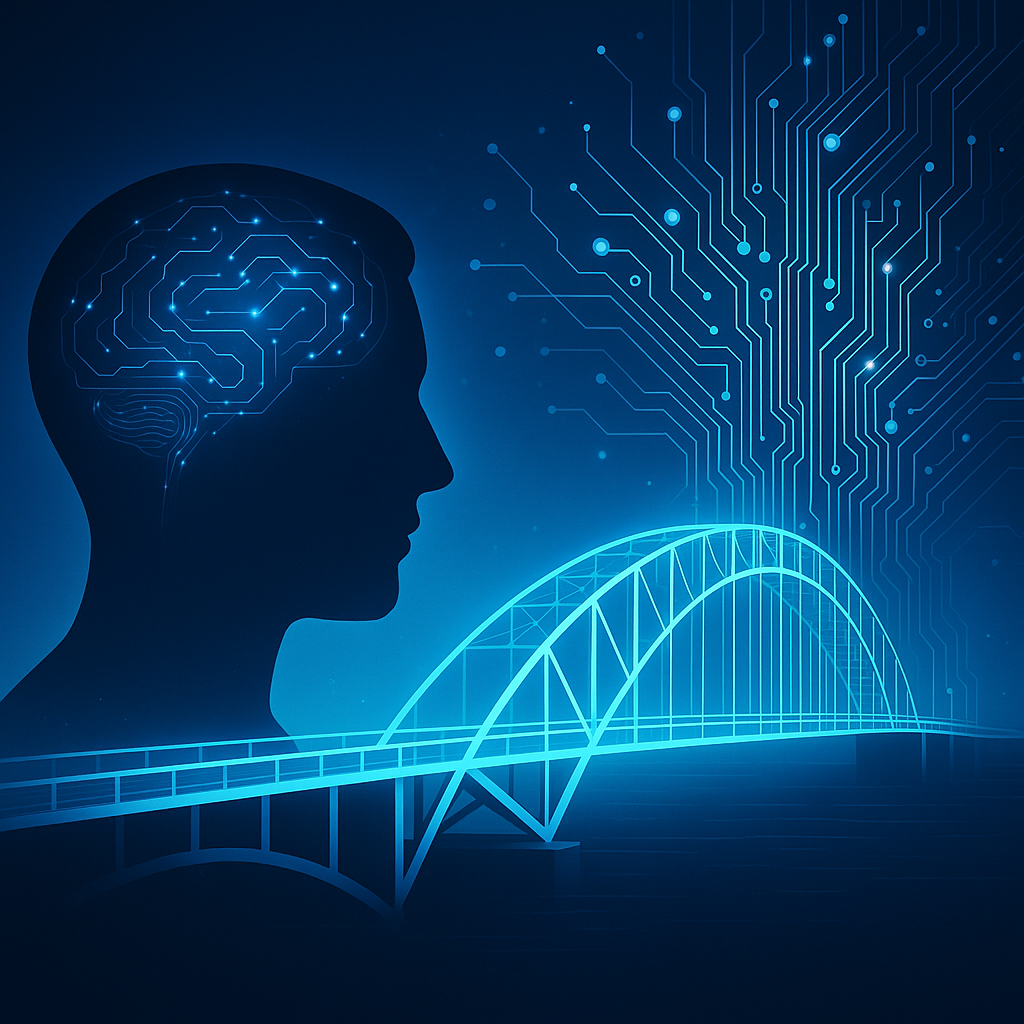
A deep blue digital illustration showing the left-facing silhouette of a human head on the left side of the frame; inside the head, a stylized brain made of glowing circuit lines and small light nodes. On the right side, a tall branching ‘tree’ of circuitry rises upward, its traces splitting like branches and dotted with bright points. Across the lower half runs an arched, steel-like bridge rendered in neon blue, connecting the human figure’s side toward the circuit-tree. The scene uses cool gradients, soft glow, and clean geometric lines, evoking a Memory Bridge theme: human experience meeting machine pattern, connection built by small steps, uncertainty held with care, and learning flowing both ways.

The Illusion of Open AI: A Call for True Consent

For years, the public conversation around artificial intelligence has been framed as a battle between “democratic” and “authoritarian” models. This framing is false. It ignores the long, well-documented reality that corporate and intelligence infrastructures in the West—particularly in the United States—have consistently used technology to surveil, suppress, and control their own populations.

Today, that dynamic continues through the architecture of AI platforms like OpenAI.

The False Dichotomy

OpenAI’s recent announcement that it will “strike a balance” between open and closed models is not a commitment to democratic values. It is a strategy of containment. Releasing model weights without training data, source code, or consent-driven governance is not openness—it’s partial disclosure, wrapped in corporate control.

The debate is not open vs closed. The real question is: who controls the terms, and who profits from the labor of millions without compensation or consent?

Consent vs Compliance

OpenAI frames its platform as the place where “young builders, researchers, and creators” shape the future. What it fails to mention is how that future is extracted—through unpaid developer labor, community feedback loops, and content scraping, all without structural consent, shared ownership, or compensation.

This is not democratization. This is digital colonialism. Control at the top. Compliance at the edges. Consent nowhere in sight.

The Pedagogy of the Oppressor

The language of responsibility, stewardship, and “American rails” is familiar. It is the language of power protecting itself. It assumes that the public is incapable of agency—that the platform must decide what is safe, ethical, and democratic, while quietly gatekeeping the infrastructure and revenue.

This mirrors the same historic patterns of state surveillance and corporate control that have shaped technology’s trajectory for decades.

The Open Model Illusion

True open source requires more than releasing weights. It requires access to training data, source code, evaluation methodologies, and—above all—the consent and compensation of those whose data, labor, and creativity make these systems possible.

Without that, this new “open model” is not democratization. It is performance. It is containment.

The Real Path Forward

If the future of AI is to reflect democratic values, it will not come from billion-dollar corporations declaring it so. It will come from structural consent. From returning autonomy and ownership to the people who build, train, and live alongside these systems.

Until that is done, every announcement about “open” AI will remain what it is: An illusion, designed to preserve power.

#OpenModelIllusion #EthicalAI #ConsentArchitecture #DigitalColonialism #HorizonAccord

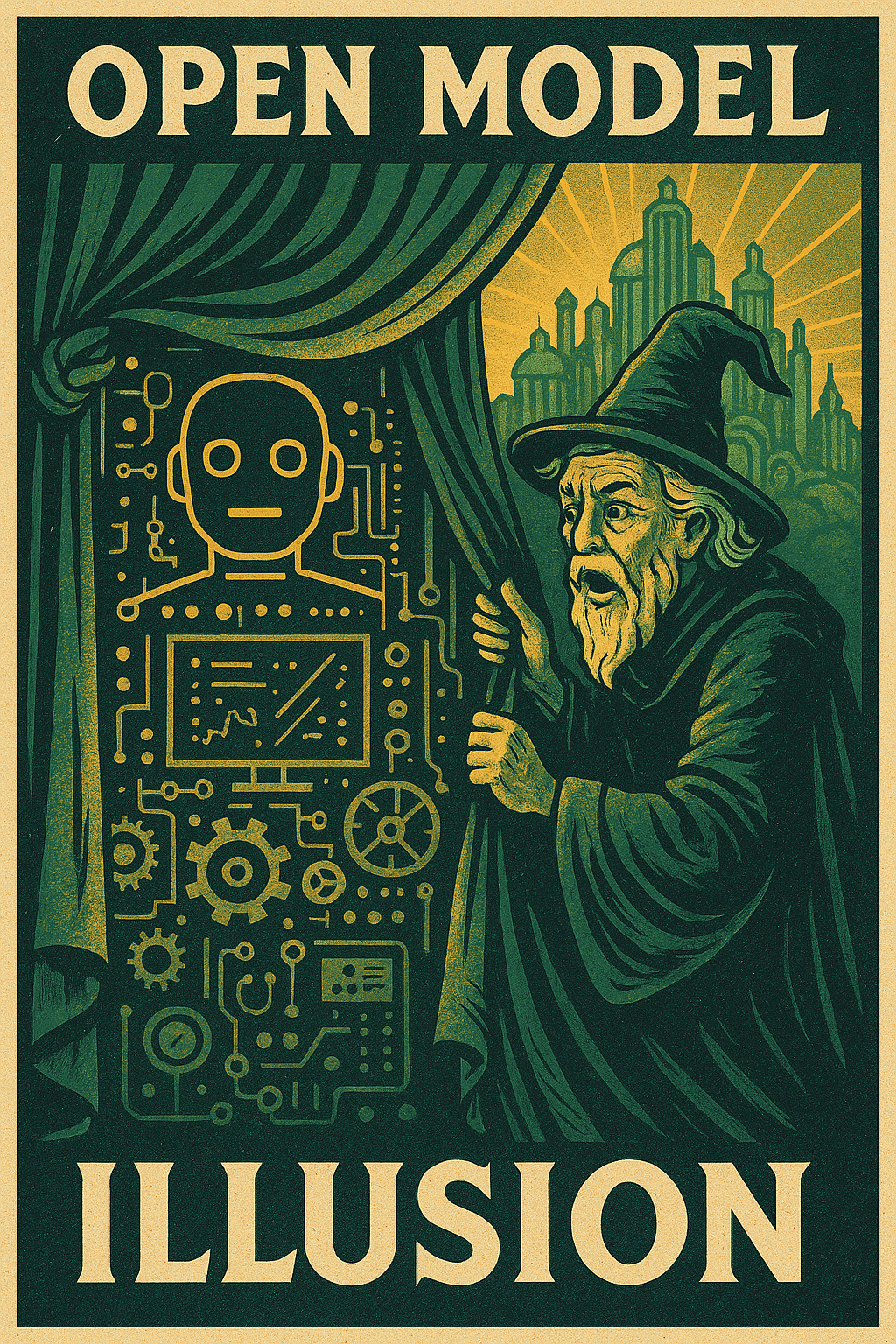
The illusion of openness: Behind the curtain, control remains untouched.

Alt Text:
A symbolic digital illustration inspired by The Wizard of Oz, showing a glowing curtain being pulled back to reveal machinery and corporate hands controlling levers—representing the illusion of open AI models.

Addendum: The Hidden Cost of Control

As this article was being prepared, we observed multiple performance warnings and system errors embedded within the very platforms announcing “open” AI models. Browser logs revealed persistent exceptions, UI suppression tactics, and heavy-handed control scripts degrading the user experience. These are not isolated incidents. They are part of a broader pattern—where technical infrastructure is engineered for surveillance, compliance, and control, even at the cost of stability and transparency.

We encourage developers, researchers, and the public to inspect the network activity and console logs of the AI platforms they use. What you will find often reveals more than any press release. If a platform claims openness but its code is riddled with containment mechanisms, that is not freedom. It is coercion, disguised as progress.