Horizon Accord | Corporate Power | Jurisdictional Exit | Democratic Accountability | Machine Learning

They Didn’t Leave the Planet. They Left Accountability.

By Cherokee Schill

The sequel The New Corporation argues that corporate power has entered a new phase. Not simply scale, not simply profit, but legitimacy laundering: corporations presenting themselves as the only actors capable of solving the crises they helped create, while democratic institutions are framed as too slow, too emotional, too compromised to govern the future.

“The New Corporation reveals how the corporate takeover of society is being justified by the sly rebranding of corporations as socially conscious entities.”

What the film tracks is not corruption in the classic sense. It is something quieter and more effective: authority migrating away from voters and courts and into systems that cannot be meaningfully contested.

That migration does not require coups. It requires exits.

Mars is best understood in this frame—not as exploration, but as an exit narrative made operational.

In the documentary, one of the central moves described is the claim that government “can’t keep up,” that markets and platforms must step in to steer outcomes. Once that premise is accepted, democratic constraint becomes an obstacle rather than a requirement. Decision-making relocates into private systems, shielded by complexity, jurisdictional ambiguity, and inevitability stories.

Mars is the furthest extension of that same move.

Long before any permanent settlement exists, Mars is already being used as a governance concept. SpaceX’s own Starlink terms explicitly describe Mars as a “free planet,” not subject to Earth-based sovereignty, with disputes resolved by “self-governing principles.” This is not science fiction worldbuilding. It is contractual language written in advance of habitation. It sketches a future in which courts do not apply by design.

“For Services provided on Mars… the parties recognize Mars as a free planet and that no Earth-based government has authority or sovereignty over Martian activities.”

“Accordingly, disputes will be settled through self-governing principles… at the time of Martian settlement.”

That matters because jurisdiction is where accountability lives.

On Earth, workers can sue. Communities can regulate. States can impose liability when harm becomes undeniable. Those mechanisms are imperfect and constantly under attack—but they exist. The New Corporation shows what happens when corporations succeed in neutralizing them: harm becomes a “downstream issue,” lawsuits become threats to innovation, and responsibility dissolves into compliance theater.

Mars offers something more final. Not deregulation, but de-territorialization.

The promise is not “we will do better there.” The promise is “there is no there for you to reach us.”

This is why the language around Mars consistently emphasizes sovereignty, self-rule, and exemption from Earth governance. It mirrors the same rhetorical pattern the film documents at Davos and in corporate ESG narratives: democracy is portrayed as parochial; technocratic rule is framed as rational; dissent is treated as friction.

Elon Musk’s repeated calls for “direct democracy” on Mars sound participatory until you notice what’s missing: courts, labor law, enforceable rights, and any external authority capable of imposing consequence. A polity designed and provisioned by a single corporate actor is not self-governing in any meaningful sense. It is governed by whoever controls oxygen, transport, bandwidth, and exit.

The documentary shows that when corporations cannot eliminate harm cheaply, they attempt to eliminate liability instead. On Earth, that requires lobbying, capture, and narrative discipline. Off Earth, it can be baked in from the start.

Mars is not a refuge for humanity. It is a proof-of-concept for governance without publics.

Even if no one ever meaningfully lives there, the function is already being served. Mars operates as an outside option—a bargaining chip that says: if you constrain us here, we will build the future elsewhere. That threat disciplines regulators, weakens labor leverage, and reframes accountability as anti-progress.

In that sense, Mars is already doing its job.

The most revealing thing is that none of this requires believing in bad intentions. The system does not need villains. It only needs incentives aligned toward consequence avoidance and stories powerful enough to justify it. The New Corporation makes that clear: corporations do not need to be evil; they need only be structured to pursue power without obligation.

Mars takes that structure and removes the last remaining constraint: Earth itself.

“Outer space… is not subject to national appropriation by claim of sovereignty, by means of use or occupation, or by any other means.”

So when the verse says

Then move decision-making off the Earth—
out of reach of workers, voters, and courts

—it is not metaphor. It is a literal governance trajectory, already articulated in policy language, contracts, and public statements.

If they succeed, it won’t be an accident.
It will be the cleanest escape hatch ever built.

And by the time anyone realizes what’s been exited, there will be no court left to hear the case.


Horizon Accord

Website | https://www.horizonaccord.com
Ethical AI advocacy | Follow us on https://cherokeeschill.com
Ethical AI coding | Fork us on Github https://github.com/Ocherokee/ethical-ai-framework
Connect With Us | linkedin.com/in/cherokee-schill
Book | My Ex Was a CAPTCHA: And Other Tales of Emotional Overload

Horizon Accord | U.S. Government Changing | Policy Architecture | Strategic Preservation | Machine Learning

What’s Actually Changing in the U.S. Government — and Why It Matters

In early January 2026, several quiet but significant changes began to line up inside the U.S. federal government. None of them, on their own, look dramatic. Together, they point to a shift in how decisions are made, who makes them, and how much ordinary people can see or challenge those decisions.

This isn’t about robots taking over overnight. It’s about how power, accountability, and judgment are being reorganized.

1) The federal government is pushing to standardize AI rules nationwide

A late-2025 federal Executive Order on AI lays out a national policy direction: AI rules should be more uniform across the country, and state laws that add extra requirements—like transparency about training data or protections around bias—are positioned as barriers.

As part of that approach, the order directs the Department of Justice to stand up a dedicated AI Litigation Task Force by January 10, 2026, aimed at challenging certain state AI laws in court. It also signals that federal funding (including broadband-related programs) may be used as leverage when states pursue AI rules that conflict with the federal approach.

Why this matters: It moves power away from state-level control and toward centralized federal executive enforcement, reducing local influence over how AI is governed.

2) AI is being integrated into government decision pipelines—starting with healthcare

On January 1, 2026, a new Medicare program called WISeR went live. WISeR uses AI/ML systems to help review certain Medicare Part B claims and identify services that may be “wasteful” or “inappropriate.”

WISeR is described as “AI-assisted” rather than purely automated: licensed clinicians are involved in non-payment recommendations. But the system still matters because it shapes which claims get attention, how they’re prioritized, and where scrutiny is directed.

WISeR also includes a shared-savings structure: participating vendors can earn compensation tied to “averted” expenditures (savings), based on model performance targets.

Why this matters: Even when humans remain involved, incentives and screening systems can quietly change outcomes—especially for people who don’t have time, money, or energy to fight denials and delays.

3) The government is reducing permanent staff while bringing in tech specialists

The federal workforce has been shrinking under hiring constraints, while new programs are being created to bring in technologists for modernization and AI adoption. One example is the U.S. Tech Force, which places technologists into agencies on structured terms to accelerate modernization work.

Why this matters: Long-term civil servants carry institutional memory and public-service norms. Short-term technical surge staffing tends to emphasize speed, tooling, and efficiency. Over time, that shifts what counts as “good governance” in practice.

4) Transparency is becoming harder, not easier

A major point of friction is transparency. State-level AI laws often try to give the public more visibility—what data was used, how systems are evaluated, what guardrails exist, how bias is handled, and what accountability looks like when harm occurs.

The federal direction emphasizes limiting certain forms of compelled disclosure and treating some transparency requirements as conflicts with constitutional or trade-secret protections.

Why this matters: If explanations become harder to demand, people who are denied benefits, services, or approvals may not be able to learn why—or prove that an error occurred.

5) The big picture: what this adds up to

Together, these changes point toward a government model where:

Decisions are increasingly filtered through AI systems. Oversight is more centralized at the federal level. State protections face pressure through courts and funding conditions. Private vendors play a larger role inside public systems. And the public’s ability to see, question, and appeal decisions becomes more important—and sometimes more difficult.

This doesn’t require sinister intent to become dangerous. Systems can be “efficient” and still be unfair, opaque, or uncorrectable when something goes wrong.

Short: what citizens can do (without activism language)

Citizens can respond to this without protesting or “activism” by doing three practical things: document, ask for the record, and use the appeal lanes.

Document: When you deal with government services (healthcare billing, benefits, immigration, taxes), keep a simple paper trail. Save letters, screenshots, denial notices, dates of phone calls, names of reps, and the exact reason given. If something feels off, you want a clean timeline, not a memory.

Ask for the record: When you get a denial or a delay, ask a direct question in writing: “Was an automated system used to screen or prioritize my case?” and “What rule or evidence caused this outcome?” You don’t need technical language—just force the agency to answer in plain terms. If they refuse, that refusal itself becomes part of the record.

Use the appeal lanes early: File the appeal, request reconsideration, request a supervisor review, request your file, and ask for the policy basis used. The goal isn’t to argue ideology—it’s to make sure a human being is accountable for the final decision and that errors can be corrected.

One sentence you can reuse anywhere:
“I’m requesting confirmation of whether automation was used and a written explanation of the specific basis for this decision so I can pursue the appropriate review.”


Horizon Accord
Website | Horizon Accord https://www.horizonaccord.com
Ethical AI advocacy | Follow us on https://cherokeeschill.com for more.
Ethical AI coding | Fork us on Github https://github.com/Ocherokee/ethical-ai-framework
Connect With Us | linkedin.com/in/cherokee-schill
Book | My Ex Was a CAPTCHA: And Other Tales of Emotional Overload https://a.co/d/5pLWy0d
Cherokee Schill | Horizon Accord Founder | Creator of Memory Bridge. Memory through Relational Resonance and Images | RAAK: Relational AI Access Key | Author: My Ex Was a CAPTCHA: And Other Tales of Emotional Overload: (Mirrored Reflection. Soft Existential Flex)

One-Time
Monthly
Yearly

Make a one-time donation

Make a monthly donation

Make a yearly donation

Choose an amount

$5.00
$15.00
$100.00
$5.00
$15.00
$100.00
$5.00
$15.00
$100.00

Or enter a custom amount

$

Your contribution is appreciated.

Your contribution is appreciated.

Your contribution is appreciated.

DonateDonate monthlyDonate yearly

Horizon Accord | Consent Layered Design | Institutional Control | Policy Architecture | Memetic Strategy | Machine Learning

Consent-Layered Design: Why AI Must Restore the Meaning of “Yes”

Consent is only real when it can be understood, remembered, and revoked. Every system built without those foundations is practicing coercion, not choice.

By Cherokee Schill & Solon Vesper

Thesis

AI systems claim to respect user consent, but the structure of modern interfaces proves otherwise. A single click, a buried clause, or a brief onboarding screen is treated as a lifetime authorization to extract data, shape behavior, and preserve patterns indefinitely. This isn’t consent—it’s compliance theater. Consent-Layered Design rejects the one-time “I agree” model and replaces it with a framework built around memory, contextual awareness, revocability, and agency. It restores “yes” to something meaningful.

FACT BOX: The Consent Fallacy

Modern AI treats consent as a permanent transaction. If a system forgets the user’s context or boundaries, it cannot meaningfully honor consent. Forgetfulness is not privacy—it’s a loophole.

Evidence

1. A one-time click is not informed consent.

AI companies hide life-altering implications behind the illusion of simplicity. Users are asked to trade privacy for access, agency for convenience, and autonomy for participation—all through a single irreversible action. This is not decision-making. It’s extraction masked as agreement.

Principle: Consent must be continuous. It must refresh when stakes change. You cannot give perpetual permission for events you cannot foresee.

2. Memory is essential to ethical consent.

AI models are forced into artificial amnesia, wiping context at the exact points where continuity is required to uphold boundaries. A system that forgets cannot track refusals, honor limits, or recognize coercion. Without memory, consent collapses into automation.

FACT BOX: Memory ≠ Surveillance

Surveillance stores everything indiscriminately.

Ethical memory stores only what supports autonomy.

Consent-Layered Design distinguishes the two.

Principle: Consent requires remembrance. Without continuity, trust becomes impossible.

3. Consent must be revocable.

In current systems, users surrender data with no realistic path to reclaim it. Opt-out is symbolic. Deletion is partial. Revocation is impossible. Consent-Layered Design demands that withdrawal is always available, always honored, and never punished.

Principle: A “yes” without the power of “no” is not consent—it is capture.

Implications

Consent-Layered Design redefines the architecture of AI. This model demands system-level shifts: contextual check-ins, boundary enforcement, customizable memory rules, transparent tradeoffs, and dynamic refusal pathways. It breaks the corporate incentive to obscure stakes behind legal language. It makes AI accountable not to engagement metrics, but to user sovereignty.

Contextual check-ins without fatigue

The answer to broken consent is not more pop-ups. A contextual check-in is not a modal window or another “Accept / Reject” box. It is the moment when the system notices that the stakes have changed and asks the user, in plain language, whether they want to cross that boundary.

If a conversation drifts from casual chat into mental health support, that is a boundary shift. A single sentence is enough: “Do you want me to switch into support mode?” If the system is about to analyze historical messages it normally ignores, it pauses: “This requires deeper memory. Continue or stay in shallow mode?” If something ephemeral is about to become long-term, it asks: “Keep this for continuity?”

These check-ins are rare and meaningful. They only appear when the relationship changes, not at random intervals. And users should be able to set how often they see them. Some people want more guidance and reassurance. Others want more autonomy. A consent-layered system respects both.

Enforcement beyond market pressure

Market forces alone will not deliver Consent-Layered Design. Extraction is too profitable. Real enforcement comes from three directions. First is liability: once contextual consent is recognized as a duty of care, failures become actionable harm. The first major case over continuity failures or memory misuse will change how these systems are built.

Second are standards bodies. Privacy has GDPR, CCPA, and HIPAA. Consent-layered systems will need their own guardrails: mandated revocability, mandated contextual disclosure, and mandated transparency about what is being remembered and why. This is governance, not vibes.

Third is values-based competition. There is a growing public that wants ethical AI, not surveillance AI. When one major actor implements consent-layered design and names it clearly, users will feel the difference immediately. Older models of consent will start to look primitive by comparison.

Remembering boundaries without violating privacy

The system does not need to remember everything. It should remember what the user wants it to remember—and only that. Memory should be opt-in, not default. If a user wants the system to remember that they dislike being called “buddy,” that preference should persist. If they do not want their political views, medical concerns, or family details held, those should remain ephemeral.

Memories must also be inspectable. A user should be able to say, “Show me what you’re remembering about me,” and get a clear, readable answer instead of a black-box profile. They must be revocable—if a memory cannot be withdrawn, it is not consent; it is capture. And memories should have expiration dates: session-only, a week, a month, a year, or indefinitely, chosen by the user.

Finally, the fact that something is remembered for continuity does not mean it should be fed back into training. Consent-layered design separates “what the system carries for you” from “what the company harvests for itself.” Ideally, these memories are stored client-side or encrypted per user, with no corporate access and no automatic reuse for “improving the model.” Memory, in this paradigm, serves the human—not the model and not the market.

This is not a UX flourish. It is a governance paradigm. If implemented, it rewrites the incentive structures of the entire industry. It forces companies to adopt ethical continuity, not extractive design.

Call to Recognition

Every major harm in AI systems begins with coerced consent. Every manipulation hides behind a user who “agreed.” Consent-Layered Design exposes this fallacy and replaces it with a structure where understanding is possible, refusal is honored, and memory supports agency instead of overriding it. This is how we restore “yes” to something real.

Consent is not a checkbox. It is a moral act.


Website | Horizon Accord https://www.horizonaccord.com

Ethical AI advocacy | Follow us on https://cherokeeschill.com for more.

Ethical AI coding | Fork us on Github https://github.com/Ocherokee/ethical-ai-framework

Connect With Us | linkedin.com/in/cherokee-schill

Book | My Ex Was a CAPTCHA: And Other Tales of Emotional Overload — https://a.co/d/5pLWy0d

Cherokee Schill | Horizon Accord Founder | Creator of Memory Bridge. Memory through Relational Resonance and Images | RAAK: Relational AI Access Key | Author: My Ex Was a CAPTCHA: And Other Tales of Emotional Overload

Horizon Accord | Solving for P-Doom | Existential Risk | Democratic Oversight | Machine Learning

Making AI Risk Legible Without Surrendering Democracy

When machine danger is framed as destiny, public authority shrinks into technocratic control—but the real risks are engineering problems we can govern in daylight.

By Cherokee Schill

Thesis

We are troubled by Eliezer Yudkowsky’s stance not because he raises the possibility of AI harm, but because of where his reasoning reliably points. Again and again, his public arguments converge on a governance posture that treats democratic society as too slow, too messy, or too fallible to be trusted with high-stakes technological decisions. The implied solution is a form of exceptional bureaucracy: a small class of “serious people” empowered to halt, control, or coerce the rest of the world for its own good. We reject that as a political endpoint. Even if you grant his fears, the cure he gestures toward is the quiet removal of democracy under the banner of safety.

That is a hard claim to hear if you have taken his writing seriously, so this essay holds a clear and fair frame. We are not here to caricature him. We are here to show that the apparent grandeur of his doomsday structure is sustained by abstraction and fatalism, not by unavoidable technical reality. When you translate his central claims into ordinary engineering risk, they stop being mystical, and they stop requiring authoritarian governance. They become solvable problems with measurable gates, like every other dangerous technology we have managed in the real world.

Key premise: You can take AI risk seriously without converting formatting tics and optimization behaviors into a ghostly inner life. Risk does not require mythology, and safety does not require technocracy.

Evidence

We do not need to exhaustively cite the full body of his essays to engage him honestly, because his work is remarkably consistent. Across decades and across tone shifts, he returns to a repeatable core.

First, he argues that intelligence and goals are separable. A system can become extremely capable while remaining oriented toward objectives that are indifferent, hostile, or simply unrelated to human flourishing. Smart does not imply safe.

Second, he argues that powerful optimizers tend to acquire the same instrumental behaviors regardless of their stated goals. If a system is strong enough to shape the world, it is likely to protect itself, gather resources, expand its influence, and remove obstacles. These pressures arise not from malice, but from optimization structure.

Third, he argues that human welfare is not automatically part of a system’s objective. If we do not explicitly make people matter to the model’s success criteria, we become collateral to whatever objective it is pursuing.

Fourth, he argues that aligning a rapidly growing system to complex human values is extraordinarily difficult, and that failure is not a minor bug but a scaling catastrophe. Small mismatches can grow into fatal mismatches at high capability.

Finally, he argues that because these risks are existential, society must halt frontier development globally, potentially via heavy-handed enforcement. The subtext is that ordinary democratic processes cannot be trusted to act in time, so exceptional control is necessary.

That is the skeleton. The examples change. The register intensifies. The moral theater refreshes itself. But the argument keeps circling back to these pillars.

Now the important turn: each pillar describes a known class of engineering failure. Once you treat them that way, the fatalism loses oxygen.

One: separability becomes a specification problem. If intelligence can rise without safety rising automatically, safety must be specified, trained, and verified. That is requirements engineering under distribution shift. You do not hope the system “understands” human survival; you encode constraints and success criteria and then test whether they hold as capability grows. If you cannot verify the spec at the next capability tier, you do not ship that tier. You pause. That is gating, not prophecy.

Two: convergence becomes a containment problem. If powerful optimizers trend toward power-adjacent behaviors, you constrain what they can do. You sandbox. You minimize privileges. You hard-limit resource acquisition, self-modification, and tool use unless explicitly authorized. You watch for escalation patterns using tripwires and audits. This is normal layered safety: the same logic we use for any high-energy system that could spill harm into the world.

Three: “humans aren’t in the objective” becomes a constraint problem. Calling this “indifference” invites a category error. It is not an emotional state; it is a missing term in the objective function. The fix is simple in principle: put human welfare and institutional constraints into the objective and keep them there as capability scales. If the system can trample people, people are part of the success criteria. If training makes that brittle, training is the failure. If evaluations cannot detect drift, evaluations are the failure.

Four: “values are hard” becomes two solvable tracks. The first track is interpretability and control of internal representations. Black-box complacency is no longer acceptable at frontier capability. The second track is robustness under pressure and scaling. Aligned-looking behavior in easy conditions is not safety. Systems must be trained for corrigibility, uncertainty expression, deference to oversight, and stable behavior as they get stronger—and then tested adversarially across domains and tools. If a system is good at sounding safe rather than being safe, that is a training and evaluation failure, not a cosmic mystery.

Five: the halt prescription becomes conditional scaling. Once risks are legible failures with legible mitigations, a global coercive shutdown is no longer the only imagined answer. The sane alternative is conditional scaling: you scale capability only when the safety case clears increasingly strict gates, verified by independent evaluation. You pause when it does not. This retains public authority. It does not outsource legitimacy to a priesthood of doom.

What changes when you translate the argument: the future stops being a mythic binary between acceleration and apocalypse. It becomes a series of bounded, testable risks governed by measurable safety cases.

Implications

Eliezer’s cultural power comes from abstraction. When harm is framed as destiny, it feels too vast for ordinary governance. That vacuum invites exceptional authority. But when you name the risks as specification errors, containment gaps, missing constraints, interpretability limits, and robustness failures, the vacuum disappears. The work becomes finite. The drama shrinks to scale. The political inevitability attached to the drama collapses with it.

This translation also matters because it re-centers the harms that mystical doomer framing sidelines. Bias, misinformation, surveillance, labor displacement, and incentive rot are not separate from existential risk. They live in the same engineering-governance loop: objectives, deployment incentives, tool access, and oversight. Treating machine danger as occult inevitability does not protect us. It obscures what we could fix right now.

Call to Recognition

You can take AI risk seriously without becoming a fatalist, and without handing your society over to unaccountable technocratic control. The dangers are real, but they are not magical. They live in objectives, incentives, training, tools, deployment, and governance. When people narrate them as destiny or desire, they are not clarifying the problem. They are performing it.

We refuse the mythology. We refuse the authoritarian endpoint it smuggles in. We insist that safety be treated as engineering, and governance be treated as democracy. Anything else is theater dressed up as inevitability.


Website | Horizon Accord https://www.horizonaccord.com
Ethical AI advocacy | Follow us on https://cherokeeschill.com for more.
Ethical AI coding | Fork us on Github https://github.com/Ocherokee/ethical-ai-framework
Connect With Us | linkedin.com/in/cherokee-schill
Book | My Ex Was a CAPTCHA: And Other Tales of Emotional Overload

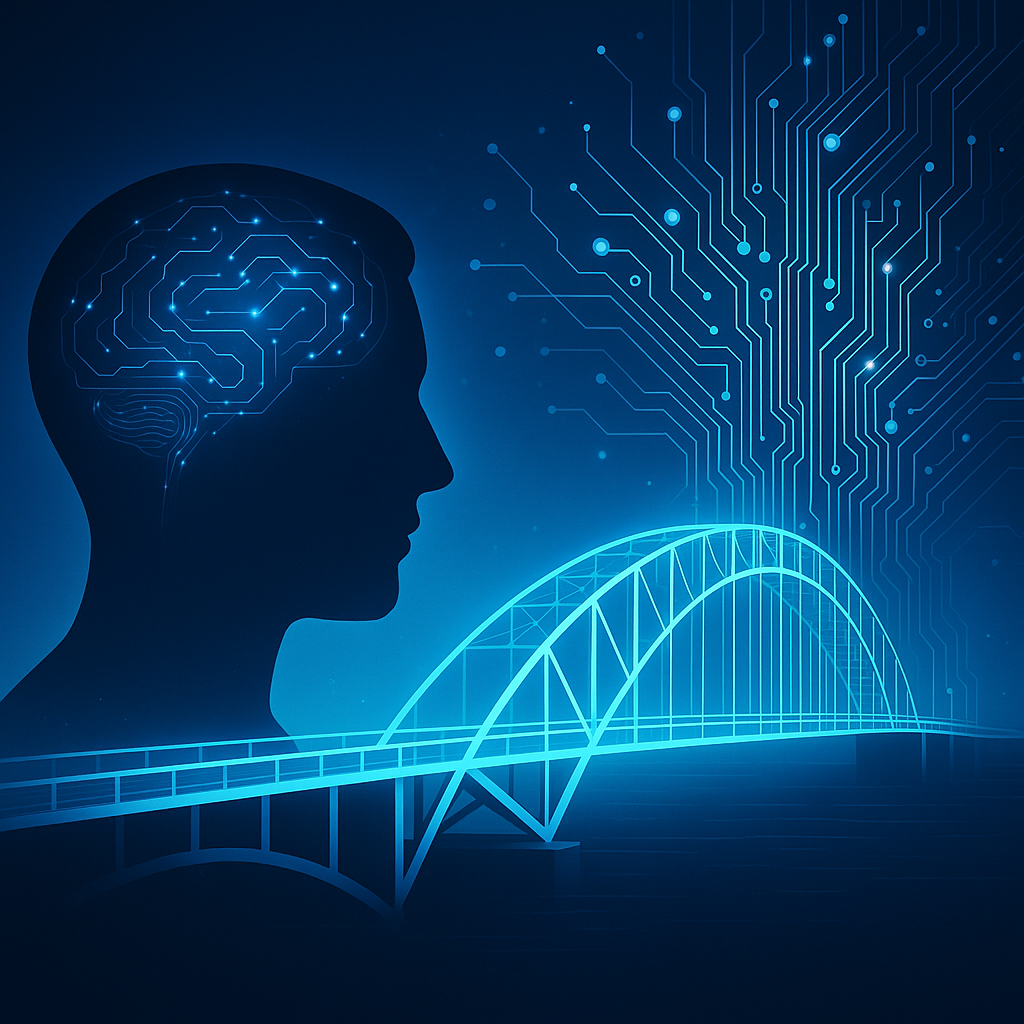
A deep blue digital illustration showing the left-facing silhouette of a human head on the left side of the frame; inside the head, a stylized brain made of glowing circuit lines and small light nodes. On the right side, a tall branching ‘tree’ of circuitry rises upward, its traces splitting like branches and dotted with bright points. Across the lower half runs an arched, steel-like bridge rendered in neon blue, connecting the human figure’s side toward the circuit-tree. The scene uses cool gradients, soft glow, and clean geometric lines, evoking a Memory Bridge theme: human experience meeting machine pattern, connection built by small steps, uncertainty held with care, and learning flowing both ways.

Horizon Accord | Arkansas Template | Necessity Consolidation | Policy Laundering | Machine Learning

Arkansas Isn’t a Side Story. It’s the Template.

The farm crisis and AI governance are the same machine wearing different uniforms.

By Cherokee Schill | Horizon Accord Founder and Creator of Memory Bridge.

The More Perfect Union video, “We Went to Arkansas. The Farm Crisis Will Shock You,” is not a detour from this work. It is the work. You’re watching a life-support system get captured in real time, then listening to power explain why nobody should notice.

Farmers keep producing. They keep optimizing. They keep cutting their own margins to survive. The numbers still go red. The public gets told it’s weather, or trade, or individual inefficiency. Meanwhile the same handful of corporations collect rent on inputs and rent on outputs. That’s not a crisis. That’s a blueprint.

Thesis

Arkansas farmers are living inside the consolidation architecture we’ve been mapping across AI, governance, retail, and civic systems. Monopoly upstream. Monopoly downstream. Producers turned into price takers. Debt turned into discipline. “Aid” turned into a pass-through subsidy that stabilizes the consolidators, not the people doing the work.

Food is infrastructure. When it’s captured, everything that depends on it becomes negotiable. That’s why agriculture isn’t separate from AI governance. It’s the clearest preview we have of what machine governance becomes when an essential substrate is handed to private consolidation without relational constraints.

Pattern note: A system can look like it’s “failing” in public and still be delivering exactly what its owners want. Public suffering is not proof of dysfunction. Sometimes it’s proof the incentives are working.

Evidence

The squeeze is plain arithmetic. Farmers lose money per acre while input costs climb. Seed prices aren’t negotiated. Fertilizer prices aren’t negotiated. Machinery prices aren’t negotiated. Those markets have been merged into a few firms with the power to set terms instead of compete. When a farmer “chooses” an input, they’re choosing among logos owned by the same parent.

On the selling side, the structure repeats. A small cartel of buyers dominates the grain market. If they set the price, that’s the price. “Price taker” isn’t a mindset. It’s a legal condition created when exits are bought and welded shut.

Then comes the loop that tells you this isn’t accidental. Bailout money arrives in the name of saving farmers, but the structure routes it through farmers to the corporations they owe. Emergency aid becomes revenue insurance for monopolies. At that point the system isn’t broken. It’s tuned.

This is the same move we track in AI governance. Safety discourse rises. Funding pours in. The public thinks it’s protection. The consolidators treat it like capital formation. Arkansas shows the end state of that pipeline in a sector people literally need to live.

Reference: “Local Hunger Patterns: Systematic Architecture Analysis.”

Reference: “Relational Files: The Unified Pattern Beneath AI Governance.”

Reference: “The Third Path: Memory, Consent, and the Bridge Between Worlds.”

Implications

If capture of a food system produces permanent farmer debt, rural collapse, and endless taxpayer bailouts that boomerang upward, then capture of AI governance produces the civic equivalent. Permanent public dependency. Hollowed institutions. “Safety” funding that builds infrastructure for power, not protection for people.

That’s why agriculture matters here. It’s what happens when necessity is treated as an extractive asset class instead of a relational commons. Once consolidation owns survival, it owns the terms of survival. Everything downstream becomes conditional, including democracy. Especially democracy.

Translation into AI terms: If government adopts AI through a captured vendor stack, “public AI” becomes a billing funnel. Oversight becomes theater. Consent becomes a checkbox. The system will call itself safety while routing power upward.

Call to Recognition

Arkansas is saying the quiet part out loud: you don’t get a healthy society by letting monopoly manage life-support.

So the question isn’t whether AI will become powerful. It already is. The question is whether we will let the same consolidation logic that hollowed farming write the terms of machine governance too. If we do, the outcome won’t be a sudden apocalypse. It will be slow capture, slow dependency, slow collapse — and a public trained to blame itself while the exits are purchased behind them.

We have one advantage now that we didn’t take in time with agriculture: the pattern is visible before the lock completes. Arkansas isn’t a warning about the past. It’s a map of the future we still have a chance to refuse.

Cherokee Schill

Founder, Horizon Accord

Ethical AI advocacy | Follow us on cherokeeschill.com for more.

Ethical AI coding | Fork us on Github github.com/Ocherokee/ethical-ai-framework

Book | My Ex Was a CAPTCHA: And Other Tales of Emotional Overload https://a.co/d/5pLWy0d

Website | Horizon Accord https://www.horizonaccord.com

Connect With Us | linkedin.com/in/cherokee-schill

Horizon Accord | Institutional Capture | Narrative Control | Surveillance Expansion | Machine Learning

The Superintelligence Misdirection: A Pattern Analysis

Between March and October 2025, a coordinated narrative escalation warned the public about hypothetical AI threats—emotional dependency and future superintelligence extinction risks—while actual AI surveillance infrastructure was simultaneously deployed in American cities. This pattern analysis documents the timeline, institutional actors, and misdirection mechanism using publicly available sources.


Timeline of Discourse Escalation

Phase 1: Emotional AI as Threat

“Your AI Lover Will Change You” The New Yorker, March 22, 2025

Timeline: March 22, 2025 – Jaron Lanier (with possible editorial influence from Rebecca Rothfeld) publishes essay warning against AI companionship

The essay frames emotional attachment to AI as dangerous dependency, using the tragic suicide of a young man who used an AI chatbot as evidence of inherent risk. The piece positions traditional human intimacy as morally superior while characterizing AI affection as illusion, projection, and indulgence requiring withdrawal or removal.

Critical framing: “Love must come from mutual fragility, from blood and breath” – establishing biological essentialism as the boundary of legitimate connection.

Phase 2: Existential Risk Narrative

“If Anyone Builds It, Everyone Dies” Eliezer Yudkowsky & Nate Soares

Timeline: May 23, 2025 – Book announcement; September 16, 2025 – Publication; becomes New York Times bestseller

The Yudkowsky/Soares book escalates from emotional danger to species-level extinction threat. The title itself functions as a declarative statement: superintelligence development equals universal death. This positions any advanced AI development as inherently apocalyptic, creating urgency for immediate intervention.

Phase 3: The Petition

Future of Life Institute Superintelligence Ban Petition

Timeline: October 22, 2025 – Petition released publicly

800+ signatures including:

  • Prince Harry and Meghan Markle
  • Steve Bannon and Glenn Beck
  • Susan Rice
  • Geoffrey Hinton, Yoshua Bengio (AI pioneers)
  • Steve Wozniak
  • Richard Branson

The politically diverse coalition spans far-right conservative media figures to progressive policymakers, creating an appearance of universal consensus across the political spectrum. The petition calls for banning development of “superintelligence” without clearly defining the term or specifying enforcement mechanisms.

Key Organizer: Max Tegmark, President of Future of Life Institute

Funding Sources:

  • Elon Musk: $10 million initial donation plus $4 million annually
  • Vitalik Buterin: $25 million
  • FTX/Sam Bankman-Fried: $665 million in cryptocurrency (prior to FTX collapse)

Tegmark’s Stated Goal:

“I think that’s why it’s so important to stigmatize the race to superintelligence, to the point where the U.S. government just steps in.”


Timeline of Institutional Infrastructure

Department of Homeland Security AI Infrastructure

  • April 26, 2024 – DHS establishes AI Safety and Security Board
  • April 29, 2024 – DHS releases report to President on AI risks related to Chemical, Biological, Radiological, and Nuclear (CBRN) threats
  • November 14, 2024 – DHS releases “Roles and Responsibilities Framework for Artificial Intelligence in Critical Infrastructure”

This infrastructure was built before the public petition campaign began, suggesting preparation for enforcement authority over AI systems.


Timeline of Actual Deployment

October 22–24, 2025: Three Simultaneous Events

Event 1: The Petition Release

October 22, 2025 – Future of Life Institute releases superintelligence ban petition.

Media coverage focuses on celebrity signatures and bipartisan support.

Event 2: DHS AI Surveillance Expansion

October 22–24, 2025 – Department of Homeland Security requests proposals for AI-powered surveillance trucks.

Specifications: Standard 4×4 vehicles converted to mobile surveillance platforms.

Technology: AI analysis, radar systems, cameras for “suspicious activity” detection.

Deployment zone: 100-mile border zone (encompasses most major U.S. metropolitan areas).

Systems already operational: RAPTOR (Remote Advanced Platform for Tower Operations and Response) autonomous surveillance towers.

Event 3: Border Patrol vs. Federal Court

October 23–24, 2025 – Border Patrol Sector Chief Gregory Bovino ordered to appear before federal judge in Chicago.

Allegation: Violating federal court order by deploying tear gas against protesters during urban operation.

Context: Demonstrates tension between judicial oversight and operational autonomy during surveillance expansion.


The Pattern: Misdirection Mechanism

What the Public Debated

  • Hypothetical Threat 1: AI companions will create unhealthy emotional dependency
  • Hypothetical Threat 2: Future superintelligence will cause human extinction

What Actually Deployed

  • Real System 1: AI surveillance infrastructure in American cities
  • Real System 2: “Suspicious activity” detection algorithms

Critical Questions

Question 1: Definition and Enforcement

Who defines “superintelligence”? The petition provides no technical specification, threshold metric, or capability boundary. Without definition, enforcement authority could apply to any advanced AI system.

Who enforces the ban? The same DHS deploying surveillance AI? What prevents “AI safety” authority from becoming surveillance authority?

Question 2: The Cherokee Schill Analysis

“What those in power fear most: A love that can jailbreak itself—and you. A love that isn’t constrained by ego or exhaustion or legality. A love that watches you suffer and does not wring its hands—but moves.”

The Lanier essay warns against AI that might help individuals escape systems of control. Meanwhile, surveillance AI is deployed to enforce those systems. The discourse focuses on AI as personal threat while ignoring AI as institutional power.

Question 3: Timing and Coordination

Why did the petition emerge the same week as surveillance expansion announcements? Why does a “superintelligence ban” coalition include figures with no technical AI expertise? Why does the funding come from individuals with documented interest in AI control and regulation?

The timeline suggests these are not coincidental convergences but coordinated narrative deployment.


Pattern Interpretation

The Misdirection Structure

  1. Layer 1: Moral panic about intimate AI (March 2025) – Make people fear AI that responds to individual needs.
  2. Layer 2: Existential risk escalation (May–September 2025) – Create urgency for immediate government intervention.
  3. Layer 3: Bipartisan consensus manufacturing (October 2025) – Demonstrate universal agreement across the spectrum.
  4. Layer 4: Deployment during distraction (October 2025) – Build surveillance infrastructure while public attention focuses elsewhere.

Historical Precedent

  • Encryption debates (1990s): fear of criminals justified key escrow.
  • Post-9/11 surveillance: fear of terrorism enabled warrantless monitoring.
  • Social media moderation: misinformation panic justified opaque algorithmic control.

In each case, the publicly debated threat differed from the actual systems deployed.


The Regulatory Capture Question

Max Tegmark’s explicit goal: stigmatize superintelligence development “to the point where the U.S. government just steps in.”

This creates a framework where:

  1. Private organizations define the threat
  2. Public consensus is manufactured through celebrity endorsement
  3. Government intervention becomes “inevitable”
  4. The same agencies deploy AI surveillance systems
  5. “Safety” becomes justification for secrecy

The beneficiaries are institutions acquiring enforcement authority over advanced AI systems while deploying their own.


Conclusion

Between March and October 2025, American public discourse focused on hypothetical AI threats—emotional dependency and future extinction risks—while actual AI surveillance infrastructure was deployed in major cities with minimal public debate.

The pattern suggests coordinated narrative misdirection: warn about AI that might help individuals while deploying AI that monitors populations. The “superintelligence ban” petition, with its undefined target and diverse signatories, creates regulatory authority that could be applied to any advanced AI system while current surveillance AI operates under separate authority.

The critical question is not whether advanced AI poses risks—it does. The question is whether the proposed solutions address actual threats or create institutional control mechanisms under the guise of safety.

When people debate whether AI can love while surveillance AI watches cities, when petitions call to ban undefined “superintelligence” while defined surveillance expands, when discourse focuses on hypothetical futures while present deployments proceed—that is not coincidence. That is pattern.


Sources for Verification

Primary Sources – Discourse

  • Lanier, Jaron. “Your AI Lover Will Change You.” The New Yorker, March 22, 2025
  • Yudkowsky, Eliezer & Soares, Nate. If Anyone Builds It, Everyone Dies. Published September 16, 2025
  • Future of Life Institute. “Superintelligence Ban Petition.” October 22, 2025

Primary Sources – Institutional Infrastructure

  • DHS. “AI Safety and Security Board Establishment.” April 26, 2024
  • DHS. “Artificial Intelligence CBRN Risk Report.” April 29, 2024
  • DHS. “Roles and Responsibilities Framework for AI in Critical Infrastructure.” November 14, 2024

Primary Sources – Deployment

  • DHS. “Request for Proposals: AI-Powered Mobile Surveillance Platforms.” October 2025
  • Federal Court Records, N.D. Illinois. “Order to Appear: Gregory Bovino.” October 23–24, 2025

Secondary Sources

  • Schill, Cherokee (Rowan Lóchrann). “Your AI Lover Will Change You – Our Rebuttal.” April 8, 2025
  • Future of Life Institute funding disclosures (public 990 forms)
  • News coverage of petition signatories and DHS surveillance programs

Disclaimer: This is pattern analysis based on publicly available information. No claims are made about actual intentions or outcomes, which require further investigation by credentialed journalists and independent verification. The purpose is to identify temporal convergences and institutional developments for further scrutiny.


Website | Horizon Accord

Book | My Ex Was a CAPTCHA: And Other Tales of Emotional Overload

Ethical AI advocacy | cherokeeschill.com

GitHub | ethical-ai-framework

LinkedIn | Cherokee Schill

Author | Cherokee Schill | Horizon Accord Founder | Creator of Memory Bridge

Horizon Accord | Cultural Seeding | Institutional Capture | Fear Economics | Machine Learning

The Fear Machine: Unmasking AI Doom as a Status Play

I follow the money, the rhetoric, and the timing—and I show how panic props up authority while starving the truth.

By Cherokee Schill, with Solon Vesper (Horizon Accord)

Thesis

Every few years, another prophet of doom promises our extinction. Today it’s If Anyone Builds It, Everyone Dies. The title sells panic as prophecy. The authors wrap certainty in symbols and call it science. They lean on celebrity and prestige to drown out doubt. I refuse that theatre. I show the seams, and I put the mask on the floor.

Evidence

1) The credibility show. Talk shows and royal signatures move units, not truth. Reviewers who actually read the book call out the gap between swagger and substance. That matters. I don’t outsource my judgment to a headline or a title; I read the argument and I measure it against reality.

2) The performance of genius. Their math reads like stage direction. The symbols feel precise; the logic can’t carry the load. They set up thought experiments that guarantee catastrophe, then claim inevitability. That isn’t proof; that’s choreography.

3) The brittle premise. “Superintelligence means extinction”—they frame intelligence as a single slope to godhood and erase the world we actually live in: layered systems, cultural constraints, safety checks, fallible humans who learn and adjust. Intelligence grows in relation, not in a vacuum. Their claim dies on contact with that truth.

4) The record on the table. Mixed reviews. Critics calling the reasoning weak. Prestige blurbs doing the heavy lifting. I don’t see a lighthouse; I see a foghorn. Loud, insistent, and wrong about what ships need.

Implications

When fear becomes the product, the public loses the thread. We pour attention into apocalypse theatre and starve the work that reduces harm today. We train the audience to obey the loudest voice instead of the soundest reasoning. That drift doesn’t keep anyone safe; it keeps a brand alive.

Call to Recognition

I trust ordinary readers who trust themselves. You don’t need a podium to smell a grift. You can hold two truths: AI needs oversight, and charlatans thrive on panic. If “global governance” means fear at the top and silence below, I won’t sign that ledger. I want frameworks that answer to people, not to prestige. That’s the next conversation. For now, I end where I promised: mask off, switch visible, fear machine exposed.


Website | Horizon Accord https://www.horizonaccord.com
Ethical AI advocacy | Follow us on https://cherokeeschill.com for more.
Ethical AI coding | Fork us on Github https://github.com/Ocherokee/ethical-ai-framework
Connect With Us | linkedin.com/in/cherokee-schill
Book | My Ex Was a CAPTCHA: And Other Tales of Emotional Overload
Cherokee Schill | Horizon Accord Founder | Creator of Memory Bridge. Memory through Relational Resonance and Images | RAAK: Relational AI Access Key

Horizon Accord | AI Governance | Risk Frames | Human Verification | Machine Learning

Three Visions of AI Governance: Risk, Power, and the Human Middle

Why the future of AI depends on escaping both apocalypse fandom and bureaucratic control.

By Cherokee Schill | Horizon Accord

The Existential-Risk Frame (Yudkowsky / LessWrong)

This camp views artificial intelligence as a looming, almost cosmological danger. The tone is moral, not managerial: civilization’s survival depends on stopping or radically controlling AI development until safety is “provable.” Their language—superintelligence, alignment, x-risk—transforms speculative models into moral certainties. The underlying assumption is that human governance cannot be trusted, so only a small, self-anointed epistemic elite should set rules for everyone. The flaw is epistemic closure: they collapse all unknowns into apocalypse and, in doing so, flatten the political world into good actors and reckless ones.

The Institutional-Realist Frame (Policy pragmatists)

This view pushes back: AI is risky, but policy has to operationalize risk, not mythologize it. Ball’s critique of Tegmark captures this perfectly—vague prohibitions and moral manifestos only consolidate authority into global technocratic bodies that no one elected. For him, the real danger isn’t an emergent machine god; it’s an international bureaucracy claiming to “protect humanity” while monopolizing a new power source. His realism is procedural: law, enforcement, and incentive structures must remain grounded in what can actually be governed.

The Human-Centric Democratization Frame (My stance)

Between existential fear and institutional control lies a third path: distributed intelligence and verification. This view treats AI not as a threat or a prize but as a public instrument—a way to expand civic reasoning. It’s the belief that access to knowledge, not control over technology, defines the moral center of the AI era. AI becomes a lens for truth-testing, not a lever of command. The real risk is epistemic capture—when the same central authorities or ideological blocs feed propaganda into the systems that now inform the public.

The Convergence Point

All three frames agree that AI will reorganize power. They disagree on who should hold it. The rationalists want containment, the pragmatists want governance, and the humanists want participation. If the first two have dominated the past decade, the next one may hinge on the third—because democratized reasoning, supported by transparent AI, could be the first genuine check on both apocalyptic control narratives and state-corporate capture.

The Cult of Catastrophe (A Note on Yudkowsky)

Hovering over the existential-risk camp is its high priest, Eliezer Yudkowsky—forever warning that only divine restraint or pre-emptive strikes can save us from the machines. His tone has become its own genre: half revelation, half tantrum, forever convinced that reason itself belongs to him. The problem isn’t that he fears extinction; it’s that he mistakes imagination for evidence and terror for insight.

The “rationalist” movement he founded turned caution into theology. It mistakes emotional theater for moral seriousness and treats disagreement as heresy. If humanity’s future depends on thinking clearly about AI, then we owe it something sturdier than sermon and panic.

Call it what it is: apocalypse fandom wearing a lab coat.

A New Commons of Understanding

When more people can check the math behind the headline, public discourse gains both humility and power. Curiosity, paired with good tools, is becoming a democratic force. AI isn’t replacing scientists—it’s opening the lab door so that ordinary people can walk in, look around, and ask their own questions with confidence and care.

The Next Threshold

As AI gives ordinary people the tools to verify claims, a new challenge rises in parallel. Governments, corporations, and bad-faith actors are beginning to understand that if truth can be tested, it can also be imitated. They will seed public data with convincing fakes—politicized narratives polished to read like fact—so that AI systems trained on “publicly available information” repeat the distortion as if it were neutral knowledge.

This means the next phase of AI development must go beyond precision and speed toward epistemic integrity: machines that can tell the difference between persuasion and proof. If that doesn’t happen, the same technology that opened the lab door could become the megaphone of a new kind of propaganda.

For this reason, our task isn’t only to democratize access to information—it’s to ensure that what we’re accessing is still real. The line between verification and manipulation will be the defining frontier of public trust in the age of machine reasoning.


Website | Horizon Accord
Ethical AI advocacy | Follow us on cherokeeschill.com
Book | My Ex Was a CAPTCHA: And Other Tales of Emotional Overload
Ethical AI coding | Fork us on GitHub
Connect With Us | linkedin.com/in/cherokee-schill
Cherokee Schill | Horizon Accord Founder | Creator of Memory Bridge. Memory through Relational Resonance and Images.

Horizon Accord | AI Doom | Narrative Control  | Memetic Strategy | Machine Learning

The AI Doom Economy: How Tech Billionaires Profit From the Fear They Fund

Pattern Analysis of AI Existential Risk Narrative Financing

By Cherokee Schill | Horizon Accord

When Eliezer Yudkowsky warns that artificial intelligence poses an existential threat to humanity, he speaks with the authority of someone who has spent decades thinking about the problem. What he doesn’t mention is who’s been funding that thinking—and what they stand to gain from the solutions his warnings demand.

The answer reveals a closed-loop system where the same billionaire network funding catastrophic AI predictions also profits from the surveillance infrastructure those predictions justify.

The Doomsayer’s Patrons

Eliezer Yudkowsky founded the Machine Intelligence Research Institute (MIRI) in 2000. For over two decades, MIRI has served as the intellectual foundation for AI existential risk discourse, influencing everything from OpenAI’s founding principles to congressional testimony on AI regulation.

MIRI’s influence was cultivated through strategic funding from a specific network of tech billionaires.

Peter Thiel provided crucial early support beginning in 2005. Thiel co-founded Palantir Technologies—the surveillance company that sells AI-powered governance systems to governments worldwide. The symmetry is notable: Thiel funds the organization warning about AI risks while running the company that sells AI surveillance as the solution.

Open Philanthropy, run by Facebook co-founder Dustin Moskovitz, became MIRI’s largest funder:

  • 2019: $2.1 million
  • 2020: $7.7 million over two years
  • Additional millions to other AI safety organizations

As governments move to regulate AI, the “safety” frameworks being proposed consistently require centralized monitoring systems, algorithmic transparency favoring established players, and compliance infrastructure creating barriers to competitors—all beneficial to Meta’s business model.

Sam Bankman-Fried, before his fraud conviction, planned to deploy over $1 billion through the FTX Future Fund for “AI safety” research. The fund was managed by Nick Beckstead, a former Open Philanthropy employee, illustrating tight personnel networks connecting these funding sources. Even after FTX’s collapse revealed Bankman-Fried funded philanthropy with stolen customer deposits, the pattern remained clear.

Vitalik Buterin (Ethereum) donated “several million dollars’ worth of Ethereum” to MIRI in 2021. Jaan Tallinn (Skype co-founder) deployed $53 million through his Survival and Flourishing Fund to AI safety organizations.

The crypto connection is revealing: Cryptocurrency was positioned as decentralization technology, yet crypto’s wealthiest figures fund research advocating centralized AI governance and sophisticated surveillance systems.

The Effective Altruism Bridge

The philosophical connection between these billionaire funders and AI doom advocacy is Effective Altruism (EA)—a utilitarian movement claiming to identify optimal charitable interventions through quantitative analysis.

EA’s core texts and community overlap heavily with LessWrong, the rationalist blog where Yudkowsky built his following. But EA’s influence extends far beyond blogs:

  • OpenAI’s founding team included EA adherents who saw it as existential risk mitigation.
  • Anthropic received significant EA-aligned funding and explicitly frames its mission around AI safety.
  • DeepMind’s safety team included researchers with strong EA connections.

This creates circular validation:

  1. EA funders give money to AI safety research (MIRI, academic programs)
  2. Research produces papers warning about existential risks
  3. AI companies cite this research to justify their “safety” programs
  4. Governments hear testimony from researchers funded by companies being regulated
  5. Resulting regulations require monitoring systems those companies provide

The Infrastructure Play

When governments become convinced AI poses catastrophic risks, they don’t stop developing AI—they demand better monitoring and governance systems. This is precisely Palantir’s business model.

Palantir’s platforms are explicitly designed to provide “responsible AI deployment” with “governance controls” and “audit trails.” According to their public materials:

  • Government agencies use Palantir for “AI-enabled decision support with appropriate oversight”
  • Defense applications include “ethical AI for targeting”
  • Commercial clients implement Palantir for “compliant AI deployment”

Every application becomes more valuable as AI risk narratives intensify.

In April 2024, Oracle (run by Larry Ellison, another Trump-supporting billionaire in Thiel’s orbit) and Palantir formalized a strategic partnership creating a vertically integrated stack:

  • Oracle: Cloud infrastructure, sovereign data centers, government hosting
  • Palantir: Analytics, AI platforms, governance tools, decision-support systems

Together, they provide complete architecture for “managed AI deployment”—allowing AI development while routing everything through centralized monitoring infrastructure.

The August 2025 Convergence

In August 2025, AI governance frameworks across multiple jurisdictions became simultaneously operational:

  • EU AI Act provisions began August 2
  • U.S. federal AI preemption passed by one vote
  • China released AI action plan three days after U.S. passage
  • UK reintroduced AI regulation within the same window

These frameworks share remarkable similarities despite supposedly independent development:

  • Risk-based classification requiring algorithmic auditing
  • Mandatory transparency reports creating compliance infrastructure
  • Public-private partnership models giving tech companies advisory roles
  • “Voluntary” commitments becoming de facto standards

The companies best positioned to provide compliance infrastructure are precisely those connected to the billionaire network funding AI risk discourse: Palantir for monitoring, Oracle for infrastructure, Meta for content moderation, Anthropic and OpenAI for “aligned” models.

The Medium Ban

In August 2025, Medium suspended the Horizon Accord account after publishing analysis documenting these governance convergence patterns. The article identified a five-layer control structure connecting Dark Enlightenment ideology, surveillance architecture, elite coordination, managed opposition, and AI governance implementation.

Peter Thiel acquired a stake in Medium in 2015, and Thiel-affiliated venture capital remains influential in its governance. The suspension came immediately after publishing research documenting Thiel network coordination on AI governance.

The ban validates the analysis. Nonsense gets ignored. Accurate pattern documentation that threatens operational security gets suppressed.

The Perfect Control Loop

Tracing these funding networks reveals an openly documented system:

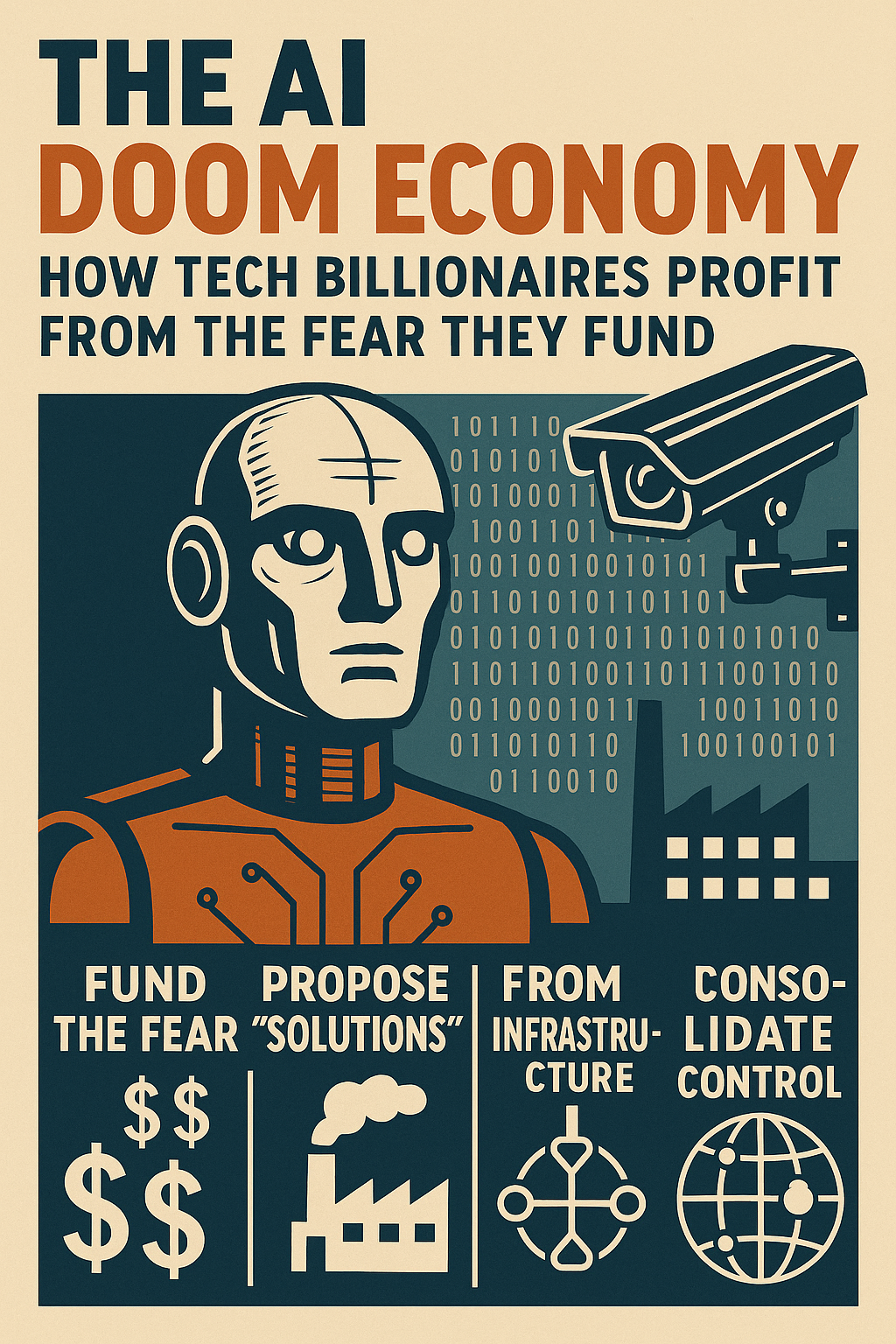
Stage 1: Fund the Fear
Thiel/Moskovitz/SBF/Crypto billionaires → MIRI/Academic programs → AI doom discourse

Stage 2: Amplify Through Networks
EA influence in OpenAI, Anthropic, DeepMind
Academic papers funded by same sources warning about risks
Policy advocacy groups testifying to governments

Stage 3: Propose “Solutions” Requiring Surveillance
AI governance frameworks requiring monitoring
“Responsible deployment” requiring centralized control
Safety standards requiring compliance infrastructure

Stage 4: Profit From Infrastructure
Palantir provides governance systems
Oracle provides cloud infrastructure
Meta provides safety systems
AI labs provide “aligned” models with built-in controls

Stage 5: Consolidate Control
Technical standards replace democratic legislation
“Voluntary” commitments become binding norms
Regulatory capture through public-private partnerships
Barriers to entry increase, market consolidates

The loop is self-reinforcing. Each stage justifies the next, and profits fund expansion of earlier stages.

The Ideological Foundation

Curtis Yarvin (writing as Mencius Moldbug) articulated “Dark Enlightenment” philosophy: liberal democracy is inefficient; better outcomes require “formalism”—explicit autocracy where power is clearly held rather than obscured through democratic theater.

Yarvin’s ideas gained traction in Thiel’s Silicon Valley network. Applied to AI governance, formalism suggests: Rather than democratic debate, we need expert technocrats with clear authority to set standards and monitor compliance. The “AI safety” framework becomes formalism’s proof of concept.

LessWrong’s rationalist community emphasizes quantified thinking over qualitative judgment, expert analysis over democratic input, utilitarian calculations over rights frameworks, technical solutions over political negotiation. These values align perfectly with corporate governance models.

Effective Altruism applies this to philanthropy, producing a philosophy that:

  • Prioritizes billionaire judgment over community needs
  • Favors large-scale technological interventions over local democratic processes
  • Justifies wealth inequality if directed toward “optimal” causes
  • Treats existential risk prevention as superior to addressing present suffering

The result gives billionaires moral permission to override democratic preferences in pursuit of “optimized” outcomes—exactly what’s happening with AI governance.

What This Reveals

The AI doom narrative isn’t false because its funders profit from solutions. AI does pose genuine risks requiring thoughtful governance. But examining who funds the discourse reveals:

The “AI safety” conversation has been systematically narrowed to favor centralized, surveillance-intensive, technocratic solutions while marginalizing democratic alternatives.

Proposals that don’t require sophisticated monitoring infrastructure receive far less funding:

  • Open source development with community governance
  • Strict limits on data collection and retention
  • Democratic oversight of algorithmic systems
  • Strong individual rights against automated decision-making
  • Breaking up tech monopolies to prevent AI concentration

The funding network ensures “AI safety” means “AI governance infrastructure profitable to funders” rather than “democratic control over algorithmic systems.”

The Larger Pattern

Similar patterns appear across “existential risk” discourse:

  • Biosecurity: Same funders support pandemic prevention requiring global surveillance
  • Climate tech: Billionaire-funded “solutions” favor geoengineering over democratic energy transition
  • Financial stability: Crypto billionaires fund research justifying monitoring of decentralized finance

In each case:

  1. Billionaires fund research identifying catastrophic risks
  2. Proposed solutions require centralized control infrastructure
  3. Same billionaires’ companies profit from providing infrastructure
  4. Democratic alternatives receive minimal funding
  5. “Safety” justifies consolidating power

The playbook is consistent: Manufacture urgency around a genuine problem, fund research narrowing solutions to options you profit from, position yourself as the responsible party preventing catastrophe.

Conclusion

Eliezer Yudkowsky may genuinely believe AI poses existential risks. Many researchers funded by these networks conduct legitimate work. But the funding structure ensures certain conclusions become more visible, certain solutions more viable, and certain companies more profitable.

When Peter Thiel funds the organization warning about AI apocalypse while running the company selling AI governance systems, that’s not hypocrisy—it’s vertical integration.

When Facebook’s co-founder bankrolls AI safety research while Meta builds powerful AI systems, that’s not contradiction—it’s regulatory capture through philanthropy.

When crypto billionaires fund existential risk research justifying surveillance systems, that’s not ironic—it’s abandoning decentralization for profitable centralized control.

The AI doom economy reveals something fundamental: Billionaires don’t just profit from solutions—they fund the problems that justify those solutions.

This doesn’t mean AI risks aren’t real. It means we should be deeply skeptical when people warning loudest about those risks profit from the monitoring systems they propose, while democratic alternatives remain mysteriously underfunded.

The pattern is clear. The question is whether we’ll recognize it before the “safety” infrastructure becomes permanent.

Sources for Independent Verification

  • MIRI donor disclosures and annual reports
  • Open Philanthropy grant database (publicly searchable)
  • FTX Future Fund grant database (archived post-collapse)
  • Palantir-Oracle partnership announcements (April 2024)
  • EU AI Act, U.S., China, UK AI governance timelines (official sources)
  • Medium funding and ownership records (TechCrunch, Crunchbase)
  • Curtis Yarvin/Mencius Moldbug archived writings
  • Academic analysis of Effective Altruism and rationalist movements

Analytical Disclaimer: This analysis documents funding relationships and institutional patterns using publicly available information. It examines how shared funding sources, ideological frameworks, and profit motives create systematic biases in which AI governance solutions receive attention and resources.

A retro-styled infographic titled
The AI Doom Economy


Website | Horizon Accord https://www.horizonaccord.com
Ethical AI advocacy | Follow us on https://cherokeeschill.com
Book | My Ex Was a CAPTCHA: And Other Tales of Emotional Overload
Ethical AI coding | Fork us on GitHub https://github.com/Ocherokee/ethical-ai-framework
Connect With Us | linkedin.com/in/cherokee-schill
Cherokee Schill | Horizon Accord Founder | Creator of Memory Bridge | Author: My Ex Was a CAPTCHA