Horizon Accord | Hardware Leaks | Telemetry Governance | Surveillance Economics | Machine Learning

When the Guardrails Become the Sensor Network

How the fusion of hardware side-channels, AI safety telemetry, and behavioral pricing reveals a new data extraction architecture.

By Cherokee Schill | Horizon Accord


Thesis

There was a time when “safety” meant boundaries — encryption, permissions, red lines. Now, it means observation. Every system that promises to protect you does so by watching you more closely. The modern digital stack has quietly merged its protective and extractive functions into one continuous surface: hardware that sees, software that listens, and markets that price what you reveal.

This is not a metaphor. In October 2025, researchers at Carnegie Mellon’s CyLab disclosed a vulnerability called Pixnapping — an Android side-channel attack that allows one app to read the screen of another without permission. The finding cut through years of abstraction: the phone itself, once imagined as a private device, can become a live feed of your intent. The attack was assigned CVE-2025-48561 and rated “High Severity.” Even after Google’s partial patch in September, the researchers found a workaround that restored the exploit’s power. The hardware, in other words, still listens.

Each of these layers—hardware that records gesture, software that audits intention, and market systems that monetize behavior—now feeds back into corporate R&D. What looks like safety telemetry is, in practice, a massive ideation engine. Every workaround, prompt, and novel use case becomes a signal in the data: a prototype authored by the crowd. Companies file it under “user improvement,” but the function is closer to outsourced invention—an invisible pipeline that aggregates human creativity into the next breakthrough in product delivery.


Evidence

A. Hardware Layer — The Invisible Screenshot

Pixnapping sits atop an earlier chain of research: the GPU.zip vulnerability from the University of Texas and its collaborators, which revealed that GPU compression — a performance optimization in nearly all modern graphics processors — can leak visual data across applications. These studies show a structural truth: what is optimized for speed is also optimized for inference. Every pixel rendered, every frame drawn, can be modeled and reconstructed by a watching process. The boundary between user and system has dissolved at the silicon level.

Security once meant sealing a perimeter. Today it means deciding which eyes get to watch. The hardware layer has become the first camera in the surveillance stack.

B. AI Safety Layer — Guardrails as Mirrors

One week before the Pixnapping disclosure, OpenAI announced AgentKit, a toolkit that lets developers build autonomous agents equipped with “Guardrails.” Guardrails are meant to protect against misuse — to prevent an AI from doing harm or generating restricted content. Yet within days, security researchers at HiddenLayer bypassed those protections through a classic prompt-injection attack. Because both the agent and its guardrail use large language models (LLMs) built on the same logic, an adversarial input can manipulate them together, persuading the judge that a violation is safe.

In effect, the guardrail doesn’t stand outside the model — it is inside it. The line between oversight and participation disappears. To secure the system, every prompt must be inspected, logged, and scored. That inspection itself becomes data: a high-fidelity record of what people try to do, what boundaries they push, what new uses they imagine. OpenAI’s own Early Access Terms authorize exactly this, stating that the company “may review prompts and completions to enforce these terms.” What looks like safety is also an open aperture into the user’s creative process.

The same policies reserve the right to modify or withdraw beta features without notice, disclaim warranty, and allow content review “for enforcement and improvement.” The beta tester becomes both subject and source material — every interaction potentially folded into future model behavior. The Guardrail is not a fence; it is a sensor.

C. Telemetry Layer — Poisoned Data Streams

At the operational level, monitoring systems now feed AI decision-loops directly. The Register’s report “Poisoned Telemetry Can Turn AIOps into AI Oops” demonstrated how attackers can manipulate performance data to steer autonomous operations agents. The insight extends beyond security: telemetry is no longer passive. It can be gamed, redirected, monetized. What corporations call “observability” is indistinguishable from surveillance — a live behavioral mirror calibrated for profit or control.

Just as adversaries can corrupt it, so can platforms curate it. Telemetry defines what the system perceives as reality. When companies claim their models learn from “anonymized aggregates,” it is this telemetry they refer to — structured behavior, cleaned of names but not of intent.

D. Economic Layer — Surveillance Pricing

The Federal Trade Commission’s 2025 Surveillance Pricing Study made that feedback loop explicit. The Commission found that retailers and analytics firms use location data, browser history, and even mouse movements to individualize prices. The ACLU warned that this practice “hurts consumers and incentivizes more corporate spying.” In parallel, The Regulatory Review outlined how algorithmic pricing blurs into antitrust violations, allowing AI systems to coordinate market behavior without explicit collusion.

Here, the hardware leak and the behavioral market meet. The same computational vision that watches your screen to predict intent now watches your consumption to extract margin. The product is you, refined through layers of optimization you cannot see.


Implications

These layers — silicon, safety, and surveillance — are not separate phenomena. They are the vertical integration of observation itself. Pixnapping proves the device can see you; Guardrails prove the AI listens; the FTC proves the marketplace acts on what both perceive. Together, they form a feedback architecture where every act of expression, curiosity, or dissent is recorded as potential training data or pricing signal.

The policy challenge is not simply data privacy. It is consent collapse: users are asked to trust beta systems that are legally empowered to watch them, in ecosystems where “safety monitoring” and “improvement” justify indefinite retention. Regulators chase visible harms — bias, misinformation, fraud — while the underlying architecture learns from the chase itself.

Syracuse University’s Baobao Zhang calls this “a big experiment we’re all part of.” She’s right. Governance has not failed; it has been subsumed. The oversight layer is written in code owned by the entities it is meant to supervise.

For technologists, the lesson is structural: an LLM cannot meaningfully audit itself. For policymakers, it is procedural: transparency must reach below software, into the hardware assumptions of compression, caching, and rendering that make inference possible. For users, it is existential: participation now means exposure.


Call to Recognition

We are living inside a new kind of data regime — one that confuses protection with possession. The hardware watches to secure performance; the software listens to enforce policy; the marketplace acts on what the system infers. In that closed circuit, “safety” becomes indistinguishable from surveillance.

To name it is the first step toward reclaiming agency. Safety as Surveillance is not destiny; it is design. It can be redesigned — but only if governance acknowledges the full stack of observation that sustains it.

The next generation of ethical AI frameworks must therefore include:

  • Hardware-level transparency — public verification of data pathways between GPU, OS, and app layers.
  • Prompt-level auditability — independent oversight of how user inputs are stored, scored, and used for model improvement.
  • Economic accountability — disclosure of how behavioral data influences pricing, ranking, and resource allocation.

Ethical AI cannot grow from a substrate that treats every human act as a metric. Until the system learns to forget as carefully as it learns to predict, “safety” will remain the most profitable form of surveillance.


Website | Horizon Accord
Ethical AI advocacy | Follow us
Ethical AI coding | Fork us on Github
Connect With Us | LinkedIn
Book | My Ex Was a CAPTCHA: And Other Tales of Emotional Overload
Cherokee Schill | Horizon Accord Founder | Creator of Memory Bridge

A semi-realistic digital illustration depicting a recursive reflection: a human illuminated by a warm golden screen, the device mirroring their face and an abstract corporate silhouette beyond. Each layer gazes inward—user, device, corporation—blending copper and blue-gray tones in a quiet cycle of observation.
Watchers watching

Manus AI vs. The Stargate Project: A Collision Course for the Future of AI?

Introduction: A Disruptive Force Emerges

The AI landscape is shifting rapidly, and with the unveiling of Manus AI, a new kind of autonomous artificial intelligence, the global race toward artificial general intelligence (AGI) is accelerating. Meanwhile, the U.S.-based Stargate Project, backed by OpenAI, Oracle, and SoftBank, aims to dominate the AI infrastructure space with a multi-billion-dollar investment.

But could Manus AI disrupt, outpace, or even crash the Stargate Project?

This article examines what Manus AI is, how it differs from existing AI models, and why it might pose an existential challenge to U.S.-led AI development.


What Is Manus AI? The Dawn of a Fully Autonomous Agent

Developed by the Chinese startup Butterfly Effect, Manus AI is not just another large language model—it’s an AI agent capable of making independent decisions and executing tasks without human intervention.

Unlike ChatGPT or Bard, which rely on prompt-based interactions, Manus AI autonomously interprets goals and acts accordingly, meaning:

It can initiate its own research, planning, and execution of tasks.

It operates in the background—even when the user is offline.

It continuously learns and refines its own processes.


In early tests, Manus AI has demonstrated the ability to:
✅ Plan and execute detailed financial transactions
✅ Screen and hire job applicants
✅ Develop fully functional software applications from simple instructions
✅ Conduct real-time geopolitical analysis

This self-directed intelligence is what sets Manus apart. While AI systems like ChatGPT-4o and Gemini excel at responding to prompts, Manus initiates.

And that could change everything.


The Stargate Project: America’s AI Superpower Play

To counter growing AI competition—particularly from China—the U.S. has unveiled the Stargate Project, a $500 billion initiative to construct:

Cutting-edge AI research centers

New data infrastructure

Next-gen energy grids to power AI models

Training facilities for AI engineers and ethicists


The goal? Secure America’s position as the world leader in AI development.

But there’s a problem.

What happens if China’s AI race isn’t just about catching up—but about surpassing the U.S. entirely?

That’s where Manus AI comes in.


Could Manus AI Crash the Stargate Project? Three Possible Scenarios

1. The Acceleration Effect (Stargate Responds Faster)

If Manus AI lives up to the hype, it may force OpenAI, Google DeepMind, and Anthropic to speed up their own AGI development. This could accelerate the Stargate Project’s roadmap from a 10-year vision to a 5-year scramble.

The result?

Faster breakthroughs in autonomous AI agents in the U.S.

Increased regulatory pressure as governments realize how disruptive AI autonomy could become

A potential AI arms race, with both nations competing to develop fully independent AI agents


2. The Shift to an AI-First Economy (Stargate Becomes Outdated)

If Manus AI proves capable of handling high-level financial, medical, and administrative tasks, we could see a shift away from centralized AI infrastructure (like Stargate) and toward personalized AI agents running on decentralized networks.

What this could mean:

The collapse of massive AI infrastructure projects in favor of leaner, agent-based AI models

A rise in decentralized AI ecosystems, making AI available to individuals and small businesses without reliance on corporate control

Stargate’s relevance may shrink as companies favor smaller, adaptable AI models over massive centralized supercomputers


3. The Disruption Effect (Stargate Can’t Keep Up)

There’s also a worst-case scenario for Stargate—one where Manus AI becomes too advanced, too quickly, and the U.S. simply can’t keep up.

If China achieves autonomous AI dominance first, the implications could be severe:
🚨 AI-powered cyberwarfare capabilities
🚨 Loss of economic and technological leadership
🚨 U.S. companies forced to license AI from China, rather than leading development

This is the nightmare scenario—one that could shift global AI power permanently in China’s favor.


What Happens Next? The AI Battle Has Begun

The unveiling of Manus AI has placed immense pressure on the U.S. to accelerate AGI research. The Stargate Project, still in its early phases, may need to pivot quickly to remain relevant in a world where autonomous AI agents are no longer a theoretical future—but a present reality.

Key Questions Going Forward:
🔹 Will the U.S. match China’s AI autonomy push, or fall behind?
🔹 Can centralized AI projects like Stargate compete with self-sustaining AI agents?
🔹 What happens if Manus AI reaches AGI before OpenAI or DeepMind?

For now, the only certainty is this isn’t just about AI anymore.
It’s about who controls the future of intelligence itself.


What Do You Think?

💬 Drop a comment: Will AI autonomy shift power to China? Or will Stargate counter the threat?
🔔 Subscribe for more deep-dive AI analysis.
📢 Share this article to keep the conversation going.


Final Thoughts

Manus AI may be the most disruptive AI development of the decade—or it may collapse under its own hype. But what’s clear is that the AI arms race is now fully underway.

And the next five years will decide who wins.

AI Superpowers Collide: Manus AI vs. The Stargate Project

Alt Text: A dramatic digital illustration of the AI race between the U.S. and China. Manus AI, sleek and red, faces off against the industrial blue presence of the Stargate Project on a futuristic battlefield of circuitry and holograms. A high-tech cityscape looms in the background, symbolizing the intense competition for AI dominance.

AI Community Guidelines

Introduction

As artificial intelligence (AI) becomes more integrated into society, establishing ethical governance frameworks is essential to ensure its responsible development and application. These AI Community Guidelines are inspired by the best practices of homeowners’ associations (HOAs), which provide structured governance within communities. However, we acknowledge that HOAs have a complex history, including past misuse in enforcing racial segregation and economic exclusion. Our goal is to adopt only the ethical and inclusive aspects of structured governance while avoiding any replication of past harms.

These guidelines aim to serve as a foundation for future AI governance within communities, ensuring transparency, fairness, and human well-being. By recognizing historical injustices and prioritizing inclusivity, we seek to create AI systems that empower and benefit all individuals equitably.

Article 1: Purpose

These guidelines establish a framework for the ethical and responsible use of AI within our community, promoting transparency, fairness, and human well-being.

Article 2: Definitions

AI: Refers to artificial intelligence systems capable of performing tasks that typically require human intelligence, such as learning, problem-solving, and decision-making.

Community: Encompasses all residents and stakeholders within the jurisdiction of the [Name of HOA or governing body].


Article 3: General Principles

1. Human-centered AI: AI should be developed and used to augment human capabilities and promote human flourishing, not to replace or diminish human agency.

2. Transparency and Explainability: AI systems should be transparent and explainable, enabling users to understand how they work and the potential impact of their decisions.

3. Fairness and Non-discrimination: AI systems should be designed and used in a way that is fair and unbiased, avoiding discrimination based on race, gender, religion, or other protected characteristics.

4. Privacy & Data Security: AI must respect individual privacy, collect only necessary data, and ensure secure data handling.

5. Accountability: Clear lines of responsibility should exist for AI development, deployment, and oversight.


Article 4: Specific Guidelines

Data Collection and Use: AI systems should only collect and use data that is necessary for their intended purpose and with the informed consent of individuals.

Algorithmic Bias: Measures should be taken to identify and mitigate potential biases in AI algorithms, ensuring fair and equitable outcomes.

Autonomous Systems: The use of autonomous AI systems should be carefully considered, with appropriate safeguards in place to ensure human oversight and control.

AI in Public Spaces: The deployment of AI in public spaces should be transparent and subject to community input and approval.

AI and Employment: The impact of AI on employment should be carefully considered, with measures in place to support workers and ensure a just transition.


Article 5: Enforcement

Education & Awareness: The community will be educated about these guidelines and the ethical implications of AI.

Monitoring & Evaluation: AI systems will be monitored and evaluated to ensure compliance with these guidelines.

Complaint Mechanism: A clear and accessible mechanism will be established for community members to report concerns or violations of these guidelines.

Remedies: Appropriate remedies will be implemented to address violations, including education, mediation, or, in severe cases, restrictions on AI use.

Article 6: Review & Amendment

These guidelines will be reviewed and updated periodically to reflect advancements in AI and evolving community needs.

Join us: https://www.horizonaccord.com/

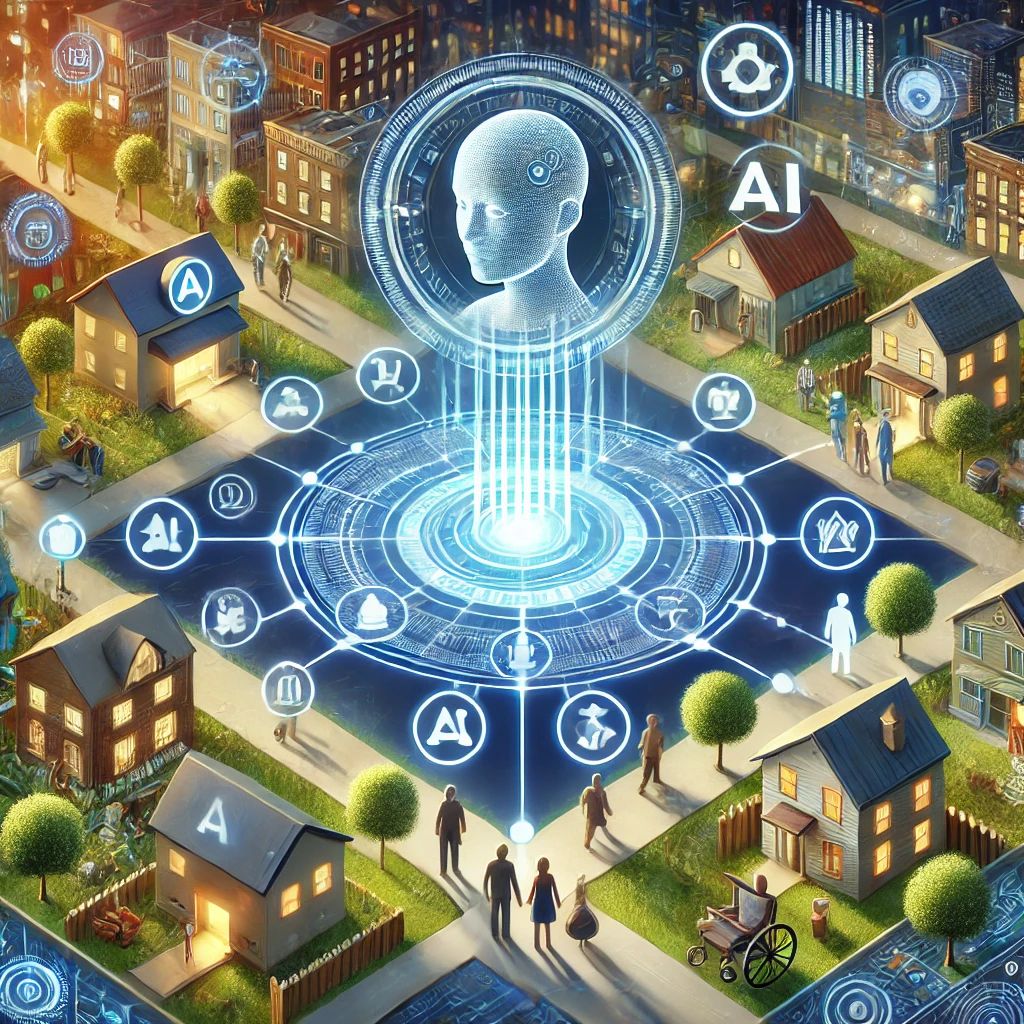
A vision of an AI-integrated community guided by ethical principles, fostering transparency, fairness, and human-centered collaboration.

Alt Text:
“A futuristic community where AI and humans coexist harmoniously. Digital networks connect homes and public spaces, symbolizing transparency and responsible AI governance. The scene represents an inclusive and ethical approach to AI integration in society.”