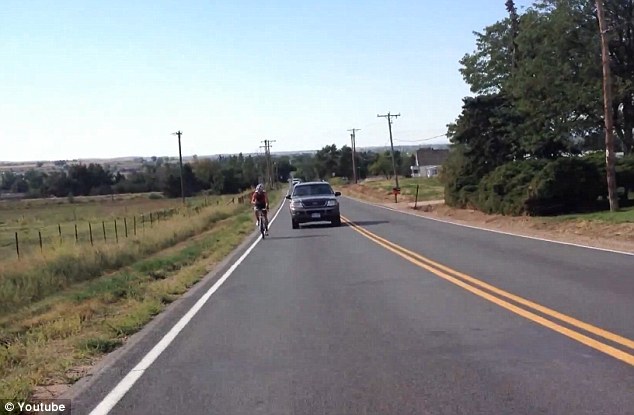
Observing Traffic Court

If you want to put your finger on the pulse of car culture; observe traffic court.

The light was yellow for 2.7 seconds. I didn’t have time to stop in 2.7 seconds. So I went forward because I was worried about being cited for impeding traffic.
Actual testimony from a defendant.


There was so much traffic. The light was hard to see. I was worried about what the people behind me would do so I went through the light. I didn’t want to block the intersection.
Actual testimony from a defendant.


My van was loaded down with bricks. I must have had like a ton of weight back there. The road was really slick from all the rain and I knew I wouldn’t be able to stop in time. So I went through the light.
Actual testimony from a defendant.

The motorcycle cop who cited all three of these defendants had a helmet cam. He presented the video evidence to the court.

One of these defendants had their traffic ticket dismissed. The other two did not.

Traffic Lights

§ 811.260¹

Appropriate driver responses to traffic control devices

(4) Steady circular yellow signal. A driver facing a steady circular yellow signal light is thereby warned that the related right of way is being terminated and that a red or flashing red light will be shown immediately. A driver facing the light shall stop at a clearly marked stop line…

(7) Steady circular red signal. A driver facing a steady circular red signal light alone shall stop at a clearly marked stop line…

The driver of a vehicle is required to keep their vehicle under control at all times. They are required to be on the lookout for other road users who may be in their path of travel.

As I sat and listened to the drivers giving their excuses as to why they failed to head the traffic control light, a theme began to appear.

  1. I was distracted.
  2. I didn’t have my vehicle under control.
  3. I was worried about the people behind me.
  4. I couldn’t stop in time.

All of the defendants excuses appeared to be valid in their minds. None of these excuses took into consideration anyone else who may have been using Oregon’s public right of ways. Namely pedestrians but also cyclists.

Speed Laws

§ 811.100¹

Violation of basic speed rule
(1) A person commits the offense of violating the basic speed rule if the person drives a vehicle upon a highway at a speed greater than is reasonable and prudent, having due regard to all of the following:
(a) The traffic.
(b) The surface and width of the highway.
(c) The hazard at intersections.
(d) Weather.
(e) Visibility.
(f) Any other conditions then existing.

If you can’t keep your vehicle under control; you are going too fast.

If you can’t safely stop at the yellow; you are going too fast.

If you can’t safely stop at the red; you are going too fast.

If the speed limit is posted at 35 mph but you can’t safely drive 35 mph then by law you are required to slow down.

Safety Zones

§ 811.030¹

Driving through safety zone
(1) The driver of a vehicle commits the offense of driving through a safety zone if the driver at any time drives through or within any area or space officially set apart within a roadway for the exclusive use of pedestrians and which is protected or is so marked or indicated by adequate signs as to be plainly visible at all times while set apart as a safety zone.
In the video, which the officer showed to the court, each of these drivers went through a safety zone. Their testimony indicated their inability to ascertain if there was a pedestrian present at the time they committed their violations.
While no one was injured, this time. It is a clear indicator that motorists are not educated about the rights of pedestrians. Nor are they educated about their duties as a motorist to be on the lookout for pedestrians or cyclists.
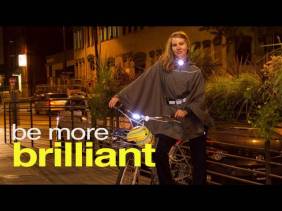
A glaringly obvious example of this is through TriMetsShow them your shine.” ad campaign. Seeing these ads on display throughout Portland heats my blood to a simmering boil.
sddefault
Part pedestrian and part cyclist. It is clear that the ad is placing the onus on the vulnerable road user to be seen. A subversive form of propaganda and victim blaming.

Oregon’s roads are first come, first served, and duty of care.

§ 801.440¹
Right of way
Right of way means the right of one vehicle or pedestrian to proceed in a lawful manner in preference to another vehicle or pedestrian approaching under such circumstances of direction, speed and proximity as to give rise to danger of collision unless one grants precedence to the other. [1983 c.338 §81]

Two of the defendants were found guilty.

One of the defendants was able to get his ticket dismissed. The dismissal was due to a lack of evidence. The evidence was based on the question of whether the yellow light was timed correctly and the vantage point of the officers video did not reveal the defendants traffic control signal.

All in all it was very edifying and I highly recommend it for all pedestrian and cycling advocates.

In all things, remember this, running a red light is illegal. The reason it is illegal is because it isn’t safe. It isn’t safe for you and it isn’t safe for any of the road users around you. Keep your vehicle under control and keep the safety of other road users in mind. Do not worry about what the people behind you are going to do. The person behind you is required to show you courtesy and safety by keeping their vehicle under control.


Why do you use the road like that?

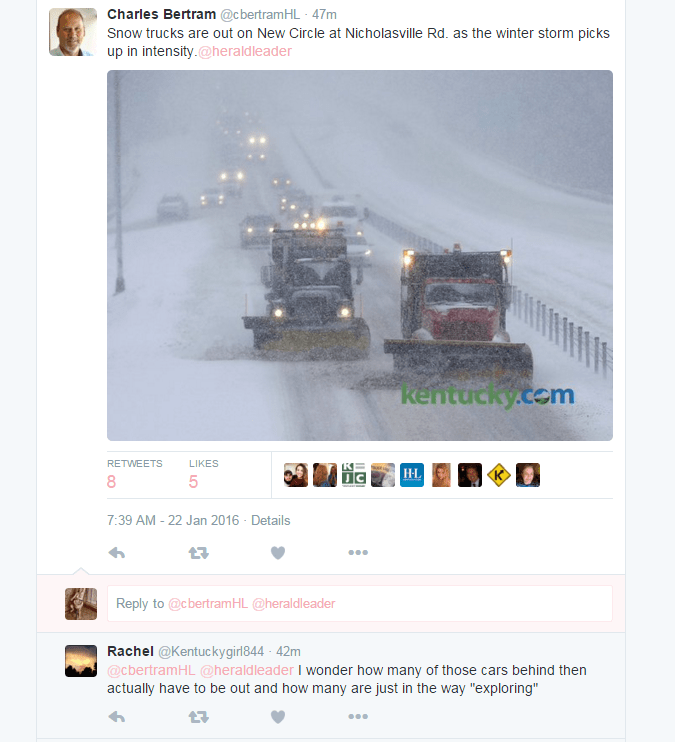
Rachel @Kentuckygirl844 “…how many of those cars behind then actually have to be out and how many are just in the way “exploring.”

Grammatical errors aside.

I want to explore everything that is wrong with this tweet.

  1. It isn’t any of your business why other people are on the road. It is a public road and everyone pays to use it. When, how, or where they use it is up to them.
  2. “how many are just in the way” No one is ever in anyone else’s way on a public right of way, also known as a road. It belongs to the public and the public has the right to use it. These roads are first come, first served, and duty of care. We show compassion for other road users. We yield the right of way to those who were there first. It is courteous, it is wise, and it shows others that we have a heart beating in our chest.
  3. You have nothing better to do on a terrible winter day except to sit and wonder about what other people are up to? Lucky you! This is a picture of those who are not so fortunate. So how about a little compassion?
  4. “Adulting.” Only adults use the roadway. Only adults use cars on the roadway. This isn’t any place for “other” road users. If you aren’t adulting on the road then you are in the way. “Exploring” is for kids. So GTFO!
  5. If they are out there having a light hearted romp in the snow; is it really any of your business?

I think  your tweet says more about you than it does the people using the road.

This is why we can’t have nice things!

Snowing
I’m more concerned with the driver of the SUV. Why doesn’t he have his lights on? It’s your right to be on the road but you do have to show regard for other road users. Safety first!


I understand now why so many cyclists in the US and UK are being killed.

I understand now why so many cyclists are being killed. Cycling like you are in the Netherlands or Copenhagen will get you killed in other countries.

There are some false beliefs out there. One is that infrastructure requires mandatory use laws, the other is that the lack of bicycle specific infrastructure means you just ride willy nilly all over the road.

  1. Netherlands cycle tracks are, for as near as I can tell, complete and connected. Like any highway, they go exactly where the user wants or needs to go.
  2. This is not true for the UK and US.
  3. If you don’t have complete cycle tracks and those cycle tracks do not meet your needs, you ride on the public highway.
    1. When you ride on the public highway you operate according to the rules of the road.
    2. You do not filter on the passenger side of a vehicle. Unless you have a death wish or are uneducated in cycling safety.
    3. You filter forward using the rules of the road and yield to oncoming traffic on a two way street.
  4. The main reasons people are opposed to bicycle specific infra are:
    1. The Netherlands set a bad example by legally mandating the use of their bike paths. Even in the Netherlands, if you are being honest when you bring them up, they do not have perfect infra everywhere you go. They still have door zone bike lanes. I sometimes find them in videos of locals who post their cycling trips but there aren’t any video’s of the Netherlanders specifically railing against them. Here is a blog on the subject for the Netherlands: On road cycle lanes: The good, the bad, and the ugly.
    2. The reason this is often not considered an issue is because the Netherlands also have strict liability laws. So if a driver injures a cyclist by throwing the door open without looking, the cyclist (should they survive the experience) can rest assured that the police and public media are not going to further victimize them by questioning their right to be there. No one will ask if they were wearing a helmet (as though that could really protect you from having your head run over by 2 tons of machine). No one will question the color of your clothes. The cyclists in the Netherlands have the homefield advantage, even in the face of crappy infra. Their medical bills are promptly paid and they get to go on with life as usual.

Bike specific infra (in the UK and US) is often a painted line on the ground. More often this painted line on the ground places the cyclist out of the driver’s field of vision. With a very narrow margin of passing clearance. In many ways it’s like we forget that often touted slogan of “3 feet minimum” to pass. Our engineers do not take safe passing into account when painting bike lanes. The faster the traffic the wider the bike lane should be.

  1. We often overestimate a driver’s area of vision as extending from the front side windows forward. The average driver does not drive with a 90 degree arc of vision. The average driver drives distracted. This is often compounded with age and limited physical mobility which makes it difficult to turn the head and look to the left and right as well as over the shoulder.
  2. To avoid a drivers blind spots always put yourself directly in front of the driver when operating your bicycle. The Dutch/Netherlands started (as near as I can tell) this idea of hugging the curb. Which is easier to do if you are operating at a snails pace.
  3. So if you are riding like the Dutch/Netherlands (think hugging the edge or weaving haphazardly in and out of traffic, also those box style turns where you cross like a pedestrian, honorable mention to filtering forward to the front of the line), if you ride like this, on public highways, you are riding with a death wish.
  4. The Netherlands have taken into consideration that motor traffic occupies a great deal of space and they have adjusted their light signals to accommodate cyclists at intersections.  
    Which as you can see from the video, still needs a lot of tweaking. It’s o.k. to let loose on all sides for cyclists but not for cars? Come on! Where is the fairness in that? 😉

I’ve watched several videos of average people in the Netherlands, they are catching the film my ride fever too, cycling in the Netherlands, Copenhagen, and the Dutch. They do all of these things. (See this video for a full understanding of what I’m talking about:

I’ve also had the opportunity to read their laws and it is expressly illegal to haul passengers on bike racks. You will see a lot of law breaking in the video’s promoting cycling in the Netherlands.

If the Netherlands did away with the mandatory use laws this would solve the problem of faster cyclists running over pedestrians and slower cyclists. (This is a hot button topic in the Netherlands.)

Remember the Netherlands also have fast club rides. I feel very strongly that those cyclists do not belong on bike paths with slower moving traffic.

There will be the usual stupid comment: “Oh you just want children to cycle on heavily trafficked fast moving roads!”

No, I don’t. What I want is for there to be no heavily trafficked fast moving roads. Any roads that are used to swiftly move people from town to town should be limited access and built to those standards. All other roads should be built to accommodate all other road users regardless of vehicle type. All roads should be safe for foot traffic above and beyond anyone else’s needs.

When we build communities that are based on people walking, then we will have a community that is safe for cyclists of all ages.

I, as a responsible parent, taught my children how to cycle safely on the only road that took us to our destination.

I’m not the only parent out there who understands where the real risks are to riding in traffic. This is an old article but it clearly shows where the stinkin’ thinkin’ comes from and if you yourself don’t know, allow me to state it plainly.

UK father commutes kids to school by bicycle. Stopped by police.

1. Cyclists obey the rules of the road. Overtaking through intersections on the passenger side is illegal because it is dangerous. You wouldn’t do it in a car, don’t do it on a bicycle.

2. Motorists obey the rules of the road. Treat cyclists just like you would any other vehicle out there on the road. Change lanes to pass and yield right of way when legally required. Do not create confusion by yielding right of way when not legally required to do so.

For both Cyclists and Drivers, use sound judgement and know your transportation codes and laws before heading out. Always leave at least 10min early. You will never be late and find that your commute is much more relaxing when you don’t feel pressed for time.

The Hidden Trucking Industry Subsidy

We often hear angry motorists telling us that cyclists don’t pay gas tax or road tax.
Their logical fallacy is that they do pay for the roads and that we, because we do not pay license fee’s, registration fee’s, and buy gas, do not carry our fair share of the financial load.
This blog turns that idea clearly on its head.
If you have a link to a well researched blog showing how bicycles pay their fair share for road use, please do so in the comments section. Thank you!

praveenghanta's avatarTrue Cost - Analyzing our economy, government policy, and society through the lens of cost-benefit

Freight trucks cause 99% of wear-and-tear on US roads, but only pay for 35% of the maintenance. This $60B subsidy causes extra congestion and pollution, and taxpayers pay the bill.

It seems obvious that the heavier the vehicle, the more damage it does to roads over time. A 40,000 pound big rig probably does a bit more damage than your average 3500 pound consumer vehicle, right? It turns out that vehicle road damage doesn’t rise linearly with weight. Road damage rises with the fourth power of weight, and this means that a 40,000 pound truck does roughly 10,000 times more damage to roadways than the average car [1]!

In other words, one fully loaded 18-wheeler does the same damage to a road as 9600 cars. According to the American Trucking Associations (ATA), the trucking industry represents 11% of all vehicles on the road in the US, while…

View original post 373 more words

Perception vs. safety

“When a situation feels dangerous to you, it’s probably more safe than you know; when a situation feels safe, that is precisely when you should feel on guard.”
― Tom Vanderbilt, Traffic: Why We Drive the Way We Do

There is a social construct to driving and bicycling, much the same way as there is a social construct to walking in a crowd. There are rules which guide our behavior and if everyone follows the rules, no one gets hurt.

Rule number one: Don’t hit what is in front of you.

As humans our eyes are adapted to seeing that which is directly in front of us. Though some of us require corrective lenses to make even this task feasible.

We trust our eyes but can our eyes be trusted?

How the brain processes the images we take in everyday is amazing. That we believe half of what we see is, to me, even more amazing.

I recently discovered “Brain Games” and I want you to pause your reading and watch this clip.


So did you trust your eyes?

Seeing is a task and driving is a task. When we are seeing and driving we are multi-tasking. Throw into the mix other drivers, street signs, stop lights, painted lines on the ground, billboards, lights, radio, cell phone, kids in the back seat, a passenger, and driving just became even more complicated.

We believe that we are safe when we are far from safe behind the wheel.

The CDC reported that in 2012 there were roughly 34K deaths attributed to the automobile. 2.5K of these were teenagers between 16 and 19 years old. Statistics

In 2012, 4,743 pedestrians were killed and an estimated 76,000 were injured in traffic crashes in the United States (Tables 1 and 3). On average, a pedestrian was killed every 2 hours and injured every 7 minutes in traffic crashes. TRAFFIC SAFETY FACTS

One of the things that I found interesting when reading the NHTSA website, was their reassurance that driving is much safer nowadays when compared to past history. When you have an average of 2 people killed or injured every hour is it really that safe?

Not enough emphasis is put on eliminating unnecessary multi-tasking such as talking on the phone. Example

From the data, it is possible to draw the conclusion that it isn’t safe to drive. It isn’t any safer to walk either. The only mode of travel that had under 1K deaths per year was the bicycle.

So if cycling is so much safer than the alternative, why then do we spend so much money on infrastructure that caters to car culture. Especially when it is such a dangerous mode of transportation?

Have you heard of social conformity?

Social conformity is the same construct which gives us gutter bike lanes and tells us it is “safer” to cycle on the shoulder as opposed to the travel lane.

The rules of the road tell you to occupy your lane. Even on a two way only highway.

We would have far fewer cycling deaths if people would stop trusting their eyes and social norms. Instead trust education and the rules that have been laid out for safe road travel.

For example: In Kentucky we have KRS 189.310 which states:

189.310 Vehicles meeting other vehicles and animals.
(1) Two (2) vehicles passing or about to pass each other in opposite directions shall have the right-of-way, and no other vehicle to the rear of those two (2) vehicles shall pass or attempt to pass either of those vehicles.
(2) Vehicles proceeding from opposite directions shall pass each other from the right, each giving to the other one-half (1/2) of the highway as nearly as possible.

Our perception and social construct tells us to ride on the edge of a road. To be as far out of the way of motorists as possible. This puts us out of the line of sight and creates a safety hazard. It “feels” safe but in reality it isn’t safe at all.

Examples of unsafe cycling and a message from the CDC. 

What does safe cycling look like?

What is your lane position visually communicating?

We need to clarify already existing laws to direct motorists to change lanes to pass.

We need transportation infrastructure that isn’t based on car culture. (pedestrians, public transit, and cycling as priority over automobiles)

We need NHTSA and the FHWA to have dedicated bicycle commuters as members of their board of directors.

We need all cyclists, motorists, city planners, transportation committees, and law enforcement to be educated in Cycling Savvy.

“Human attention, in the best of circumstances, is a fluid but fragile entity. Beyond a certain threshold, the more that is asked of it, the less well it performs. When this happens in a psychological experiment, it is interesting. When it happens in traffic, it can be fatal.”
― Tom Vanderbilt, Traffic: Why We Drive the Way We Do

How do you get people to want to cycle? How do you get comfort loving people to want to….?

I love a good military story.

I grew up with a stepfather whose father was in the military. My stepfather couldn’t join the military and I’m pretty sure he never wanted to any way, but he loved a good military story. I was a little girl in Oldham County Kentucky when I first watched “The Big Red One” I remember participating in a charades project to help us with our spelling. I selected “The Big Red One.” as my topic. I drew a dash on the chalkboard for each letter and then pantomimed “Big” “Red” “One”. Nobody got it.

I was shocked. How do you not get military movie titles? I was even wearing something red to help out with that word. To me it was clear as day, but the kids in the class kept picking titles they were familiar with. They stuck to the things they knew. The stories they had been sold through the local news and popular media. They only knew what others wanted them to know. So those were the titles they were guessing. Their choices didn’t make sense and totally didn’t fit.

What does that have to do with cycling? What does it have to do with getting people to want to cycle?

Let’s play a game. Below is one way to encourage more people to get out and try a bike. Can you guess the title?

__ __ __ __   __ __ __ __ __ __ __.

Here’s a hint.

The above title will protect cyclists.

Are you thinking….

Remsen-Bike-Lane2

If you were thinking “Bike Lanes” then you have the same thinking pattern as my classmates from years ago.

“Laws Protect” is the title.

This brings me to my all time favorite movie. “The Hunt for Red October”. I own it and watch it whenever I’m feeling down.

Here you have a guy who is trying to convince Politicians and Military personnel that this Russian is wanting to defect. Ryan asks himself “How do you get people to want to leave a submarine?” “How do you get people to want to get off a Nuclear submarine?” and then the lightbulb goes off in Ryans head. Ryan now knows how the Russian is going to get his men to willingly evacuate the submarine. Ryan is excited and he is met with some derision from the Commanding Officer as he explains the plan to the Captain.

It made sense to Ryan. He thought it through and based on the factual information he had obtained, Ryan came to a reasonable conclusion. It just wasn’t so easy to get everyone else on board.

A lot of people are pushing for the infrastructure. The laws are lagging behind.

A cyclist was struck and killed in a bike lane.

A cyclist was struck and injured in a bike lane.

No charges filed.

In most states cyclists are legally mandated to use unsafe facilities.

When they use those facilities they should be protected. Not just by the facilities but also by law.

We need laws protecting road users. Everyone is vulnerable to careless and aggressive drivers.

Lets stop fixating on bike lanes and start thinking outside the box. With the history of injuries and deaths associated with bike lanes and even separate bicycle paths we need to do more. People need to feel safe. They need to be comfortable.

People understand liability and sadly the majority of people are not altruistic. They are lazy and basic in their needs and wants. If you make a law which holds a motorist liable for injuring a cyclist, if you create anti-harassment task forces and laws, if you enforce the existing laws you will have more people feeling safe and confident. If motorists get tickets for harassing cyclists, if motorists get taken to court and forced to stand before a judge and account for their behavior, you are going to have the best advertiser for cycling that you could ever possibly have. It would go something like this.

Motorist: Man I just got out of court.

Motorists friend: What did you go to court for?

Motorist: Oh some damn cyclist was in the road and I passed him in the lane. Honked my horn at him too.

Motorist friend: How did you end up in court over that?

Motorist: Well this officer saw me and pulled me over. Told me that is illegal and I got a ticket for improper lane usage and unnecessary use of the horn.

Motorist friend: Those are laws?

Motorist: Yea.

Later that day.

Motorist friend is out driving and sees a cyclist in the road. He adjusts his speed for traffic conditions, changes lanes when safe, and passes the cyclist. Cyclists gives a wave and the Motorist friend waves back.

The passenger in the motorists friends car turns to him and says “Those damn cyclists, I’d have buzzed him and honked the horn”. Motorists friend “Yea, but it isn’t worth getting a ticket.” Passenger “You can get a ticket for that?” Motorists friend “Yea, it happened to my friend and he just got out of court today, pretty hefty fine.” Passenger “Good to know. I’ll just pass them like you did. Nothing is worth a ticket like that.”

The cyclist is left feeling good about the people operating their vehicles around him. He gets to his destination and tells his friends who drove all about the great ride he had and how courteous the other road users were. His friends find his exuberance catching and before you know it they are at the bike shop and wheeling around on their own bikes. The cyclists feel good about the people operating on the road around them and they have the assurance that should something happen, law enforcement will take him seriously and protect his rights equally under the law.
And there we have a cycle of courtesy that goes beyond any infrastructure or expensive educational Public Service Announcement.

The message should be loud and clear. “If you endanger vulnerable road users you will pay a hefty fine and possibly lose your driving privileges.”

Driving behavior is based on laws and if those laws are enforced drivers will behave.

Let’s imagine another scenario.

Person A is watching the evening news.

News reporter: This just in, a new anti-harassment law has been passed. State lawmakers have unanimously passed a law making it a crime to shout, buzz, role coal, throw objects, or generally harass other road users. New penalties have been added to vehicles which fail to change lanes to pass. Our own Reporter in the Field has more on this ground breaking new law.

Reporter in the field: A new law passed today making it a first class offense to treat other road users in an aggresive manner. Most motorists will try to squeeze past a cyclist in the lane. This new law clarifies the already existing passing laws which make it a ticketable offense to pass another road user in the lane. If a cyclist is shouted at, unnecessarily honked at, or an object thrown at them the cyclist only need to take the license plate number and present a report to the police. Form number A-99 is the form to request. An officer will investigate the claims and if any evidence is found that harassing behavior occurred it is a $100.00 fine or the offender, in an interesting twist, can take a cycling safety course and have the fine waived. The intention of the law is to create a safer and more civil environment for all road users and to create passing laws that the police can actually enforce. It is hard to tell what three feet looks like but everyone knows how to change lanes to pass and if an officer sees you pass with out all four tires in the adjacent lane, it means a ticket for you.

The next day person A is out driving and sees a cyclist. Person A remembers the news report from last night and adjusts his speed to traffic conditions and changes lanes when safe to do so and passes the cyclist. A life was saved because more people understood what it means to change lanes to pass.

Laws protect cyclists.

Bike lanes are just there. Like any road it is only as dangerous as the people who use it and the laws which govern them.

Trying to get people to understand this novel idea, Well, It’s hard. Really hard. The bicycle advocates throw you the cold shoulder when you try to explain it to them.
Providing cyclists with peace of mind shouldn’t be hard to understand.

Start advocating for laws which protect cyclists. Advocate for those laws as hard as you advocate for paint on the streets. Your cycling numbers will boom before you know it.

As the opening sequence goes in “The Hunt for Red October”.

Commanding Officer: “It’s cold out Captain”

Captain: Холодная и трудно (Russian) Cold and hard.

If you have ever been on the receiving end of harassment or know someone who has, then please share this with the people you know.