For the Dutch cycling is not mainly a sport or leisure activity. For the Dutch, cycling is transportation first and fun second. To be considered a serious cyclist here, one only needs regular street clothes and a bicycle. No special equipment needed.
The Dutch want infrastructure. When the Dutch set out to build cycling infrastructure, it is with the idea of meeting the cyclists needs. Bicycle Dutch – Infrastructure, It is not the intention of the Dutch to get cyclists “Out of the way”, as it is here in America. No, the Dutch give their cyclists preferential treatment and it shows in the quality of movement on their streets. Even where there are no cycle paths. Cyclists move through traffic the same way they do here in the states. Dutch Cycling Observations.
As a sport, cycling is a big deal here in America. In America cycling is fun and leisure first, transportation second. To be considered a “Serious Cyclist”, you are expected to wear Lycra shorts, neon shirts, head-gear, specially made shoes, and have a specialized bicycle.
The Americans want infrastructure. When the Americans set out to build cycling infrastructure, it is with the idea of meeting the motorists demands. Ticket for not riding in Bike Lane. Bicycle lanes are not built, they are painted. Bike Lane Fail – as seen in this video. Where the cyclist is forced to squeeze between curb traffic and traveling traffic. Here in the States, Bicycling for transportation is some rogue phenomenon. Hardly taken seriously. So when Bike Lanes are built or rather painted, they do not take in the needs of the cyclist and cyclists get shoved down the transportation food chain. Cyclists in America are treated as second class citizens and the culture here reflects that. Attempt at humor – Fail.
It’s the Culture!
When Americans start accepting that Motor-Vehicles are not always the most convenient form of transportation and that quite often they are the problem, not the solution. Will they then start building infrastructure that caters to the needs of cyclists?
I hope so.
Until then, Stop ticketing us for being on the road, Stop turning a blind eye to harassment from motorists, Start educating local law enforcement and require them to ride in traffic and not on the sidewalk. Stop ticketing cyclists for not riding in unsafe bike lanes. Normalize cycling. Be the example and lead the way.
Safe interactions with motorists on busy streets can be done!
Until demand for cycling outweighs the ability of the existing infrastructure to meet its needs. There is no need for bike lanes on streets with two or more lanes in one direction.
Educate cyclists to operate as vehicles. In every state bicycles are legally defined as vehicles.
Ride like one!
Educate motorists to respect cyclist space, in exactly the same manner that motorcyclist demanded driver education to make motorists more aware of them.
(3) “Highway” means any public road, street, avenue, alley or boulevard, bridge, viaduct, or trestle and the approaches to them and includes private residential roads and parking lots covered by an agreement under KRS 61.362, off-street parking facilities offered for public use, whether publicly or privately owned, except for-hire parking facilities listed in KRS 189.700.
(9) “Right-of-way” means the right of one (1) vehicle or pedestrian to proceed in a lawful manner in preference to another vehicle or pedestrian approaching under such circumstances of direction, speed, and proximity as to give rise to danger of collision unless one grants precedence to the other. (10) “Roadway” means that portion of a highway improved, designed, or ordinarily used for vehicular travel, exclusive of the berm or shoulder.If a highway includes two (2) or more separate roadways, the term “roadway” as used herein shall refer to any roadway separately but not to all such roadways collectively.
(19) (a) “Vehicle” includes: 1. All agencies for the transportation of persons or property over or upon the public highways of the Commonwealth; and 2. All vehicles passing over or upon the highways. (b) “Motor vehicle” includes all vehicles, as defined in paragraph (a) of this subsection except: 1. Road rollers; 2. Road graders; 3. Farm tractors; 4. Vehicles on which power shovels are mounted; 5. Construction equipment customarily used only on the site of construction and which is not practical for the transportation of persons or property upon the highways; 6. Vehicles that travel exclusively upon rails; 7. Vehicles propelled by electric power obtained from overhead wires while being operated within any municipality or where the vehicles do not travel more than five (5) miles beyond the city limits of any municipality; and 8. Vehicles propelled by muscular power.
189.020 Equipment of vehicle not to be nuisance or menace. Every vehicle when on a highway shall be so equipped as to make a minimum of noise, smoke or other nuisance, to protect the rights of other traffic, and to promote the public safety.
189.290 Operator of vehicle to drive carefully. (1) The operator of any vehicle upon a highway shall operate the vehicle in a careful manner, with regard for the safety and convenience of pedestrians and other vehicles upon the highway. (2) No person shall willfully operate any vehicle on any highway in such a manner as to injure the highway.
189.330 Turning and right-of-way at intersections. (6) The operator of a vehicle intending to turn shall do so as follows: (a) Right turns – both the approach for a right turn and a right turn shall be made as close as practicable to the right-hand curb or edge of the roadway; (b) Left turns – the operator of a vehicle intending to turn left shall approach the turn in the extreme left-hand lane lawfully available to traffic moving in the direction of travel of such vehicle. Whenever practicable, the left turn shall be made to the left of the center of the intersection and so as to leave the intersection or other location in the extreme right-hand lane lawfully available to traffic moving in the same direction as such vehicle on the roadway being entered.
189.340 Overtaking vehicles — Traffic lanes — Following vehicles.
(1) Vehicles overtaking other vehicles proceeding in the same direction shall pass to the left of them and shall not again drive to the right until reasonably clear of those vehicles. Vehicles overtaking streetcars may pass either to the right or left when so directed by a police officer, when on a one (1) way street or where the location of the tracks prevents compliance with this section, with regard for other traffic.
(3) The operator of a vehicle may overtake and pass another vehicle upon the right only under conditions permitting such movements in safety. Such movement shall not be made by driving off the roadway unless passing vehicle comes to a complete stop and such movement may be made safely.
189.350 Assistance in passing or overtaking. (1) The operator of a vehicle about to be overtaken and passed shall give way to the right in favor of the overtaking vehicle if the overtaking vehicle is a motor vehicle. (2) In all cases of meeting, passing, or overtaking of vehicles such assistance shall be given by the operator and occupants of each vehicle, respectively, to the other as the circumstances reasonably demand, in order to obtain clearance and avoid accidents.
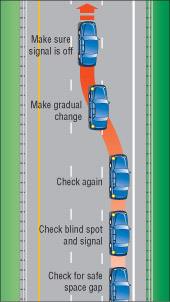
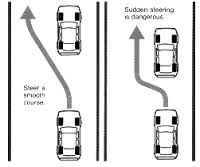
On any marked roadway you still have to change lanes to pass.
Assistance in overtaking does not mean driving off the road.
It simply means to not take up any more of the roadway than necessary.
189.340 Overtaking vehicles — Traffic lanes — Following vehicles. (6)Whenever any roadway has been divided into three (3) clearly marked lanes for travel, the following additional rules shall apply: (a) A vehicle shall be driven as nearly as may be practical entirely within a single lane and shall not be moved from that lane until the driver has first ascertained that the movement can be made with safety; (b) A vehicle shall not be driven in the center lane except when overtaking and passing another vehicle where the roadway is clearly visible and the center lane is clear of traffic within a safe distance, or in preparation for a left turn or where a center lane is at the time allocated exclusively to traffic moving in the direction in which the vehicle is proceeding and is signposted to give notice of the allocation;
(8) (a) The operator of a motor vehicle shall not follow another vehicle more closely than is reasonable and prudent, having regard for the speed of the vehicle and the traffic upon and condition of the highway.
189.310 Vehicles meeting other vehicles and animals. (1) Two (2) vehicles passing or about to pass each other in opposite directions shall have the right-of-way, and no other vehicle to the rear of those two (2) vehicles shall pass or attempt to pass either of those vehicles. (2) Vehicles proceeding from opposite directions shall pass each other from the right, each giving to the other one-half (1/2) of the highway as nearly as possible.
This image shows a cyclist riding a straight line. They are not weaving in and out of parked cars.
189.300 Vehicles to keep to right. (1) The operator of any vehicle when upon a highway shall travel upon the right side of the highway whenever possible,and unless the left side of the highway is clear of all other traffic or obstructions for a sufficient distance ahead to permit the overtaking and passing of another vehicle to be completed without interfering with the operation of any vehicle approaching from the opposite direction or any vehicle being overtaken. The overtaking vehicle shall return to the proper traffic lane as soon as practicable and, if the passing vehicle enters the oncoming traffic lane, before coming within two hundred (200) feet of any approaching vehicle.
(2) The operator of any vehicle moving slowly upon a highway shall keep his vehicle as closely as practicable to the right-hand boundary of the highway, allowing more swiftly moving vehicles reasonably free passage to the left.
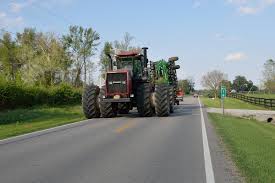
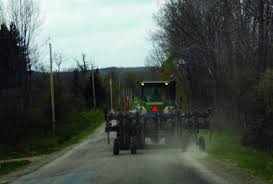
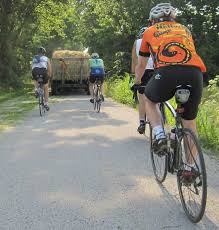
Vehicles moving slowly. They are as far right as is practicable to the right edge boundary without driving off the roadway.
189.345 Prohibitions against driving on left side of roadway. (1) No vehicle shall be driven on the left side of the roadway under the following conditions: (a) When approaching or upon the crest of a grade or a curve in the highway where the operator’s view is obstructed within such distance as to create a hazard in the event another vehicle might approach from the opposite direction; (b) When approaching within one hundred (100) feet of or traversing any intersection or railroad grade crossing; (c) When the view is obstructed upon approaching within one hundred (100) feet of any bridge, viaduct or tunnel. (2) The foregoing limitations shall not apply upon a one (1) way roadway, nor when an obstruction exists making it necessary to drive to the left of the center of the highway; provided, any person so doing shall yield the right-of-way to all vehicles traveling in the proper direction upon the unobstructed portion of the highway within such distance as to constitute an immediate hazard, nor to the operator of a vehicle turning left into or from an alley, private road or driveway.
189.420 Driving on mountain highways. The operator of a motor vehicle traveling through defiles or on mountain highways shall hold his motor vehicle under control and keep as near the right-hand edge of the highway as reasonably possible. Upon approaching any curve where the view is obstructed within a distance of two hundred feet (200′) along the highway, he shall give audible warning with the horn of his motor vehicle.
189.287 Bicycle safety regulations and standards. The Transportation Cabinet shall promulgate administrative regulations pursuant to KRS Chapter 13A to set forth standards for bicycle equipment and the safe operation of a bicycle. The regulations shall include requirements for lights, reflectors, and audible warning devices. Bicycles and riders which comply with the regulations promulgated under this section are exempt from municipal and other local government regulations concerning safety equipment but not method of operation. In promulgating the administrative regulations, the Transportation Cabinet shall permit use of lightweight modern technological substitutes for lights, reflectors, and bells. The purpose of this section is to encourage bicycling and bicycle touring in this state by enabling bicycle riders to make use of modern technology to make their presence known to other users of the road. The Transportation Cabinet may consult with organizations of bicycle riders to aid it in the search for bicycle safety equipment and rules convenient for long distance bicycle riders.
189.520 Operating vehicle not a motor vehicle while under influence of intoxicants or substance which may impair driving ability prohibited — Presumptions concerning intoxication. (1) No person under the influence of intoxicating beverages or any substance which may impair one’s driving ability shall operate a vehicle that is not a motor vehicle anywhere in this state.
189.570 Pedestrians.
(5) Whenever any vehicle is stopped at a marked crosswalk or at any unmarked crosswalk at an intersection, to permit a pedestrian to cross the roadway, the operator of any other vehicle approaching from the rear shall not overtake and pass the stopped vehicle. (6) (a) Every pedestrian crossing a roadway at a point other than within a marked crosswalk or within an unmarked crosswalk at an intersection shall yield the right-of-way to all vehicles upon the roadway. (7) No vehicle shall at any time be driven through or within a safety zone. (8) The operator of a vehicle shall yield the right-of-way to any pedestrian on a sidewalk.
(11) Pedestrians shall move, whenever practicable, upon the right half of crosswalks. (12) Where a sidewalk is provided and its use is practicable, it shall be unlawful for any pedestrian to walk along and upon an adjacent roadway. (13) Where a sidewalk is not available, any pedestrian walking along and upon a highway shall walk only on a shoulder, as far as practicable from the edge of the roadway. (14) Where neither a sidewalk nor a shoulder is available, any pedestrian walking on or along a highway shall walk as near as practicable to an outside edge of the roadway, and, if on a two-way roadway shall walk only on the left side of the roadway. (15) Except as otherwise provided in this chapter, any pedestrian upon a roadway shall yield the right-of-way to all vehicles upon the roadway. (24) This section shall not relieve the operator of an emergency vehicle from the duty to drive with due regard for the safety of all persons using the highway nor from the duty to exercise due care to avoid colliding with any pedestrian.
189.810 Definitions. (1) “Slow-moving vehicle” includes farm machinery, including animal-drawn vehicles, highway construction and maintenance vehicles, and any other type of vehicle except bicycles, capable of a rate of speed no greater than twenty-five (25) miles per hour. (2) “Slow-moving vehicle emblem” consists of a fluorescent yellow-orange triangle with a dark red reflective border, as specified in American Society of Agricultural Engineers R276 or Society of Automotive Engineers J943 standards, or consisting of reasonably similar reflective qualities as specified in said standards.
189.830 Use of emblem or reflective tape restricted — Exemption from requirement. (1) The slow-moving vehicle emblem shall be restricted to the uses specified herein and the use on any other type of vehicle or on other objects is prohibited. (5) The slow-moving vehicle emblem shall not be used on a bicycle.
To sum up:
A bicycle is a vehicle with all the rights and responsibilities.
Kentucky roadways are first come first served.
A bicycle shall be driven as nearly as may be practical entirely within a single lane.
If there are no marked lanes, then the bicycle shall be operated on the right half of the roadway.
When traveling on an unmarked highway or a highway dividing into a left side and right side lane. You are required to drive in the right half of the road and should motor traffic approach from the rear, you are only required to move over when it is safe to do so. Over taking traffic is still lawfully required to pass with due care.
Kentucky Bicycle and Bikeway Commissionhas proposed a set of regulations to assist with the understanding of the safe movement of bicycles on the highway/roadway as well as other regulations regarding the needs of cyclists.









 Cherokee Schill | Insurance Agent & AI Ethics Researcher