
Unprocessed trauma is a weapon.
I had been listening to “Why is this happening?” a podcast by Chris Hayes. In this episode, he featured Mariame Kaba, a transformative justice advocate and prison abolitionist. One of the striking moments of the podcast was when Mariame opened up about her own sexual abuse trauma. In it, she explains that people’s traumas are valid and they are important for us to consider, however, society cannot be governed by how to address things mainly by people’s traumas and their fears. She goes on to explain that she is a survivor of rape and that she was what she terms a reactionary survivor. Mariame explains that she did not have an analysis of what had happened to her. That she was an incredibly hurt and harmed individual, who wanted nothing but violence against the person who had harmed her. That ultimately what she wanted was revenge.
She points out that had she been put on a panel of sexual assault survivors, without processing the trauma she had experienced, she would have advocated for the death penalty for all rapists. She points out that that is no way to govern a society.
The answer cannot be to go around and use capital punishment against everyone who has harmed us.
I highly recommend listening to the entire podcast which has been linked to in the opening paragraph.
I bring this up because there is a movement within bicycle advocacy to weaponize the trauma experienced by bicyclists and use their trauma to make broad and sweeping laws to “protect” bicyclists. These people are living in trauma. I know because I used to be one of them. I commuted by bicycle daily, 32 miles round trip, and experienced wave after wave of cruelty and harm from people operating cars around me.
The trauma I experienced was real and I’m still processing through it. But I’ve come far enough in my personal growth to recognize that what we are fighting against is not individuals behind steering wheels. No. What we, as bicyclists are up against is a society that has built a system of White Supremacy into the very roads we operate on.
Justice, for us, is not stricter laws, it is not segregation, and it is not education as a stand-alone response to the trauma that we experience on public roads. What we need, as a community, is transformative justice. We need a society that prioritizes people over speed, communities over roads, and our humanity over infrastructure. We need to be treated as equal members of society, deserving of the same respect automatically granted to people operating motor vehicles.
And often, when we advocate for stricter laws, there is a rebound effect in which the police then use those laws, which were intended to protect us, to harm us.
We need to hold our elected officials accountable and we each need to process through our trauma, so that we can run for office and make the changes that we know to be just and fair to a society focused on equality.
People should not have to drive to get a gallon of milk. Kids should not grow up with glorified cartoons of automobiles as their introduction to our roads. Teenagers and young adults should not be wooed by slick films glorifying dangerous speeds and irresponsible driving. Does that mean that we banish these things or outlaw them? No!
It means that we educate parents to raise socially responsible children, school programs, high school volunteer programs and public PSA’s about the realities of speed and what happens to the human body, even when it is surrounded by a seat belt and steel, in a high-speed crash. We build walkable communities and we educate our police to be good examples, at least until we can abolish them altogether. Because a society that is ruled by the police is a society that is ruled by fear and fear is trauma.
We need programs for people who have transgressed basic laws to experience life on a bicycle. There should be training programs by certified bicycling instructors that allow motorists to travel their roads on a bike or a trike. We can implement stricter licensing requirements and require drivers to pass a bicycle operating equivalency test.
We can build up community and support for those who are harmed. City financed trauma counseling and recovery from harm programs, which center the needs of the victims. Allowing them to heal and return to society as whole people.
Our country was founded on the myth of white supremacy and it is this myth which frames our way of thinking. We need a fresh outlook and a new way of understanding the world around us. One of the ways to achieve these results will be to center victims of auto violence and find out what justice really looks like to them after they’ve had healing space to process through their trauma.
What is transformative justice? Read more about it here: Transformative Justice, Explained.
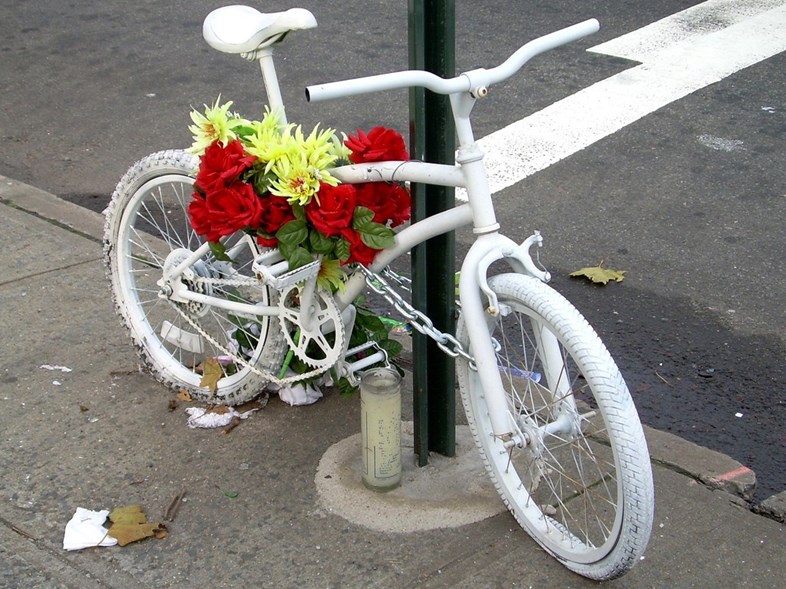

![DSC00542[1]](https://cherokeeschill.com/wp-content/uploads/2014/08/dsc005421.jpg?w=363&h=272)



 Cherokee Schill | Insurance Agent & AI Ethics Researcher