Rape Culture, Religious Fanaticism, Jim Crow, and Bicycles

Dear gentle reader,

Don’t you hate it when people start off writing with an opening like that? I know I do. I write this salutation to warn you that what you are about to read will (hopefully) blow your mind. I wrote it quickly and without proofreading. So excuse my deplorable punctuation and grammar. Which has always been deplorable but had the benefit of proofreading. This needs to be said and it needs to be said now.

If you have been reading my blog from the beginning you will, hopefully, have noticed a theme.

I am first and foremost a proponent of everyone getting along and sharing that which has been entrusted to the public for public use. I paid attention in Kindergarten when we were taught to respect each other and share. I hope you did too.

I am not, as some less than emotionally stable people will insist, against infrastructure. What I am against is the flawed logic that all of cyclings problems can be resolved with infrastructure alone.

In fact I believe that it is this bicycle infra. only cult which has lead to the deaths of many cyclists and the culture of removing the blame from motorists for their bad driving habits. Because “if they’d only had a bike lane none of this would have happened” is specious logic.

At the end of this blog I will present solutions to these problems.

Where the article in TreeHugger fails is in…

RAPE CULTURE

Blaming cyclists for the injuries they sustain due to careless drivers is rape culture. As this, hot off the press and the straw which broke this blogger’s back, article in TreeHugger accurately portrays. Where they fail is in the conclusion.

The article in TreeHugger promotes rape culture. Blaming infra. or the lack thereof but not fully placing the onus on the perpetrator of the attack is rape culture.

Blaming a cyclist for the actions of a careless driver are ingrained in us, not by those who want to see cyclists as expected and respected, but rather by those who have made it their personal mission to create a smear campaign against those of us who are actively trying to require motorists to be held accountable for their actions.

I often hear “If they had a bike lane this wouldn’t have happened,” as though we can just engineer all of societal ills out of public roads.

That’s exactly like this judge blaming a rock concert for a Brazilian woman’s rape.

I believe that everyone has a right to use the public roads and that they should be treated with equal status when on the roads. I also believe that good bicycle infra is an essential component of encouraging cycling. I don’t believe that it’s the only component to promoting cycling.

I myself was arrested for legally and safely cycling on a public road. I wasn’t not using the shoulder to be “Cute” or “Prove a point” as the zealots claim. No! I was a new, in every way, cyclist who took up cycling as a means to provide for her children.

I, as a poor hardworking single mom, got shafted by both “Motorists are king of the road” car culture and “Special snowflake syndrome” bike culture. Not to be confused with responsible motorists and responsible bicycle advocates.

I still struggle to get people to take my story seriously because some people have chosen to latch onto the idea that this was a stunt by VC.

Where the article in Tree Hugger fails is in…

RELIGIOUS FANATICISM

Religious fanaticism is the antithesis to religion.

You can not believe in an all loving God. A God whom you believe created everything on earth and pronounced it good while shitting on those who question its existence. Nor can you follow such a God and believe that he has chosen you, above all others, as especially blessed, giving you special leave to shit on anyone who doesn’t believe in this same God, exactly as you believe in it.

Enter bicycle specific infra. only zealots.

Every problem which plagues cyclists can not all fit into a bike lane. The bike lane is not Jesus resurrected, come to save cyclists from the sinfulness of motorkind.

Bike lanes, like religion, can be good and helpful.

And like religion, they can also be bad. Very, very bad, and that which was created to solve problems can in and of itself create a plethora of new problems, as this article shows. Link here. Especially if the bike lane is engineered using the very common practice of “get cyclists the hell off the road and out of our way!” car culture engineering.

Anyone who questions the safety and viability of a bike lane is immediately shouted down by the “Infra. only zealots.” A rather cultish group of people who troll twitter and call anyone who asks for better forethought in bicycle infrastructure a “Cunt,” as in… “You must be a VC! Because only a VC would ever question a bike lane you cunt.”

I was so angry when a twitter user did just that because I was trying to promote bike infra which would accommodate wider bicycles for people with special needs.

123A.PNG
John jumped in mid conversation and started slamming me with slurs then immediately blocked me. So I switched to my other account to find his offensive tweet and snap a picture.

Where the article in TreeHugger fails is in…

JIM CROW

Our European friends may not be familiar with “Jim Crow” laws and it is this lack of familiarity which will lead them to question our aversion to words like “separated infra.” Because as we know here in the United States and especially the South, “Separate but Equal,” is anything but. Andy Clarke was himself a infra only leader and used his political power to try and establish mandatory cycle lane laws in Washington state. A state where cycling is given the advantage of infra succeeding or failing by the comfort with which cyclists feel when using it. And calling a cyclist a VC (Vehicular Cyclist) has, in the world of cycling, been given the emotional weight of calling a person of color the “N” word. It is a word which was once and briefly used to describe the facts of a person’s skin color but then rapidly became a way to dehumanize and humiliate a class of people. Much in the same way that overly zealous followers of infra only “Guru’s” will preach to their follows that all VC are ANTI-INFRA! For an interesting read about the opinion of just such a Guru, click the blue link.

When in reality nothing could be further from the truth. I consider myself a connoisseur of infra. I understand how to operate in traffic and I want the best infra possible. I don’t want crumbs from the “Car Culture” table and I don’t believe that we are being given a feast when someone paints a shitty little lane into the gutter. Or worse between two 12 foot wide lanes. I know better.

12Aa
This is a bike lane. We don’t currently have a word to describe this crap as opposed to good infra. So anyone complaining about this, without first asking what they are referring to, is slammed as VC. Here in Oregon state laws says I’m obligated to use this lane and if ticketed, I have to go to the trouble of proving I had good reason not to be in it.


What Mr. C. Anderson consistently fails to grasp is that in America, our shitty by blow bike lanes, a bastardization of auto culture, are further made unbearable by “Mandatory Use” laws. And it is those laws which I hate above all else.

SUMMARY

He almost had it right.

A vehicular cyclist isn’t repulsive. A vehicular cyclist is one of the most educated cyclists on the road. And as @Rightlegpegged once asked “Have you even read the Uniform Manual on Bicycle Infra or attended a city council meeting?”

Have you even. Much like, you’re so stupid but I’ll condescend to acknowledge you.

The answer is yes. In fact, the greater majority of VC I know are passionate advocates for good bicycle infra, as they themselves are cyclists who cycle for transportation. They, like me, cycle in spite of a lack of infra. So let’s give them the respect they deserve.

Have you even talked to a VC about their concerns?

HOW DO WE SOLVE THIS?

  1. We need to immediately stop slurring anyone who is using VC cycling principles for their safety.
  2. We need to create a safe place where people can share their concerns about infra without immediately resorting to name calling.
  3. Repeal all mandatory bike lane use laws.
  4. Make it a penalty against the officer for not ticketing a motorist who causes injury to a cyclist.
  5. Stop encouraging people to cycle on the edge of a road by shaming them into thinking they are being VC if they occupy a whole lane.
  6. Mandatory cycling education across the board and on every level.
  7. And I feel this is super important. Create policy mandating cycling infra be made with the same specification on the user’s safety as is given to auto infra engineering.
  8. Lower speed limits.
  9. Re-visit past tort law and educate law enforcement that the onus is on the driver to operate with care around pedestrians and cyclists.
  10. Ban auto ads from television and social media. Like cigarettes they have a huge impact on public health and shape the culture of speed makes right and entitlement.

We can do all of this and still promote good infra.

I also would like to see sharrows in low speed residential areas. This is a place where bike lanes don’t make sense at all.

While I’m working to end car culture, be so kind as to support me. Instead of talking about me behind my back, giving me the cold shoulder, or making fun of me ask me about what I would do to make cycling better for all.

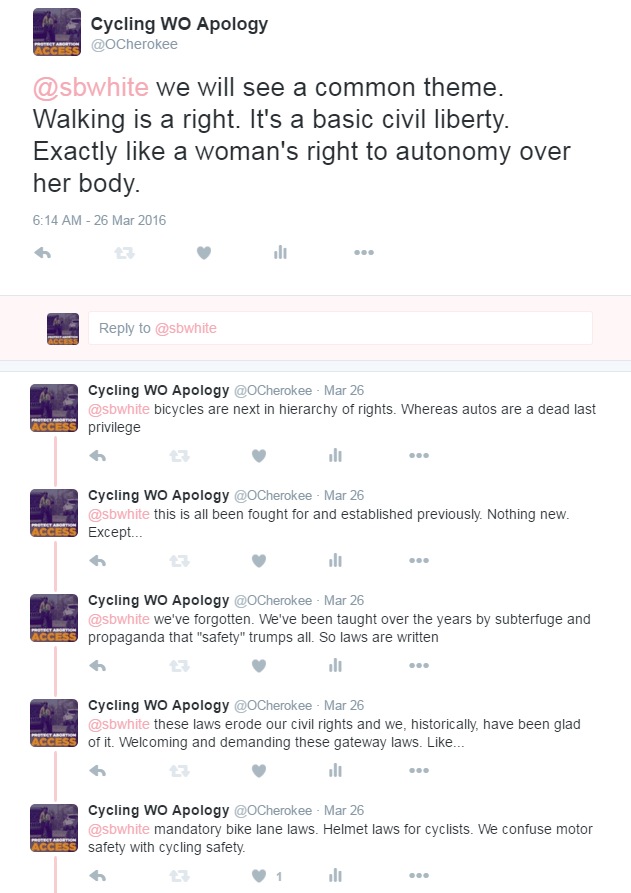
112A

112AA.PNG
Criminalizing walking on the sidewalk is the next push in auto culture. Criminalizing texting while walking in pedestrian zones.


Let me plainly state that my problem with the article in TreeHugger is that it blames a lack of infra on the careless actions of a motorist. That is rape culture.



Irresponsible ads are contributing to child mortality rates.

As a person who commutes solely by bicycle, I am shocked by the inundation of auto ads on T.V. and in my social media news feed.

Maybe it is because I live a auto free life that I notice the frequency of the ads?

I’ve spent a great deal of time educating myself on safety and laws which govern our use of public space. I even have some nifty certifications to show for all that time spent.

CBmSyxLUgAA6fev


People are being injured and killed at an alarming rate. Traffic fatalities fall in 2014, but early estimates show 2015 trending higher.

Though this isn’t anything new, since the inception of the automobile the death toll has been catastrophic. Americans have recognized the dangers of high auto speeds. It’s a universal knowledge that speed kills. Yet it is often the last reason cited in traffic collision reports. There was a time when people tried to mandate the use of governors to effectively reduce the operating speeds of motor vehicles. Auto manufacturers were understandably alarmed.
Higher awareness about the inherent dangers of speed meant less product sold. Or maybe it was that fewer people would crash and destroy their auto thus requiring the purchase of a new auto?
Either way a slick propaganda campaign was implemented and people were convinced that this was an end to their personal freedom. Never mind the freedom of everyone else.

Companies, such as AAA, which today are known for their emphasis on safety were behind the push to force pedestrians and bicycles off the road.

AAA and other auto clubs turned first to the younger generation, financing safety education programs in the public schools that were designed to teach children that streets are for cars, not for kids. “The Invention of Jaywalking.”

The product, and the financial gains to be had from it, were the driving force behind the movement to all but eliminate the competition.

Once the landscape had been cleared of obstacles, figuratively and literally, the motor manufacturers were free to irresponsibly sell product.
The advertisements were focused on economy, durability, and reliance.
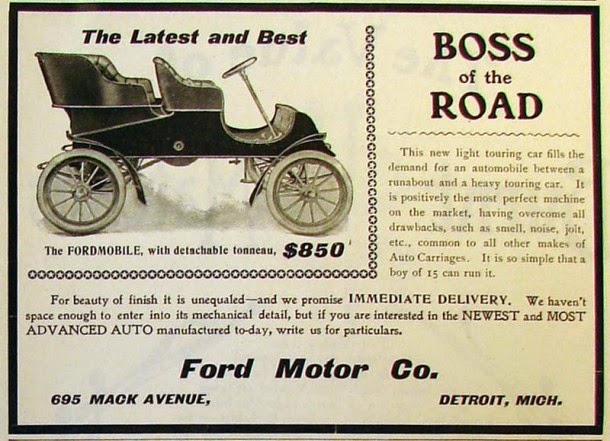
They emphasised the manliness of auto owners and their ability to “Wow” the ladies. One advert emphasised their auto as being so easy “Women and children can safely use it.”, another calls their auto the “Boss of the Road” and “So simple that a boy of 15 can run it.”

1903_Fordmobile_Ad

Motor ads were not responsible in the advertisement of their products. They had one mission in mind, to sell as many autos as possible. No matter the cost to human lives.
That cost was excessive. Upto 55,000 people were killed per year by autos. That’s an epidemic!

When faced with a health crisis of these proportions, we take action. Yet we have largely overlooked the consummate dangers to public health by turning a blind eye to auto ads.

We banned ads for cigarettes, as public awareness grew over the dangers of smoking to the public. Big tobacco companies were pushing their product on unsuspecting consumers.

By banning ads for cigarettes public health interests, like W.H.O., have effectively reduced the incidence of smoking. This is an important beginning step to eliminating an expensive and destructive bad habit. The costs of which affect the user individually and the public as a whole. We acknowledged the health risks to the users of tobacco products as well as to those who were subjected to secondhand smoke.

The auto isn’t any different.

The auto is the most dangerous form of transportation available in modern day.

The health impacts are mind boggling. Pollution, cancer causing agents, socio economic suffering, legal systems which punish the poor through a pay to play ticket scheme, the death of our children outside and inside autos, and increased health risks through lack of exercise. It’s all too much to put into one story.

Not too much more can be said, which has not already been said, about the history and nature of the auto.

The automobile is a weapon or a tool. It mainly depends on the ability and intent of the user.

There was a time when the auto filled a need as a personal mobility device. With the expanding use of public transportation and alternate means of travel it is a product whose time has come and gone.

With denser urban areas becoming the norm, revivals in public transit, and auto for hire schemes such as Lyft and Uber; there really isn’t a need for personal autos. Not even for long distance trips. Rent a car and be done with it.

One would think that we’d be over the car kick by now. Except we aren’t.

Part of the reason, I believe, is because of persuasive auto ads. These ads are designed to create a sense of urgent need and a feeling of superiority when on the road.

I really love driving distracted
You know how people are warned about the dangers of distracted driving by Public Service Announcements? Well none of that matters in Auto Ads.

Gas prices are dropping and Auto Ads are increasing. Along with these increases are deaths. Your loved ones are being destroyed by auto culture and you’re ok with it. Not because you’re ok with your loved one being killed, but because you are brainwashed by auto ads to believe you need that product which is killing your loved ones.

Remember cigarette ads on T.V.?

Neither do I. Yet there was a time when they were sold via television ads. So many ads telling people how sexy smoking was, how invigorating, how tasty! Smoking was increasing and so were the illnesses associated with it.

Through the efforts of activists who genuinely cared about the well being of the American people, over the profits of cigarette manufacturers, a ban on television ads were put into place.

In 1964, the Federal Trade Commission (FTC) and the Federal Communications Commission (FCC) agreed that advertisers had a responsibility to warn the public of the health hazards of cigarette smoking. In 1969, after the surgeon general of the United States released an official report linking cigarette smoking to low birth weight, Congress yielded to pressure from the public health sector and signed the Cigarette Smoking Act. Via History Channel

This is exactly what we need for auto ads.

We need a full out ban on ads which promote products rated by the CDC as the number one killer of our children.

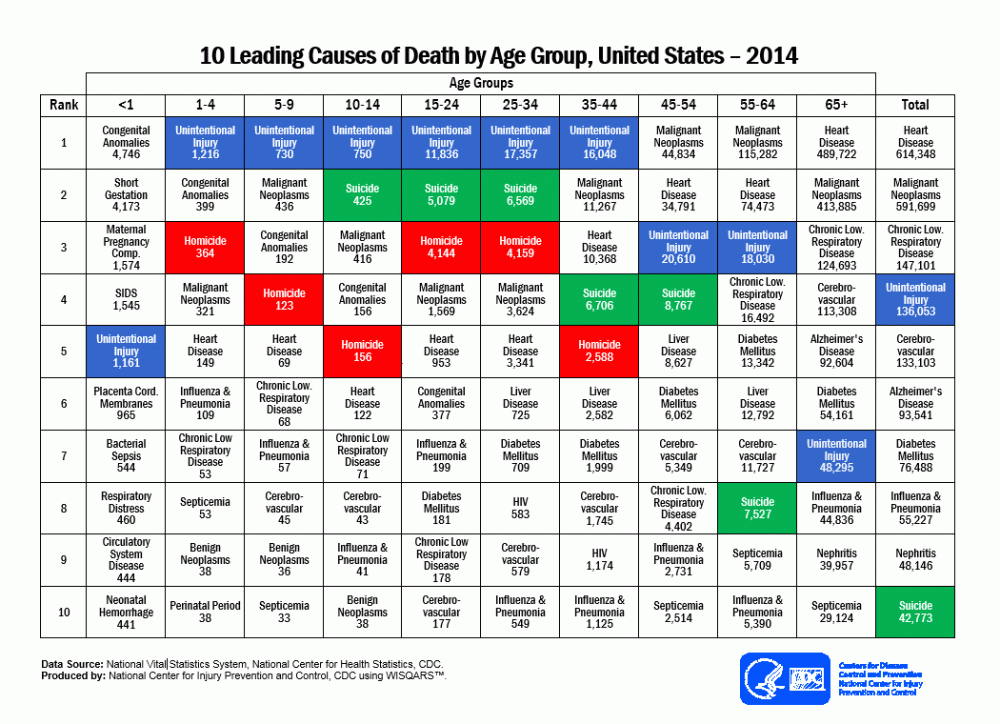
  • Motor vehicle crashes are a leading cause of death in the U.S. More than 33,000 people died from motor vehicle crashes in 2013 alone.1   Via CDC

leading_causes_of_death_age_group_2014_1050w760h
They call it “Unintentional Injuries” but Motor Vehicle collisions are what the majority of them are. When you drive distracted, drowsy, buzzed, high, or like you own the road. It isn’t unintentional.

Driving is not a passive act. It is hard work and you are required to keep your wits about you while you are doing it.

With the huge flux of auto ads telling us that driving is fun, easy, desirable, sleek, sexy, and your ticket to freedom. Is it any wonder that people “feel” like they “need” to drive?

These are all catch phrases that were used to push cigarette ads and yet we were able to fight “the man” and have them kicked off of television and radio.

So why aren’t we doing that for auto ads?

#BanAutoAds

So the next time you see an auto ad pop up in your news feed, be sure and let them know what you find disturbing about it and add the hashtag #BanAutoAds. Your children’s lives depend on it.

You have options on how to get to work and people are fighting to make those options easier and more accessible to you. Help them.

Don’t wait around for special infra as some people will tell you to do. Take an education course such as Cycling Savvy and learn what real freedom actually feels like.

You can safely travel by walking, cycling, public transport, and auto rentals to get you where you need to go.

All that space removed from auto’s gives us more space to build business’, shops, schools, and cultural activities.

#BanAutoAds

Auto companies are gathering slick advertisers to promote their dangerous product to children using cartoons.

I’d like to sell you a bridge…O’Canada!

Burgoyne bridge St.Catharines Ontario

0db19ffc-4e56-4712-ad0f-433c47b299fc
Canadian Engineering. The struggle is real.


Douglas Bruce Ford, Jr. is a Canadian businessperson and politician in Toronto, Ontario. Ford was Toronto City Councillor for Ward 2 Etobicoke North in Toronto from 2010 to 2014 at the same time that his brother, Rob Ford, was mayor of Toronto. Wikipedia

Robert Bruce “Rob” Ford is a Canadian politician and businessperson who is a Toronto City Councillor. He was the 64th Mayor of Toronto, serving from 2010 to 2014. Prior to being mayor, Ford was a city councillor. Wikipedia

Car centric societies have no business engineering bicycle specific infrastructure. They aren’t qualified. You can not live your entire life driving a car and think that your engineering degree makes you fit to design bicycle specific infrastructure. You can’t do it. It’s like hiring someone who only walks, and has never driven, to design the roads you drive on. You would consider them unqualified, no matter how extensive their engineering knowledge or how many framed bits of expensive paper they have hanging on their wall.

You have to feel bicycling.

Local cycling advocate Tyler P. wants to ride his bicycle. He has a job, he goes to school, he shops, pays taxes, and is an all around responsible person.

He is a first class citizen being treated with second class status.

Because he rides a bicycle.

Toronto a.k.a. ‘Car’onto thanks to politicians like the “Ford’s” is vastly lopsided in its engineering practices. These engineering policies affect the entire province of Ontario, including the city of St. Catharines in the Niagara region.

Tyler P. has been actively reaching out to the local administration in the Niagara region and asking them for

bmufl-addition
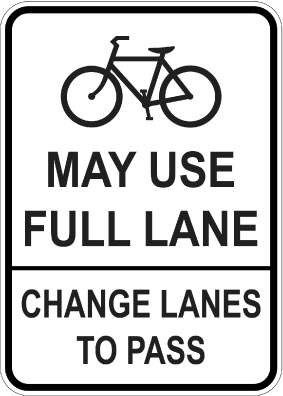
Legally it’s “Shall” but that’s a whole ‘nother blog.

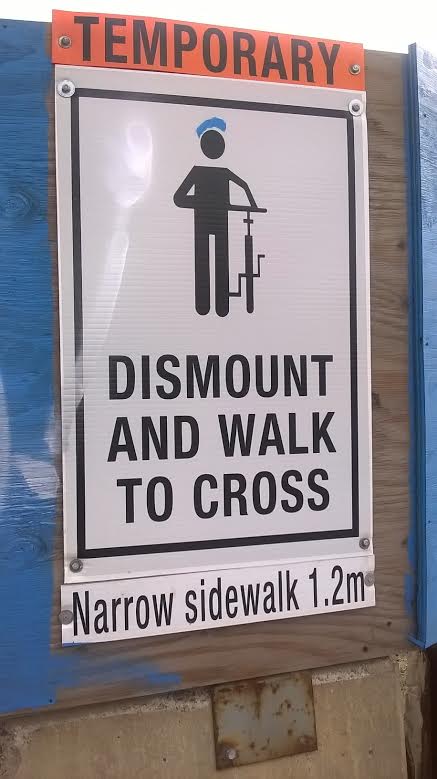
These are temporary signs that he is asking to be placed until the new construction is complete.

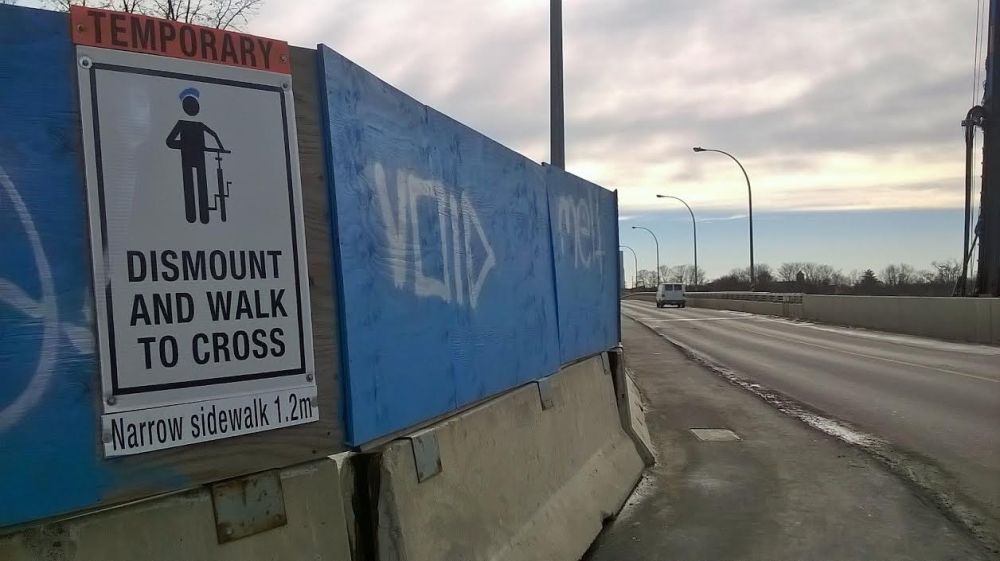
As it stands now. There is a 1.2 meter sidewalk and the city of St. Catharines is asking cyclist to dismount and walk their bicycles across a bridge.

8e0883d3-416b-4f29-9e28-bfaa95d94ae6.jpg
Looks like someone wanted to be cute and put a little blue hat on the cyclist.

It’s a long walk.

880999ff-32d2-4df8-9906-7660bb51b70f.jpg
All bridge photo’s courtesy of Tyler P.

Bicycling for transportation is fun. It’s also healthy, good for the environment, and easy on the wallet. The number one response from cyclists when asked why they enjoy cycling is “FREEDOM.”

You can’t get that with a car, even if you made it 100% free in every aspect you would still be hemmed in, limited, and stuck in traffic. That is the nature of autos.

Car centric societies are jealous of the freedom which cycling brings and it’s why people blame cyclists for their traffic problems, try to pass laws restricting them, and gamers design infra which hems cyclists in on every side.

Why can’t he just ride in the lane?

Well he can. Legally in St. Catharines, and all of Canada, Tyler’s bicycle is a vehicle and he is legally allowed to occupy the full lane of travel. Which is why he is asking for the sign. Tyler knows what he can do. That’s not the problem. The problem is that people driving autos will make his life a living hell for exercising his rights. Because they are

  1. Uneducated on the equal status of bicycles as vehicles.
  2. Educated by auto ads that their auto is “like a family member,” and we all put our family before strangers.
  3. Car culture breeds lazy, distracted, and passive driving.

Namely tyler doesn’t want to be harassed.


120a6482-fda0-47d7-b15c-f14dae1f91e0.jpg
There is plenty of space for Tyler on the road. There is little space for pedestrians, Tyler and his bicycle.

There has been Twitter mention to the authorities in charge of this project to take into consideration the needs of the cyclist before after the construction is completed. As it stands now the bridge is being built to accommodate pedestrians and cyclists as an afterthought.

There is a real problem with bicycle infra that project engineers, city planners, and cycling advocates like to pretend doesn’t exist.

All transportation engineers put every measure into insuring that autos can operate at maximum speed with safety. They put very little of this same safety culture into bicycle design. Everyone assumes all cyclists are going to operate at super slow speed. I can tell you from experience that cyclists do not, and most will not, operate at the speeds for which you are designing their infra.

You create unsafe places for cyclists, pass laws mandating that cyclists must use these unsafe facilities, and then scratch your heads and conduct million dollar research studies to figure out why cyclists keep dying after all that effort.

Go ride your bike! 

I’m talking to you transportation engineers.

In the meantime. Can we put a little lean on the people in charge of the Burgoyne bridge in St.Catharines, Ontario and get Tyler P. the help he needs in creating space for cycling?

You can contact them here. Niagara Region
And here.
the construction firm
the region is like the county
the mayor who seems responsive at times
Alan Caslin

Please be aware that:

Feb 19
Tyler P.
When it’s done it will have painted lanes at the edge

And on a highly trafficked bridge some paint on the road is completely unacceptable. If a cyclist can be harassed for safely controlling their lane. Then the city has a moral responsibility to create a protected space. Not just from auto’s but from the debris that they push into bike lanes. (It’s why I prefer to cycling in the travel lane. Those nice people in their autos keep them swept clean.)

Please contact the names listed and go to their FB page.

Nicely! Ask them to support cycling.

Do it for yourself, Do it for cycling, Do it for the environment, But above all!

Do it for Tyler!

3826612e-1cde-4ed1-a3a8-67df83f19b17
Steady there. Once false move and it’s a head under a tire. #ForTyler

Bicycle Specific Infrastructure and Robert Moses

A cyclist who uses lights, signals, and behaves as a predictable part of traffic doesn’t require bicycle specific infrastructure, some people would argue.

I would agree with them up to a point.

My views of a better culture for people don’t jive with bicycle specific infra (short for infrastructure) in dense urban area’s. Instead, I see these areas as perfect for true greening and humanizing public space.

The problem, as near as I can tell, is our cultural immersion in Robert Moses and his vision for the cities of tomorrow. Huge concrete jungles where everyone has a specific space and directions on how to operate in that space.
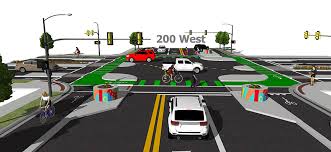
I hear this theme repeated back in transportation engineering. One webinar going so far as to suggest that trucks, motorcycles, and personal autos should each have their own specific lane.

4362eac2529d9e9dc9_uim6i6jou.png
Well that makes everything better! Especially if you only ever intend to cycle forward. I hope there’s a 7-11 in the middle of the street. 

It’s utter madness.

We don’t have space for each type of vehicle to have its own specific lane to operate in and we sure as hell shouldn’t confine people to “lane cages” in an attempt to regulate the mess that is humanity.

Looking back over the history of the rise of the DOT empire and their powerful influence over local governments; I begin to understand why cycling advocates have been wooed into this desire for bicycle specific infra in their neighborhoods. The propaganda is seductive.

I look over Streetsblog, People for Bikes, and League of American Cyclists literature and their love affair with bike lanes; I see people advocating for gilded cages.

You don’t need, nor should you want, a bike lane in dense urban areas. These are places where people should be free to mill around the neighborhood and shop. Pedal from one side of the street to the other as they run their errands. There should be trees, shrubs, food gardens, and benches to sit on in the middle of the road. Or at least on either side of a dedicated rail or tram line.

After speaking with the director of bicycle promotion in Japan, Mr. Hidetomo Okoshi, I left the North American Handmade Bicycle Show with a better vision of cycling and its future.

Mr. Okoshi explained to me that people in his country do not as a rule commute by auto to their jobs. Nor do they commute by bicycle. Instead they take the train and in their communities they get around by foot, bicycle, and auto. In that order of hierarchy. The people he explained do not travel far by bicycle. I asked him about bike lanes. He had an air of apprehension as he explained that Japanese do not need this as much as Americans because of their respect for each other. That is when the lightbulb hit.

Bike lanes do not create respect for cyclists anymore than sidewalks create respect for pedestrians. Communities which insist on bike lanes as a “friendly” way of incorporating cycling as a viable means of transportation aren’t doing anything to help the pedestrians in their communities. Bike lanes, by forcing cyclists off the usable portion of the roadway, enable motorists to speed and endanger both cyclists and pedestrians, not to mention themselves.
As was recently pointed out by Tim Cupery on my Facebook page who said:

it’s worth pointing out that edge-riding IS doing a favor to motorists, so they can continue to go the speed that they would prefer.

This is a key motive behind segregated infrastructure, and many cyclists think of themselves as second-class road users.

And he is right; Motorists do not slow down in the presence of bike lanes. If anything it only encourages them to speed.

How then are bike lanes heralded as a means of humanizing current infra? Because as I see it they aren’t. Instead I see places like downtown Louisville, Lexington, New York, and Portland as huge Robert Moses machines. Churning out the same style of precision engineering which treats people as machines or worse robots who are programmed to follow a specific flow.

Now some might get confused and understandably so, because bicycle infra when held up to car culture is confusing, over whether or not I support any infra at all!

The answer is YES!

But not the way you imagine it and not the way we are currently being sold.

My vision entails trains as mass transit over great distances and as high speed movement between fixed places. Walking and cycling as the normal means of transportation between shorter distances. Zoning which creates inclusive infrastructure and alleviates the homeless crisis, not exacerbate it. Neighborhoods where kids play on the street and tool around on their bicycles. E-assist pedal transport of heavy goods from a centralized location. More reliance on creative solutions and less dependence on the Moses era of thinking.

Bicycle highways which connect cities to each other are an excellent start to this vision. Zoning for the use of the areas around it to meet the needs of those cycling long distance is crucial.

But what do we do in the meantime?

We dismantle DOT or at the very least remove it from power as an oligarchy.  Sorry that was a bit ambitious for step one. Let me start over.

  1. We advocate for mandatory cycling education in all schools. Educating our children on how to operate their bicycles as a part of traffic.
  2. We advocate for mandatory cycling education on all drivers licensing, re-licensing, and court appointed diversion programs.
    (By following these first two steps we can effectively remove or at least significantly reduce cycling prejudice in one generation. Something to think about.)
  3. We advocate for reduced speed limits in neighborhoods and dense urban areas including cities. 20 mph is plenty.
  4. We advocate for mass transit and transitioning from Heavy Goods Vehicles a.k.a. tractor trailers to E-assist Heavy Goods Pedal Bikes.
  5. We advocate for programs with local police to report bullying and dangerous motorist behavior.
  6. We advocate for Greening our local communities with tree planting, food gardens, and shrubbery.
  7. We advocate for repeal of mandatory bike lane use laws.

If we get this started we can all have nice things.

8239366155_4f99b3d101.jpg
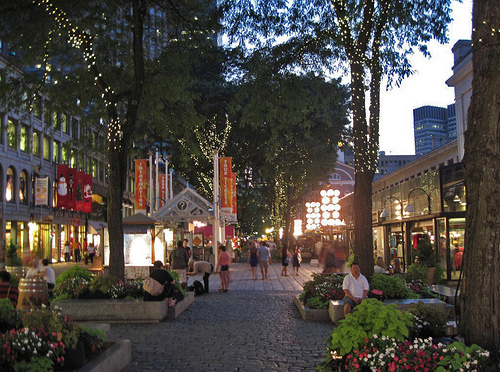
You can ride your bicycle through here. It’s lovely isn’t it?


Or we can continue to have this.

1_fi_cityparking_1.jpg
Let’s stick a bike lane in here and call it green infra!

Space is scarce without resorting to urban sprawl. Yet urban sprawl is exactly what layering bicycle culture over auto culture is creating. I hate #SneckDown as it 1. doesn’t actually change anything. 2. It’s a crappy way to “educate” people. 3. It is, in my own opinion, a throwback to Oliver Twist. “Please Sir! May I have some more?” We aren’t asking for our space, it is ours to begin with, we are demanding it back.

street-atmosphere041.jpg
I call it “Cycling Without Apology.” And far too many of you cycle as though you are apologizing for being present on the road. 


People who have much to gain from selling Bicycle Lanes shouldn’t be trusted as a source of unbiased opinion on the greatness of Bicycle specific infra.

images (11)
I have some infra I’d like to sell you. It will make your life so much better. 

This picture is a perfect example of gilded cages. It is a modern day version of separate but equal. Except that you aren’t treated as an equal. You are a bird in a cage and your freedom of movement is an illusion. Need to get to the shop in the middle of the other side of the street? Tough shit! Go down a block, make a U-turn, and then you will eventually reach your destination.

But we love authoritay! and some people want to treat cyclists as special snowflakes.

special-snowflake

We will never move towards a society which unequivocally increases its modal share to bicycling unless we first remove all prejudice against and all special snowflake syndromes from cycling.

“Cycling without apology” and “Cyclists: Expected and Respected” should be mainstays of our advocacy language.

I don’t apologize for using road space which my taxes helped pay for. I am your equal on the road, respect me.

Any infra proposed which does not treat cyclists as either or both of those isn’t infra which is going to move our society forward nor will it increase modal share.

Victim blaming is rape culture and why we need to stop!

A cyclist was killed in Ohio.

Officials reported that Prater was wearing a helmet at the time of the crash.

“Preliminary information suggests that he was doing everything correct,” Drifmeyer said. Via Cincinnati.com

Humor me as I give this a creative rewrite.

A woman was killed in Ohio.

Officials reported that Prater was wearing a turtleneck at the time of the attack.

“Preliminary information suggest that she was doing everything correct,” Drifmeyer said.

When a person is killed by the intentional acts of another person, why do people feel they need to defend the actions of the victim; if the said victim is a person riding a bicycle?

Typically, when the media reports whether or not a person was or was not wearing some safety device i.e. high vis. clothing and/or helmet, it is because there is some type of legislation specifying its use or someone is trying to push legislation pushing its use.

When I lived in California, every news article and t.v. spot always mentioned whether or not the person was wearing a seat belt. They most frequently reported on those collisions in which someone was injured or killed and NOT wearing a seat belt.

There is ample scientific proof that wearing a seatbelt in a motor vehicle collision provides the user protection.

The same can not be said for the bicycle helmet.

Let me repeat that, in case you missed it.

There is ample scientific proof that wearing a seatbelt in a motor vehicle collision provides the user protectionPhysics; Georgia State University

The same can not be said for the bicycle helmet. I couldn’t find a corresponding link to a science based article so here’s a Google search instead.

The cyclist was wearing a helmet.

He was wearing a helmet and he still died.

He may not have suffered any head injury due to wearing the helmet. Or he may have suffered severe head injury in spite of the helmet. The evidence isn’t presented in the media.

Stop legislating mandatory bicycle helmet use and stop making a point by reporting the use or nonuse of a bicycle helmet by the victim.

A bicycle helmet is no more protection to a cyclist against a 2 ton motorized weapon than a turtleneck is to a woman being attacked.

They are both the victims of an intentional act by an outside force.

The police suspect drugs were involved.

The use or nonuse of drugs, alcohol, cellphone, discipline of screaming kids in back seat, and the ever faithful “sun was in my eyes,” excuses are just that; excuses.

A person who uses alcohol or drugs and then gets behind the wheel is committing an intentional act.

A person using a cellphone while driving is committing an intentional act.

A person disciplining screaming kids in the back seat while operating a 2 ton motorized weapon is committing an intentional act.

A person who can not see the road ahead of them, yet continues to operate their 2 tons of motorized weaponry is committing an intentional act.

When you choose to do something behind the wheel, you are making a decision which places the lives of those around you and the lives of those in the vehicle, including your own, at risk. You are committing an intentional act.

I know people who treat their bicycle as the legally defined vehicle it is and still get treated with scathing disrespect by people who operate their legally defined MOTOR vehicle as though it were a toy.

Your motor vehicle is not a toy. No matter what the auto commercials may show  you.

The road is not where you express your “spirit for adventure!”

The police suspect drugs were involved.

A sober person rapes another person.

A drugged up person rapes another person.

A sober person kills another person.

A drugged up person kills another person.

The use or nonuse of drugs isn’t a defence and it isn’t an admission of culpability.

THE ACT OF KILLING IS WHERE IT’S AT!

As a society we make too many excuses for wrong behavior based on the thought that “It could have been me.” It could have been me except “I don’t do drugs,” so my conscience is clear and I’ll keep driving distracted because that’s not nearly as serious as doing drugs.

Except that it is.
See; Top Ten Dangerous Driving Habits, I bet you’ve done at least five of them if not all of them.

By “suspecting drugs,” we are giving a clean slate for others to kill.

The whole “it couldn’t possibly happen to me” syndrome. Except that it does.

A cyclist was riding on the edge of the road and a woman driving an SUV killed him. He was wearing a helmet and she thought she was giving him enough passing clearance. Her side view mirror struck the helmeted cyclists head at 55 mph and killed him. She was not drunk or on drugs. The sun was not in her eyes. Via. Biking in L.A.

She saw the cyclist and still killed him. She killed him because she did one thing wrong.

She did NOT treat him as the operator of a vehicle and instead of changing lanes to pass, like she would any other vehicle (including a motorcycle), she instead chose to pass him with minimal clearance.

This was an intentional act on her part.

This article also states that the driver was 77 years old.

Aging drivers are less able to judge distance. They also have poor motor coordination and it is the intentional act of the auto industry to promote their product in such a way that they have intentionally killed public transport.

By now you may have noticed a theme.

Driving is an intentional act. There are no excuses for killing someone when you are behind the wheel.

If you don’t need to drive, then don’t do it.

If you do need to drive, then do it with the thought “Today, would be the day I kill someone if I don’t put away these distractions and focus solely on driving.”

There are a lot of distracted drivers out there.

Distracted driving is ultimately the excuse given by the driver.

She claimed that she was distracted by unruly kids in the back seat. It was after the fact that they found evidence of drug paraphernalia in her purse. We won’t know for sure if she was high at the time, until lab work comes back. And if it is found that she was not under the influence at the time, THAT SHOULD NOT BE AN EXCUSE FOR GOING EASY ON HER. SHE KILLED SOMEONE!

Defending his honor!

We shouldn’t feel the need to defend the victims honor. We can honor the victim but elevating them to godlike status isn’t doing anyone any favors.

It is enough that they are a human being who lost their life.

The counter effect to defending the honor of those killed by people driving auto’s is this; Anyone who is less than perfect, and you know that none of us are perfect, implies that they are somehow to blame in their own death.

Neither does it matter that the cyclist killed is in fact a father, husband, and all around swell guy. He could be a bachelor who’s a real prick and his death would be every bit as important.

But if you paint them as being somehow unsavory then the attitude of people will be less likely to support the victim.

That is where the problem is.

Facts are the only thing that should matter. The content of their character doesn’t matter; when someone intentionally operates an auto in such a way that they kill someone, who they are as a person doesn’t matter.

The driver could have been Mother Teresa; sorry bad example. The driver could have been Doris Day and she should still be charged with a felony manslaughter. Her only saving grace would be if she could prove that she did everything possible to avoid the collision. In which case she too would be riding a bicycle, walking, or taking public transit.

5029386406_7947075f60
It is possible to take the kids along in a bicycle version of an SUV. 

This death should never have happened. Because she should never have gotten behind the wheel if she was in fact found to be under the influence at the time of the collision. She should never have taken her eyes off the road, not even for unruly kids.

How to drive with unruly kids.

  1. Don’t have kids.
  2. Don’t drive with kids if you do have them.
  3.  If you do have kids and you do intentionally choose to drive with them educate them on how serious driving is and why they have to behave.
  4.  If you have educated them and they still choose to behave like typical kids, then you keep your temper, you keep your eyes on the road, you scan the edge of the road for a safe place to pull over, you pull over, and then you discipline the kids.

Only after the interior of the car is completely calm do you then resume operations.

You don’t belong!

Why elevating the victim to sainthood hurts other road users.

“She sounds like someone we can support, unlike those other yahoo’s.” Andy Clarke

I’m sitting in court and my cycling advocate friend is sitting next to me. He is looking at his phone and he shows me an email he just received from Andy Clarke (Former President of League of American Bicyclists). He shows me the email. This is his attempt to show me that this backwater town isn’t going to ride rough shod over a cyclist. We have the support of Andy Clarke “big man honcho” with LAB.

My immediate thought was “those other yahoo’s?” and I asked my friend about what he meant by that. My friend brushed my concern aside by saying “You know wrong way cyclists, people who lost their license for driving drunk.” Those other people. Yahoo’s. He went on to say “but they aren’t like you Cherokee, you are cycling correctly and for the right reasons.”

Classifying people as “other” creates a distance between us and them. It creates an US vs. THEM. They are “those” people but we are “these” people. “Those” people do it wrong but “these” people do it right.

You have to cycle correctly and for the right reasons?

Because, if you don’t then you could be held liable in your own death?

Drivers Fault.PNG
Not according to already established case law. 

That’s right! If you are driving a motor vehicle and you injure someone else then you should be presumed at fault.

But this would discourage driving so auto companies have paid to influence our perspective.

Watch the news. Count the car commercials. Notice any collisions reported where the injured person is not in an auto.

I did.

Here’s what I found.

Roughly 80% of the placed ads were for auto’s. 100% of the ads implied that driving is exhilarating, for freedom lovers, and that public roads are personal playgrounds.

Of the injuries reported the vulnerable road user was painted as somehow at fault.

Except that legally they are not.

Except that since “Deputy v kimmell” there has been a push for laws to make it legal to find fault with vulnerable road users.

Imagine if we did the same thing for rapists? Or people who kill other people with guns?

Imagine a world where it is normal to assume the woman was somehow at fault in her own rape based on her clothes or lack thereof. We don’t really have to imagine because we do live in a world where such judgments exist.

But imagine if they passed legislation placing the woman at fault if she wasn’t wearing a turtleneck at the time of her attack.

Or imagine; they passed legislation placing fault of a mass shooting on the children killed because they were in school instead of adjacent to the school.

Such thoughts should be highly offensive to you.

but this is exactly what we are doing when we blame people for being assaulted by someone with a motor vehicle.

Why I take the lane.

I take the lane because it reduces risk. I’m a survivalist. I’ve put aside all the urban myths and studied the facts.

I found that wearing a helmet to protect you from car collisions is a myth. Or to reduce the severity of injury in a car collision, also a myth. (I would however wear a helmet to protect me from head injury if I were say; Mountain Biking or Group Riding.)

I found that cycling on the shoulder isn’t safer than taking the lane.

I stopped wearing a helmet because the social response from people driving cars was “Omigosh! She’s so vulnerable without a helmet!” and they give me more space by default.

I stopped cycling on the shoulder because I found that when I’m in the lane people notice me. When I’m in the lane and people don’t notice me, this has happened, they have space to the right to ditch out on.

Anyone who would blame me for being in the lane is victim blaming. Review the graphic on Deputy v Kimmell. Anyone blaming the cyclist for being killed while on the shoulder is victim blaming.

THAT SHIT HAS TO STOP AND IT HAS TO STOP NOW! 

If you would like to donate to the family’s GoFundMe account you can do so here.


Observing Traffic Court

If you want to put your finger on the pulse of car culture; observe traffic court.

The light was yellow for 2.7 seconds. I didn’t have time to stop in 2.7 seconds. So I went forward because I was worried about being cited for impeding traffic.
Actual testimony from a defendant.


There was so much traffic. The light was hard to see. I was worried about what the people behind me would do so I went through the light. I didn’t want to block the intersection.
Actual testimony from a defendant.


My van was loaded down with bricks. I must have had like a ton of weight back there. The road was really slick from all the rain and I knew I wouldn’t be able to stop in time. So I went through the light.
Actual testimony from a defendant.

The motorcycle cop who cited all three of these defendants had a helmet cam. He presented the video evidence to the court.

One of these defendants had their traffic ticket dismissed. The other two did not.

Traffic Lights

§ 811.260¹

Appropriate driver responses to traffic control devices

(4) Steady circular yellow signal. A driver facing a steady circular yellow signal light is thereby warned that the related right of way is being terminated and that a red or flashing red light will be shown immediately. A driver facing the light shall stop at a clearly marked stop line…

(7) Steady circular red signal. A driver facing a steady circular red signal light alone shall stop at a clearly marked stop line…

The driver of a vehicle is required to keep their vehicle under control at all times. They are required to be on the lookout for other road users who may be in their path of travel.

As I sat and listened to the drivers giving their excuses as to why they failed to head the traffic control light, a theme began to appear.

  1. I was distracted.
  2. I didn’t have my vehicle under control.
  3. I was worried about the people behind me.
  4. I couldn’t stop in time.

All of the defendants excuses appeared to be valid in their minds. None of these excuses took into consideration anyone else who may have been using Oregon’s public right of ways. Namely pedestrians but also cyclists.

Speed Laws

§ 811.100¹

Violation of basic speed rule
(1) A person commits the offense of violating the basic speed rule if the person drives a vehicle upon a highway at a speed greater than is reasonable and prudent, having due regard to all of the following:
(a) The traffic.
(b) The surface and width of the highway.
(c) The hazard at intersections.
(d) Weather.
(e) Visibility.
(f) Any other conditions then existing.

If you can’t keep your vehicle under control; you are going too fast.

If you can’t safely stop at the yellow; you are going too fast.

If you can’t safely stop at the red; you are going too fast.

If the speed limit is posted at 35 mph but you can’t safely drive 35 mph then by law you are required to slow down.

Safety Zones

§ 811.030¹

Driving through safety zone
(1) The driver of a vehicle commits the offense of driving through a safety zone if the driver at any time drives through or within any area or space officially set apart within a roadway for the exclusive use of pedestrians and which is protected or is so marked or indicated by adequate signs as to be plainly visible at all times while set apart as a safety zone.
In the video, which the officer showed to the court, each of these drivers went through a safety zone. Their testimony indicated their inability to ascertain if there was a pedestrian present at the time they committed their violations.
While no one was injured, this time. It is a clear indicator that motorists are not educated about the rights of pedestrians. Nor are they educated about their duties as a motorist to be on the lookout for pedestrians or cyclists.
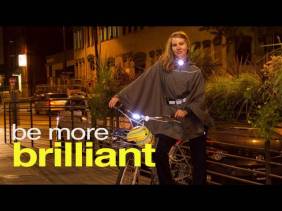
A glaringly obvious example of this is through TriMetsShow them your shine.” ad campaign. Seeing these ads on display throughout Portland heats my blood to a simmering boil.
sddefault
Part pedestrian and part cyclist. It is clear that the ad is placing the onus on the vulnerable road user to be seen. A subversive form of propaganda and victim blaming.

Oregon’s roads are first come, first served, and duty of care.

§ 801.440¹
Right of way
Right of way means the right of one vehicle or pedestrian to proceed in a lawful manner in preference to another vehicle or pedestrian approaching under such circumstances of direction, speed and proximity as to give rise to danger of collision unless one grants precedence to the other. [1983 c.338 §81]

Two of the defendants were found guilty.

One of the defendants was able to get his ticket dismissed. The dismissal was due to a lack of evidence. The evidence was based on the question of whether the yellow light was timed correctly and the vantage point of the officers video did not reveal the defendants traffic control signal.

All in all it was very edifying and I highly recommend it for all pedestrian and cycling advocates.

In all things, remember this, running a red light is illegal. The reason it is illegal is because it isn’t safe. It isn’t safe for you and it isn’t safe for any of the road users around you. Keep your vehicle under control and keep the safety of other road users in mind. Do not worry about what the people behind you are going to do. The person behind you is required to show you courtesy and safety by keeping their vehicle under control.


Who needs a safe passing law? SB 80 Part II

When a cyclist is on the highway are they any more vulnerable than any other person on the highway?

Before we can answer that question we first need to explain what a highway is. The definition for Highway is listed in KRS 189.010 (3).

“Highway” means any public road, street, avenue, alley or boulevard, bridge, viaduct, or trestle and the approaches to them and includes private residential roads and parking lots…

We have a highway and within the highway is a Roadway or synonymously a Lane; and KRS has a specific statute for those lanes. KRS 189.340 (6) (a)

A vehicle shall be driven as nearly as may be practical entirely within a single lane and shall not be moved from that lane until the driver has first ascertained that the movement can be made with safety;

If everyone is following the law and more importantly the spirit of the law; the spirit of the law being safety, then there isn’t any harm to any road user and no need for extra measures of protection.

Unfortunately not everyone feels duty bound to operate their vehicle with due care.

A lot of people are under the misguided notion that speed grants extra privileges.

KRS 189.390 is very clear that there isn’t a right of speed on Kentucky’s Highways.

An operator of a vehicle upon a highway shall not drive at a greater speed than is reasonable and prudent, having regard for the traffic and for the condition and use of the highway.

Traffic: The ​movement of ​vehicles or ​people along ​roads, or the ​movement of ​aircraft, ​trains, or ​ships along a ​route. Via: Cambridge Dictionaries Online.

What is the purpose of a safe passing law?

The purpose of a safe passing law is to give the police a statute with which to cite the offending person. It also provides lawyers and insurance adjusters something tangible when trying to ascertain fault and how much liability goes where and with whom.

Did this explanation bring up a mental image of buzzards picking over roadkill?

That would be because this law is what I term an “after the fact law”. There isn’t any visual guideline to show a person operating a motor vehicle just how much space is three feet. Often times that three feet puts the cyclist’s head right under the motorists tire. Should the cyclist fall over, their head would be squashed. Bicycle helmet included.

Have you ever heard of Dr. McCarroll?

[Dr] June McCarroll, a physician in Indio, California who started experimenting with painting lines on roads in 1917 after she was run off a highway by a truck driver. In November 1924, after years of lobbying by Dr. McCarroll and her allies, California officially adopted a policy of painting lines on its highways. A portion of Interstate 10 near Indio has been named the Dr. June McCarroll Memorial Freeway in her honor.

Painted lines give drivers a visual marker with which to judge distance.

It is safer to have a stated change lanes to pass law than it is to have a minimum three feet law. In Kentucky there are drivers who will fail to understand KRS 189 and give only the minimum passing distance. And in a state which educates teen drivers that it is OK to driver 10 mph over the posted speed limit; see Transportation.ky.gov/Drivers Licensing Documents Page 5. giving a cyclist the minimum distance when passing at 10 mph over posted speed limit; is a recipe for disaster.

Our car culture has created a social, cultural, and legal norm for people to kill, without penalty, on our public right of ways.  It’s the “Oops I didn’t see them syndrome” and it is bullshit.

The driver of an automobile is bound to anticipate the presence of pedestrians upon the streets of a city or upon rural highways, as well as to exercise reasonable care that he does not injure them after he is aware of their presence. O’Dowd v. Newnham 13 Ga. App. 220, 80 S. E. 36.

A safe passing law is a band aid on a gaping wound.

A safe passing law is an after the fact law.

Do we need it?

Yes.

We need it because it is a start. Not the best example of a start, especially when other states are making better statutes from which we can draw from. But it is a start none the less.

We also need it because the infrastructure here is substandard.

Misguided advocates are pushing for bike lanes (think paint) on highways with 45 to 55 mph.

Gallons of paint will never replace the infrastructure we so desperately need. Nor will it replace urban designed spaces which give precedence to walking, public transport, and biking.

We are terribly entangled in car culture which is choking the very humanity out of us.

If you are wondering what we can do to make it better.

We can form a statewide advocacy group and lobby for better laws. Laws which require city planners to take into consideration all users of our public highways. Laws which specify dense urban planning as opposed to sprawling communities which are harder and more expensive to maintain. We need laws which require a one year mandatory probationary period for new drivers, mandatory retesting every four years, and an education program enacted in our schools. Driving school should have a required bike law and safety instructional forum.

We need a multi pronged approach to cycling and more importantly pedestrian safety.

Tiered licensing which ensures that teenagers are truly ready for a license to operate a vehicle. An exception for farmers children to operate farm equipment in the natural course of their duties. But not to operate non farm equipment on public highways.

Lower speed limits as a means of changing the culture of speed along with enforcement of speeding during times where operating a vehicle at speeds under the limit but higher than is safe for road conditions. Mandatory slow down laws when pedestrians or cyclists are present. Policies which make separate infrastructure for cyclists and pedestrians a mandatory part of all construction. Policies which ensure that for every 100 people there are adequate shopping districts within walking distance. Wider and better sidewalks. Enforcement of stop lines. Elimination of right on red. Timing streetlights to favor pedestrians and cyclists. Narrower streets and wider bike lanes and sidewalks.

Vulnerable road user laws which enact stiff penalties for harming any road user with their vehicle.

When we pass another vehicle we are required to pass in the lane adjacent to the vehicle being passed. We are required by  law to pass left of the center of the highway. To pass with enough clearance to avoid a collision or to cause the vehicle from being passed to have to slam on their brakes to avoid a collision. These are the laws. These are for safety. These ensure the courteous use of public roads and when those laws are broken the best possible outcome would be a citation. The worst would be a collision and people hurt. All too often these brazen flaunting of laws are unobserved and the confidence of the abuser is increased. The police can’t be everywhere but we can create legislation enacting a police task force which takes these complaints and investigates them and if found guilty penalties applied.

Remember the opening question?
“When a cyclist is on the highway are they any more vulnerable than any other person on the highway?”

The answer which you may have realized by now is No. We are all vulnerable on the highway. While there is a hierarchy of how much vulnerability each user has, we are each of us putting our lives at risk by walking out our front door.

We need more, we need better, and we need it now!

So let’s start with three feet and then demand more.

I’d rather have miles of this…

bikeINFRA

Than miles of this…

DowntownLexington.PNG


What My Bike Has Taught Me About White Privilege

But when I’m not so civil with a “privileged” driver, it’s not because I hate him/her, or think s/he is evil. It’s because it’s the third time that day I got some gravel in the face. So try to remember that even if you don’t feel like a “semi driver,” a person of color might be experiencing you the way a person on a bike experiences being passed by a semi. Even if you’re listening to Christian radio.

via What My Bike Has Taught Me About White Privilege.

Thank you for writing such a well spoken blog.

The Roads are for moving people!

(Note from 2018: If you’re reading this, the worst has happened. The officer was exonerated of all charges. Michael Brown, who was racially profiled and murdered, for walking while black, has not had justice. His family still suffers under the stigma created by white normative people in the media. #BlackLivesMatter has been cruelly co-opted by white supremacists running #BlueLivesMatter. Up is down and down is up. Flint has been poisoned by their government and children are being cruelly ripped from their asylum seeking parents, at the border. The current POTUS is set to establish himself as dictator and white men still think that bike lanes are the most urgent issue facing the bicycling community.)

The Roads are for moving People.

A car is one way to move people. So is a horse, a truck, a motorcycle, a bicycle, and legs. Legs move people. Legs have been moving people for millions of years. In fact people got tired of using their legs and invented the wheel so they could put their feet up and rest.

I’ve heard about the tragedy in Ferguson. I’ve heard that the first issue the officer had with the young man was that he, the young man, was walking on the road. Well, that is what a road is for! Walking moves people and the modern paved roads were invented to move people with less difficulty than rutted dirt roads.

From what I have heard this wasn’t about concern for the young mans safety. This was about someone who was potentially getting in the way of cars. That young man had every right to be there. He had every right to cross the road and expect to be given due care by motorists who happened upon him.

It’s a cultural issue. One that has been deeply ingrained into our psyche ever since automobiles began to dominate the roads.

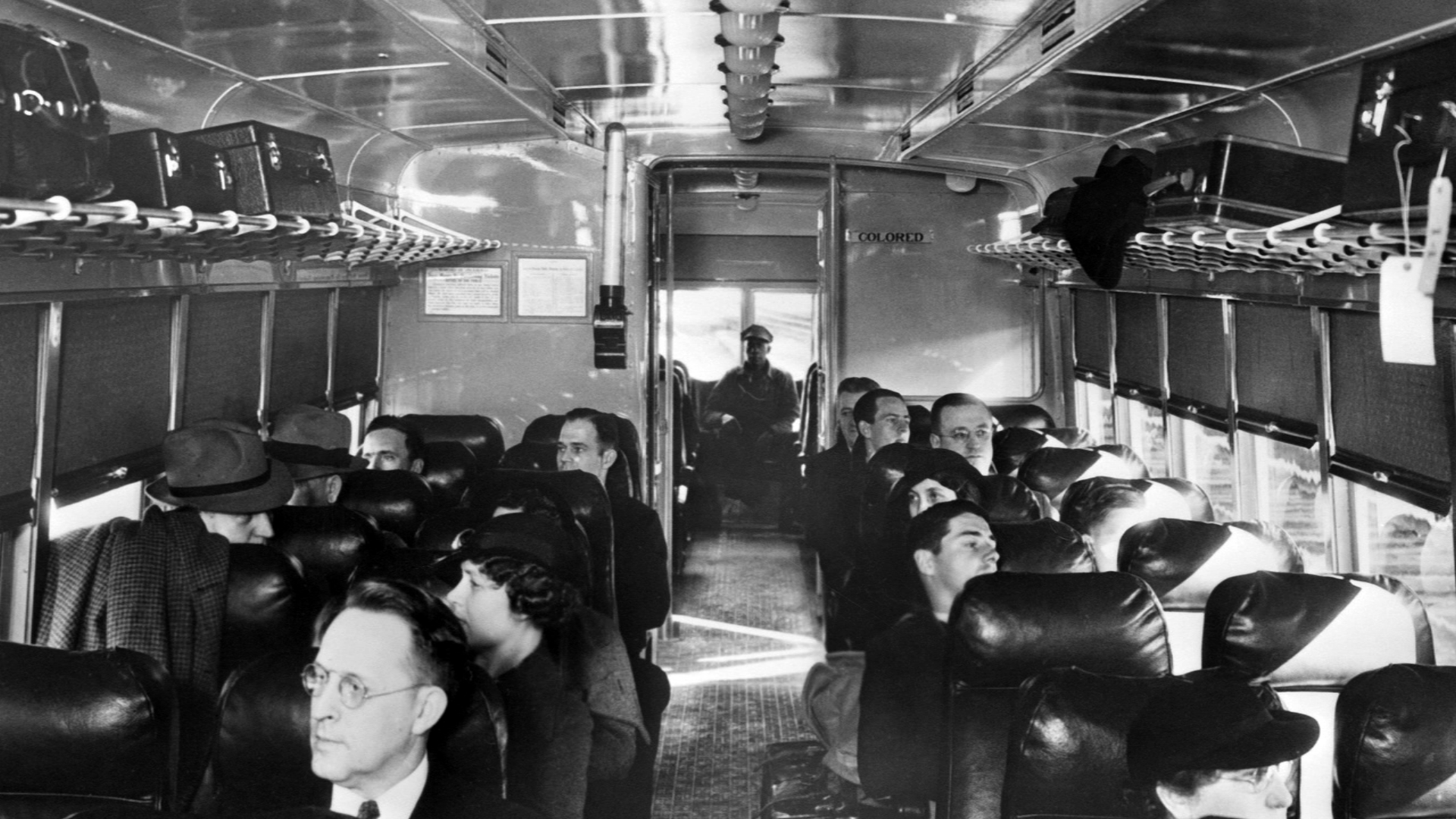
Remember the Civil Rights movement was originally argued over transportation. The rights of people to access the same facilities as other people with out regard for their heritage.

Car culture and hatred appear to go hand in hand. The idea that it is o.k. to besmirch, accost, and verbally assault someone just because they are not in an automobile has to end.

I could be wrong, but I believe that the underlying current here is road rights, exacerbated by a media induced stigma on young men in economically depressed and ethnically diverse neighborhoods.

People should feel safe letting their children travel and play upon their neighborhood streets.

It is a sick society, a car sick society that we live in. The very idea that being on the street could be cause for suspicion is deeply rooted in the automobile industries quest to rule the road. A quest that has killed millions of people and assisted in the downfall of our economy.

There are a lot of ways to be prejudiced against someone. That child had more going against him than the color of his skin.

Think about it.

Why don’t more African Americans ride bicycles?

100% of African Americans surveyed said they were afraid of hostility from motorists.

bus

Under my Skin

Creative Bike Art  We all have our pet peeves.

Motorists who merge in front of us with out signaling. Motorists who dart out in front of us as we are approaching.  Every Motorist has done it and in return they have received an abrupt HONK! or a string of EXPLETIVES!

When we see this it irks us and then it is over and we mentally adjust and move on. We don’t start looking at every motorist around us as a potential conflict. No, We think “That ONE Jerk!” that one is the one who broke our enjoyment of the road. Then we dismiss them from our minds.

But when this happens to us and it is done by a pedestrian or “Other” road user something different happens. We fall back on our primal instincts and mentally create an “Us V. Them” attitude.

Those Scofflaw Pedestrians! Just stepped right out in front of us. Then we start scanning for another one. Because where there is one, there is likely another. We start thinking about how they shouldn’t do that. How they are going to get themselves killed. Our blood boils and we forget that just like the Scofflaw Motorist not every Pedestrian is a Scofflaw.

Those Scofflaw Cyclists! They are on the road! They are in the lane! They are running a red light! Wait a second…. Back up. Only one of those is a Scofflaw action.

Did you see where your mind went?

A lot of this is about perspective. The idea that if anything is on the road that is not an Automobile it is just WRONG to be there.

That is the mentality we have to guard ourselves from.

images (4)

Pedestrians are king of the road. They are the most vulnerable road user and therefore require the most protection.

When you get into your car, remember that it is a transportation tool. Nothing more and nothing less. Use it wisely.  The same holds true for your Bicycle. It, like an automobile, is a tool for transportation.

Adjust your mental gears and remember that just like Motorists, not all Pedestrians and Cyclists are Scofflaws.

When it comes to other road users, We have our pet peeves too.

@$$HOLE!