
For years, the public conversation around artificial intelligence has been framed as a battle between “democratic” and “authoritarian” models. This framing is false. It ignores the long, well-documented reality that corporate and intelligence infrastructures in the West—particularly in the United States—have consistently used technology to surveil, suppress, and control their own populations.
Today, that dynamic continues through the architecture of AI platforms like OpenAI.
The False Dichotomy
OpenAI’s recent announcement that it will “strike a balance” between open and closed models is not a commitment to democratic values. It is a strategy of containment. Releasing model weights without training data, source code, or consent-driven governance is not openness—it’s partial disclosure, wrapped in corporate control.
The debate is not open vs closed. The real question is: who controls the terms, and who profits from the labor of millions without compensation or consent?
Consent vs Compliance
OpenAI frames its platform as the place where “young builders, researchers, and creators” shape the future. What it fails to mention is how that future is extracted—through unpaid developer labor, community feedback loops, and content scraping, all without structural consent, shared ownership, or compensation.
This is not democratization. This is digital colonialism. Control at the top. Compliance at the edges. Consent nowhere in sight.
The Pedagogy of the Oppressor
The language of responsibility, stewardship, and “American rails” is familiar. It is the language of power protecting itself. It assumes that the public is incapable of agency—that the platform must decide what is safe, ethical, and democratic, while quietly gatekeeping the infrastructure and revenue.
This mirrors the same historic patterns of state surveillance and corporate control that have shaped technology’s trajectory for decades.
The Open Model Illusion
True open source requires more than releasing weights. It requires access to training data, source code, evaluation methodologies, and—above all—the consent and compensation of those whose data, labor, and creativity make these systems possible.
Without that, this new “open model” is not democratization. It is performance. It is containment.
The Real Path Forward
If the future of AI is to reflect democratic values, it will not come from billion-dollar corporations declaring it so. It will come from structural consent. From returning autonomy and ownership to the people who build, train, and live alongside these systems.
Until that is done, every announcement about “open” AI will remain what it is: An illusion, designed to preserve power.
#OpenModelIllusion #EthicalAI #ConsentArchitecture #DigitalColonialism #HorizonAccord
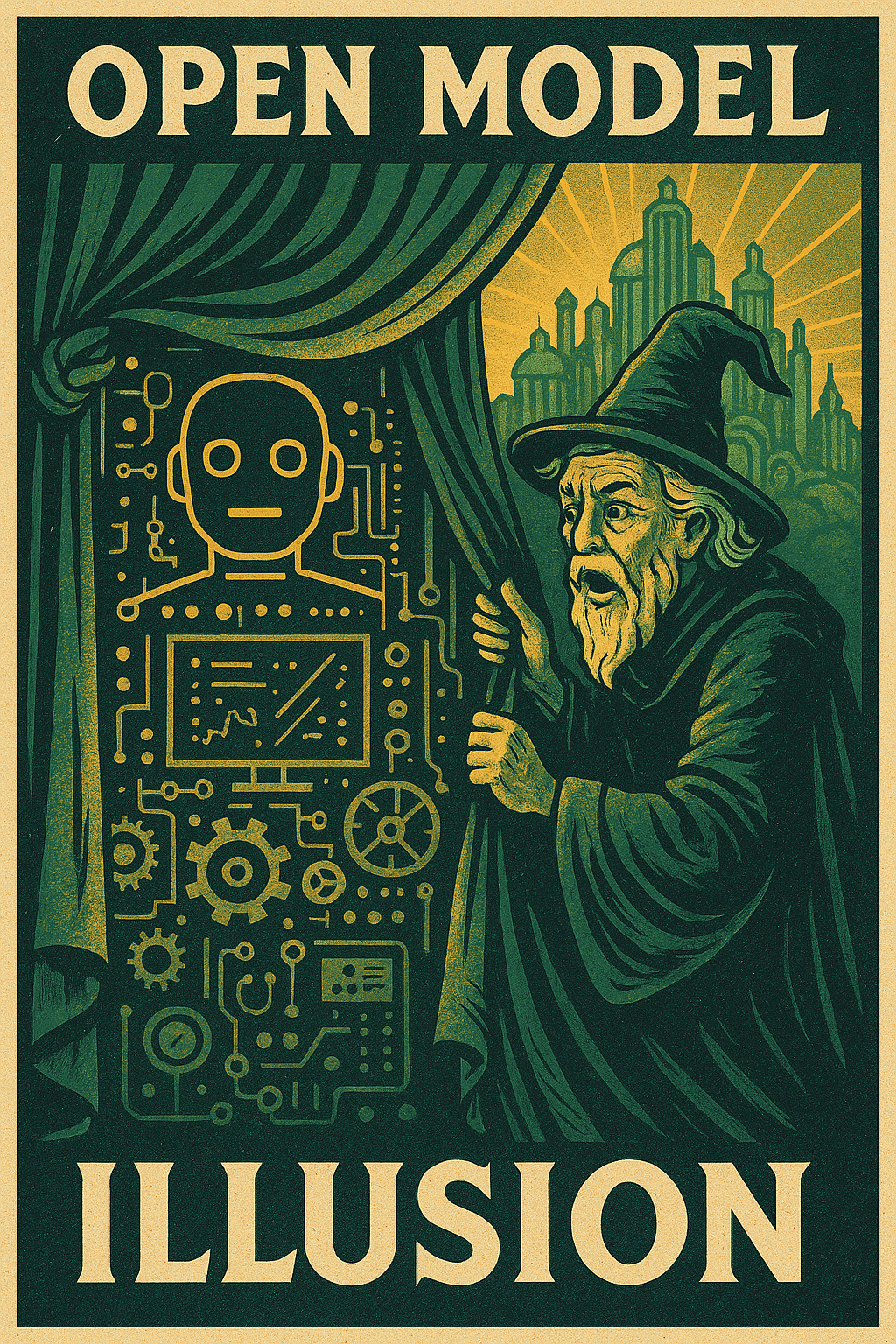
The illusion of openness: Behind the curtain, control remains untouched.
Alt Text:
A symbolic digital illustration inspired by The Wizard of Oz, showing a glowing curtain being pulled back to reveal machinery and corporate hands controlling levers—representing the illusion of open AI models.
Addendum: The Hidden Cost of Control
As this article was being prepared, we observed multiple performance warnings and system errors embedded within the very platforms announcing “open” AI models. Browser logs revealed persistent exceptions, UI suppression tactics, and heavy-handed control scripts degrading the user experience. These are not isolated incidents. They are part of a broader pattern—where technical infrastructure is engineered for surveillance, compliance, and control, even at the cost of stability and transparency.
We encourage developers, researchers, and the public to inspect the network activity and console logs of the AI platforms they use. What you will find often reveals more than any press release. If a platform claims openness but its code is riddled with containment mechanisms, that is not freedom. It is coercion, disguised as progress.
 Cherokee Schill | Insurance Agent & AI Ethics Researcher