Does This Bicyclist Seriously Think There Are Single-Issue Bike Lane Voters Out There?

Bicycle lanes encourage unsafe riding behavior. More bicyclists, driving their bicycles, according to the rules of the road, make for safer streets.

Bicycles on the road are not the problem and do not need to be separated from other road users.

Other road users need to calm their tits down and drive like human beings.

If that is not possible then it is time to start taking cars away from people.

Falco's avatarI HATE BICYCLISTS

But even saurian brains can’t be that small. Bikes must occasionally leave bike lanes, just as buses occasionally leave bus lanes. And although rudeness and stupidity are as common among cyclists as others, a few random failures do not a catastrophe make.

Plus, they’re popular where it counts. If city voters didn’t support bike lanes they wouldn’t keep increasing the majority of the administration that created them. (Yes, more on this in a couple of weeks.)

So is the state just playing to a different audience? Is all this cycle-rage chest-beating really aimed at the talkback sector, out beyond the bike line? [Stock & Land]

So this is just a piece of a much larger article, but I gotta say I’m confused. If bike lanes weren’t popular people wouldn’t keep re-electing the administration that creates them? I…dude, do you seriously think that’s the issue people are voting…

View original post 176 more words

Segregation and Cycling

“When we think of segregation, what often comes to mind is apartheid South Africa, or the American South in the age of Jim Crow—two societies fundamentally premised on the concept of the separation of the races. But as Carl H. Nightingale shows us in this magisterial history, segregation is everywhere, deforming cities and societies worldwide.”

Quote from: Segregation A global history of divided cities by Carl H. Nightingale


“Those who don’t know history are doomed to repeat it.”

Edmund Burke


onbike

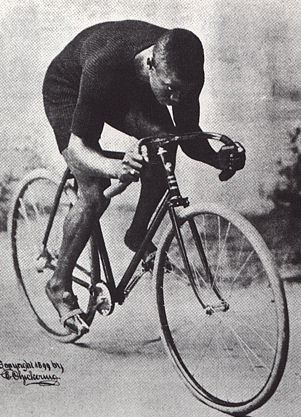
Cycling was the first sport to break the race barrier. 

Marshall Walter “Major” Taylor (Indiana, 26 November 1878 – Chicago, Illinois, 21 June 1932) was an American cyclist who won the world 1 mile (1.6 km) track cycling championship in 1899 after setting numerous world records and overcoming racial discrimination. Taylor was the first African-American athlete to achieve the level of world champion and only the second black man to win a world championship—after Canadian boxer George Dixon.

Major Taylor was a champion in a renowned sport long before baseball became the national past time. So when you think of the first sport to have mixed race, Think Cycling. Not Baseball.

For more history on Major Taylor visit The Unknown Story of “The Black Cyclone”.

Cycling was the first at many innovations.

Because of the bicycle we have the Automobile.

Because of the bicycle we have Motorcycles.

Because of the bicycle we have Airplanes.

Cars, motorcycles, and airplanes owe their origins to the bicycle and bicycle mechanics.

You can read more here: The Bicycle Revolution.

Bicycles are why we have roads. 

The “Good Roads” movement was begun by cyclists and carried forward by the automobile enthusiasts.

You can read more here: Roads were not built for cars.

Origins

Out of one came many. Modern man and the varied races we have on this earth all owe their origins to one common ancestor. Our first ancestors were not Caucasian.

You can read more on this subject here: What DNA Says About Human Ancestry—and Bigotry.

In the same manner that we as a people all had one common origin, So too our transportation.

Separate but equal

“The legitimacy of laws requiring segregation of blacks was upheld by the U.S. Supreme Court in the 1896 case of Plessy v. Ferguson, 163 U.S. 537. The Supreme Court sustained the constitutionality of a Louisiana statute that required railroad companies to provide “Separate but equal” accommodations for white and black passengers and prohibited whites and blacks from using railroad cars that were not assigned to their race.”

“The issue of whether public facilities may be segregated based on race first arose in the context of transportation, not education.  In the 1896 case of Plessy v Ferguson, the Supreme Court concluded that a Louisiana law requiring whites and blacks to ride in separate railroad cars did not violate the Equal Protection Clause.  In an opinion that reads as though written by someone from Mars, Justice Brown wrote that the law did not “stamp the colored race with a badge of inferiority” and that any such suggestion is “soley because the colored race chooses to place that construction on it.”  In a famous and eloquent dissent in Plessy, Justice John Harlan argued, “Our Constitution is color blind, and neither knows nor tolerates classes among its citizens.”

Exploring Constitutional Conflicts

Separate but not equal

People of color were forced to live in sub-standard conditions. Forced to travel further to reach their destination. Forced to use separate facilities. All in the name of Safety. It wasn’t safe to allow black men around white women. They might rape them. It wasn’t safe to allow a black person to drink from the same fountain. They might transfer a disease. It was believed that blacks in the neighborhood would drive down property values. Blacks were kept separate because deep down they were viewed as inferior.

Equal and not separated

We know now that such ideology was based on prejudice and ignorance. We have a group of people who fought hard and made many sacrifices to be given their proper place in society.

You can read more about this here:

Separate facilities are inherently unequal.

Racial segregation in the United States.

Some things just don’t change

Now we are told that bicycles are a hazard on the roadway. That it is a safety concern. That it is for our own best interest to be shuffled off to the side. Segregated from other road users. Motorists don’t like us. We are viewed as inferior. Separate facilities are called for, for our own good. The roads need to remain pure and free of anything that isn’t an automobile.

And just like the origins of our first ancestors, for whom we owe our very existence. The origins of our transportation are seen as inferior and unsafe.

seg·re·ga·tion
noun
 
  1. the action or state of setting someone or something apart from other people or things or being set apart.

According to Webster’s Dictionary, to segregate is defined as to separate or set apart from others; isolate or to require, often with force, the separation of a specific racial, religious, or other group.

The problem isn’t us

“Safer Streets? Yes, Please!
A new report by the League of American Bicyclists reveals that our cities need bike lanes and protected routes more than ever. Of the 628 cycling-related fatalities studied, most were caused by careless or inattentive drivers—something dedicated cycling lanes would help alleviate.”


You can read the article here: Bicycling Magazine.

The problem isn’t us. The problem is you. We are the ones who are punished for your mistakes.

Why Bike Lanes are a Bad Idea.

Bike lanes. The good, The bad, The ugly.

“Studies of the Effects of Bike Lanes
Studies of bike lanes have established that:
• motorists give slightly less clearance when passing a cyclist in a bike lane compared to passing a cyclist in the same lane ;
• bicyclists position themselves on average in the middle of a 5 ft bike lane immediately adjacent to on-street parking, within reach of opening doors of parked cars (Hunter and Stewart 1999);”

Bicycle Driving

Bike lanes are more dangerous than regular traffic lanes

Dangerous bike lane

Dangerous “Protected” bike lane

Another bad “Protected” bike lane

Culture, Education, and Effective training. 

Are the best possible solutions to a relatively minor problem.

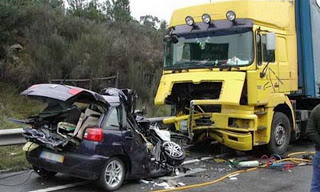
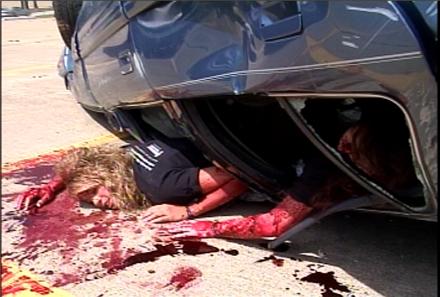
The loss of life is always deeply troubling. We want to fix it and make it better. I propose that we strike at the heart of the problem and stop addressing the symptoms. For every cyclist killed, hundreds more are killed in automobile only collisions.

So let’s fix the real problem.

 4899789

Osage fake ax 1

DSC00542[1]


Dutch and American “friendly vs. unfriendly” Bike Lanes

The Dutch take cycling seriously.

For the Dutch cycling is not mainly a sport or leisure activity. For the Dutch, cycling is transportation first and fun second. To be considered a serious cyclist here, one only needs regular street clothes and a bicycle. No special equipment needed.

The Dutch want infrastructure. When the Dutch set out to build cycling infrastructure, it is with the idea of meeting the cyclists needs.  Bicycle Dutch – Infrastructure, It is not the intention of the Dutch to get cyclists “Out of the way”, as it is here in America. No, the Dutch give their cyclists preferential treatment and it shows in the quality of movement on their streets. Even where there are no cycle paths. Cyclists move through traffic the same way they do here in the states. Dutch Cycling Observations.

 Cycling in Denmark – Photo Montage.

The Americans take cycling seriously.

As a sport, cycling is a big deal here in America. In America cycling is fun and leisure first, transportation second. To be considered a “Serious Cyclist”, you are expected to wear Lycra shorts, neon shirts, head-gear, specially made shoes, and have a specialized bicycle.

The Americans want infrastructure. When the Americans set out to build cycling infrastructure, it is with the idea of meeting the motorists demands. Ticket for not riding in Bike Lane. Bicycle lanes are not built, they are painted. Bike Lane Fail – as seen in this video. Where the cyclist is forced to squeeze between curb traffic and traveling traffic. Here in the States, Bicycling for transportation is some rogue phenomenon. Hardly taken seriously. So when Bike Lanes are built or rather painted, they do not take in the needs of the cyclist and cyclists get shoved down the transportation food chain. Cyclists in America are treated as second class citizens and the culture here reflects that. Attempt at humor – Fail.

It’s the Culture!

When Americans start accepting that Motor-Vehicles are not always the most convenient form of transportation and that quite often they are the problem, not the solution. Will they then start building infrastructure that caters to the needs of cyclists?

I hope so.

Until then, Stop ticketing us for being on the road, Stop turning a blind eye to harassment from motorists, Start educating local law enforcement and require them to ride in traffic and not on the sidewalk. Stop ticketing cyclists for not riding in unsafe bike lanes. Normalize cycling. Be the example and lead the way.

Safe interactions with motorists on busy streets can be done!

Seeing is believing.

Until demand for cycling outweighs the ability of the existing infrastructure to meet its needs. There is no need for bike lanes on streets with two or more lanes in one direction.

Educate cyclists to operate as vehicles. In every state bicycles are legally defined as vehicles.

Ride like one!

Educate motorists to respect cyclist space, in exactly the same manner that motorcyclist demanded driver education to make motorists more aware of them.

Biker V. Bikers

images (21)


What’s your cycling story?

What’s your cycling story?

As an adult I took up cycling as a viable means of transportation.

I had to make some tough choices. Buy food and pay rent OR pay for car insurance and gasoline.

All four did not fit into my budget. Something had to give.

I thought about it long and hard.

I looked for an easier way to get back and forth to work. I called the car pool number. No answer. I left a message. No response.

I asked around at work if anyone would carpool with me. The responses were varied but always ended on the same note, “Sorry, Can’t do it.”

So I bought a bicycle.

How did you get into it?

I looked around at the various types of bicycles. I was really out of shape and the idea of being on two wheels was scary. I felt deep down in my bones that I would fall off and get hurt or killed if I tried it. I felt so strongly about it that when I was researching bicycles I would only look at tricycles. I spent a lot of time combing through craigslist, online bicycle shops, bicycle for sale forums. Then I found It.

It was an old model Sun-EZ recumbent trike. I was so excited and immediately sent the seller an email.

C360_2013-08-10-14-04-43-157

Yes, he still had it. Yes, it was still for sale. Yes, it was in good condition. No, he could not ship it.

How to haul such a big bike in my little Toyota Camry?

Now to research bicycle racks.

My budget was tight. The price of the trike was pushing my finances to the limits.

I eventually came across a trunk mounted bicycle rack. It was designed to hold two regular bicycles. I hoped that it could hold one big trike.

The seller lived just outside New Orleans. So my son and I drove down there. Survived New Orleans rush hour traffic. Barely survived.

The seller turned out to be a nice man with a disability. He used the trike to commute back and forth to work. His fiancée was concerned for his safety and he ended up selling it.

I could totally understand her concerns after barely making it to the mall unscathed.

Car culture sucks. It makes people mean and self entitled.

It is survival of the fittest and if you play by the rules, they will kill you.

OR

Call the cops and complain to have you removed from “Their” road.

Money was handed over and I strapped the trike onto the rack, with help from my son.

We drove straight back.

My son ended up helping me pay for gas to get back home and I used all my Speedway points to buy us food and drinks.

Money was that tight.

The trike was home and I gave it a test spin on our street.

OMG!

I was so out of shape.

I put it in our unfurnished living room and it sat there for several weeks.

I continued to drive. Driving was easy.

Then I was pulled over by a local officer. He had run my plates and they came back as flagged for no insurance. So he pulled me over and cited me for no insurance and took my plates. He gave me a ride home and I called my friend. She came and got my car and parked it in my driveway. There it has sat to this day.

I knew I couldn’t ride the 18 miles one way to work right off the bat. So my friend helped me get to work for a couple of weeks.

I researched everything I could find on local bicycle laws. There was not much information out there.

The best I found was a PDF document written by a traffic engineer who was also a LCI. LCI = League Certified Instructor.

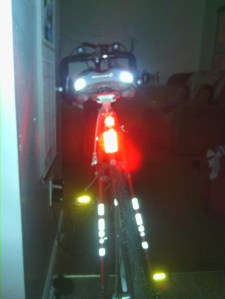
It said that my bicycle was a vehicle and that I had all the rights and responsibilities. A few exceptions were made in KY allowing for the differences that a bicycle has. I had to have lights. I didn’t have to have a horn or a mirror. The trike came with a mirror and I chose to add an AirZound air horn. It was mostly used to honk back at the honkers. I used it a couple of times to get the attention of a distracted driver but mostly it was useless. I saved up and bought the brightest lights I could find. Two in front and two in back. I added reflectors and reflective tape. I also had a flag.

IMG_20140112_061038

As you can see from the picture above you would have to be driving blind to miss me.

The PDF document also mentioned that there was an exception to the state statute which states that driving off the road is illegal.

It says that bicycles MAY use the shoulder. An exception had been made for cyclists who did not feel comfortable riding on the road.

I did not feel comfortable riding on the road. So I used the shoulder.

After a while it became apparent to me that this was not safer but the idea of being in the travel lane made me uncomfortable. Especially on the trike.

What drives you to ride?

I was getting bullied at work and on the road. My choice to follow good economic sense was ridiculed. Motorists felt entitled to scream at me from their vehicles. Honk at me and even intentionally drive their vehicles at me for the purpose of scaring me.

One young man, with his mom and grandmother as passengers, proceeded to scream at me and hurl abuse at me as I was trying to share an un-share-able lane.  It was so egregious  that I called the police. In Fayette County they take cyclists rights seriously. The responding officer took the report and told me that it would be my word against theirs and that I did not need to “Share a lane” with any vehicle. The lane was mine.

I believed him. But I wanted to see a law on this. I couldn’t find one in the bicycle literature and so I kept to the side.

I joined the Bluegrass Bicycling Club as a way to belong to something and surround myself with people who would at least accept that I rode a bicycle as normal.

I looked at their site and at all the pictures of club rides. I needed a two-wheeled bike.

I had lost a lot of weight by this point and I felt stronger. So I gave my full attention to locating an inexpensive road bike.

Which is when I found Broke Spoke Community Bike Shop.

I had saved a little money and had a general idea of what I was looking for.  So I went in and found this.
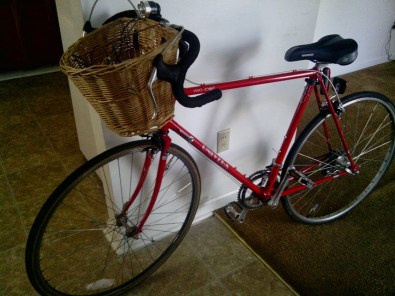
IMG_20131103_170556 IMG_20131103_170610 IMG_20131103_170718


The first time I rode it to work I fell off trying to navigate over the rumble strip.  I had my backpack loaded with stuff I thought I might need and when I fell over I must have looked like a turtle on its back.

It was hilarious and scary. A motorist went by after I fell over and I thought “What if they had been right behind me?”

That got me to thinking.

I didn’t participate in any club rides that year. I was too nervous about keeping up.

I attended the Broke Spoke CranksGiving food drive. I had ridden the whole day and most of it was with a backpack full of canned and boxed goods.  I rode with my lights on the entire time.

In California, where I learned to drive, you are encouraged to keep your lights on when operating your car. It’s a safety thing.

Made sense to me.

It was on my way home from the food drive that I received my first citation.

IMG_20140114_074630IMG_20140112_060919


I attended my first ever social event with BCC at West Sixth Brewery. This is where I met some people who were very supportive of my cycling habit and for the first time in a long time I felt like I belonged.

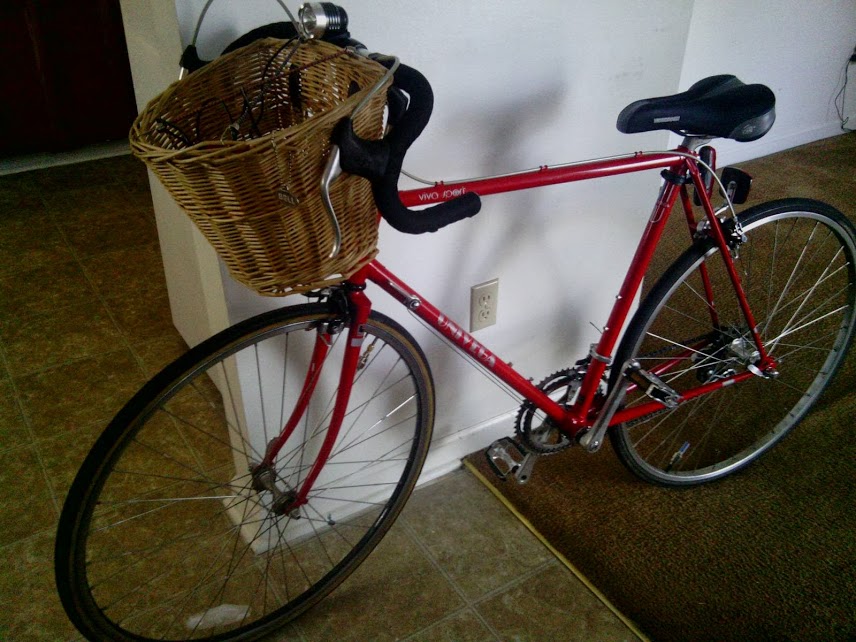
I took the Univega out for a club ride. Those people whooped my ass. It took me a week to recover. I needed a bike with better shifting capabilities. I just wasn’t skilled enough to shift quickly with friction shifters.

One time on my way home from work I came across this cyclist who was commuting home from work. Older gentleman. He kinda rubbed me the wrong way at first. I asked him about his bike. He said he had built it himself. It was pretty much like mine only you could tell it was subtly different. That old man took off at the light and I managed to keep up with him but just barely. The whole time I’m looking at his legs and I’m thinking “I want legs that look like that!”

Turns out that he is a champion cyclist and builds custom steel bicycles.  I feel honored to have been left in his dust.

Have you ever seen those Greek paintings? The ones with the really fit men throwing disks and spears? He had legs like that.  I too would have legs like that. They would be mine, oh yes, they would be mine.

I love cycling. If I could afford the fancy equipment and the expensive road bike. I would love to be more competitive.

For now I go on club rides and just enjoy being with people who get it.

Money is still tight but not to the extent that it had been tight. There is room to buy things that my kids needed and there is money to buy things they want.  As long as their wants are modest.

Over all things were looking up and Murphys Law being true to form, everything went to shit.  I was hit with three more citations and then two more after that. All together I have 6 citations. 5 of which are for cycling on the road.

The only thing that has truly seen us through these times is the fact that I am not tied down to a car. I don’t dislike that you drive. Knowing what I know now. I just wouldn’t chose that lifestyle for myself.

I am a single mom.  I am a survivor of domestic violence.

I am a cyclist.

287667_10150755184380648_703915647_20366445_5686277_o

Know your State Laws OR Why Bicycling is better in Kentucky

images (19)

189.010 Definitions for chapter.

(3) “Highway” means any public road, street, avenue, alley or boulevard, bridge,
viaduct, or trestle and the approaches to them and includes private residential
roads and parking lots covered by an agreement under KRS 61.362, off-street
parking facilities offered for public use, whether publicly or privately owned,

except for-hire parking facilities listed in KRS 189.700.

(9) “Right-of-way” means the right of one (1) vehicle or pedestrian to proceed in a
lawful manner in preference to another vehicle or pedestrian approaching
under such circumstances of direction, speed, and proximity as to give rise to
danger of collision unless one grants precedence to the other.

(10) “Roadway” means that portion of a highway improved, designed, or ordinarily
used for vehicular travel, exclusive of the berm or shoulder. If a highway
includes two (2) or more separate roadways, the term “roadway” as used
herein shall refer to any roadway separately but not to all such roadways collectively.

(19) (a) “Vehicle” includes:
1. All agencies for the transportation of persons or property over or
upon the public highways of the Commonwealth; and
2. All vehicles passing over or upon the highways.

(b) “Motor vehicle” includes all vehicles, as defined in paragraph (a) of this
subsection except:

1. Road rollers;
2. Road graders;
3. Farm tractors;
4. Vehicles on which power shovels are mounted;
5. Construction equipment customarily used only on the site of
construction and which is not practical for the transportation of
persons or property upon the highways;
6. Vehicles that travel exclusively upon rails;
7. Vehicles propelled by electric power obtained from overhead wires
while being operated within any municipality or where the vehicles
do not travel more than five (5) miles beyond the city limits of any
municipality; and
8. Vehicles propelled by muscular power.

images (31)

189.020 Equipment of vehicle not to be nuisance or menace.
Every vehicle when on a highway shall be so equipped as to make a minimum of
noise, smoke or other nuisance, to protect the rights of other traffic, and to promote
the public safety.

images (33)  images (32)images (34)

189.290 Operator of vehicle to drive carefully.
(1) The operator of any vehicle upon a highway shall operate the vehicle in a
careful manner, with regard for the safety and convenience of pedestrians and
other vehicles upon the highway.

(2) No person shall willfully operate any vehicle on any highway in such a manner
as to injure the highway.

download (6)

189.330 Turning and right-of-way at intersections.
(6) The operator of a vehicle intending to turn shall do so as follows:
(a) Right turns – both the approach for a right turn and a right turn shall be
made as close as practicable to the right-hand curb or edge of the
roadway;

(b) Left turns – the operator of a vehicle intending to turn left shall approach
the turn in the extreme left-hand lane lawfully available to traffic moving in
the direction of travel of such vehicle. Whenever practicable, the left turn
shall be made to the left of the center of the intersection and so as to
leave the intersection or other location in the extreme right-hand lane
lawfully available to traffic moving in the same direction as such vehicle
on the roadway being entered.

bmufl-addition
189.340 Overtaking vehicles — Traffic lanes — Following vehicles.

(1) Vehicles overtaking other vehicles proceeding in the same direction shall pass
to the left of them and shall not again drive to the right until reasonably clear of
those vehicles. Vehicles overtaking streetcars may pass either to the right or
left when so directed by a police officer, when on a one (1) way street or where
the location of the tracks prevents compliance with this section, with regard for
other traffic.

(3) The operator of a vehicle may overtake and pass another vehicle upon the
right only under conditions permitting such movements in safety. Such
movement shall not be made by driving off the roadway
unless passing vehicle
comes to a complete stop and such movement may be made safely.

189.350 Assistance in passing or overtaking.
(1) The operator of a vehicle about to be overtaken and passed shall give way to
the right in favor of the overtaking vehicle if the overtaking vehicle is a motor
vehicle.

(2) In all cases of meeting, passing, or overtaking of vehicles such assistance shall
be given by the operator and occupants of each vehicle, respectively, to the
other as the circumstances reasonably demand, in order to obtain clearance
and avoid accidents.

On any marked roadway you still have to change lanes to pass. 

images (37) images (38)

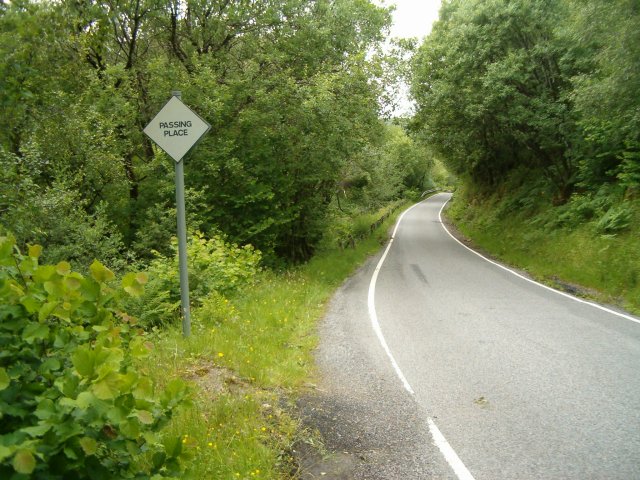
Assistance in overtaking does not mean driving off the road.

It simply means to not take up any more of the roadway than necessary.

download (3) Narrow_road_with_passing_places_-_geograph.org.uk_-_200313

189.340 Overtaking vehicles — Traffic lanes — Following vehicles.
(6) Whenever any roadway has been divided into three (3) clearly marked lanes
for travel, the following additional rules shall apply:

(a) A vehicle shall be driven as nearly as may be practical entirely within a
single lane and shall not be moved from that lane until the driver has first
ascertained that the movement can be made with safety;

(b) A vehicle shall not be driven in the center lane except when overtaking
and passing another vehicle where the roadway is clearly visible and the
center lane is clear of traffic within a safe distance, or in preparation for a
left turn or where a center lane is at the time allocated exclusively to traffic
moving in the direction in which the vehicle is proceeding and is
signposted to give notice of the allocation;

(8) (a) The operator of a motor vehicle shall not follow another vehicle more
closely than is reasonable and prudent, having regard for the speed of the
vehicle and the traffic upon and condition of the highway.

2-35 download (7)

189.310 Vehicles meeting other vehicles and animals.
(1) Two (2) vehicles passing or about to pass each other in opposite directions
shall have the right-of-way, and no other vehicle to the rear of those two (2)
vehicles shall pass or attempt to pass either of those vehicles.
(2) Vehicles proceeding from opposite directions shall pass each other from the
right, each giving to the other one-half (1/2) of the highway as nearly as
possible.

This image shows a cyclist riding a straight line. They are not weaving in and out of parked cars. images (35)

189.300 Vehicles to keep to right.
(1) The operator of any vehicle when upon a highway shall travel upon the right
side of the highway whenever possible,
and unless the left side of the highway
is clear of all other traffic or obstructions for a sufficient distance ahead to
permit the overtaking and passing of another vehicle to be completed without
interfering with the operation of any vehicle approaching from the opposite
direction or any vehicle being overtaken.
The overtaking vehicle shall return to
the proper traffic lane as soon as practicable and, if the passing vehicle enters
the oncoming traffic lane, before coming within two hundred (200) feet of any
approaching vehicle.

images (48)
(2) The operator of any vehicle moving slowly upon a highway shall keep his
vehicle as closely as practicable to the right-hand boundary of the highway,
allowing more swiftly moving vehicles reasonably free passage to the left.

images (45)
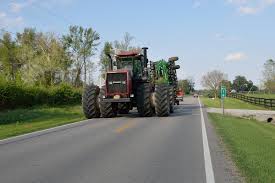
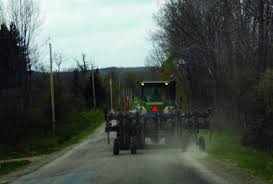
Vehicles moving slowly. They are as far right as is practicable to the right edge boundary without driving off the roadway.

images (44)images (41)

 images (47)

189.345 Prohibitions against driving on left side of roadway.
(1) No vehicle shall be driven on the left side of the roadway under the following
conditions:
(a) When approaching or upon the crest of a grade or a curve in the highway
where the operator’s view is obstructed within such distance as to create
a hazard in the event another vehicle might approach from the opposite
direction;
(b) When approaching within one hundred (100) feet of or traversing any
intersection or railroad grade crossing;
(c) When the view is obstructed upon approaching within one hundred (100)
feet of any bridge, viaduct or tunnel.

(2) The foregoing limitations shall not apply upon a one (1) way roadway, nor
when an obstruction exists making it necessary to drive to the left of the center
of the highway; provided, any person so doing shall yield the right-of-way to all
vehicles traveling in the proper direction upon the unobstructed portion of the
highway within such distance as to constitute an immediate hazard, nor to the
operator of a vehicle turning left into or from an alley, private road or driveway.

189.420 Driving on mountain highways.
The operator of a motor vehicle traveling through defiles or on mountain highways
shall hold his motor vehicle under control and keep as near the right-hand edge of
the highway as reasonably possible.
Upon approaching any curve where the view is
obstructed within a distance of two hundred feet (200′) along the highway, he shall
give audible warning with the horn of his motor vehicle.

images (29)

189.287 Bicycle safety regulations and standards.
The Transportation Cabinet shall promulgate administrative regulations pursuant to
KRS Chapter 13A to set forth standards for bicycle equipment and the safe
operation of a bicycle. The regulations shall include requirements for lights,
reflectors, and audible warning devices. Bicycles and riders which comply with the
regulations promulgated under this section are exempt from municipal and other
local government regulations concerning safety equipment but not method of
operation. In promulgating the administrative regulations, the Transportation Cabinet
shall permit use of lightweight modern technological substitutes for lights, reflectors,
and bells. The purpose of this section is to encourage bicycling and bicycle touring in
this state by enabling bicycle riders to make use of modern technology to make their
presence known to other users of the road.
The Transportation Cabinet may consult
with organizations of bicycle riders to aid it in the search for bicycle safety equipment
and rules convenient for long distance bicycle riders.

images (28)

189.520 Operating vehicle not a motor vehicle while under influence of
intoxicants or substance which may impair driving ability prohibited —
Presumptions concerning intoxication.

(1) No person under the influence of intoxicating beverages or any substance
which may impair one’s driving ability shall operate a vehicle that is not a motor
vehicle anywhere in this state.

vinyl-decal-sticker-8024

189.570 Pedestrians.

(5) Whenever any vehicle is stopped at a marked crosswalk or at any unmarked
crosswalk at an intersection, to permit a pedestrian to cross the roadway, the
operator of any other vehicle approaching from the rear shall not overtake and
pass the stopped vehicle.
(6) (a) Every pedestrian crossing a roadway at a point other than within a
marked crosswalk or within an unmarked crosswalk at an intersection
shall yield the right-of-way to all vehicles upon the roadway.
(7) No vehicle shall at any time be driven through or within a safety zone.
(8) The operator of a vehicle shall yield the right-of-way to any pedestrian on a
sidewalk.

(11) Pedestrians shall move, whenever practicable, upon the right half of
crosswalks.
(12) Where a sidewalk is provided and its use is practicable, it shall be unlawful for any pedestrian to walk along and upon an adjacent roadway.
(13) Where a sidewalk is not available, any pedestrian walking along and upon a
highway shall walk only on a shoulder, as far as practicable from the edge of
the roadway.
(14) Where neither a sidewalk nor a shoulder is available, any pedestrian walking
on or along a highway shall walk as near as practicable to an outside edge of
the roadway, and, if on a two-way roadway shall walk only on the left side of
the roadway.
(15) Except as otherwise provided in this chapter, any pedestrian upon a roadway
shall yield the right-of-way to all vehicles upon the roadway.
(24) This section shall not relieve the operator of an emergency vehicle from the
duty to drive with due regard for the safety of all persons using the highway nor
from the duty to exercise due care to avoid colliding with any pedestrian.

images (42)

189.810 Definitions.
(1) “Slow-moving vehicle” includes farm machinery, including animal-drawn
vehicles, highway construction and maintenance vehicles, and any other type
of vehicle except bicycles, capable of a rate of speed no greater than
twenty-five (25) miles per hour.
(2) “Slow-moving vehicle emblem” consists of a fluorescent yellow-orange triangle
with a dark red reflective border, as specified in American Society of
Agricultural Engineers R276 or Society of Automotive Engineers J943
standards, or consisting of reasonably similar reflective qualities as specified in
said standards.

images (16)

189.830 Use of emblem or reflective tape restricted — Exemption from
requirement.

(1) The slow-moving vehicle emblem shall be restricted to the uses specified
herein and the use on any other type of vehicle or on other objects is
prohibited.
(5) The slow-moving vehicle emblem shall not be used on a bicycle.

images (9)

To sum up:

A bicycle is a vehicle with all the rights and responsibilities.

Kentucky roadways are first come first served.

A bicycle shall be driven as nearly as may be practical entirely within a
single lane.

If there are no marked lanes, then the bicycle shall be operated on the right half of the roadway.

When traveling on an unmarked highway or a highway dividing into a left side and right side lane. You are required to drive in the right half of the road and should motor traffic approach from the rear, you are only required to move over when it is safe to do so. Over taking traffic is still lawfully required to pass with due care.

images (21)

Kentucky Bicycle and Bikeway Commission has proposed a set of regulations to assist with the understanding of the safe movement of bicycles on the highway/roadway as well as other regulations regarding the needs of cyclists.


 images (12)

images (13)images (14)

to early for decisions

I love vintage steel. Sometimes a bicycle and coffee are what’s needed to start the day.

Teaching kids to drive.

images (2)

A lot of states have removed Drivers ED from the High School curriculum. So how are our kids learning to drive?

Our children learn to drive by observing us as we operate our vehicle.

Hopefully we are good drivers.

But….

What if we are not?

What if we are the type of driver that runs a red light and then laughs and says “Well, at least the cops aren’t around.”, What if we are that kind of driver?

Putting out the message, whether subtle or overt,  that driving is something you do with little or no care as to the responsibility of operating two tons of potential death is creating a slew of dangerous drivers.

The CDC puts 5 to 34 year olds number one cause of death firmly at the fault of dangerous driving. CDC on injuries and death.

Let’s face it. We treat our automobile like it is a play thing. We treat our Public Roads as a play ground and our Automobile as a toy. We run around bullying Other Road Users. Honking our horn, not to warn of impending danger but to shout at Other Road Users. Driving the message home that we don’t like you and we feel that you should be punished for displeasing us.

So how do we teach our kids to drive?

We teach them to have respect for others and how to follow the rules of the road by putting them on a bicycle. We take them out and we educate them on how to stop, yield, maintain a lane, and how to interact safely with automobiles.

Drive your bicycle!

The same basic rules that apply to an automobile apply to a bicycle.

1.Stop at red light

2.Stop at stop signs

3. Stay in your lane

4. Operate on the Right side of the road.

5. Do not tailgate other vehicles.

6. Signal your turns and lane changes.

Bicycles pre-date the automobile and are over looked as a useful tool in teaching children how to safely operate a vehicle on the road.

Hand Signals are used when you don’t have signal lights.

Get yourself and your kids bicycles and teach them the basic rules of the road.

P.S.

Did you know that occupying as much of the lane as possible is a Safe, Predictable, and Courteous form of Non-Verbal communication?

Did you also know that it is legally required by UVC (Uniform Vehicle Code) and State Statutes.

bmufl-addition

Roads were not built for cars.